
Home / ISO 22000 Lead Auditor / Traceability tests
Audit practice for food safety auditors and QA managers
Traceability tests at a food safety audit: how auditors run them
The course that teaches it
- Course ISO 22000:2018 Lead Auditor (FSMS)
- Provider ASC Food Safety Training
- Price USD 999 (R16 595 at checkout)
- Study time about 44.5 hours, self-paced
- Format fully online, no live sessions
- Access 12 months from enrolment
- Trace test Lesson 3.2, Activity A4, virtual audit step 7
- Capstone 13-step virtual audit, 70 of 100 to pass
- Exams A and B, webcam proctored, photo ID
- Standards ISO 22000 with Amd 1:2024, ISO 19011:2026, ISO 22003-1:2022
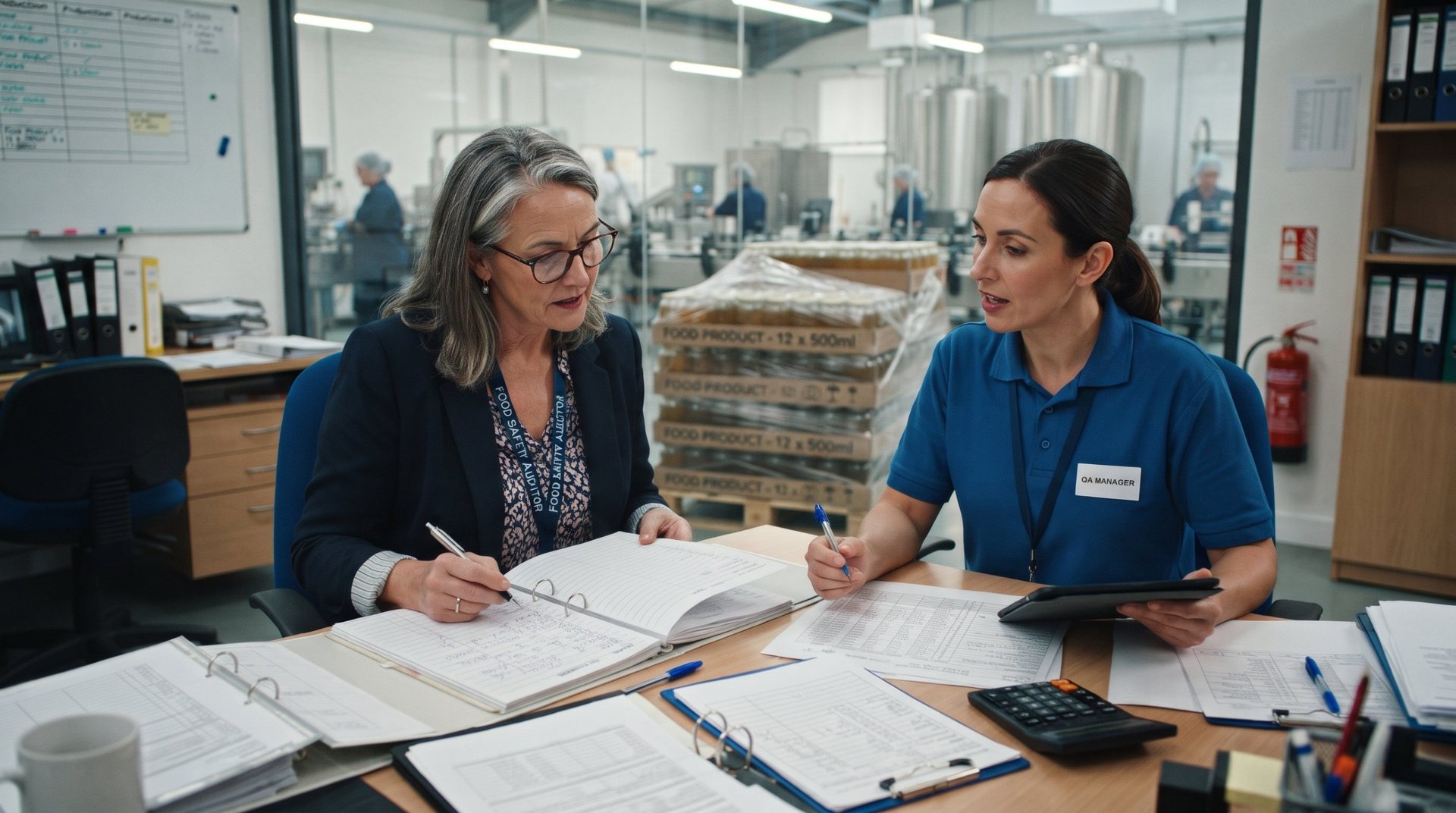
The trace test is the hour of the audit when a food safety system either works or it does not. Documents can be polished for months, but not a batch the auditor picked that morning. Below is how a competent auditor runs it, with a worked mass balance you can copy for your own internal audits.
Run your first trace test as a lead auditor
Learn it in Module 3, then run one against the clock in a full virtual certification audit. Fully online, about 44.5 hours, USD 999.
What is a traceability test at an audit?
A live exercise that the auditor picks and times. One step back means every ingredient, processing aid and food contact packaging lot in the batch, with its supplier. One step forward means every first customer who received any of it. The site then reconciles the quantities in a mass balance.
It is not a mock recall, which tests whether the organisation can notify customers and get product back. Test both, and never let one stand in for the other. If you are building the site’s own traceability and recall system rather than auditing it, start with our traceability, withdrawal and recall risk assessment guide.
Where does the requirement to test traceability come from?
ISO 22000:2018 clause 8.3 requires a traceability system that relates lots of received materials, ingredients and intermediate products to the end products, including rework. Records are kept for a defined period, and the clause requires the organisation to verify and test the effectiveness of its traceability system. So the auditor runs a test instead of reading the procedure.
| Source | What it asks for |
|---|---|
| ISO 22000:2018 clause 8.3 | A system whose effectiveness is verified and tested, not only described. |
| FSSC 22000 Version 7, Part 3 section 4.3 | At least 50% of audit duration on operational planning, PRPs and control measures, including the traceability exercise |
| FSSC 22000 Version 7, Part 2 clause 2.5.2 | Where a label carries a claim, verification that includes traceability and mass balance |
| EU Regulation (EC) No 178/2002, Article 18 | Identify who supplied you and whom you supplied, available to the authorities on demand |
| US FDA Food Traceability Rule | For listed foods, key data elements and traceability lot codes, with records to the FDA within 24 hours of a request |
Congress has directed the FDA not to enforce that rule before 20 July 2028, and the FDA says it will comply, but exporters of listed foods should test against the 24 hours now.
How does an auditor run a traceability test?
- Choose the batch yourself, on the day. Recent and high risk is best, ideally one that used rework.
- Ask for both directions in one request.
- Start the clock when you ask, not when the right person arrives.
- Reconcile the main ingredient lot: received against used in every batch and still in store.
- Reconcile the finished batch: made against dispatched, in stock, sampled, rejected and destroyed.
- Check every link is a record made at the time. A spreadsheet typed up this morning is a reconstruction.
- Test one link against an outside document, such as a customer’s goods received note.
- Compare the time taken with the site’s target and any customer or legal limit.
A worked mass balance: tomato and basil pasta sauce
This example is fictional. The site makes pasta sauce in 400 g glass jars, and its procedure sets a three hour target for a full trace with mass balance. At 10:05 the auditor asks for batch TB-1907, made on 19 July on line 2.
One step back
The batch record shows a 2 400 kg mix, 2.4 times the 1 000 kg recipe. By 10:52 the site had produced this.
| Input | Lot | Used | Proved by |
|---|---|---|---|
| Tomato paste | TP-552 | 672 kg | Weigh-out sheet, goods received note |
| Water | Municipal | 1 248 kg | Flow meter reading on the batch record, 1 248 L taken as 1 248 kg |
| Diced onion | ON-0718 | 216 kg | Weigh-out sheet, delivery note |
| Sunflower oil | Tank, delivery SO-311 | 96 kg | Tank log, no top-up since SO-311 arrived |
| Sugar | SG-904 | 72 kg | Weigh-out sheet |
| Garlic | GA-212 | 48 kg | Weigh-out sheet |
| Salt | SA-560 | 28.8 kg | Weigh-out sheet |
| Basil | BA-077 | 16.8 kg | Weigh-out sheet |
| Citric acid | CA-031 | 2.4 kg | Weigh-out sheet |
| Jars, lids, labels | GJ-2207, LD-118, LB-TB-04 | As issued | Packaging issue sheet |
| Rework | None | 0 kg | Line 2 rework log, read by the auditor |
The inputs add up to 2 400 kg. The auditor reads the rework log personally, because a missing rework entry is the quietest way a chain breaks, and checks the oil tank log for the heel left in the tank when SO-311 arrived and for any top-up since, because either would blur the lot boundary.
The main ingredient
Lot TP-552 arrived as four 220 kg drums, 880 kg. TB-1907 used 672 kg, three full drums and 12 kg from the fourth. No other batch has used any, and the paste left in the opened drum, resealed and held in the chiller as the procedure requires, weighed 207.5 kg net in front of the auditor. Against the 208 kg expected, the difference is 0.5 kg, or 0.24%, inside the 1% tolerance the procedure sets for weighed ingredients.
The finished batch
The kettle load cell read 2 316 kg after cooking, a 3.5% evaporation loss. The checkweigher counted 5 640 jars at an average of 405 g, which is 2 284.2 kg, and the line log records 30 kg of start-up purge and hold-up sent to waste. The last 1.8 kg, under 0.1%, is within the combined accuracy of the water meter, kettle load cell and checkweigher.
| Batch TB-1907 | Jars |
|---|---|
| Filled (checkweigher count) | 5 640 |
| Retail distribution centre | 3 600 |
| Wholesaler | 1 200 |
| Export distributor | 480 |
| In finished goods store, counted by the auditor | 288 |
| Checkweigher rejects, destroyed | 46 |
| Retained and laboratory samples | 18 |
| Total accounted for | 5 632 |
| Unaccounted for | 8 jars, 0.14% |
Eight jars is small, but every unit should have a known fate, so the auditor asks. At 12:10 the site finds the handwritten line log for 19 July: eight jars broken at the palletiser, signed by the shift supervisor and matched in the glass breakage record, but never entered in the waste system.
The packaging confirms it. Jar lot GJ-2207 shows 5 700 issued to line 2, and the 5 640 filled, 22 broken at the depalletiser and 38 returned to store make exactly 5 700.
The verdict
Trace and mass balance took 2 hours 5 minutes against a three hour target, with every input and unit accounted for by records made at the time. The trace works. The auditor still reports the waste system gap and checks that the glass breakage procedure was followed both times, which is often where the more serious finding sits.
Practise the judgement, not only the arithmetic
Step 7 of the virtual audit makes you run a trace test on site records with a timer running.
What does “within a target time” mean?
The target time is the shortest of the times the site committed to and that its customers, scheme or law require. ISO 22000:2018 clause 8.3 requires the effectiveness of the traceability system to be verified and tested, and sets no time limit. The EU asks for information on demand. The US rule gives 24 hours for listed foods.
Retailers and schemes set their own, so read the current text of each. The clock stops when the mass balance closes, and a site with no written target cannot pass or fail its own test.
How should the auditor judge the result?
On the consequence. Units missing matter more than minutes.
| What you find | How to read it |
|---|---|
| Complete, reconciled within a stated tolerance, on time | The system works. Under ISO 22000, note weaknesses as opportunities for improvement; FSSC 22000 does not allow them, so raise a minor where a requirement is not met, or record nothing. |
| Complete but over the site’s own target | The site missed its own criterion. A finding, graded on how far over and why |
| Units unaccounted for, with no record | Effectiveness not shown. Grade on what the units are and who could have them |
| Rework used but not recorded to batch | A broken chain, serious where rework could carry an allergen or pathogen into another product |
| Bulk lots mixed in a tank or silo with no boundary | Clause 8.3 cannot be met. Can justify a major |
For grading rules see how certification auditors grade food safety nonconformities, and for wording, how to write a food safety audit finding that gets fixed.
What do auditors find most often?
- Internal trace tests always run on the same simple product.
- The trace stops at the ERP, with no link checked against an outside document.
- Rework goes back into the mixer with no record of its source batch.
- Printed labels and film left out of the back trace.
- Samples and breakages never recorded, so the forward count never closes.
Rework and line clearance are where many of these gaps start, as our post on where most allergen recalls actually start shows.
What evidence should an auditor request?
| Ask for | Why |
|---|---|
| Traceability procedure with target time and tolerance | The criteria you judge against |
| Goods received notes and supplier delivery notes | Proves the back trace from outside the system |
| Batch record with every input lot and weight | Links inputs to the batch |
| Rework log and bulk tank logs | Shows whether lots stayed separate |
| Packaging issue and return records | Back trace for packaging and a cross-check on units |
| Filler counts, the line log and waste records | Units made, and units that left without being sold |
| Dispatch notes and a customer’s goods received note | Proves the forward trace |
How do you learn to run a trace test as a lead auditor?
By doing it on unfamiliar records with a clock running, which is how the ISO 22000:2018 Lead Auditor course teaches it. Lesson 3.2 covers clause 8.3, export market traceability law and how to grade the result. In Module 4, Activity A4 gives you a timed trace test and mock recall.
Step 7 of the 13-step virtual certification audit, on a fictional dairy, is the Stage 2 site walk and a timed trace test in the online Audit Workbench. A named examiner marks the whole audit out of 100, with 70 to pass.
Two webcam proctored exams follow, needing at least 70% in every section. Each unit passed as Competent earns a Certificate of Achievement, which is evidence of training, and personnel certification bodies decide registration on their own criteria.
Lead the trace test at your next audit
A trace test that runs past its target time, or a mass balance that will not close, is one of the fastest ways to lose an audit day. Start today with the orientation and entry check. 12 months of access, no live sessions, USD 999.
Buy now, USD 999See the full course outlineAsk us on WhatsApp
Why food professionals train with ASC
- 4.9 average from 2 552 delegate reviews across ASC courses
- 7 100+ course enrolments
- 4.9 from more than 400 Google reviews across our three offices
- SAATCA registered training provider TC 065
- FoodBev SETA accredited provider 587/00337/1900
- ISO 9001 certified
Read our Google reviews for Gqeberha, Johannesburg and Cape Town. These registrations belong to ASC as a training provider. Personnel certification bodies set their own criteria, and the lead auditor course certificate is evidence of your training.
Frequently asked questions
What is a traceability test in a food safety audit?
A live exercise in which the auditor picks a finished batch and asks the site to identify every input lot and every first customer, then reconcile the quantities, against the clock.
What is the difference between a trace test and a mock recall?
A trace test shows that product and inputs can be identified and accounted for. A mock recall tests whether the organisation can notify customers and get the stock back.
Does ISO 22000 set a time limit for a traceability test?
ISO 22000:2018 clause 8.3 requires the effectiveness of the traceability system to be verified and tested, and sets no time limit. The target comes from the site’s procedure, its customers, its scheme and the law, such as the 24 hours under the US Food Traceability Rule.
What is a mass balance in a traceability exercise?
A reconciliation of quantities. For an ingredient lot, received against used and left. For a batch, units made against the fate of each unit. Any difference must be explained by a record.
How much difference is acceptable in a mass balance?
No international standard sets one figure. The site should state a tolerance and justify it from scale accuracy and known process losses. Whole units missing with no record are never within tolerance.
Does FSSC 22000 require a traceability exercise at the audit?
FSSC 22000 Version 7 says at least half of the audit duration goes on operational food safety planning and the implementation of PRPs and control measures, and that this time includes conducting the traceability exercise or exercises.
Buy now, USD 999Read the course outlineInternational Visa and Mastercard accepted. Charged as R16 595, converted by your card issuer.
Sources
- ASC Food Safety Training, ISO 22000:2018 Lead Auditor (Food Safety Management Systems), course page
- ISO 22000:2018 contents, published by DIN (clause 8.3 Traceability system)
- Foundation FSSC, FSSC 22000 Scheme Version 7.0, May 2026 (Part 2 clause 2.5.2, Part 3 sections 4.3 and 6.2)
- Regulation (EC) No 178/2002, Article 18 (EUR-Lex)
- US FDA, FSMA Final Rule on Requirements for Additional Traceability Records for Certain Foods