
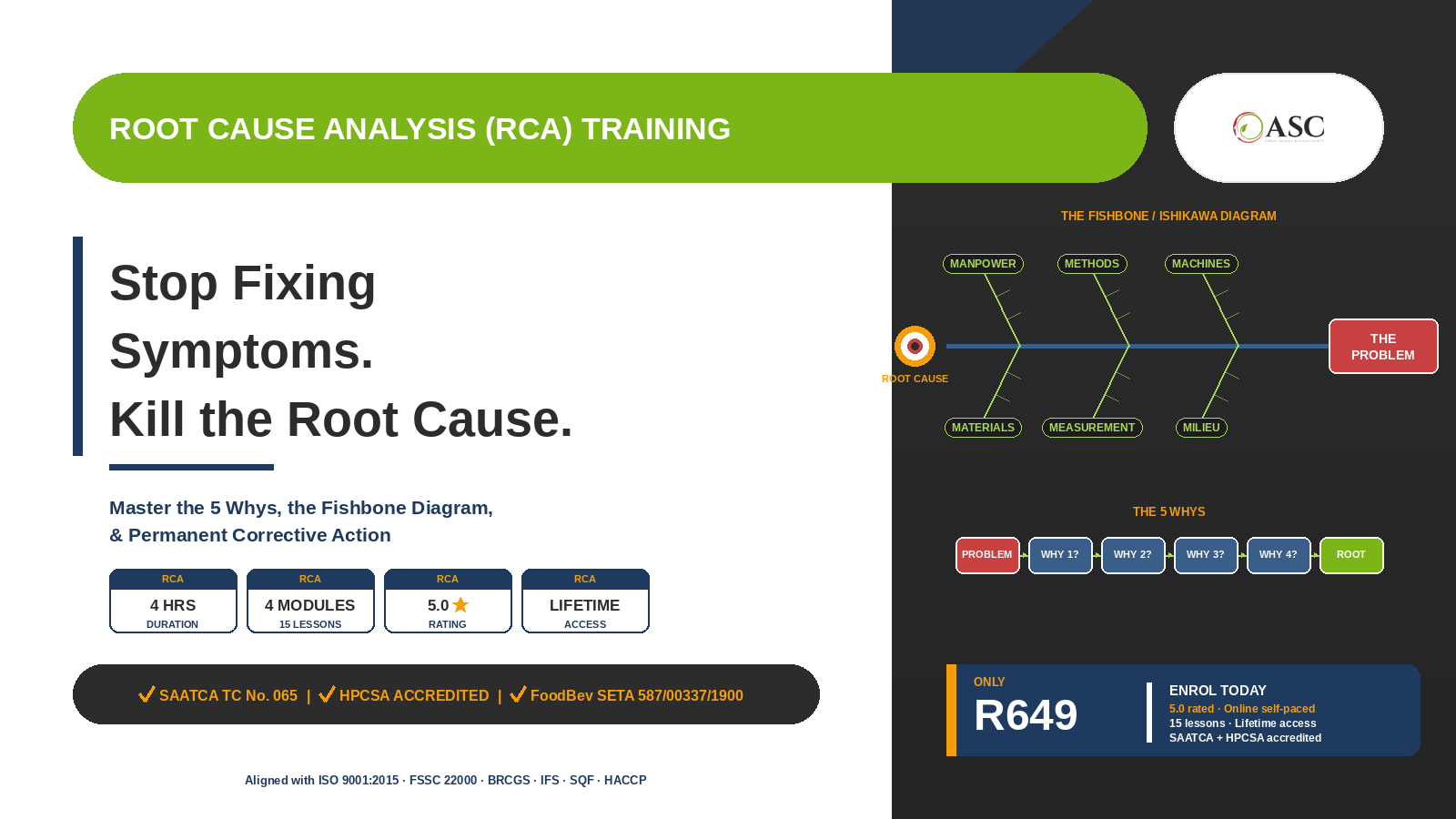
Root Cause Analysis (RCA) Training in South Africa: The Definitive 2026 Guide to the 5 Whys, Fishbone Diagram & Corrective Action
The single most common audit finding in ISO 9001, FSSC 22000, BRCGS and IFS audits worldwide is the same: ineffective root cause analysis. Companies fix the symptom, not the cause — the same problem returns, the certification body issues a major non-conformance, and revenue walks out the door. This guide shows you how to use the 5 Whys, Fishbone (Ishikawa) Diagram and structured CAPA methodologies to permanently kill non-conformances — and why ASC’s accredited online Root Cause Analysis course at R649 is the fastest, cheapest, highest-rated path to RCA mastery in South Africa.
Quick AnswerRoot Cause Analysis (RCA) is a structured problem-solving methodology that identifies the underlying systemic cause of a non-conformance — not just the visible symptom. The two most widely-used RCA tools are the 5 Whys (developed by Toyota) and the Fishbone / Ishikawa Diagram (developed by Kaoru Ishikawa). Effective RCA is a mandatory requirement in ISO 9001:2015 Clause 10.2, FSSC 22000, BRCGS, IFS and SQF — and the most common cause of audit non-conformances when it’s done poorly. ASC’s Overview of Root Cause Analysis course (FS35) — 2.5 hours · 4 modules · 15 lessons · R649 · SAATCA + HPCSA + FoodBev SETA accredited · 5.0★ rated — equips QA, quality and food safety teams with the skills to investigate, document and permanently resolve non-conformances.
1. Why RCA Is the Most Valuable Skill in Your FSMS
Ask any certification body auditor — IAS, SGS, Bureau Veritas, NSF, DQS, Intertek — what the single most common non-conformance they issue is, and you’ll get the same answer across every industry: “Ineffective root cause analysis and corrective action.”
Companies have procedures. They document non-conformances. They record the corrective action. But when the auditor returns for the surveillance audit 12 months later, the same problem has recurred — because the original investigation stopped at the symptom. Allergen cross-contamination recurred because the team said “retrain staff” instead of addressing why the sanitation programme failed structurally. A customer complaint repeated because “the packaging line was cleaned” instead of asking why the original cleaning SOP wasn’t being followed.
RCA is not an academic exercise. It is the single mechanism that stops non-conformances from recurring. Master it and you:
- Pass audits without repeat findings
- Reduce customer complaints permanently
- Lower quality and food safety failure costs
- Prevent product recalls
- Build a culture of continual improvement
- Strengthen your CAPA (Corrective and Preventive Action) system
- Become indispensable to your organisation
2. What Is Root Cause Analysis?
Root Cause Analysis (RCA) is a systematic, structured problem-solving methodology used to identify the underlying cause of a non-conformance, deviation, complaint, incident or failure — rather than stopping at the obvious surface-level symptom.
The core insight: every problem you see is a symptom; the real cause usually lies several layers beneath it. Fix the symptom and the problem returns. Fix the root cause and it’s gone forever.
A non-conformance is the tip of the iceberg — what’s visible. Beneath the waterline lie the proximate causes (immediate triggers), the contributing causes (conditions that enabled it), and finally the root cause (the systemic weakness that made the whole thing possible). RCA gives you the tools to dive below the waterline.
3. The Audit Reality Nobody Talks About
Every major management system standard now explicitly requires documented root cause analysis:
| Standard | RCA Clause | What Auditors Check |
|---|---|---|
| ISO 9001 | Clause 10.2 Nonconformity & corrective action | Did the organisation determine the cause and take action to prevent recurrence? |
| FSSC 22000 | Throughout FSMS corrective action clauses | Documented RCA methodology, CAPA effectiveness, trending of recurring issues |
| BRCGS Food Safety | Clause 3.7 Corrective & preventive actions | Root cause analysis conducted, documented, timeframes set, effectiveness verified |
| IFS Food | Corrective action clauses | Cause identification, CAPA system, verification of effectiveness |
| SQF | Corrective action & preventive action requirements | Root cause identified, corrected, prevention of recurrence |
| AS9100 (Aerospace) | Clause 10.2 plus 8D methodology expected | 8D problem-solving process, 5 Whys or equivalent, preventive action |
| ISO 14001 | Clause 10.2 Environmental nonconformity | Root cause of environmental non-conformance |
| ISO 45001 | Incident investigation clauses | OH&S incident root cause with worker participation |
| HACCP (Codex) | Principle 5 Corrective Action | Cause of deviation identified, corrective action taken |
Research from the American Society for Quality shows that up to 60% of all audit non-conformances relate directly to ineffective root cause analysis or corrective action. Companies that invest in proper RCA training see non-conformance repeat rates drop by as much as 70–80%. Skipping RCA training is not saving money — it’s costing you money every single day.
4. Correction vs Corrective vs Preventive Action — The Three Every Auditor Asks About
One of the most frequent questions in ISO 9001 and food safety audits: “Can you explain the difference between correction, corrective action and preventive action?” Most candidates fumble this. The course teaches it precisely.
| Action Type | Purpose | Example (allergen cross-contact) | When Applied |
|---|---|---|---|
| Correction | Deal with the immediate symptom / the specific non-conforming product or situation | Quarantine and destroy the contaminated batch | Immediately, on discovery |
| Corrective Action | Eliminate the root cause so the same non-conformance does not recur | Redesign sanitation programme, train all operators, update allergen matrix, add verification step | After root cause analysis is complete |
| Preventive Action / Risk-Based Thinking | Identify potential problems before they occur and implement controls proactively | Review every other production line for similar vulnerabilities; add allergen check to annual risk assessment | During planning, risk assessment, management review |
ISO 9001 technically replaced “preventive action” as a separate clause with risk-based thinking woven through the entire standard — but the concept remains central to every FSMS.
5. The 5 Whys — Deep Dive With a Food Industry Example
Developed by Sakichi Toyoda and systematised by Taiichi Ohno as part of the Toyota Production System, the 5 Whys is the simplest, most powerful RCA tool ever invented. The rule is disarmingly simple: keep asking “why” until you hit the systemic cause.
Here’s a real-world food industry example worked through all five levels:
PROBLEM: A customer complained that a biscuit contained a small piece of metal.
Why #1? A metal fragment passed the metal detector without being rejected.
Why #2? The metal detector sensitivity was set too low for the product size.
Why #3? The sensitivity was last verified 8 months ago, not at each shift change.
Why #4? The verification SOP only requires weekly verification, not shift-change verification.
Why #5? The SOP was written in 2019 and never updated after the new high-volume product was introduced in 2023.
ROOT CAUSE: Management of change procedure did not trigger a review of metal detector verification requirements when the new product was added — a systemic document control gap, not an operator error.
Notice how the answer changed at every level. Stop at “Why #1” and your corrective action is “reject metal fragment” — useless. Stop at “Why #2” and you adjust sensitivity for this one batch. Only the fifth why reveals the systemic weakness that must be fixed: the management of change procedure.
Five is a guideline, not a target. Sometimes you hit root cause at Why #3. Sometimes you need seven. Stop when you reach a cause that is within your organisation’s control to fix — not “because it’s human nature” or “because of the weather”. If your final “why” points at something outside the management system, you haven’t reached root cause yet.
6. The Fishbone (Ishikawa) Diagram — Visual Problem Solving
Developed by Japanese quality pioneer Kaoru Ishikawa in the 1960s at Kawasaki Shipyards, the Fishbone Diagram (also called the Ishikawa Diagram or Cause-and-Effect Diagram) organises potential causes into standard categories, making team brainstorming systematic rather than chaotic.
The classic categories are the 6Ms (sometimes 5Ms + 1E, or extended to 8M):
6.1 The 6Ms Explained
- Manpower / People: training gaps, skill mismatches, fatigue, supervision weaknesses
- Methods / Procedures: outdated SOPs, missing work instructions, unclear decision rights
- Machines / Equipment: calibration drift, wear, design flaws, inadequate maintenance
- Materials / Inputs: supplier variability, contamination, substitution, storage damage
- Measurement / Metrology: inadequate test methods, measurement uncertainty, lack of verification
- Milieu / Mother Nature / Environment: temperature, humidity, airflow, dust, pests, power fluctuations
Some organisations add Management (governance, culture, communication) and Money (resource constraints) as the 7th and 8th Ms. The ASC course teaches when and how to use the 6M, 7M or 8M variant.
7. Other RCA Methodologies You Should Know
While the 5 Whys and Fishbone are the dominant tools, mature RCA practitioners use a wider toolkit:
| Methodology | Best For | Origin / Context |
|---|---|---|
| 5 Whys | Simple, non-catastrophic non-conformances | Toyota Production System (Sakichi Toyoda) |
| Fishbone / Ishikawa | Complex, multi-cause problems requiring team brainstorming | Kaoru Ishikawa, 1960s Japan |
| Pareto Analysis | Prioritising which problems to tackle first (80/20 rule) | Vilfredo Pareto / Juran |
| Fault Tree Analysis (FTA) | Safety-critical failures, aerospace, nuclear, pharma | Bell Labs, 1962 (Minuteman missile) |
| Failure Mode & Effects Analysis (FMEA) | Proactive — identify failure modes before they occur | US military (MIL-P-1629), 1949 |
| 8D Problem Solving | Automotive, aerospace supplier non-conformances | Ford Motor Company, 1987 |
| A3 Thinking | Structured problem-solving and management reporting | Toyota; lean management |
| DMAIC | Six Sigma quality improvement projects | Motorola, GE |
| Kepner-Tregoe Problem Analysis | Critical thinking for complex incidents | Kepner & Tregoe, 1950s/60s |
ASC’s course focuses on the 5 Whys and Fishbone as the two methodologies with the highest leverage for 90% of real-world quality and food safety non-conformances — but also introduces PDCA / Plan-Do-Check-Act (Deming / Shewhart cycle) as the continuous improvement framework that sits over everything.
8. Why Teamwork Makes or Breaks RCA
Single-person RCA almost always fails. A quality manager alone investigating a production deviation will inevitably miss causes visible only to operators, maintenance, procurement, QA lab technicians and logistics. Effective RCA requires a cross-functional team — which is why Module 4 of ASC’s course dedicates a full section to:
- What makes a genuine team (vs a committee or working group)
- Selecting the right members for the investigation at hand
- Establishing psychological safety — the #1 predictor of RCA quality
- Managing conflict constructively when team members disagree on causes
- Moving from blame culture to learning culture
- Facilitating effective RCA brainstorming sessions
9. The 8-Step Professional RCA Process
World-class RCA isn’t random — it follows a structured process. Here’s the 8-step approach taught in the course:
- Define the problem precisely. A vague problem statement kills the investigation before it starts. “Customer complaint” is not a problem statement. “On 14 March, customer X received product Y with metal fragment >2mm detected during consumption” is.
- Contain the immediate risk (correction). Quarantine, recall, isolate, inform regulators — whatever protects consumers and customers while the investigation proceeds.
- Assemble the right team. Cross-functional. Includes people closest to the process. Avoid politics.
- Gather the facts. Timeline, records, witness statements, physical evidence, CCTV, data logs. Separate fact from assumption.
- Identify potential causes. Apply the 5 Whys and/or Fishbone methodology systematically.
- Verify the root cause. Test your hypothesis — can you explain every fact with this cause? Would removing it prevent recurrence?
- Develop and implement corrective action. Targeted at the root cause. Documented. Time-bound. Assigned ownership.
- Verify effectiveness. Monitor for recurrence. Close the CAPA only after evidence confirms the problem is genuinely eliminated — often 3-6 months later.
10. The 10 Most Common RCA Mistakes (That Get You Written Up)
- Stopping at the first plausible cause — especially the cause that’s easiest to “fix”
- Blaming a person — “operator error” is almost never a root cause, it’s a symptom of a system failure
- Confusing correction with corrective action — quarantining a batch is not corrective action
- No verification of effectiveness — closing a CAPA the same week it opened
- Single-person investigation — missing causes only visible to other functions
- Rushing the process — auditors can smell a 24-hour investigation
- No objective evidence — relying on “I think” and “we remember”
- Generic corrective actions — “retrain staff” as a catch-all
- No trending of recurring issues — treating each non-conformance as unique when it’s the 4th in 12 months
- No preventive / risk-based thinking — not asking “where else could this happen?”
11. The ASC Root Cause Analysis Course
An Overview of Root Cause Analysis Course
What’s included:
- 15 video lessons across 4 focused modules
- In-depth coverage of the 5 Whys methodology (over 51 minutes on this single technique)
- Fishbone (Ishikawa) Cause-and-Effect Diagram walkthrough
- Problem-solving process from definition to verification
- Correction vs Corrective Action vs Preventive Action clarified once and for all
- PDCA (Plan-Do-Check-Act) continuous improvement cycle
- History & evolution of RCA (Toyota, Ishikawa, Ford 8D)
- Teamwork & conflict management during RCA investigations
- Interactive Q&A section for every lesson
- Knowledge tests after each module (70% pass mark, multiple attempts)
- Comprehensive final assessment
- Downloadable Certificate of Achievement immediately on passing
- Lifetime access to revisit content
12. Full Curriculum Breakdown — 4 Modules · 15 Lessons
Introduction to Root Cause Analysis
Establish the core concepts — what RCA is, where it came from, and how it fits into the problem-solving universe.
- Lesson 1 — Learning outcomes & introduction (4 min)
- Lesson 2 — Introduction to root cause analysis (2 min)
- Lesson 3 — The problem-solving process (10 min)
- Lesson 4 — Correction, corrective action and preventive action (4 min)
- Lesson 5 — History of root cause analysis (3 min)
- Knowledge Test — Module 1
Root Cause Analysis & Continuous Improvement
Connect RCA to the broader continuous improvement culture — why every non-conformance is an improvement opportunity.
- Lesson 1 — Learning outcomes & introduction (6 min)
- Lesson 2 — Methodologies for root cause analysis (10 min)
- Lesson 3 — The continuous improvement model / PDCA (4 min)
- Knowledge Test — Module 2
Methodologies & Techniques for Conducting Root Cause Analysis
The heart of the course — an in-depth masterclass on the 5 Whys and Fishbone Diagram, including structured brainstorming.
- Lesson 1 — Learning outcomes & introduction (12 min)
- Lesson 2 — The 5 Whys (51 minutes — our most in-depth single lesson)
- Lesson 3 — Cause and effect (Fishbone / Ishikawa) for RCA (15 min)
- Lesson 4 — Brainstorming techniques (8 min)
- Knowledge Test — Module 3
The Importance of Teamwork When Conducting Root Cause Analysis
The human factor — without effective teamwork, even the best methodologies fail.
- Lesson 1 — Learning outcomes & introduction (2 min)
- Lesson 2 — What is a team?
- Lesson 3 — Managing conflict within a team (10 min)
- Knowledge Test — Module 4
- Final Assessment — comprehensive RCA competency check
Most online courses devote 5-10 minutes to the 5 Whys and move on. ASC’s course spends 51 minutes on the 5 Whys alone — walking through multiple worked examples, common pitfalls, escaping “human error” dead ends, and documenting the analysis properly for auditors. That depth is what turns theoretical knowledge into investigative skill.
13. Why ASC Is the #1 Choice for RCA Training in South Africa
The ASC Advantage
| Feature | ASC FS35 Course | Typical Competitors |
|---|---|---|
| Instructor is a Registered Lead Auditor (Exemplar Global & IRCA) | ✓ Mthokozisi Nkosi | Often generic trainers |
| Real-world RCA examples from 50+ FSSC/BRCGS/ISO implementations | ✓ | Textbook examples only |
| 51-minute deep dive on the 5 Whys | ✓ | 5–10 minute overview typical |
| Dedicated module on teamwork & conflict management | ✓ | Often omitted |
| SAATCA + HPCSA + FoodBev SETA triple accreditation | ✓ | Usually one only |
| Applies to both ISO 9001 Quality & Food Safety Management Systems | ✓ | Usually one context only |
| Lifetime access to course materials | ✓ | Time-limited |
| QR-verified certificate (tamper-proof) | ✓ | Simple PDF |
| Full consultancy backing (audits, CAPA implementation) | ✓ | Training only |
| BBBEE Level 1 (135% procurement recognition) | ✓ | Usually lower |
| Price | R649 | R2 000–R8 000 typical |
What the Review Says
“Verified 5-star rating for the course — clear, practical, and directly applicable to audit preparation.”
14. The ROI of Mastering RCA
R649 is one of the most accessible course prices in the ASC catalogue. Compare that to the cost of a single RCA failure:
| RCA Failure Scenario | Typical Cost |
|---|---|
| Major audit non-conformance requiring remedial audit | R30 000 – R80 000 per re-audit |
| Certification suspension for repeat non-conformances | R500 000 – R5M+ in lost contracts |
| Product recall from failure to identify true root cause | R1M – R50M direct costs |
| Customer complaint that becomes a class action | R millions, unbounded |
| Hiring a consultant to investigate a single non-conformance | R10 000 – R40 000 per investigation |
| External RCA training per seat | R2 000 – R8 000 |
| ASC FS35 per learner | R649 |
A single effectively-closed non-conformance — one that doesn’t recur — saves multiples of what the course costs.
Stop Fixing Symptoms. Start Killing Problems at the Root.
2.5 hours of self-paced learning. Accredited by SAATCA, HPCSA and FoodBev SETA. Taught by a Registered Lead Auditor. Lifetime access. Just R649.
Enrol in the RCA Course Book a Free Consultation15. Who Should Take This Course?
- QA Managers & QC Managers investigating production and lab non-conformances
- Quality Management Representatives running ISO 9001 systems
- Food Safety Managers & HACCP Team Leaders managing CAPA systems
- Internal Auditors evaluating RCA effectiveness during audits
- Production Supervisors & Managers responding to deviations
- Customer Complaint Handlers investigating repeat issues
- Maintenance & Engineering teams solving recurring equipment failures
- Environmental, OH&S and Information Security Coordinators under ISO 14001, 45001, 27001
- Six Sigma Yellow/Green Belts building their quality toolkit
- Consultants delivering CAPA and management system projects
- Anyone pursuing FSSC 22000, BRCGS, IFS, SQF, ISO 9001, AS9100 certification
16. Frequently Asked Questions
Is this course appropriate if I’m not in the food industry?
Yes. Root Cause Analysis is universally applicable — the methodologies (5 Whys, Fishbone, PDCA) were originally developed in manufacturing and automotive, and apply identically to pharma, aerospace, engineering, services, logistics, healthcare and IT. The course uses some food industry examples but the techniques transfer seamlessly.
How does this course compare with a Six Sigma Green Belt?
Six Sigma Green Belts are much longer (typically 40+ hours, R15 000–R35 000) and cover statistical tools, DMAIC, hypothesis testing and project management. ASC’s RCA course is focused specifically on root cause identification and CAPA — the single most-used skill in management systems. If you need statistical process control and designed experiments, take a Six Sigma course. If you need to close audit non-conformances effectively, this is your course.
Will this course help me pass an ISO 9001 or FSSC 22000 audit?
Absolutely. Ineffective RCA is the #1 most common audit non-conformance across all management system standards. The course is specifically aligned with ISO 9001:2015 Clause 10.2 and the corrective action requirements of FSSC 22000, BRCGS, IFS and SQF.
How long does the course take to complete?
Approximately 2.5 hours of video content plus time for the knowledge tests and final assessment. Most learners complete it within 1-2 weeks around their normal work schedule. Because it’s self-paced, you can go faster or slower as needed.
What is the pass mark for the assessments?
70% for each knowledge test and the final assessment. Multiple attempts are allowed. You receive feedback so you can master the content.
Will I learn enough to lead real RCA investigations after this course?
Yes — the course is designed to take you from introductory knowledge to practical competence in conducting structured RCA using the 5 Whys and Fishbone Diagram. For facilitating very large, complex or safety-critical investigations (e.g. fatal incidents, major recalls), pairing this course with ASC’s FS26 Internal & Supplier Auditing course is recommended.
What if I’m new to quality and food safety — is this too advanced?
No. This course is marked Basic level and is designed to be accessible to newcomers. It builds up from the basics of problem-solving, so you don’t need prior quality experience to benefit. Some familiarity with workplace processes is helpful but not required.
Can I use the course in a regulated industry like pharma or aerospace?
Yes — the underlying methodologies (5 Whys, Fishbone, PDCA) are the same tools required by 21 CFR 820, ICH Q10, AS9100 and ISO 13485. The course is industry-neutral at its core.
What other ASC courses pair well with RCA training?
Great pairings: FS10 HACCP for Supervisors (deviation management), FS26 Internal & Supplier Auditing (audit findings and CAPA), FS11 VACCP & TACCP (incident investigation), and FS32 Food Safety & Quality Culture (moving from blame to learning).
Does ASC offer implementation support beyond training?
Yes. ASC Food Safety Consultants has guided 50+ companies through CAPA system design, audit preparation and certification. Beyond training we provide gap analyses, mock audits, document toolkits and on-site RCA facilitation for critical non-conformances.
17. Enrol Today — Turn Every Non-Conformance Into a Permanent Win
Every Problem Has a Root. Learn to Find It.
Join QA managers, food safety practitioners, internal auditors and quality teams across South Africa who’ve equipped themselves with ASC’s RCA methodology. SAATCA-accredited, built by a Registered Lead Auditor, applicable to ISO 9001, FSSC 22000, BRCGS, IFS, SQF, AS9100 and beyond.
Enrol Now — R649 Browse All 20+ CoursesTraining a team? Book a free consultation for group pricing
Gqeberha (Head Office): +27 41 004 0382 · Randburg: +27 10 500 4661 · Cape Town: +27 21 300 4024 · info@ascfoodsafety.com
Last reviewed: 24 April 2026 · © 2026 ASC Food Safety Consultants · SAATCA TC No. 065 · HPCSA Accredited · FoodBev SETA 587/00337/1900 · BBBEE Level 1. This article is educational and does not constitute legal advice. Verify specific certification scheme requirements with your registered certification body.