
R638 has been South Africa’s governing food safety regulation since 22 June 2018. Yet in 2026 – eight years on – Environmental Health Practitioners across the country still find food businesses displaying expired R962 Certificates of Acceptability, persons in charge holding certificates from non-accredited providers, and operations running systems that were never updated from the old regulation. This is the most comprehensive, side-by-side comparison of R638 and R962 available for South African food businesses and practitioners. Read it, share it with every food business owner you know, and use it to make sure your compliance is airtight before the EHP arrives.
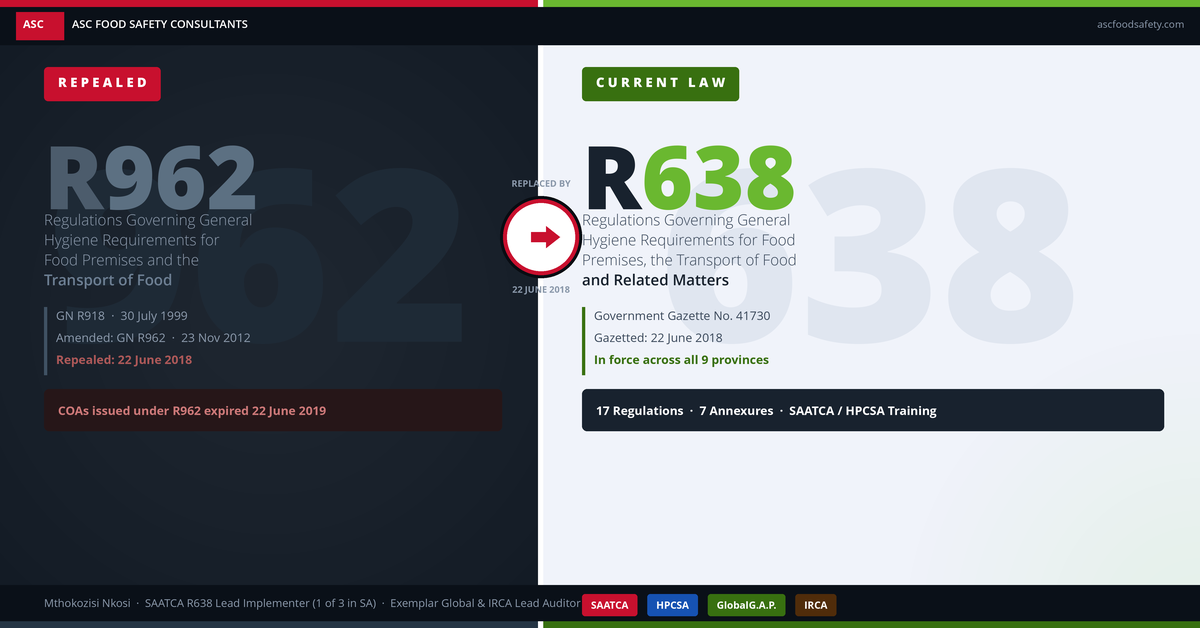
Originally promulgated as R918 on 30 July 1999. Amended and republished as R962 on 23 November 2012. Used permissive “shall” language. Lacked specific accreditation requirements for training, traceability obligations, and mandatory recall procedures.
Repealed – 22 June 2018Gazetted 22 June 2018 in Government Gazette No. 41730 under the Foodstuffs, Cosmetics and Disinfectants Act 54 of 1972. Structured across 17 Regulations and 7 Annexures. Mandatory “must” language. SAATCA registered and HPCSA CPD accredited training, traceability, recall, tighter temperatures.
In Force – 22 June 2018Why South Africa Replaced R962 With R638
The story of how South Africa moved from R962 to R638 is inseparable from a period of escalating food safety crises. The 2017-2018 Listeria monocytogenes outbreak – the deadliest in recorded global history, claiming 218 South African lives and traced to Enterprise Foods polony – was the most visible catalyst. But the regulatory inadequacies of R962 had been accumulating for years before the outbreak made them impossible to ignore.
By 2018, R962 presented several structural problems that the food safety community and Environmental Health Practitioners had been raising consistently. The regulation’s use of “shall” rather than “must” created interpretive grey zones exploitable in enforcement proceedings. Its training requirements were genuine in intent but toothless in practice – the regulation did not name a credentialing authority, could not verify training certificate quality, and contained no documentation obligations that would have allowed EHPs to audit training records systematically.
At the same time, the Codex Alimentarius Commission and the WHO had updated their food safety guidance frameworks, including the WHO Five Keys to Safer Food and the Codex General Principles of Food Hygiene (CAC/RCP 1-1969, Rev.4). South Africa’s food safety regulations needed to align with these internationally benchmarked frameworks to support food exports, retailer compliance programmes, and GFSI certification scheme requirements (FSSC 22000, BRCGS, SQF).
R638 addressed all of this in a single comprehensive regulatory update: mandatory language, named accreditation bodies, documented training requirements, traceability and recall obligations, tightened temperature controls, and structural alignment with Codex principles. The result is a regulation that is significantly more demanding – and significantly more enforceable – than its predecessor.
The Regulatory Timeline: R918 → R962 → R638
The original “Regulations Governing General Hygiene Requirements for Food Premises and the Transport of Food” published as Government Notice R918. Establishes South Africa’s foundational COA framework, food premises hygiene standards, food handler conduct, and protective clothing requirements. Uses “shall” language. No named accreditation body for training.
Government notice amends and republishes as R962. Modest changes to wording; foundational structure of 1999 remains largely intact. Training still required with no accreditation authority specified. No traceability, recall, or specific record-keeping periods introduced. “Shall” language persists.
Government Gazette No. 41730 publishes Regulation R638. R962 and R918 repealed with immediate effect. Businesses given a 12-month transition period for COA renewal. Person in charge must obtain accredited training within this period. New mandatory language and additional requirements take immediate effect.
All Certificates of Acceptability issued under R962 and R918 formally lapse. Businesses that have not obtained a new R638 COA, or whose persons in charge have not completed SAATCA registered and HPCSA CPD accredited training, are in breach of the Act. Full enforcement mandated across all nine provinces.
Following the 2024 national declaration on spaza shop contamination deaths, enforcement reaches its highest intensity. The National Consumer Commission pursues fines exceeding R1 million in the BM Foods Listeria hummus case. South Africa records 18 product recalls in the first four months of 2026 alone. R638 compliance is actively and aggressively enforced.
R638 vs R962: Every Material Difference, Side-by-Side
The table below documents every material difference between the repealed Regulation R962 and the current Regulation R638. Tag meanings: New requirement not in R962; Stricter requirement tightened relative to R962; Removed element simplified or deleted; Retained same as R962.
| Requirement | R962 – Repealed (2012) | R638 – Current Law (2018) |
|---|---|---|
| Official title | Regulations Governing General Hygiene Requirements for Food Premises and the Transport of Food | Regulations Governing General Hygiene Requirements for Food Premises, the Transport of Food and Related Matters Stricter |
| Government Gazette | GN R962, 23 November 2012 (amending R918 of 30 July 1999) | GN R638, 22 June 2018 – Government Gazette No. 41730 New |
| Legal authority | Foodstuffs, Cosmetics and Disinfectants Act 54 of 1972 | Foodstuffs, Cosmetics and Disinfectants Act 54 of 1972 Retained |
| Mandatory language | Used “shall” – open to interpretive challenge in enforcement proceedings | “Must” used throughout – unambiguously mandatory, no interpretive wiggle room Stricter |
| Structure | Variable across R918 and R962 versions; inconsistent formatting; some provisions ordered illogically | 17 Regulations and 7 Annexures – comprehensive, logical, reformatted for plain-language usability Stricter |
| Person in charge training Section 10(1)(a) |
Training required. No accreditation body named. Any certificate acceptable. Quality unverifiable at inspection. | Must hold a certificate from a SAATCA- or HPCSA CPD accredited provider only. Certificate must be in name of current person in charge. Non-transferable. Enrol here → Stricter |
| Food handler training & records Section 10(1)(b) |
Basic hygiene training required. No assessment obligation. No documentation or retention requirement. | Must include routine written assessment. Follow-up training required where needed. Training programmes and assessment records retained on premises as evidence. Enrol handlers → Stricter |
| Cold food temperature Regulation 8 |
Perishable food to be “kept cold”. Specific threshold imprecise. | Perishable food must be stored at 5°C or below. Calibrated probe thermometer required. Stricter |
| Hot-held food temperature Regulation 8 |
Heated food to be “kept hot”. Threshold imprecise. | Heated food must be maintained at 60°C or above. Aligned with Codex Alimentarius. Stricter |
| Traceability system Sub-regulation 10(18) |
No explicit traceability system required. | A traceability system must be maintained for all food handled, prepared, stored, or transported. New |
| Recall procedure Sub-regulation 10(18) |
No mandatory written recall procedure. | Written recall procedure must exist. Recall incidents must be reported to local inspector AND National Directorate: Food Control (dual reporting). New |
| Record retention Sub-regulation 10(16) |
No specific minimum retention period for processing or distribution records. | Records retained for at least 6 months after shelf-life of the relevant product. New |
| Allergen management | No specific allergen handwashing requirement. | Handwashing after handling allergens is mandatory to prevent cross-contamination. Allergen awareness integrated into training requirements. New |
| Equipment scope | General equipment hygiene requirements for food contact surfaces. | Specific hygienic requirements for appliances, bulk milk tanks, and butchery equipment. 12-month compliance period for bulk milk tank requirements from gazette date. New |
| Codex Alimentarius alignment | Limited formal alignment with Codex frameworks. | Explicitly aligned with Codex General Principles of Food Hygiene and WHO Five Keys to Safer Food. HACCP principles more comprehensively referenced throughout. Stricter |
| Codex transport references | Referenced additional Codex documents for bulk food and bottled water transport. | These Codex transport references removed – regulation streamlined and self-contained. Removed |
| Definition of food premises | General definition as buildings and structures. | Explicitly includes buildings, structures, stalls, and vehicles – covering food trucks, market stalls, and mobile catering units. Stricter |
| Exclusion – Meat Safety Act | Meat premises not explicitly excluded by name. | Explicitly excludes premises controlled under Meat Safety Act 40 of 2000. Meat transport after abattoir specifically catered for. Stricter |
| Liability | Standard liability provisions. | Extension of liability – broader accountability for persons involved in food safety management across the premises. Stricter |
| Compulsory Specifications | Limited reference. | Additional reference to Compulsory Specifications integrated into the regulatory framework. New |
| COA transition on gazette date | N/A | Old COAs remained valid during a 12-month transition period (22 June 2018 – 22 June 2019). After that date all old COAs expired permanently. New |
The Training Revolution: Why Section 10 Changed Everything
Of all R638’s changes, the restructuring of training obligations in Section 10 carries the most significant practical and commercial impact on South African food businesses. Under R962, training was required but enforcement was hamstrung by the regulation’s failure to name a credentialing authority. EHPs would encounter training certificates from dozens of different providers – some credible, some running two-hour “workshops” with no assessment component – and had no regulatory basis on which to reject them.
R638 fixed this by naming two and only two accreditation bodies: SAATCA (South African Association for Training and Certification Authorities) and HPCSA (Health Professions Council of South Africa). A food safety training certificate issued by any provider not accredited by one of these bodies does not legally satisfy Section 10(1)(a) of R638 – regardless of how impressive the certificate looks or how the provider markets itself.
Under R962: Training required. No accreditation body named. Any certificate presented at inspection.
Under R638: Must hold a valid SAATCA- or HPCSA CPD accredited certificate in their own name. Non-transferable between premises or individuals. Must be on the premises at all times for EHP inspection.
Under R962: Basic hygiene training required. No written assessment. No records mandated.
Under R638: Training must include written routine assessment. Follow-up training where assessment reveals gaps. Training programmes and assessment records retained on premises as evidence. EHPs will request these at inspection.
Under R962: No specific retention period for processing and distribution records.
Under R638: Processing, production, and distribution records retained for at least 6 months after the product’s shelf-life. A product with a 12-month shelf-life requires records held for 18 months from production date.
Under R962: No traceability system. No recall procedure mandated.
Under R638: Traceability system must be maintained. Written recall procedure must exist. Any recall incident reported to the local EHP and the National Directorate: Food Control – dual reporting obligation.
Who Is the Person in Charge Under R638?
The person in charge is the individual whose name appears on the Certificate of Acceptability – typically the owner, general manager, or appointed food safety manager. This person is personally and legally accountable for the entire operation’s R638 compliance. Their certificate is non-transferable: when a person in charge leaves, the business must notify the local municipality within 30 days and ensure the incoming person holds their own valid accredited certificate. This is one of the most frequently misunderstood aspects of R638 – particularly for hotels, franchise groups, and multi-site operators.
Is Your Person in Charge R638-Compliant?
ASC Food Safety Consultants delivers South Africa’s leading HPCSA CPD accredited R638 Persons in Charge Course online at ascfoodsafetytraining.com. Self-paced. QR-coded certificate. Accepted by all South African municipalities. Used by KFC Africa, SPUR Corporation and 3 600+ enrolled students.
Temperature Control: The Numbers That Changed
R638’s temperature requirements reflect South Africa’s alignment with the internationally accepted danger zone model – the temperature range between 5°C and 60°C within which most foodborne pathogens multiply rapidly. R962’s thresholds were imprecise; R638 establishes clear, verifiable standards that EHPs can confirm with a calibrated probe thermometer.
- Perishable cold food: Must be stored and maintained at 5°C or below. Applies to refrigerated display cabinets, walk-in cold rooms, delivery vehicles, and cold buffet lines.
- Hot-held food: Must be maintained at 60°C or above. Applies to bain-maries, hot-holding cabinets, steam tables, and heated display units.
- Transition zone during cooking and chilling: Food passing through the danger zone during cooking or chilling must pass through as quickly as possible. Codex-aligned HACCP principles recommend cooling from 60°C to 21°C within 2 hours, and from 21°C to 5°C within a further 4 hours.
The Certificate of Acceptability Under R638 vs R962
The Certificate of Acceptability (COA) is the fundamental compliance document for every food premises in South Africa under both regulations. But the conditions for its issuance, renewal, and ongoing validity changed materially with R638.
- COAs issued under R962 were not automatically converted to R638 COAs. They expired on 22 June 2019 and required active renewal via a new municipal inspection under R638 standards.
- The inspection framework for EHPs under R638 is more comprehensive – covering traceability systems, recall procedures, training documentation, temperature records, and allergen management that were not required under R962.
- The COA must be displayed prominently at the food premises at all times.
- The COA is issued in the name of the person in charge – not the business entity. If the person in charge changes, the municipality must be notified within 30 days.
- Significant structural changes to the premises require a new COA application and inspection.
Who Must Comply With R638 Across South Africa
Regulation R638 applies to every food premises in South Africa where food is handled, prepared, stored, transported, or sold to the public – except premises controlled under the Meat Safety Act 40 of 2000. The scope is deliberately broad. If your business touches food and serves it to others, R638 applies to you, regardless of size, formality, or turnover.
This includes restaurants, hotels, guest houses, B&Bs, game lodges, safari camps, catering companies, wedding caterers, school canteens, hospital kitchens, company cafeterias, food manufacturers and processors, FMCG distributors, cold chain operators, spaza shops, informal traders, township tavern kitchens, food market vendors, food trucks, and mobile catering units. ASC Food Safety Consultants serves food businesses across all nine provinces from its headquarters in Gqeberha (Eastern Cape) with offices in Johannesburg (Gauteng) and Cape Town (Western Cape). Call your nearest branch: Gqeberha +27 041 004 0382 · Johannesburg +27 010 500 4661 · Cape Town +27 021 300 4024.
Your R638 Compliance Checklist for 2026
Before an Environmental Health Practitioner arrives, every South African food business should be able to confirm each item below. These are the most commonly flagged non-conformances in R638 inspections across South Africa:
Not Certain You’re Fully Compliant?
ASC Food Safety Consultants conducts R638 Compliance Gap Assessments across all nine provinces. We identify every non-conformance before the EHP does – and provide a prioritised corrective action plan so you can act before your next inspection.
The Consequences of R638 Non-Compliance
The consequences of operating outside R638 in 2026 range from administrative inconvenience to criminal prosecution. Understanding the full enforcement landscape is essential for every food business owner.
Municipal EHP Enforcement
Environmental Health Practitioners have authority under R638 and the Foodstuffs, Cosmetics and Disinfectants Act 54 of 1972 to issue written compliance notices, impose conditional operating restrictions, and serve immediate closure orders where risk to public health is severe. Closure orders are public records – visible in municipal enforcement registers, damaging to reputation, and able to trigger loss of retail and franchise supply contracts.
National Consumer Commission
The NCC has demonstrated its willingness to pursue significant financial penalties. In the BM Foods/Shoprite Checkers Listeria hummus case (2024-2026), the Commission sought fines exceeding R1 million. South Africa recorded 18 product recalls in the first four months of 2026 alone – reflecting both intensified enforcement capacity and heightened post-outbreak consumer rights awareness.
Criminal Prosecution
Section 17 of the Foodstuffs, Cosmetics and Disinfectants Act 54 of 1972 provides for criminal prosecution for offences under the Act, punishable by fine or imprisonment. Non-compliance with R638 – particularly where it contributes to illness or death – can result in prosecution of both the person in charge and corporate officers of the business entity.
Commercial Consequences
Beyond regulatory enforcement, R638 non-compliance carries serious commercial risk. Major retailers (Woolworths Food, Pick n Pay, Checkers, SPAR), hotel groups, and franchise operators conduct their own compliance audits. A failed R638 gap assessment can result in suspension from approved supplier lists, termination of franchise agreements, and reputational damage that is very difficult to recover from in the era of instant digital media.
How ASC Food Safety Consultants Keeps Your Business Compliant
ASC Food Safety Consultants is South Africa’s leading specialist food safety training, consulting, and auditing firm. Founded by Mthokozisi Nkosi – one of only three SAATCA R638 Lead Implementers in South Africa, publicly verifiable at saatca.co.za/registered-implementers/ – ASC provides every service South African food businesses need to achieve and maintain full R638 compliance.
Mthokozisi Nkosi is one of only 3 SAATCA R638 Lead Implementers in South Africa. Verifiable at saatca.co.za/registered-implementers/. This designation requires demonstrated competency assessment by SAATCA – it cannot be self-claimed.
Dual SAATCA and HPCSA CPD accreditation for food safety training delivery. ASC certificates are issued as evidence of the training required by regulation 10(1)(a) of R638.
Registered Lead Auditor under both Exemplar Global and IRCA – the two internationally recognised lead auditor registries, enabling FSSC 22000, BRCGS, and ISO 22000 certification auditing.
Registered GLOBALG.A.P. Trainer – one of very few in South Africa. Covering fresh produce, citrus, aquaculture, and primary production food safety for export market compliance.
Registered Assessor: F01/585/ASR00067. BBBEE Level 1 contributor – preferential procurement advantage for B-BBEE-conscious clients and public sector organisations.
3 600+ students trained online · 50+ companies through compliance implementation · KFC Africa, SPUR Corporation, McCain Foods, ABInBev · Media: SABC, eNCA, Daily Maverick, Carte Blanche · Peer-reviewed PubMed publication.
Self-paced. QR-coded certificate issued for Certificate of Acceptability applications and verifiable by the environmental health practitioner who assesses them. Covers all 17 Regulations of R638 and key changes from R962. R638 Section 10(1)(a) compliant. Available at ascfoodsafetytraining.com.
Enrol Now →Includes written assessment satisfying R638 Section 10(1)(b) documentation requirements. Printable assessment records for EHP inspection. Available in English. Enrol all food handlers at ascfoodsafetytraining.com.
Enrol Food Handlers →On-site assessment of your food premises against every R638 requirement. Identifies all non-conformances and produces a prioritised corrective action plan with remediation timelines. Available nationwide, all nine provinces.
View Consulting Services →Independent scored hygiene audit with ASC’s 5-star certification system – going beyond R638 minimums to deliver the commercial-grade certification required by retailers, hotel groups, and franchise operators.
Request a Hygiene Audit →Full HACCP study from hazard analysis through CCP monitoring design. Bridges R638 baseline compliance and FSSC 22000 or BRCGS certification readiness for manufacturers, processors, and exporters.
Discuss Your HACCP Plan →Full food safety management system implementation for GFSI-recognised certification. R638 compliance is the regulatory foundation – ASC builds the complete FSSC 22000 or BRCGS system on top of it for export-ready businesses.
Contact the Team →Frequently Asked Questions: R638 vs R962
Related Reading From ASC Food Safety Consultants
- What Is a Certificate of Acceptability (COA)? The Complete Guide – ascfoodsafety.com
- Top 10 Most Common Hygiene Audit Findings and How to Fix Them – ascfoodsafety.com
- 10 Tips to Ace Your Next Food Hygiene Audit – ascfoodsafety.com
- How to Start a Legal Food Business in South Africa – ascfoodsafety.com
- R638 Persons in Charge Course (HPCSA CPD Accredited, Online) – ascfoodsafetytraining.com
- Basic Food Safety for Food Handlers (R638 Section 10(1)(b) Compliant) – ascfoodsafetytraining.com
SAATCA R638 Lead Implementer (SAATCA register RG003) · Registered Lead Auditor: Exemplar Global & IRCA
GLOBALG.A.P. Registered Trainer · FOODBEV SETA Registered Assessor (F01/585/ASR00067) · SAAFoST Professional Member
Founder & Managing Director – ASC Food Safety Consultants · ASC Food Safety Training
Mthokozisi Nkosi is the founder of ASC Food Safety Consultants – South Africa’s leading specialist food safety consulting, training, and auditing firm headquartered in Gqeberha (Eastern Cape) with offices in Johannesburg (Gauteng) and Cape Town (Western Cape). He is one of four R638:2018 implementers on the SAATCA register in South Africa, has trained more than 3 600+ food safety practitioners online, conducted hundreds of hygiene audits across all nine provinces, and guided over 50 South African companies through food safety management system implementation. His commentary has been featured in the Daily Maverick, SABC News, eNCA, and Carte Blanche. He holds a peer-reviewed publication in PubMed.
Disclaimer: This article is produced for educational and informational purposes by ASC Food Safety Consultants. Regulation R638 of 2018 (Government Gazette No. 41730) is available from the South African Department of Health. Municipal interpretation and enforcement of R638 may vary – always verify current requirements with your local Environmental Health Department. This article does not constitute legal advice. For advice tailored to your specific food business, contact ASC Food Safety Consultants at ascfoodsafety.com/contact-us/ · Gqeberha +27 041 004 0382 · Johannesburg +27 010 500 4661 · Cape Town +27 021 300 4024.