
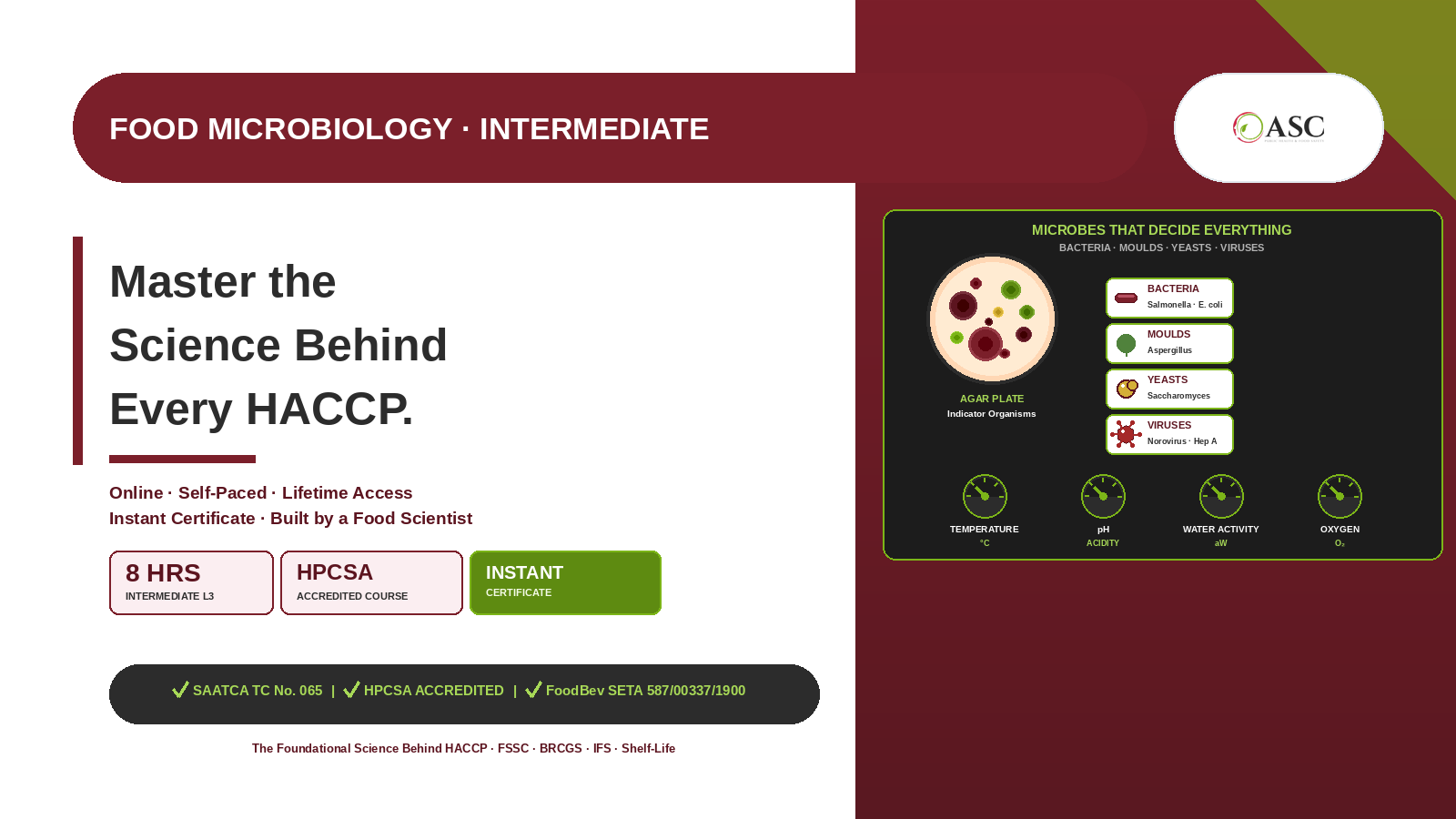
The Food Microbiology Course That Quietly Decides Whether Your HACCP, FSSC and BRCGS Programmes Actually Work
Most SA food safety and QA professionals work with microbiology terminology daily — Listeria, Salmonella, indicator organisms, water activity, aerobic plate counts — without ever having been formally trained in any of it. Close that gap in 8 hours, online, self-paced, HPCSA CPD accredited.
Quick AnswerThe Intermediate Food Microbiology: Principles and Application course is an HPCSA CPD accredited 8-hour online programme covering bacteria, moulds, yeasts and viruses; the growth factors (temperature, pH, aw, oxygen) that govern microbial behaviour; foodborne pathogens; beneficial microbes; food spoilage mechanisms; aseptic sampling; microbiological testing; indicator organisms; and the microbiology of food preservation. It is the silent prerequisite behind every credible HACCP plan, FSSC 22000 hazard analysis, BRCGS food safety plan, and shelf-life study.
Why This Course Quietly Decides Everything
You can implement HACCP without understanding microbiology. You can pass a BRCGS audit without ever having defined what an indicator organism is. You can run shelf-life studies without genuinely understanding microbial growth kinetics. You just won’t be very good at any of them.
Food microbiology is the underground language of food safety. Every decision a HACCP team makes — every Critical Control Point, every monitoring parameter, every corrective action — is built on microbiological assumptions. When those assumptions are wrong, products go out unsafe, recalls happen, and people die.
What Happens When Food Microbiology Knowledge Is Missing
- HACCP plans miss real hazards — teams identify the wrong critical limits because they don’t understand which organisms grow at which temperatures, water activities, or pH levels.
- Sampling plans are statistically meaningless — without indicator organism knowledge, sites swab the wrong surfaces, at the wrong frequency, with the wrong methodology.
- Lab results get misinterpreted — APC counts, coliform results and Enterobacteriaceae swabs come back from the lab and nobody on site can correctly interpret what they mean for product release.
- GFSI auditors find gaps — FSSC 22000, BRCGS and IFS auditors specifically test team microbiology knowledge during interviews. Wrong answers = non-conformances.
- Shelf-life dates are guessed — without microbial growth understanding, manufacturers can’t justify why their “use-by” date isn’t a fortnight too long (a recall waiting to happen).
- Recalls and listeriosis-style outbreaks — the 2017–2018 SA listeriosis outbreak that killed 200+ people had microbiological knowledge gaps at multiple levels of the supply chain.
- Production wastes spike — without understanding spoilage mechanisms, manufacturers over-process, over-preserve, or over-reject perfectly safe product.
In auditing 50+ South African food manufacturers, we have repeatedly found QA managers, HACCP team leaders, and production supervisors who use the words “indicator organism”, “water activity”, “log reduction” and “L. monocytogenes” daily — but who have never been formally trained in any of it. They learnt on the job, picked up bits and pieces, and bluff their way through audits. This course exists to fix that, permanently and affordably.
Where This Course Sits in the ASC Learning Pathway
Food Microbiology is the foundational science course that everything else builds on. Look at where it sits in the typical SA food professional’s learning journey:
Your Recommended Learning Pathway
You can take this course standalone — but pair it with HACCP, FSSC, BRCGS or Shelf-Life Studies and your understanding compounds dramatically.
What This Course Teaches — In Practical Terms
By the end of this 8-hour course, you and your team will be able to:
- Classify foods based on perishability — and predict which spoilage organisms dominate which products
- Identify the structural parts of microorganisms and understand why this matters for cleaning, sanitising and thermal processing
- Predict microbial growth and reproduction in your specific food handling environment based on temperature, water activity, pH, and oxygen
- Identify GMP failures that lead to microbiological contamination — before they become recalls
- Distinguish indicator organisms from pathogens — and know what each result actually tells you
- Apply correct sampling techniques — surface, environmental, product, water — using aseptic methodology
- Interpret laboratory results — APC, TVC, coliforms, Enterobacteriaceae, Listeria, Salmonella, yeast and mould counts
- Understand the microbiology behind every preservation method — refrigeration, freezing, drying, fermentation, modified atmosphere, irradiation, chemical preservation
- Communicate confidently with microbiology labs, GFSI auditors, and regulators — using the right terminology with confidence
- Connect microbiology to FSSC 22000, BRCGS, IFS, R638 and R908 requirements — bridging the science to the regulatory framework
Enrol Today — Instant Access · Lifetime Validity
HPCSA CPD accredited. 8 hours of structured online content. Text, audio, and video lessons. Knowledge tests after every module. Downloadable Learner Manual. Instant Certificate of Completion.
Enrol Now → Group Enquiry / Bulk PricingThe Microbes You’ll Master
Bacteria
Pathogens, spoilage, indicator organisms
Moulds
Spoilage, mycotoxins, beneficial uses
Yeasts
Fermentation, spoilage, brewing
Viruses
Norovirus, Hepatitis A, food carriers
Indicator Organisms
What they really mean
What’s Inside — The Course Structure
Foundations of Food Microbiology
- Learning outcomes & navigation
- Classification of food based on perishability
- History of food microbiology
- Where microorganisms exist in nature
- Advantages and disadvantages of microbes
- Structural parts of microorganisms & their functions
- Knowledge test 1
Growth & Reproduction of Microorganisms
- Bacterial growth phases
- Temperature effects (psychrophiles, mesophiles, thermophiles)
- Water activity (aw) thresholds
- pH and acid tolerance
- Oxygen requirements (aerobic, anaerobic, facultative)
- Knowledge test 2
GMPs to Control Microbial Contamination
- Cross-contamination pathways
- Personnel hygiene controls
- Equipment & environmental hygiene
- Cleaning & sanitation efficacy
- Zoning & segregation
- Knowledge test 3
Indicator Organisms
- Why we use indicators (vs direct pathogen testing)
- Total viable count (APC / TVC)
- Coliforms & Enterobacteriaceae
- E. coli as a faecal indicator
- Yeasts and moulds
- Knowledge test 4
Sampling Techniques
- Aseptic technique fundamentals
- Surface sampling (swabs, sponges, contact plates)
- Environmental sampling programmes
- Product sampling (n,c,m,M plans)
- Water sampling & preservation
- Knowledge test 5
Microbiology of Food Preservation
- Thermal processing (pasteurisation, sterilisation)
- Refrigeration & freezing
- Drying & dehydration
- Fermentation (beneficial microbes)
- Modified atmosphere packaging
- Chemical preservation
- Final assessment
What’s Included With Your Enrolment
- 8 hours of structured content
- Multiple modules of progressive learning
- Text, audio AND video formats — learn how you like
- Knowledge test for every module
- Comprehensive final assessment
- Downloadable Learner Manual (PDF reference)
- Self-paced — learn on your schedule
- Access on desktop, tablet, mobile
- Downloadable Certificate of Completion
- Lifetime enrolment validity
- Email support during your study
- Q&A and Announcements area
Who Should Enrol
This Course Was Built For:
- Business owners or persons in charge of food premises
- QA managers
- QC managers
- Production managers
- Supervisors
- HACCP / Food safety team members
- Laboratory personnel
- Environmental health practitioners
- R&D and product development teams
- Anyone preparing for FSSC, BRCGS, IFS implementation
- New hires in food handling, testing, or QA roles
- Food technologists and food scientists upskilling
This course is the perfect induction module for any new QA, lab, or food safety hire. Get the entire team onto the same microbiology baseline in 8 hours flat. Bulk enrolment discounts available for teams of 5+. Contact ASC for group pricing →
Why Learn From Mthokozisi Nkosi
Mthokozisi Nkosi
Food Scientist · Registered Lead Auditor (Exemplar Global & IRCA) · SAATCA R638:2018 Lead Implementer · Registered GLOBALG.A.P. Trainer · FoodBev SETA Registered Assessor (F01/585/ASR00067)
Mthokozisi is a Food Scientist by training — not a generalist food safety consultant who picked up microbiology second-hand. He has spent 10+ years implementing food safety management systems at 50+ South African manufacturers across red meat, dairy, bakery, beverage, fresh produce and ready-to-eat sectors.
His teaching style bridges the rigour of food science with the practical realities of SA factory floors and lab benches. The technical depth is real; the explanations are clear; the SA context is throughout.
Built for South African Food Industry Reality
| Feature | This Course | Generic International Microbiology Courses |
|---|---|---|
| SA legislation references | ✓ R638, R908, R146, Act 54 of 1972 | ✗ Mostly EU/US frameworks |
| Built by a Food Scientist + Lead Auditor | ✓ Mthokozisi Nkosi | Often academics with no audit experience |
| HPCSA CPD accredited | ✓ | ✗ |
| SAATCA-listed provider | ✓ Verify directly | Limited applicability in SA |
| FoodBev SETA-registered | ✓ 587/00337/1900 | ✗ |
| Online & self-paced | ✓ Lifetime access | Often time-limited |
| Multimedia learning (text, audio, video) | ✓ All three formats | Often video-only or text-only |
| Connects to FSSC, BRCGS, IFS, R638 expectations | ✓ | Limited |
| Practical sampling and lab interpretation | ✓ | Often theory-heavy |
Frequently Asked Questions
Is this course HPCSA CPD accredited?
Yes. HPCSA CPD accredited and offered through ASC Food Safety Training, an officially SAATCA-listed online training course provider, FoodBev SETA-registered (587/00337/1900).
What does this course cost?
Contact ASC for current pricing. Bulk enrolment discounts available for teams of 5 or more. Request a quote here.
How long do I have access?
Lifetime. Once you enrol, the course is yours forever — including any future content updates.
Will I get a certificate?
Yes — a downloadable Certificate of Completion is issued upon successful completion of the final assessment. Issued by ASC Food Safety Training.
Do I need a science background?
No. The course is rated Intermediate Level 3 and is designed to be accessible to QA personnel, supervisors, food technologists and managers without specialist microbiology degrees. Knowledge builds progressively.
Can I complete it on my phone?
Yes. The platform is fully mobile-responsive — complete lessons on phone, tablet, or desktop, whenever it suits you.
What if I fail an assessment?
You can retake assessments. Multiple attempts are allowed so you have every opportunity to demonstrate competence.
Do you offer in-house / on-site delivery?
Yes — for groups of 8 or more, ASC can deliver this course in-person or via Zoom for your team, customised to your sector. Request an in-house quote.
How does this course connect to GFSI schemes?
Directly. FSSC 22000, BRCGS Issue 9 and IFS Food all require demonstrable microbiology competence within the food safety team. This course gives every team member that competence.
Should I take this before HACCP?
It’s strongly recommended. Without microbiology fundamentals, HACCP teams often misidentify hazards and set incorrect critical limits. Take this course before or alongside FS10 HACCP for Supervisors for maximum impact.
How can I verify ASC’s accreditation?
ASC is officially listed on the SAATCA registered providers directory. Also HPCSA CPD accredited and FoodBev SETA-registered (587/00337/1900).
Trusted by SA Food Manufacturers
The ASC Training Track Record
Pair This Course With…
Food Microbiology is foundational. For maximum impact, combine it with:
- FS10 — HACCP for Supervisors & HACCP Teams · R2 730 · View course
- FS33 — Implementation of Good Manufacturing Practices · R1 950 · View course
- FS-SLS — Overview of Conducting a Shelf-Life Study · Read article
- FS21 — Introduction to FSSC 22000 V6 · R1 195 · View course
- FS37 — Introduction to BRCGS for Food Safety · R1 450 · View course
- FS26 — Internal & Supplier Auditing · R3 500 · View course
Bundle pricing available — contact ASC for a custom quote.
Stop Bluffing the Microbiology. Master It in 8 Hours.
The next time a GFSI auditor, retailer QA, or NCRS official asks your team about microbial growth limits, indicator organisms, or sampling rationale — be ready. HPCSA CPD accredited. SAATCA-listed. Built by a Food Scientist who has personally implemented FSMS at 50+ SA manufacturers. The most credible food microbiology course available to SA food professionals online.
Enrol Now Request Group PricingGqeberha: +27 41 004 0382 · Randburg: +27 10 500 4661 · Cape Town: +27 21 300 4024 · info@ascfoodsafety.com
© ASC Food Safety Consultants · SAATCA TC No. 065 (officially listed) · HPCSA · FoodBev SETA 587/00337/1900 · BBBEE Level 1.