
Food Handler Training in South Africa: The Complete R638 Compliance Guide for Owners, Managers & HR Teams
Every kitchen, every factory, every food truck, every spaza shop in South Africa needs trained food handlers. Regulation 10(1)(b) of R638 of 2018 makes it a legal requirement — not a recommendation, not best practice, not a “should-have”. Without it, your Certificate of Acceptability (COA) cannot be issued or renewed. This guide explains exactly which course your team needs, how much it costs, how fast it can be done, and how to prove compliance to any Environmental Health Practitioner.
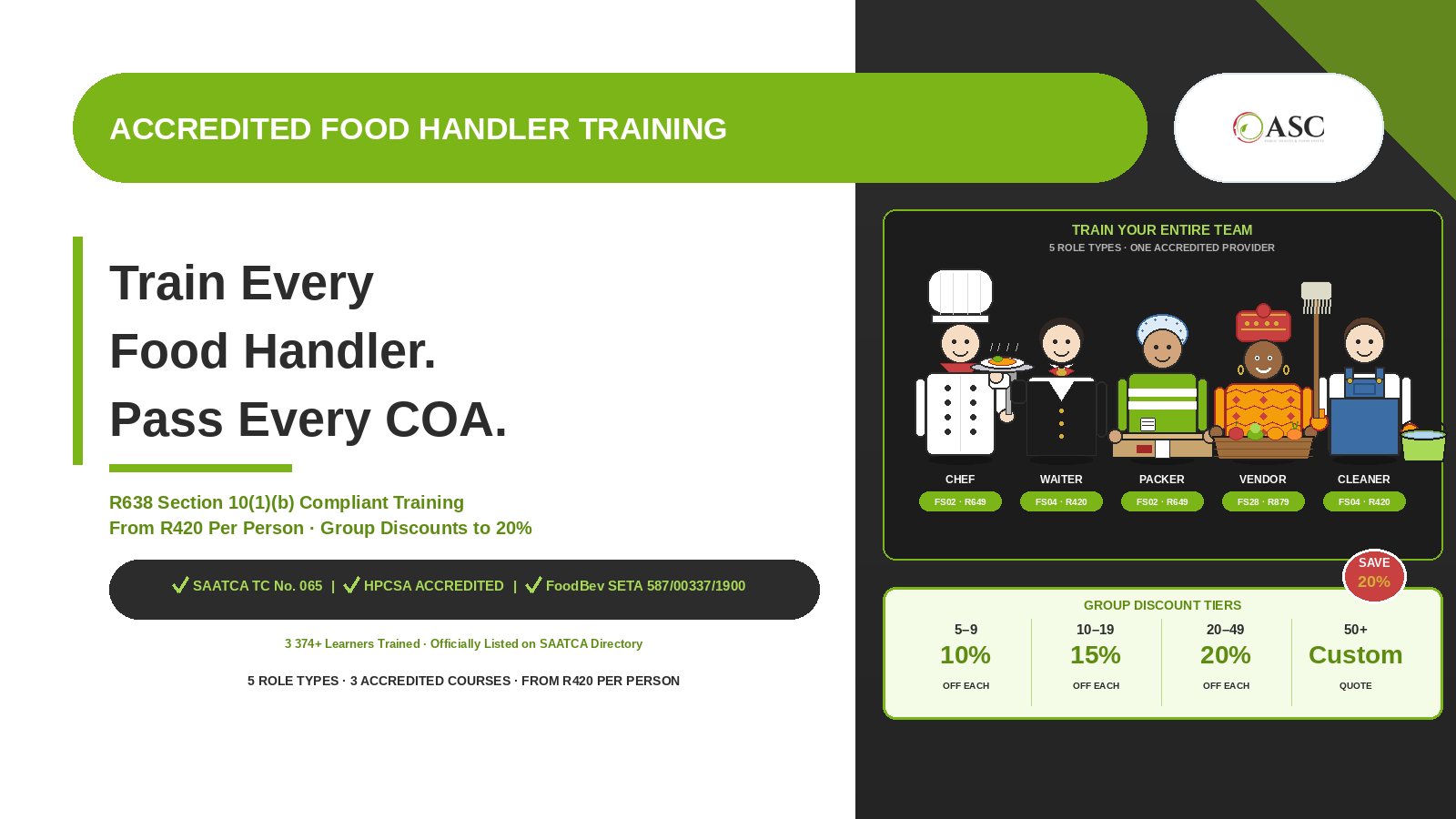
Quick AnswerUnder Regulation R638 of 2018, Section 10(1)(b), every food handler in South Africa must receive regular documented training in basic food hygiene. ASC offers three accredited online food handler courses covering every workforce type: FS02 Basic Food Safety for Food Handlers (R649) for kitchen, production and packing staff; FS04 Basic Food Hygiene Awareness (R420) for waiters, casuals and entry-level staff; and FS28 for Spaza Shops, Vendors and Informal Traders (R879). Group discounts of 10–20% apply from 5 enrolments — the most cost-effective way to train an entire team.
1. The Legal Requirement: R638 Section 10(1)(b)
South Africa’s most important food safety regulation — Regulation R638 of 2018, made under the Foodstuffs, Cosmetics and Disinfectants Act 54 of 1972 — has two specific training requirements in Section 10:
| Sub-section | Who | Requirement |
|---|---|---|
| 10(1)(a) | Person in Charge | Accredited food safety training, OR an equivalent qualification (chef, food technologist, food scientist) |
| 10(1)(b) | Every food handler | Regular documented training in basic food hygiene |
Most owners focus on 10(1)(a) and forget 10(1)(b) — until an inspector asks for the training register. An EHP cannot issue or renew a Certificate of Acceptability if any food handler on the premises is untrained.
For the Person in Charge requirement, see our complete Persons in Charge R638 training guide.
2. Who Counts as a “Food Handler”?
R638 defines a food handler broadly — anyone who handles food or food contact surfaces. This includes:
- Kitchen brigade: chefs, sous chefs, line cooks, prep staff, pastry chefs, bakers
- Production line staff: in food manufacturing — operators, packers, mixers
- Front-of-house: waiters who handle plates, cutlery, and any wrapped food
- Cashiers who handle wrapped/packaged food
- Bartenders handling glassware, ice, garnishes, snacks
- Receiving and dispatch staff handling raw materials and finished products
- Warehouse and cold-store staff
- Cleaning crews working in food preparation areas (yes, even cleaners)
- Delivery staff handling packaged food
- Casual workers, part-timers, temporary staff — R638 makes no distinction
- Spaza shop assistants and informal traders handling unpackaged or packaged food
Owners often think waiters or cashiers don’t need training because they don’t “cook”. Wrong. The moment a waiter handles a wrapped sandwich or carries an open plate, they’re a food handler under R638. EHPs check this routinely.
3. What Happens If You Don’t Train Them?
- COA refusal or revocation — premises closed
- Criminal prosecution under Act 54 of 1972 — fines and/or imprisonment
- Voided insurance if a foodborne illness occurs and untrained staff are implicated
- Lost retailer listings — Shoprite, Pick n Pay, Woolworths, Spar and Checkers all require evidence of trained staff
- Civil claims under Consumer Protection Act 68 of 2008 if a customer falls ill
- Reputational damage when EHP closure makes social media
March 2025 saw a Boxer Superstore in Tshwane and Burger King outlets fined or closed for COA non-compliance. Untrained staff was a contributing factor in multiple cases.
4. Which Course Does Each Staff Member Need?
This is the question every HR manager and restaurant owner asks. Use this decision matrix:
| Staff Type | Recommended Course | Price | Why |
|---|---|---|---|
| Kitchen brigade (chef, cook, prep) | FS02 Basic Food Safety for Food Handlers | R649 | Comprehensive R638-aligned content for full-time food handlers |
| Factory production / packing staff | FS02 | R649 | Same — full-time food contact |
| Waiters & runners (handle plates only) | FS04 Basic Food Hygiene Awareness | R420 | Sufficient for indirect food contact roles |
| Cashiers handling packaged food | FS04 | R420 | Awareness-level appropriate |
| Cleaners working in food areas | FS04 | R420 | Awareness — they don’t prepare but must understand contamination |
| Casual / part-time / temp staff | FS04 | R420 | Quick onboarding for seasonal labour |
| Spaza shop / vendor / informal trader | FS28 Spaza Shops & Informal Traders | R879 | Purpose-built for the spaza shop registration drive |
| HACCP team member, line supervisor | FS10 HACCP for Supervisors | R2 730 | Beyond hygiene — system-level competence |
5. FS02 — Basic Food Safety Practices for Food Handlers (R649)
Basic Food Safety Practices for Food Handlers
The flagship food handler course. Aligned with R638 Section 10(1)(b). Covers all the essentials every kitchen, production and packing staff member must know — personal hygiene, contamination prevention, temperature control, allergens, cleaning and sanitation, traceability basics.
Duration: 6 hours · Format: Online self-paced · Certificate: QR-verified, downloadable instantly · Access: Lifetime
What FS02 covers
- Introduction to food safety and why it matters
- The microbial enemy: bacteria, viruses, parasites, moulds
- Personal hygiene — handwashing, grooming, illness reporting, protective clothing
- Contamination types: biological, chemical, physical, allergens
- Cross-contamination prevention
- Time and temperature control of food
- Cleaning and sanitation procedures
- Pest control basics for food handlers
- Allergen awareness and management
- Receiving, storage and FIFO basics
- Reporting food safety issues
- Knowledge tests and final assessment (70% pass mark, multiple attempts)
6. FS04 — Basic Food Hygiene Awareness (R420)
Basic Food Hygiene Awareness for Food Handlers
South Africa’s most affordable accredited food hygiene training. Perfect for waiters, cashiers, casual workers, runners, cleaners working in food areas, and any staff with indirect food contact. Awareness-level content — enough to satisfy R638 Section 10(1)(b) without the full handler depth.
Duration: 4 hours · Format: Online self-paced · Certificate: QR-verified, downloadable instantly · Access: Lifetime
FS04 is the perfect match for the modern, fast-moving hospitality sector where staff turnover is high and onboarding speed matters. A new hire can be R638-compliant within their first shift.
7. FS28 — Spaza Shops, Vendors & Informal Traders (R879)
Basic Food Safety for Spaza Shops, Vendors & Informal Traders
Designed in response to the 2024-2025 spaza shop registration drive that’s still running across SA municipalities. Specifically tailored to informal trader contexts — limited storage, hawker stalls, township shop conditions, common food types.
Duration: 3.5 hours · Format: Online self-paced · Mobile-friendly for trader phones · Certificate: QR-verified
8. Bulk Pricing & Group Enrolment
Training a whole team is where ASC’s pricing destroys the competition. Tiered group discounts apply across all food handler courses:
Group Enrolment Discounts
Plus dedicated client manager · consolidated invoicing · centralised certificate dashboard via Client Group Management
Real-world example pricing
- Restaurant with 12 kitchen staff + 8 waiters: 12 × FS02 (R649) + 8 × FS04 (R420) = R7 788 + R3 360 = R11 148, less 15% group discount = R9 476
- Manufacturing facility with 40 production staff: 40 × FS02 (R649) = R25 960, less 20% = R20 768
- Hotel kitchen brigade of 25: 25 × FS02 (R649) = R16 225, less 20% = R12 980
Compare to private classroom training at R3 000+ per person — ASC saves you 50–80%.
9. How to Prove Training to an EHP
Inspectors expect to see evidence, not assurances. Maintain:
- Training register — name, ID number, course, provider, date, certificate number
- Hard-copy certificates displayed on noticeboard or filed in a binder
- Digital backup — email PDFs to a shared drive
- Refresher schedule — annual renewal dates marked
- Onboarding checklist — every new hire trained before handling food
Every ASC certificate carries a QR code the inspector can scan to instantly verify authenticity on the SAATCA-listed ASC database. No phone calls. No “we’ll get back to you”. Compliance verified in 5 seconds.
10. Refresher Training: How Often?
R638 says “regular” without specifying. Industry best practice and audit reality:
| Trigger | Action |
|---|---|
| New hire | Complete training before first shift handling food |
| Annual interval | Refresher for every food handler — best-practice baseline |
| Significant menu / process change | Topical refresher on the change |
| After a non-conformance / complaint | Targeted retraining |
| FSSC 22000 / BRCGS / IFS facility | Annual mandatory; recorded against scheme |
| Major retailer supplier audit | Pre-audit refresher |
ASC courses include lifetime access — your team can log back in at any time and revisit content for free. Refresher reminder emails are sent automatically 11 months after enrolment.
11. Why ASC Beats Every Competitor
The ASC Advantage
| Feature | ASC | Typical Competitors |
|---|---|---|
| SAATCA-listed online provider | ✓ Verify directly | Some only |
| Triple accreditation (SAATCA + HPCSA + FoodBev SETA) | ✓ Only provider in SA | One only |
| Cheapest accredited course | R420 (FS04) | R450–R750 |
| Group discount up to | 20% (50+ learners) | 5–10% typical |
| QR-verified certificate | ✓ Tamper-proof | Plain PDF |
| Lifetime access & refresher reminders | ✓ | Time-limited |
| Client Group Management dashboard | ✓ | Manual spreadsheet |
| Mobile-friendly courses | ✓ All courses | Some only |
| BBBEE Level 1 (135% procurement) | ✓ | Lower |
12. Frequently Asked Questions
Is food handler training legally required in South Africa?
Yes. Regulation 10(1)(b) of R638 of 2018 makes it a legal requirement that every food handler receives regular documented basic food hygiene training. An EHP cannot issue a Certificate of Acceptability without evidence of compliant training for all handlers.
What is a food handler under R638?
Anyone who handles food or food contact surfaces — kitchen staff, cooks, waiters who handle plates, cashiers handling wrapped food, packers, dispatch, cleaners working in food areas, and delivery personnel.
How often must food handlers be retrained?
R638 requires “regular” training. Industry best practice is annual refresher plus immediate training for new hires. Major retailers and FSSC 22000-certified facilities require annual refresher contractually.
What’s the cheapest accredited food handler course?
ASC’s FS04 Basic Food Hygiene Awareness at R420 per person. For full R638-aligned content, FS02 at R649 is recommended.
Can the Person in Charge train handlers themselves?
Technically yes if the PIC has accredited training, but EHPs increasingly request formal accredited handler training because in-house quality is inconsistent. ASC’s QR-verified certificates remove all doubt.
Do part-time staff and waiters need training?
Yes. R638 makes no distinction between full-time, part-time, casual or temporary. If they handle food or food contact surfaces, they need training.
Are spaza shops treated the same?
Following the 2024-2025 spaza shop registration drive, informal traders must demonstrate basic food hygiene knowledge. ASC’s FS28 course at R879 is purpose-built for this market.
How do I prove training to an EHP?
Maintain a training register, display certificates, file digital copies. ASC certificates carry QR codes inspectors can scan for instant verification.
What’s the bulk price for a whole team?
5-9 learners save 10%, 10-19 save 15%, 20+ save 20%. Contact ASC for custom pricing on 50+ learners.
How can I verify ASC’s accreditation?
ASC is officially listed on the SAATCA registered online training providers directory. Also accredited by HPCSA and FoodBev SETA (587/00337/1900).
13. Enrol Your Team Today — From R420 Per Person
Train Your Whole Team. Pass Every Inspection.
SAATCA-listed. HPCSA-accredited. FoodBev SETA-registered. Used by KFC, Spur and major SA hospitality and food manufacturing brands. From R420 per person, with up to 20% off for bulk enrolment.
Enrol in FS02 — R649 FS04 from R420Training a whole team? Get a group quote · Client Group Management
Gqeberha: +27 41 004 0382 · Randburg: +27 10 500 4661 · Cape Town: +27 21 300 4024 · info@ascfoodsafety.com
© ASC Food Safety Consultants · SAATCA TC No. 065 (officially listed) · HPCSA Accredited · FoodBev SETA 587/00337/1900 · BBBEE Level 1.