
Food Microbiology Course South Africa: The Best Intermediate Online Programme for QA & Food Safety Teams (2026)
By Mthokozisi Nkosi – Food Scientist (BSc Agric Hons in Food Science, MSc, MBA), Lead Auditor registered with both Exemplar Global and IRCA, Founder of ASC Food Safety Consultants. Updated 2026.
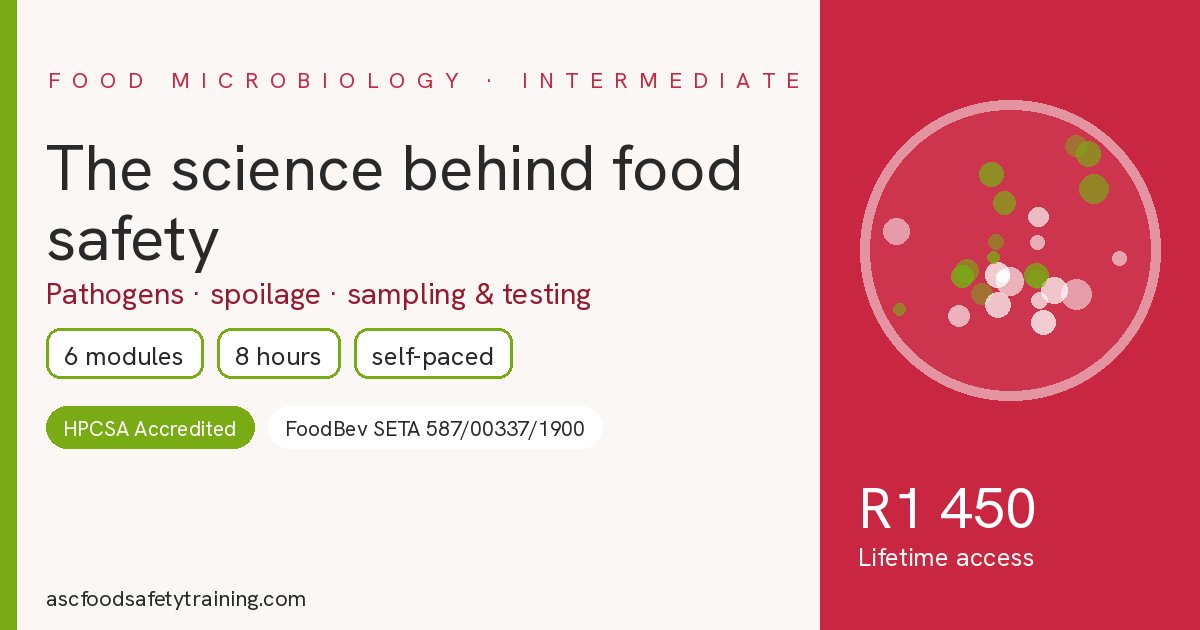
If you want to understand why food spoils, how foodborne pathogens grow, and how to sample and test for them with confidence, the ASC Intermediate Food Microbiology: Principles and Application course is the most complete, practical and genuinely scientific online programme in South Africa – six modules, eight hours, HPCSA CPD accredited, fully self-paced, with a downloadable learner manual and an instant certificate on completion. Enrol now for R1,450 with lifetime access.
→ Go straight to the course and enrol | WhatsApp +27 61 483 0381 for group rates.
Why food microbiology is the skill gap holding QA teams back
Most food safety training tells you what to do – wash hands, control temperatures, separate raw and cooked. Food microbiology explains why, and that is the difference between a team that follows a checklist and a team that can actually solve a problem. When a product fails a swab, when shelf life comes up short, when a positive Listeria result lands on your desk, the people who understand the microbiology are the ones who find the root cause and fix it. This is the knowledge that turns operators into food safety professionals and lets QA teams hold their own with auditors, customers and laboratories.
Why this is the food microbiology course South African professionals choose
There is a real reason this course stands apart from generic e-learning and from the many R638-only trainers in the market: it is built and curated by a genuine food scientist, not a generalist. Here is what you get:
- Taught at true scientific depth. ASC’s training is led by Mthokozisi Nkosi, who holds a BSc (Agric) Hons in Food Science and Technology, an MSc and an MBA. Most R638-only trainers in South Africa simply cannot teach microbiology at QA-team depth – this course can.
- HPCSA CPD accredited. A recognised, credible accreditation that carries weight with employers, auditors and regulators.
- Genuinely practical. Beyond the theory, you learn the tools used in real food laboratories and factories: aseptic sampling technique, microbiological testing methods, media and equipment selection, and the use of indicator organisms to detect contamination.
- Self-paced and built for working professionals. Eight hours of focused video and text lessons you complete around your job, with a knowledge test after every module and a final assessment.
- Lifetime access plus a downloadable learner manual. Enrol once and keep the material and manual as a permanent desk reference – most competitors charge per year.
- Rated 5.0 out of 5 by enrolled delegates, who describe it as informative and an excellent way to expand their knowledge of the food industry.
Build real microbiology skills – R1,450, lifetime access
6 modules · 8 hours · self-paced · HPCSA CPD accredited · downloadable learner manual · instant certificate · lifetime access.
Enrol in the Food Microbiology Course
Training your whole QA team? WhatsApp +27 61 483 0381 for group rates and a manager dashboard.
What you will learn: the full course structure
The course moves logically from how microbes grow, through how they are identified and the diseases they cause, to the indicator organisms, preservation science and laboratory techniques that food teams use every day.
Module 1 – the multiplication of different microorganisms
How bacteria, yeasts, moulds and viruses grow and reproduce in food systems, and the conditions – temperature, acidity, moisture and oxygen – that drive or slow that growth. This is the foundation for everything that follows.
Module 2 – identification of microorganisms
How microorganisms are identified, the difference between Gram-negative and Gram-positive cell walls, different identification techniques, and an introduction to microorganism nomenclature – so laboratory reports stop being a mystery.
Module 3 – introduction to different foodborne diseases
The most common foodborne illnesses caused by bacteria, moulds, yeasts and viruses, and their symptoms. Understanding the organism behind an illness is the first step to preventing it.
Module 4 – indicator organisms
The index and indicator organisms used in food, and how they signal contamination or process failure. This is core knowledge for anyone interpreting micro results or designing a monitoring programme.
Module 5 – the microbiology of food preservation
What spoilage really is and its different types, heat processing, aseptic packaging, the link between food safety and food microbiology, microbiological quality assurance, and how different microorganisms affect food quality by product type. This is the science behind shelf life.
Module 6 – sampling and testing
How to conduct proper aseptic technique, and how to select the right media and equipment – the hands-on laboratory skills that make the difference between a reliable result and a contaminated one.
Why microbiology matters more than ever in 2026
Food safety expectations are rising sharply, and microbiology sits at the centre of it. Global schemes like FSSC 22000 Version 7 now demand stronger environmental monitoring and allergen verification with testing evidence – both of which require staff who genuinely understand indicator organisms, sampling and interpretation. After the 2024 foodborne-illness tragedies in South Africa, regulators and customers are scrutinising microbiological control like never before. A team that understands the science is a team that can prevent the next outbreak, defend its results in an audit, and protect the business from recalls and reputational damage. This is no longer a “nice to have” – it is a core competency for any serious food operation.
Who should take this course
This intermediate course is ideal for QA managers, QC managers and production managers, HACCP and food safety teams, supervisors, laboratory personnel, environmental health practitioners, and business owners or persons in charge of food premises who want to lead from knowledge rather than guesswork. It pairs naturally with HACCP and FSMS training, deepening the scientific foundation those systems rely on.
From training to a stronger food safety system: the ASC ecosystem
Because ASC Food Safety Consultants is both an accredited training provider and a full food safety consultancy, the learning does not stop at the certificate. Once your team understands the microbiology, ASC can help you build it into practice – environmental monitoring programmes, micro testing schedules, shelf-life studies and HACCP validation – through the consulting division at ascfoodsafety.com. One accredited partner, from foundational knowledge through to a fully implemented system.
Why ASC, and why now
South African food manufacturers, processors and laboratories trust ASC because the training is local, accredited, and taught with genuine scientific authority – not a generic global module. Microbiology is the one area where depth cannot be faked, and it is exactly where ASC’s food-science credentials set the course apart. Whether you are strengthening a QA team, upskilling laboratory staff, or building the scientific base for FSSC 22000 and HACCP, this is the course that delivers it.
Give your team the science behind food safety
The most complete intermediate food microbiology course in South Africa – HPCSA CPD accredited, taught at true scientific depth, R1,450 with lifetime access and an instant certificate.
ascfoodsafetytraining.com · WhatsApp +27 61 483 0381 · info@ascfoodsafety.com
Frequently asked questions
What is the food microbiology course about?
It is an intermediate course covering the role of microorganisms in food production, spoilage and safety – how bacteria, moulds, yeasts and viruses grow, how they are identified, the foodborne diseases they cause, indicator organisms, the microbiology of preservation, and practical sampling and testing techniques.
Is the food microbiology course accredited?
Yes. The course is HPCSA CPD accredited and is offered by ASC Food Safety Consultants, a FoodBev SETA accredited provider (No. 587/00337/1900). You receive a downloadable certificate of completion.
How long is the course and how is it delivered?
It is an 8-hour, self-paced online course across six modules, with text, audio and video lessons, a knowledge test after each module and a final assessment. You have lifetime access and a downloadable learner manual.
How much does the food microbiology course cost?
The course is R1,450 per delegate with lifetime access included. Group rates are available for teams – contact ASC on WhatsApp +27 61 483 0381.
Who is the course for?
It is designed for QA, QC and production managers, HACCP and food safety teams, supervisors, laboratory personnel, environmental health practitioners, and business owners or persons in charge of food premises.
Do I need a science background to take it?
No. It is an intermediate course that builds the concepts from the ground up, making it accessible to working food professionals while still delivering genuine scientific depth.
How does this course support FSSC 22000 and HACCP?
Microbiology underpins HACCP hazard analysis and FSSC 22000 requirements such as environmental monitoring and allergen verification. This course gives your team the scientific foundation those systems depend on.