
Food Fraud (VACCP) & Food Defence (TACCP) Training in South Africa: The Definitive 2026 Guide for QA Managers & HACCP Teams
Between November 2024 and December 2025 South African inspectors seized thousands of fake honey and counterfeit olive oil products. Methanol-laced counterfeit alcohol has killed South Africans as recently as 2022–2023. And every FSSC 22000, BRCGS Issue 9 and IFS Food 8 auditor now demands documented VACCP and TACCP assessments. If you manufacture, process, pack or sell food in South Africa, this is the course you cannot afford to skip.
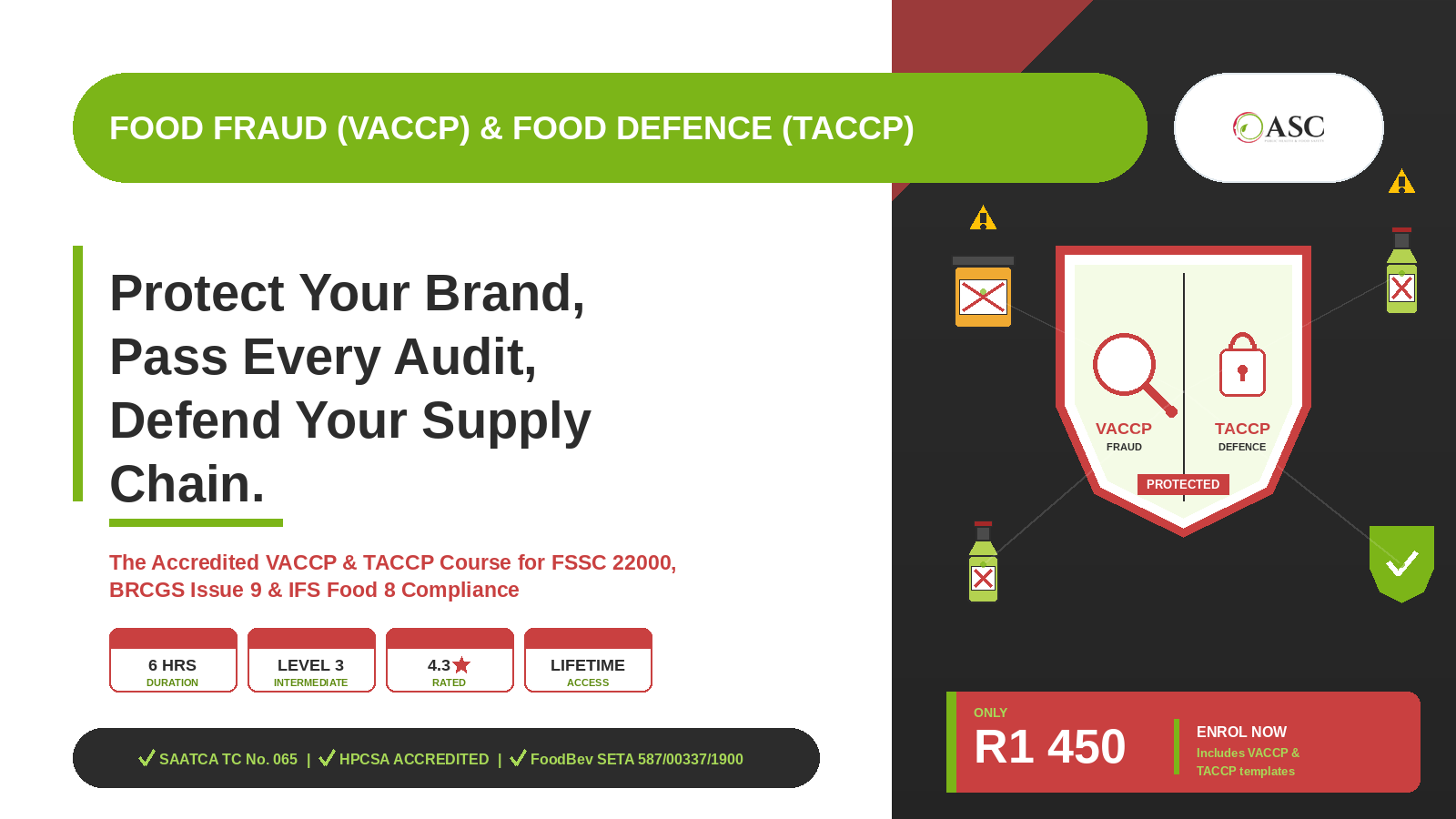
Quick AnswerVACCP (Vulnerability Assessment Critical Control Point) protects your business from economically-motivated adulteration — food fraud. TACCP (Threat Assessment Critical Control Point) protects it from intentional, malicious contamination — food defence. Both are mandatory under FSSC 22000 V6, BRCGS Issue 9, IFS Food 8 and every major South African retailer’s supplier programme. The ASC Food Fraud & Food Defence Course (FS11) is a 6-hour, online, self-paced, accredited intermediate-level programme — R1 450 — that equips QA managers, HACCP teams, internal auditors and supervisors with the tools, templates and methodologies to build compliant VACCP and TACCP systems in weeks, not months.
1. The 2025 Food Fraud Wake-Up Call
South Africa’s food fraud crisis has moved from academic concern to national emergency. Consider what has happened in the last 24 months alone:
- November 2024: Inspectors under the Agricultural Product Standards Act seized 1 059 honey-based syrups and 388 mislabelled honey products in Crown Mines, Kempton Park, Laudium and Marabastad in a single week
- 2025 study (University of Cape Town): Honey is the third most adulterated food globally. South African honey imports rose from 65% of the market in 2010 to 86% in 2021 — heightening vulnerability to counterfeit products
- 2022–2023: Methanol poisoning deaths linked to counterfeit alcohol distributed to South African communities
- Ongoing: Counterfeit olive oil cut with industrial dyes sold to impoverished communities
- Ongoing: Fish species mislabelling and meat species substitution across retail and food service
- Shocking case: Fire hydrant water bottled and sold as branded mineral water
- 2015–2025 review: A recent comprehensive study of South African food fraud incidents documented counterfeiting, illicit alcohol and adulteration as systemic problems — linked to “inadequate enforcement capacity, insufficient laboratory infrastructure, and outdated legislative penalties”
Globally the numbers are equally alarming: reported food fraud incidents increased by more than 1 000% between 2020 and 2023. Food fraud costs the global food industry an estimated USD 40 billion annually. The 2025 FoodAkai Global Food Fraud Index projects increases of 358% for nuts, 150% for eggs, 80% for dairy, 74% for fish/seafood and 66% for cocoa.
If your supplier list includes any of these commodities — and most South African manufacturers’ do — a documented VACCP system is no longer optional. It is survival.
2. VACCP vs TACCP — What’s the Difference?
The two terms are often confused. They are complementary but distinct risk-based methodologies, both derived from the HACCP approach:
| Dimension | VACCP (Food Fraud) | TACCP (Food Defence) |
|---|---|---|
| Full name | Vulnerability Assessment Critical Control Point | Threat Assessment Critical Control Point |
| Addresses | Food fraud — deliberate deception for economic gain | Food defence — intentional contamination for ideological, malicious or terror motives |
| Motive of perpetrator | Profit | Harm, protest, blackmail, brand damage, ideology |
| Typical perpetrators | Dishonest suppliers, brokers, repackers, organised crime | Disgruntled employees, activists, extortionists, extremists |
| Examples | Adulterated honey, counterfeit olive oil, species substitution, mislabelling | Deliberate contamination, tampering, sabotage, malicious product recalls |
| Core tool | Vulnerability assessment → Vulnerability Risk Register → Mitigation Plan | Threat assessment → Threat Risk Register → Food Defence Plan |
| Certification clauses | FSSC 22000 V6 Clause 2.5.5 · BRCGS Issue 9 Clause 4.3 · IFS Food 8 | FSSC 22000 V6 Clause 2.5.4 · BRCGS Issue 9 Clause 5.4 · IFS Food 8 · PAS 96:2017 |
| Primary output | Vulnerability assessment covering every ingredient & supplier | Threat assessment covering premises, people & processes |
A fraudster wants your money — VACCP catches them. A saboteur wants to harm your customers or brand — TACCP catches them. A complete Food Safety Management System requires both, and every major audit scheme now checks for both. Our course covers both methodologies in a single integrated programme.
3. Why Every South African Food Business Needs VACCP & TACCP in 2026
3.1 Major Retailers Require It
Every tier-1 South African retailer — Shoprite, Pick n Pay, Woolworths, Spar, Checkers, Massmart — now requires supplier VACCP and TACCP documentation as part of their standard supplier audits. No documentation, no listing. No listing, no revenue.
3.2 GFSI-Recognised Schemes Mandate It
If you hold or are pursuing any GFSI-recognised certification, VACCP and TACCP are non-negotiable:
- FSSC 22000 V6 — Clauses 2.5.4 (Food Defence) and 2.5.5 (Food Fraud Mitigation)
- BRCGS Food Safety Issue 9 — Clauses 4.3 (Product Security & Food Defence — sic, addresses both) and 5.4 (Food Defence requirements)
- IFS Food 8 — Clauses on food defence, site security and food fraud mitigation
- SQF Edition 9 — Food defence and food fraud requirements throughout
3.3 Export Markets Demand It
EU, UK, US and GCC importers require documented VACCP and TACCP as a baseline. No export market of meaningful size accepts supplier food without these systems in place.
3.4 The Liability Picture Is Terrifying
Under the Consumer Protection Act 68 of 2008 and the Foodstuffs, Cosmetics and Disinfectants Act 54 of 1972, a food manufacturer whose product causes consumer illness or death can face strict product liability, criminal prosecution, and class action. If adulterated raw material entered your supply chain and you had no VACCP programme, you have no defence.
4. The Legal & Certification Requirements Unpacked
4.1 FSSC 22000 V6 Requirements (Effective 2024 Onward)
FSSC 22000 V6 makes food defence and food fraud explicit, separately-audited requirements. Clause 2.5.4 requires a documented food defence threat assessment and mitigation plan. Clause 2.5.5 requires a documented food fraud vulnerability assessment and mitigation plan. Both must be:
- Conducted using a recognised methodology (e.g. PAS 96:2017 for TACCP, SSAFE or CARVER+Shock-based for VACCP)
- Signed off by a qualified person
- Reviewed at least annually and after any significant change
- Communicated to relevant personnel
- Underpinned by training (ASC’s FS11 course satisfies this)
4.2 BRCGS Issue 9 Requirements
BRCGS Issue 9 — effective 1 February 2023 — strengthened food defence (Clause 5.4) and food fraud (Clause 4.3) requirements. Auditors check for assessed, documented plans covering your raw materials, supplier chain, finished products, and premises, and they check training records of staff responsible for the programmes.
4.3 Alignment with PAS 96:2017
The course integrates PAS 96:2017 — the British Standards Institute’s publicly available specification for food defence and TACCP — widely recognised as the global reference for threat assessment methodology.
4.4 South African Regulatory Context
While Regulation R638 of 2018 does not yet explicitly require VACCP or TACCP, the Agricultural Product Standards Act supports enforcement against adulteration (as demonstrated by the 2024 honey raids), and the Consumer Protection Act creates civil liability. A formal South African food fraud surveillance framework is under discussion for the coming years, which means businesses that act now will be ahead of future regulation, not scrambling to catch up.
5. The 7 Types of Food Fraud You Must Prevent
The United States Pharmacopeia and the US FDA classify food fraud into seven main types. Your VACCP assessment must consider all seven:
1. Adulteration
Substituting a high-value component with a lower-value (or dangerous) one — e.g. diluting honey with corn syrup.
2. Substitution
Replacing an ingredient with an entirely different species — e.g. fish species mislabelling, meat species substitution.
3. Counterfeiting
Copying a brand, packaging or label — e.g. fake Johnnie Walker, fire-hydrant-water sold as branded mineral water.
4. Mislabelling
Placing false statements on the label — false claims of organic, kosher, halal, free-range, or geographic origin.
5. Concealment
Hiding a defect in a product — e.g. painting faded old meat to look fresh; disguising spoilage.
6. Unapproved Enhancement
Adding unauthorised substances to mask or enhance — e.g. industrial dyes to improve colour; melamine to inflate protein readings.
7. Grey Market Diversion
Products intended for one market sold in another — parallel imports, exported goods sold locally, stolen product channels.
6. Food Defence Threats: Who, What, Why
TACCP assesses the full spectrum of malicious threats to your food supply:
| Threat Source | Motivation | Typical Attack Surface |
|---|---|---|
| Insider (disgruntled employee) | Revenge, grievance, financial distress | Production line, warehouse, labels, records |
| Organised crime / economic saboteur | Extortion, blackmail, competitor damage | Public announcement, product tampering |
| Activists / ideological groups | Animal welfare, environmental, political protest | Farms, slaughterhouses, retail shelves |
| Extremists / terrorists | Mass harm, fear, ideological statement | Water supply, mass-produced ready-to-eat foods |
| Opportunist (vandal, mentally ill) | Personal gratification | Retail displays, open-display food service |
| Cyber attacker | Financial, disruption, data theft | Recipe control systems, process control (ICS/SCADA) |
A proper TACCP plan protects your people, premises, processes, products, and information. The ASC course walks you through each category using PAS 96-aligned methodology.
7. The ASC Food Fraud (VACCP) & Food Defence (TACCP) Course
Food Fraud (VACCP) & Food Defence (TACCP) Course
What’s included:
- Text, audio & video lessons — learn how it suits you
- Downloadable VACCP exercise files — real-world vulnerability templates you can use immediately
- Downloadable TACCP exercise files — threat assessment templates and worked examples
- Knowledge tests after each module (70% pass mark, 3 attempts)
- Final assessment with a VACCP assignment (build a vulnerability risk register)
- Final assessment with a TACCP assignment (build a threat risk register)
- Personalised invigilator feedback on every assignment
- Downloadable QR-verified certificate on successful completion
- Lifetime access to course materials for refresher learning
8. Full Curriculum — Exactly What You’ll Learn
Module 1: Introduction to Food Fraud & Food Defence
- Definitions, scope, and why VACCP and TACCP matter
- Global and South African food fraud landscape (2020–2026)
- The regulatory and certification context (FSSC 22000 V6, BRCGS Issue 9, IFS Food 8, PAS 96:2017)
- Distinction between food safety, food quality, food fraud and food defence
Module 2: Food Fraud & VACCP Methodology
- The 7 types of food fraud (USP classification)
- Horizon scanning & food fraud intelligence sources (FoodAkai, EU RASFF, Decernis, HorizonScan)
- Vulnerability assessment methodology (SSAFE, CARVER+Shock principles applied)
- Building the Vulnerability Risk Register
- Mitigation planning — supplier assurance, testing, specification control
- Practical VACCP assignment — build a full vulnerability assessment
Module 3: Food Defence & TACCP Methodology
- Identifying threats and threat actors
- PAS 96:2017 step-by-step methodology
- Assessing people, premises, processes, products, and information
- Building the Threat Risk Register
- Food defence plan development — access control, personnel screening, supply chain security, cyber
- Practical TACCP assignment — build a full threat assessment
Module 4: Integration, Documentation & Audit Readiness
- Integrating VACCP and TACCP into your FSMS
- Review cycles, management review, continuous improvement
- Training your team and creating awareness
- Handling food fraud or food defence incidents
- Preparing for FSSC 22000 V6, BRCGS Issue 9 and IFS Food 8 audits
Unlike most online courses, ASC’s FS11 course includes real assignments with personalised invigilator feedback. You don’t just tick boxes — you leave the course with a completed VACCP risk register and TACCP threat assessment that you can adapt directly to your business. One recent student noted: “After failing and receiving feedback from the invigilator, concepts were explained in sufficient detail.” — real accountability, real learning.
9. Why ASC Is the #1 Choice for VACCP & TACCP Training in South Africa
| Feature | ASC FS11 Course | Typical Competitors |
|---|---|---|
| Instructor is a Registered Lead Auditor (Exemplar Global & IRCA) | ✓ Mthokozisi Nkosi | Rarely — often generic trainers |
| Covers both VACCP and TACCP in one programme | ✓ | Often separate courses at 2× the price |
| Aligned with FSSC 22000 V6, BRCGS 9, IFS 8, PAS 96 | ✓ Current to 2026 | Often outdated to Issue 8 or earlier |
| Real assignments with personalised invigilator feedback | ✓ | Multiple-choice only |
| Downloadable VACCP & TACCP templates | ✓ Plug & play | Rarely included |
| SAATCA + HPCSA + FoodBev SETA accreditation | ✓ All three | Usually one only |
| Lifetime access to course materials | ✓ | Often time-limited |
| QR-verified certificate | ✓ Tamper-proof | Simple PDF |
| Full consultancy backing (audits, FSMS implementation) | ✓ | Training only |
| BBBEE Level 1 (135% procurement recognition) | ✓ | Usually lower |
| Price | R1 450 | R2 500–R5 000 typical |
10. What Students Are Saying
“Fabulous to find a self-paced, online solution. Detailed assignments ensure robust understanding of the tools to be applied to conduct your Food Fraud studies.”
“Great course for self learning at your own pace, the tests throughout the course help prepare you for the assessment.”
“Great content.”
“In general, the course was informative. After receiving feedback from the invigilator, concepts were explained to me in sufficient detail.”
Verified reviews from learners who completed the course.
11. ROI — Why R1 450 Is the Cheapest Insurance You’ll Ever Buy
Let’s put the R1 450 price tag in perspective. A single food fraud or food defence failure can cost you:
| Failure Scenario | Typical Cost |
|---|---|
| Lost retailer listing due to failed audit (annual contract with Woolworths / PnP / Shoprite) | R5 million – R500 million+ |
| FSSC 22000 / BRCGS certification suspended | Lost export contracts — R millions/year |
| Product recall after adulterated raw material enters your system | R1 million – R50 million direct + brand damage |
| Class action under the Consumer Protection Act after fraudulent product causes harm | R millions + criminal prosecution |
| Failed audit requires remedial re-audit | R30 000 – R80 000 per re-audit |
| Hiring a consultant to build VACCP & TACCP from scratch | R25 000 – R80 000 |
| ASC FS11 Course (for one trained team member) | R1 450 |
A single trained QA manager applying ASC’s VACCP and TACCP templates once pays back the course investment hundreds — often thousands — of times over.
12. Who Should Take This Course?
- QA Managers & QC Managers responsible for your FSMS
- HACCP Team Leaders extending the HACCP approach to fraud and defence
- HACCP Team Members contributing to VACCP and TACCP reviews
- Internal Auditors auditing food fraud and food defence programmes
- Food Safety & Compliance Officers preparing for FSSC 22000, BRCGS or IFS Food audits
- Technical Managers at manufacturers, packhouses, importers and food service
- Supply Chain & Procurement Managers managing supplier approval and assurance
- Production Supervisors responsible for site security and incoming goods
- Consultants delivering VACCP and TACCP projects to clients
- Students pursuing food safety careers who want a CV-differentiating credential
13. Frequently Asked Questions
Do I need to have HACCP training before this course?
It’s not required, but highly recommended. Because VACCP and TACCP build on HACCP thinking, learners who have already completed Introduction to HACCP (FS07) or HACCP for Supervisors (FS10) progress faster. If this is your first food safety course, consider our bundle pricing.
Is the course recognised by FSSC 22000, BRCGS and IFS auditors?
Yes. Training content is aligned with FSSC 22000 V6 Clauses 2.5.4 & 2.5.5, BRCGS Issue 9 Clauses 4.3 & 5.4, IFS Food 8, and PAS 96:2017. Certificates are QR-verified and accepted by all major GFSI audit bodies.
What is the pass mark?
70% on knowledge tests (3 attempts each). You must also submit and pass the VACCP and TACCP assignments, which receive personalised invigilator feedback.
How long do I have to complete the course?
Enrolment is lifetime. There is no deadline to complete. Most learners finish within 1–2 weeks around existing work.
Can I use the templates in my workplace?
Yes. The downloadable VACCP and TACCP exercise files are provided for your professional use. You can adapt them to your operations, supplier list, and product range.
Do I get a physical certificate?
You receive a digital, QR-verified PDF certificate on successful completion. It’s tamper-proof, employer-verifiable, and universally accepted — we recommend downloading and storing it for audit purposes.
How does ASC’s VACCP course compare with international alternatives like BRCGS Professional or SSAFE?
ASC’s course delivers the same international methodology (PAS 96, SSAFE-inspired VACCP) at a fraction of the cost, with the critical advantage of being locally contextualised to the South African food fraud landscape — real SA enforcement examples, real SA regulatory context, real SA supplier realities. International courses often cost R8 000–R20 000 and lack this local relevance.
Do I need to renew?
The certificate does not expire. However, VACCP and TACCP methodology evolves with new certification scheme updates. ASC recommends refreshing your knowledge annually — and because you have lifetime access, you can revisit the course material whenever FSSC 22000, BRCGS or IFS Food issue updates.
Which other ASC courses work well alongside this one?
The natural progression is: HACCP for Supervisors (FS10) → FS11 VACCP & TACCP → Internal & Supplier Auditing (FS26) → Food Safety & Quality Culture (FS32). Together these form the complete FSSC 22000 / BRCGS readiness stack.
Does ASC help with the actual FSSC 22000 / BRCGS implementation?
Yes. ASC Food Safety Consultants has guided 50+ companies through certification. Beyond training we offer FSMS document toolkits, gap analysis, mock audits, and on-site implementation support.
14. Enrol Today — Protect Your Brand, Pass Your Audit, Save Your Supply Chain
Food Fraud is a R40 Billion Global Problem. Your Insurance Is R1 450.
Join QA managers and HACCP teams at food manufacturers, packhouses and retailers across South Africa who’ve equipped themselves with ASC’s VACCP & TACCP skills. SAATCA-accredited, built by a Registered Lead Auditor, audit-ready for FSSC 22000 V6, BRCGS Issue 9 and IFS Food 8.
Enrol Now — R1 450 Browse All 20+ CoursesTraining a team? Book a free consultation for group pricing
Gqeberha (Head Office): +27 41 004 0382 · Randburg: +27 10 500 4661 · Cape Town: +27 21 300 4024 · info@ascfoodsafety.com
Last reviewed: 24 April 2026 · © 2026 ASC Food Safety Consultants · SAATCA TC No. 065 · HPCSA Accredited · FoodBev SETA 587/00337/1900 · BBBEE Level 1. This article is educational and does not constitute legal advice. Verify specific certification scheme requirements with your registered certification body.