
HACCP Training in South Africa: The Ultimate 2026 Guide to Accredited HACCP Courses, Certification & FSMS Implementation
The complete 2026 guide to HACCP training in South Africa — the 7 Codex Principles, the 12 Implementation Steps, the 3-level HACCP career pathway, and how HACCP forms the foundation of FSSC 22000, ISO 22000, BRCGS Issue 9 and GLOBALG.A.P. certification. Written by a registered Lead Auditor who has guided 50+ South African companies through HACCP certification.
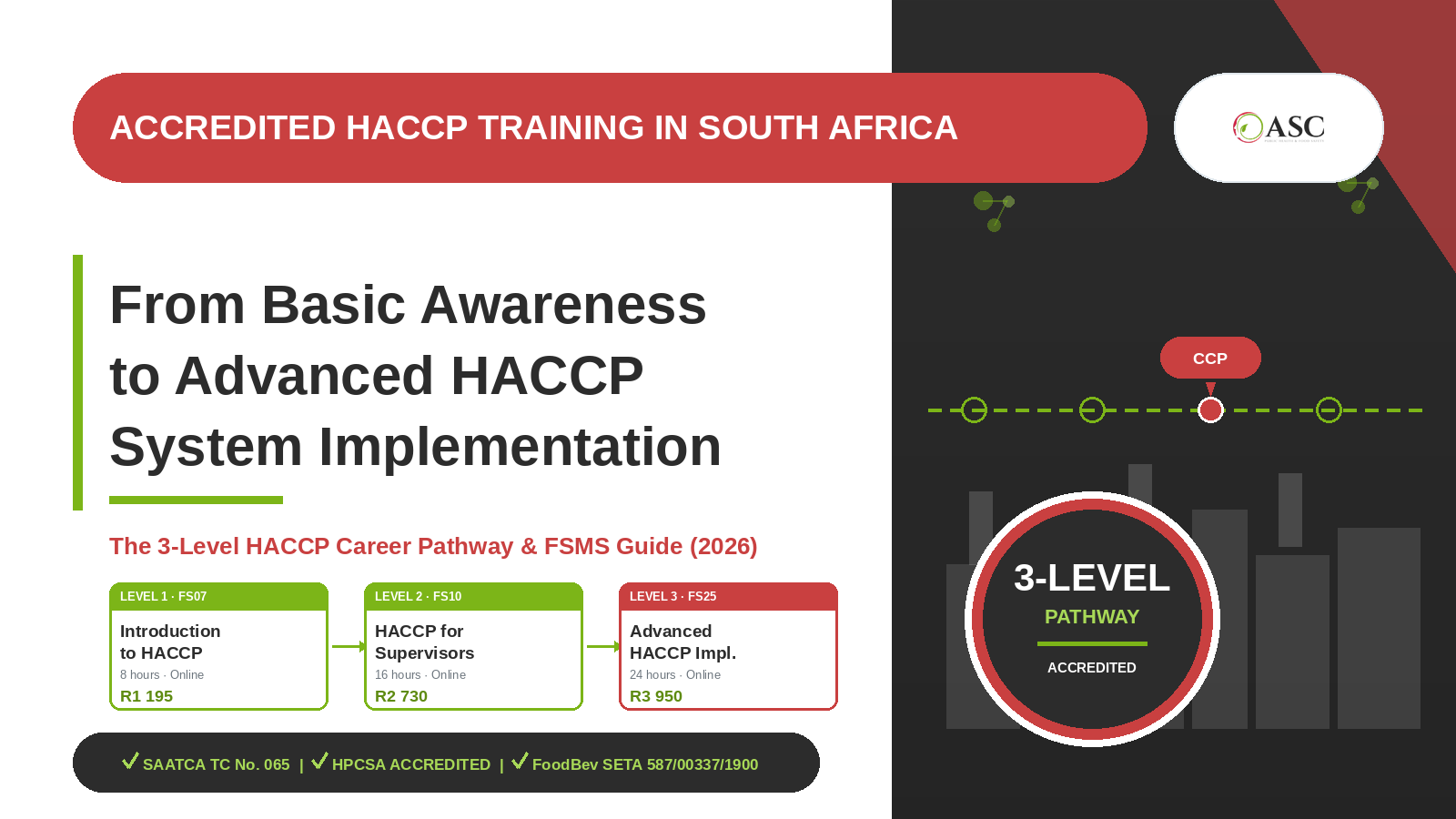
Quick AnswerHACCP (Hazard Analysis and Critical Control Point) is the internationally recognised food safety system developed by Codex Alimentarius to prevent food safety hazards at every stage of the supply chain. While Regulation R638 only requires basic HACCP awareness for the Person in Charge of a food premises, food manufacturers, processors, exporters and suppliers to major retailers (Shoprite, Pick n Pay, Woolworths, Spar, Checkers) must implement a full HACCP-based Food Safety Management System — which requires formal HACCP training for every HACCP team member. ASC Food Safety Training’s 3-level HACCP pathway — Introduction to HACCP (R1 195), HACCP for Supervisors (R2 730), and Advanced HACCP System Implementation (R3 950) — is the most complete, accredited HACCP programme in South Africa, delivered by one of only three SAATCA Registered R638 Lead Implementers in the country.
1. What Is HACCP?
HACCP — Hazard Analysis and Critical Control Point — is an internationally recognised, science-based food safety management system developed by the Codex Alimentarius Commission (the joint WHO/FAO food standards body). It is the globally accepted methodology for identifying, evaluating and controlling hazards that are significant for food safety.
Unlike traditional inspection approaches that test finished products, HACCP is a preventive system. It builds food safety into every stage of the process — from raw material procurement through processing, packaging, storage and distribution — by identifying the specific points where hazards must be controlled.
1.1 What Hazards Does HACCP Address?
| Hazard Type | Examples |
|---|---|
| Biological | Salmonella, Listeria monocytogenes, E. coli O157:H7, Campylobacter, Clostridium botulinum, norovirus, parasites, biofilm |
| Chemical | Mycotoxins (aflatoxin, patulin, ochratoxin), allergens, cleaning chemical residues, pesticide residues, veterinary drug residues, heavy metals, natural toxins, process contaminants (acrylamide) |
| Physical | Metal fragments, glass, hard plastic, stones, bone, insects, jewellery, plasters |
| Allergens | Milk, eggs, fish, shellfish, tree nuts, peanuts, wheat/gluten, soya, sesame, sulphites (cross-contact and labelling errors) |
1.2 Why HACCP Is Central to Modern Food Safety
HACCP forms the scientific core of every major food safety certification scheme:
- FSSC 22000 V6 — incorporates HACCP via ISO 22000 + prerequisite programmes + additional FSSC requirements
- ISO 22000:2018 — built around HACCP principles applied with a process approach
- BRCGS Food Safety Issue 9 — requires a documented HACCP plan as Section 2
- GLOBALG.A.P. — includes HACCP principles in its Integrated Farm Assurance scope
- SQF, IFS Food — all GFSI-recognised schemes require HACCP
If you want FSSC 22000, ISO 22000 or BRCGS certification, you must implement a full HACCP system first.
2. Why HACCP Matters in South Africa (2026 Update)
South African food safety has changed fundamentally in the past five years. Here’s what’s driving HACCP adoption:
2.1 Intensified Municipal Enforcement
Regulation R638 enforcement is accelerating — the Tshwane and Johannesburg enforcement operations of 2024–2025 signal a national shift towards active prosecution. In March 2025, the City of Tshwane closed Boxer Superstore in Atteridgeville and issued fines to Burger King outlets. While R638 only requires basic HACCP for the Person in Charge, retailers and auditors expect far more.
2.2 Major Retailer Requirements
The major South African retailers — Shoprite/Checkers, Pick n Pay, Woolworths, Spar, and Massmart — now require their suppliers to hold at minimum a documented HACCP system, and most require GFSI-recognised certification (FSSC 22000 or BRCGS). No HACCP = no supply contract.
2.3 Export Market Access
EU, UK, US, Middle East and Asian markets require HACCP as a minimum entry standard. For fresh produce, GLOBALG.A.P. is often also required. For processed food, BRCGS or FSSC 22000 is typical.
2.4 Food Safety Culture — Now a Certification Requirement
FSSC 22000 V6 and BRCGS Issue 9 now explicitly require organisations to demonstrate a measurable food safety culture. This goes beyond HACCP documentation — it requires demonstrable commitment from management through to frontline staff.
2.5 Digital HACCP Management
Paper-based HACCP records are being replaced by digital platforms for real-time monitoring, traceability and audit readiness. Advanced HACCP training provides the conceptual foundation needed to transition effectively.
3. Who Needs HACCP Training?
| Role | Recommended Course | Why |
|---|---|---|
| Food handler / kitchen staff | Introduction to HACCP (FS07) | Foundational HACCP awareness required in medium/high-risk premises |
| QA technician / QC operator | Introduction to HACCP + HACCP for Supervisors | Operational monitoring of CCPs |
| HACCP team member | HACCP for Supervisors & HACCP Teams (FS10) | Formal HACCP team training required by ISO 22000 / FSSC 22000 |
| Supervisor / Line manager | HACCP for Supervisors & HACCP Teams | Oversight of HACCP monitoring & corrective actions |
| HACCP team leader | Advanced HACCP System Implementation (FS25) | Leading HACCP plan development, validation, verification |
| QA manager / Food safety manager | Advanced HACCP System Implementation | System ownership for certification |
| Compliance officer / Consultant | All three HACCP levels + ISO 19011 auditing | Multi-client HACCP implementation |
| Internal auditor | HACCP for Supervisors + Internal Auditing course (FS26) | Audit HACCP plan conformance |
4. The 7 Codex HACCP Principles Explained
These 7 principles are the backbone of every HACCP system worldwide. They are taught in depth in ASC’s HACCP for Supervisors course (FS10) and expanded further in Advanced HACCP System Implementation (FS25).
Conduct a Hazard Analysis
Identify all potential biological, chemical, physical and allergen hazards at every step of your process. Assess the likelihood of occurrence and severity of consequences. Document control measures for each significant hazard.
Determine Critical Control Points (CCPs)
A CCP is a step at which control is essential to prevent, eliminate or reduce a food safety hazard to an acceptable level. Use the Codex decision tree or a risk-based equivalent. Typical CCPs: cooking, chilling, metal detection, allergen cleaning.
Establish Critical Limits
Define measurable, science-based limits for each CCP — for example, cooking to ≥75°C for 15 seconds, or pH ≤4.6 for shelf-stable canned foods. Critical limits must be validated (proven to work).
Establish Monitoring Procedures
For each CCP, define what is monitored, how it is monitored, when (frequency), and by whom. Continuous monitoring (e.g. thermograph) is preferred where practical. All monitoring must be recorded.
Establish Corrective Actions
Define the actions to take when monitoring shows a critical limit has been exceeded: isolate the affected product, determine the disposition (rework, reject, release), identify root cause, and prevent recurrence.
Establish Verification Procedures
Confirm the HACCP system is working: calibration of monitoring equipment, review of records, microbiological and environmental testing, internal audits, HACCP plan review. Verification is how you prove your system is effective.
Establish Documentation and Record Keeping
The auditor’s trail. Maintain records for the HACCP plan, hazard analysis, CCP monitoring, deviations, corrective actions, verification activities, training, and management reviews. If it isn’t recorded, it didn’t happen.
5. The 12 HACCP Implementation Steps
The Codex HACCP methodology expands the 7 principles into a logical 12-step implementation sequence that any food business can follow:
- Assemble the HACCP Team — multi-disciplinary: production, QA, maintenance, hygiene, senior management
- Describe the Product — composition, physical/chemical structure, packaging, shelf life, intended storage
- Identify Intended Use — who is the consumer? Are there vulnerable groups (infants, elderly, immunocompromised)?
- Construct a Flow Diagram — every process step from receiving to dispatch
- On-site Verification of Flow Diagram — walk the floor and confirm the diagram matches reality
- List Hazards, Conduct Hazard Analysis, Identify Control Measures (Principle 1)
- Determine CCPs (Principle 2)
- Establish Critical Limits (Principle 3)
- Establish Monitoring Systems (Principle 4)
- Establish Corrective Actions (Principle 5)
- Establish Verification Procedures (Principle 6)
- Establish Documentation and Record Keeping (Principle 7)
6. Prerequisite Programmes (PRPs) — The Foundation Beneath HACCP
HACCP cannot exist in isolation. It sits on top of Prerequisite Programmes (PRPs) — the basic hygiene and operational conditions that must be in place before HACCP can work. The ISO/TS 22002 series defines PRPs for each sector:
| Standard | Sector |
|---|---|
| ISO/TS 22002-1 | Food manufacturing |
| ISO/TS 22002-2 | Catering |
| ISO/TS 22002-3 | Farming |
| ISO/TS 22002-4 | Food packaging manufacturing |
| ISO/TS 22002-5 | Transport & storage |
| ISO/TS 22002-6 | Feed & animal food production |
Typical PRP elements include facility design, utilities (water, air, compressed gases), waste management, pest control, cleaning and sanitation, personal hygiene, rework, product recall, warehousing, product information and food defence. ASC’s Implementation of GMP course (FS33) (R1 950) provides the PRP foundation every HACCP team needs.
7. The ASC 3-Level HACCP Career Pathway
ASC Food Safety Training is the only South African provider offering a complete, progressive HACCP career pathway — from entry-level awareness to advanced GFSI-ready implementation. Each course is accredited, self-paced online, mobile-friendly, and includes an instantly downloadable QR-coded certificate.
Introduction to HACCP
The HACCP foundation. Covers Codex 7 Principles, 12 Implementation Steps, prerequisite programmes (PRPs) and basic hazard analysis. Ideal for food handlers, QA technicians, Persons in Charge, and anyone joining a HACCP team for the first time.
HACCP for Supervisors & HACCP Teams
The core HACCP team training. Full hazard analysis methodology, CCP determination (Codex decision tree), critical limit establishment, monitoring systems, corrective actions, verification procedures, and HACCP plan development. Aligned with ISO 22000 and FSSC 22000.
Advanced HACCP System Implementation
The apex course for QA managers and HACCP team leaders. Advanced chemical hazards (mycotoxins, allergens, cleaning carry-over, natural toxins), biofilm formation, microbial growth kinetics, metal detection and X-ray inspection, HACCP validation. Prepares you for FSSC 22000, ISO 22000 and BRCGS certification.
8. Why ASC Is the #1 Choice for HACCP Training in South Africa
| Feature | ASC Food Safety Training | Typical Competitors |
|---|---|---|
| SAATCA Accreditation | ✅ TC No. 065 | Rarely held |
| HPCSA Accreditation | ✅ Yes | Rare |
| FoodBev SETA | ✅ No. 587/00337/1900 | Varies |
| Instructor — Registered Lead Auditor (Exemplar Global & IRCA) | ✅ Mthokozisi Nkosi | Rarely |
| 3-level progressive HACCP pathway | ✅ Introduction → Supervisors → Advanced | Usually 1 generic course |
| Aligned with FSSC 22000, ISO 22000, BRCGS | ✅ All three | Partial |
| Covers VACCP, TACCP, Allergens, Mycotoxins | ✅ Dedicated modules | Rarely |
| QR-coded certificates | ✅ Tamper-proof | PDF only |
| Self-paced online, any device, 24/7 | ✅ | Often fixed schedules |
| Lifetime access to materials | ✅ | Rarely |
| Full consultancy backing (audits, FSMS, implementation) | ✅ | Training only |
| Offices in Gqeberha, Randburg & Cape Town | ✅ 3 offices | Usually 1 |
| BBBEE Level 1 (135% procurement) | ✅ | Usually lower |
9. Beyond HACCP — FSSC 22000, ISO 22000, BRCGS and GLOBALG.A.P.
Once your HACCP system is in place, most South African food businesses face commercial pressure to achieve internationally-recognised FSMS certification. Here’s what each standard is for and which ASC course prepares you:
| Standard | Best For | GFSI? | ASC Course |
|---|---|---|---|
| FSSC 22000 V6 | Food manufacturers, packaging, feed — global retailers & brands | ✅ Yes | FS21 Intro to FSSC 22000 V6 (R1 195) · FS06 Transition to V6 (R1 195) |
| ISO 22000:2018 | Any food chain category; flexible | No (widely accepted) | FS19 Intro to ISO 22000 (R999) |
| BRCGS Issue 9 (Food) | UK & EU retailers (Tesco, M&S, Sainsbury’s, ALDI) | ✅ Yes | FS15 Intro to BRCGS Issue 9 (R1 195) |
| BRCGS Issue 7 (Packaging) | Packaging manufacturers | ✅ Yes | FS17 Intro to Packaging Issue 7 (R1 195) |
| GLOBALG.A.P. IFA V6 | Fresh-produce exporters | ✅ Yes | FS14 Implementation of IFA V6 (R4 200) — Registered Trainer |
| GLOBALG.A.P. CoC | Packhouses & distributors | ✅ Yes | FS27 CoC Plants (R649) · FS36 CoC Aquaculture (R795) |
10. Specialised Courses — VACCP, TACCP, Auditing & More
Beyond the core HACCP and FSMS training, a complete food safety function needs capabilities in these specialised areas — all offered by ASC:
- FS11 Food Fraud (VACCP) & Food Defence (TACCP) (6h, R1 450) — mandatory for FSSC 22000, BRCGS and most major retailers
- FS26 Internal & Supplier Auditing based on FSMS (20h, R3 500) — ISO 19011 audit methodology
- FS35 Root Cause Analysis (4h, R649) — essential for effective corrective action
- FS37 Intermediate Food Microbiology (8h, R1 450) — understand the pathogens HACCP controls
- FS32 Food Safety & Quality Culture (12h, R1 195) — now an FSSC 22000 V6 and BRCGS Issue 9 requirement
- Shelf-Life Studies (4.5h, R649) — evidence-based expiry dating
11. How to Implement HACCP in Your Business — The ASC Methodology
Based on 10+ years of guiding 50+ South African companies through HACCP implementation and certification, this is the proven approach:
- Management commitment. HACCP without management buy-in fails. Commit resources, budget, and time.
- Secure PRP foundations. Before HACCP, ensure GMP/PRPs are in place (use ASC FS33).
- Train the HACCP team. Every team member completes at least HACCP for Supervisors (FS10). The team leader completes Advanced HACCP (FS25).
- Assemble a multi-disciplinary team. Production, QA, maintenance, hygiene, management, procurement.
- Conduct the hazard analysis. Use Codex methodology. Evaluate likelihood × severity.
- Identify CCPs using the decision tree. Keep them few and defensible — too many CCPs is a sign of a weak PRP foundation.
- Validate critical limits. Use published scientific data, challenge studies, or regulatory reference limits.
- Design practical monitoring. Monitoring that frontline staff cannot actually perform is worse than useless.
- Train all operators on monitoring procedures. Document the training.
- Run the system, collect records, identify deviations.
- Verify the system. Internal audits (FS26), environmental monitoring, product testing, CCP calibration.
- Review the HACCP plan at least annually and whenever products, processes, suppliers or regulations change.
12. Common HACCP Implementation Mistakes (And How to Avoid Them)
- Too many CCPs. If you have 20 CCPs, most aren’t really CCPs — they are operational prerequisites (oPRPs). Weak PRP foundations inflate the CCP count.
- Unvalidated critical limits. Using “cooking to 72°C” without reference to Salmonella D-values or regulatory guidance.
- Monitoring frequencies that are impractical. If operators cannot realistically do it, it won’t happen.
- Missing corrective action records. Deviations documented but no evidence of root cause or preventive action.
- Hazard analysis that doesn’t address allergens. Allergen cross-contact is a Top-3 cause of product recalls.
- Flow diagrams that don’t match reality. Step 5 (on-site verification) is skipped.
- No HACCP team leader competency evidence. Auditors want training certificates and evidence of experience.
- Static HACCP plans never reviewed. Plans must be reviewed annually and on any change.
- No consideration of vulnerable consumer groups. Infants, elderly, immunocompromised — your risk assessment must address this.
- No link between HACCP and product recall procedures. HACCP deviations must trigger recall consideration where required.
13. How Online HACCP Training Works
ASC’s HACCP courses are delivered through a dedicated online learning management system. Here’s what to expect:
13.1 Enrolment
Visit ascfoodsafetytraining.com, select your course, and complete secure payment via EFT, credit/debit card, SnapScan or other major South African payment methods.
13.2 Learning
Login credentials are sent immediately upon payment confirmation. Courses include video lessons, text-based scripts with supplementary information, downloadable learner guides, and a copy of Regulation R638.
13.3 Assessment
Knowledge tests at the end of each module (70% pass mark, 3 attempts per test) and a final assessment.
13.4 Certification
A QR-coded Certificate of Achievement is available for immediate download upon successful completion. This certificate is accepted by South African municipalities, major retailers, and international auditors.
13.5 Access
Available 24/7 on any device — desktop, laptop, tablet or smartphone. Video lessons can be downloaded for offline viewing. Lifetime access to course materials.
14. HACCP by Industry — Sector-Specific Guidance
14.1 Food Manufacturing (FMCG, Bakeries, Confectioneries, Beverages)
Most manufacturers need FSSC 22000 or BRCGS Issue 9. Recommended pathway: GMP (FS33) → HACCP for Supervisors (FS10) → Advanced HACCP (FS25) → FSSC 22000 or BRCGS introduction.
14.2 Wine Estates & Beverage Production (Stellenbosch, Paarl, Franschhoek)
HACCP plus GLOBALG.A.P. (for grape production) plus IFS or BRCGS (for wine export). ASC serves the Cape Winelands from its Rondebosch office.
14.3 Fresh Produce & Packhouses (Citrus, Fruit, Vegetables)
HACCP as a foundation for GLOBALG.A.P. IFA V6 plus Chain of Custody. Critical hazards: pesticide residues, microbial contamination of irrigation water, allergen cross-contact.
14.4 Food Service & Catering (Corporate, Institutional, Healthcare)
HACCP plus ISO/TS 22002-2 prerequisite programmes for catering. Focus on time-temperature control, allergen management, vulnerable consumer groups.
14.5 Butcheries & Meat Processors
HACCP plus R638 Section 6(8) and Annexure F (cleaning of meat equipment). Critical hazards: Salmonella, E. coli O157:H7, Listeria monocytogenes.
14.6 Dairy Processors
HACCP plus pasteurisation validation, environmental monitoring for Listeria, allergen control. High-risk — full HACCP mandatory.
14.7 Aquaculture & Seafood
HACCP plus histamine control, Vibrio species management, GLOBALG.A.P. Aquaculture, Chain of Custody.
14.8 Automotive Sector Employee Catering
High-volume, high-risk. HACCP plus robust supplier assurance. ASC’s Gqeberha office has served major OEM canteens for over a decade.
15. Frequently Asked Questions
What is HACCP in simple terms?
HACCP is a preventive food safety system that identifies exactly where things could go wrong in your food process, and puts controls at those specific points to stop them. It replaces the old “inspect the finished product” approach with “build safety into every step.”
Is HACCP mandatory in South Africa?
R638 only requires basic HACCP awareness for the Person in Charge. However, any business supplying major retailers, manufacturing food, exporting, or producing for vulnerable populations (infants, hospitals, care homes) must implement a formal HACCP system — usually as part of FSSC 22000, ISO 22000 or BRCGS certification.
Is ASC’s HACCP training accredited?
Yes. ASC Food Safety Training is SAATCA accredited (TC No. 065), HPCSA accredited, and FoodBev SETA accredited (587/00337/1900). Our Advanced HACCP course is specifically HPCSA accredited. Certificates are accepted by all major South African retailers and international auditors.
Which HACCP course should I start with?
If you are new to HACCP: Introduction to HACCP (FS07, R1 195). If you are joining a HACCP team or supervising production: HACCP for Supervisors (FS10, R2 730). If you are a QA manager leading HACCP implementation for certification: Advanced HACCP System Implementation (FS25, R3 950). For maximum value, take all three as the HACCP Mastery Pathway Bundle (R6 300, saving R1 575).
Can I take HACCP training entirely online?
Yes. All ASC HACCP courses are delivered online, self-paced, and accessible 24/7 from any device. South African municipalities, major retailers and international auditors all accept the resulting certificates.
How long does HACCP certification take for a business?
A typical HACCP implementation project takes 4–9 months from commitment to third-party certification audit, depending on business size and starting point. Training the HACCP team is step one. ASC’s consulting division can support you end-to-end.
Do I need HACCP if I already have R638 compliance?
R638 is a minimum legal baseline. HACCP is a commercial necessity if you supply retailers, manufacture, or export. Most ASC clients hold both: R638 compliance for legal trading, plus HACCP (often within FSSC 22000 or BRCGS) for commercial survival.
What is the difference between a CCP and an oPRP?
A Critical Control Point (CCP) is where control is essential to prevent, eliminate or reduce a hazard. An operational Prerequisite Programme (oPRP) is a control measure applied to prevent contamination but where failure does not by itself cause an unsafe product. ISO 22000 introduced this distinction. Advanced HACCP (FS25) covers the differentiation in detail.
Can I train my whole team?
Yes. ASC offers corporate group enrolments, bulk pricing, and managed client groups (used by KFC and Spur). Contact us for a quote.
What happens if my HACCP plan fails an audit?
Audit non-conformances must be addressed through root cause analysis (ASC’s FS35 course covers this), corrective action, and preventive action. A well-designed HACCP system includes verification procedures that catch most issues before an external audit.
16. Enrol Today — Start Your HACCP Journey
Ready to Master HACCP?
Join 3 374+ food safety professionals trained by the only SAATCA Training Centre (No. 065) that also holds HPCSA, FoodBev SETA and Lead Auditor credentials. BBBEE Level 1. Trusted by KFC, Spur, wine estates, packhouses, and food manufacturers across South Africa.
Get the HACCP Mastery Bundle — R6 300 Browse All HACCP & FSMS CoursesNeed expert guidance? Book a free virtual consultation
Eastern Cape (Head Office): +27 41 004 0382 · Gauteng: +27 10 500 4661 · Western Cape: +27 21 300 4024 · Mobile: +27 61 483 0381 · info@ascfoodsafety.com
Last reviewed: 23 April 2026 · © 2026 ASC Food Safety Consultants · ASC Food Safety Training (trading as ASC Food Safety, previously ASC Consultants) · SAATCA TC No. 065 · HPCSA Accredited · FoodBev SETA 587/00337/1900 · BBBEE Level 1. This guide is educational and does not constitute legal advice.