
Home › HACCP Training South Africa
Online HACCP Training for Food Safety Teams
Learn how to identify food safety hazards, understand prerequisite programmes, apply the seven HACCP principles and support a practical food safety management system. Three online courses take you from an introduction for food handlers and supervisors to building and verifying a full HACCP system.
- Seven HACCP principles
- Hazard analysis
- Critical control points
- Prerequisite programmes
- HACCP plan
A process flow, read the HACCP wayExample
- 1Receive raw chickenSupplier approval and delivery checksPRP
- 2Chilled storageTemperature monitoring and stock rotationPRP
- 3Prepare and marinateSeparation of raw and ready-to-eatPRP
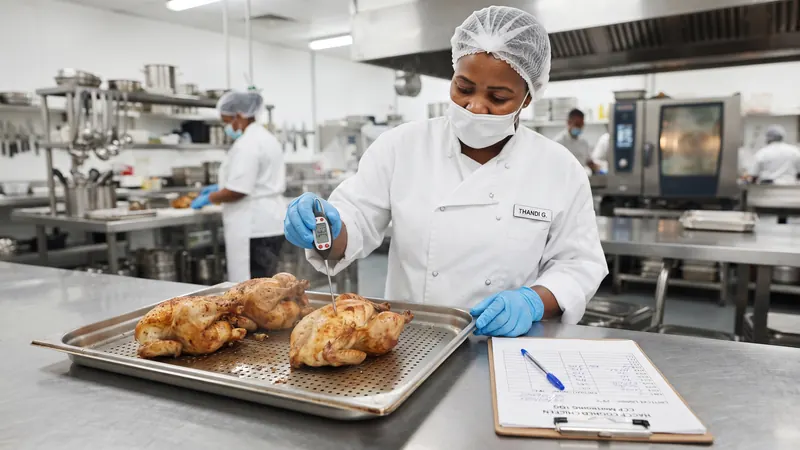
- 4CookCritical limit on core temperature and timeCCP 1
- 5Cool and packCooling time, hygiene and labellingOPRP
- 6DispatchTraceability and cold chainPRP
HACCP and food safety courses for your next step
Start with Introduction to HACCP, move to HACCP for Supervisors and HACCP Teams when you sit on the team, and take Advanced HACCP System Implementation when you own, validate or verify the system.
Prices are in South African rand. The smaller figures under each price are indicative conversions at today’s exchange rate. You pay in rand and your bank sets the final rate.
Introduction to HACCP
For food handlers, supervisors, QA staff and anyone new to HACCP.
- The structure of a food safety management system
- Microbiology and contamination basics
- The seven principles and prerequisite programmes
- Knowledge tests and certificate
R1 195About 8 hours · online
View the course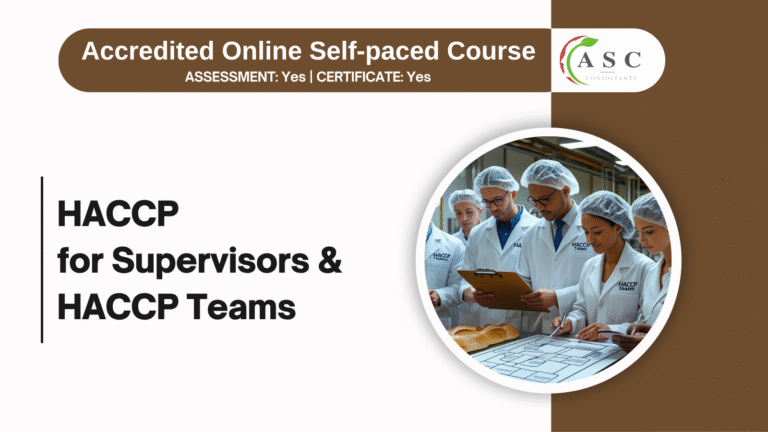
HACCP for Supervisors and HACCP Teams
For supervisors and HACCP team members who run the plan day to day.
- Food safety management systems and microbiology
- Top management’s role in food safety
- Running a hazard analysis and setting critical limits
- The CCP records an auditor checks
R2 730About 16 hours · online
View the course
Advanced HACCP System Implementation
For HACCP team leaders and technical managers who own the system.
- Food safety hazards and food preservation
- Conducting a full hazard analysis
- From flow diagram to CCP records
- Validating and verifying the system
R3 950About 24 hours · online
View the courseHACCP Mastery Pathway: all three levels
R5 906 instead of R7 875 for the three HACCP courses, a saving of R1 969.
| Your role | Start with | Then add |
|---|---|---|
| Food handlers and new staff | Introduction to HACCP | GMP training |
| Supervisors and HACCP team members | HACCP for Supervisors and HACCP Teams | Advanced HACCP System Implementation |
| HACCP team leaders and technical managers | Advanced HACCP System Implementation | ISO 22000 or FSSC 22000 |
| QA and QC teams | The HACCP Mastery Pathway | Internal auditing |
| Restaurant, catering and retail managers | Introduction to HACCP | Allergen management |
Not sure which level fits? Read which HACCP course you need, or talk to ASC about group training for a whole team or several sites.
What is HACCP?
HACCP stands for Hazard Analysis and Critical Control Points. It is a structured, preventive food safety system used to identify hazards that could make food unsafe and to control them before they reach the consumer. That is why HACCP sits at the heart of ISO 22000, FSSC 22000, BRCGS and most customer food safety requirements.
- Question 1What could go wrong?
- Question 2Where can we control it?
- Question 3How do we prove it is under control?
Hazard analysis
HACCP begins by identifying the biological, chemical, physical and allergen hazards that may reasonably occur in a product, process or food handling environment.
Critical control points
A critical control point is a step where control is essential to prevent, eliminate or reduce a food safety hazard to an acceptable level.
Records and proof
HACCP is not only about procedures. It also needs monitoring records, corrective actions, verification and evidence that the controls are working.
Who uses HACCP? Food manufacturers, restaurants, caterers, bakeries, retailers, warehouses, distributors, butcheries, dairies, seafood processors, fresh produce packhouses and any organisation that needs a systematic food safety control system.
The HACCP principles your team must understand
ASC’s HACCP training explains the logic behind each principle, so learners understand how HACCP works in a real food business, not only on paper.
- 1Conduct a hazard analysisIdentify likely food safety hazards, assess their significance and identify control measures.
- 2Determine the CCPsIdentify the steps where control is essential for food safety.
- 3Set critical limitsDefine validated, measurable limits such as time, temperature or pH.
- 4Monitor each CCPCheck that every critical control point stays under control.
- 5Take corrective actionAct when a limit is not met and stop unsafe product from being released.
- 6Verify the systemValidate the plan and confirm that the HACCP system works as intended.
- 7Keep documentationKeep the records that prove the system is applied consistently.
- Before you startKnow what actually lives in food. Introduction to Food Microbiology builds the foundation hazard analysis depends on.
The five preliminary steps that come first
- Assemble the HACCP team
- Describe the product
- Identify the intended use and users
- Construct the flow diagram
- Confirm the flow diagram on site
Together with the seven principles, these make the twelve steps of HACCP in the Codex General Principles of Food Hygiene.
What the Introduction to HACCP course covers
The course builds a practical foundation before learners move into implementation, internal auditing or advanced food safety management systems.
HACCP is the foundation behind major food safety standards
Whether your business is preparing for customer audits, retail requirements, certification or legal compliance, HACCP thinking helps your team control food safety risks systematically.
- R638 and hygieneBasic hygiene, food handler training and safe premises form the operational foundation.
- GMP and PRPsPrerequisite programmes control the general food safety environment before HACCP is applied.
- HACCP planHazards, CCPs, critical limits, monitoring and corrective actions are defined for the process.
- FSMS certificationFSSC 22000, ISO 22000 and BRCGS build on HACCP-based risk control.
Why choose ASC for HACCP training?
ASC combines online learning with real food safety consulting, auditing and implementation experience.
| Capability | ASC online training | Typical generic course |
|---|---|---|
| Food industry relevance | Built around practical food operations | Often theory-heavy |
| Online and self-paced | Yes, complete on your own schedule | Varies |
| Learner dashboard | Yes | Not always |
| Certificate after completion | Yes, downloadable certificate | Sometimes |
| Three levels, one pathway | Introduction, HACCP team and advanced implementation | Often a single course |
| Consulting support | Available through ASC Food Safety Consultants | Usually training only |
Training your team is step one. Implementing HACCP is step two. For help developing a HACCP plan, preparing for certification, improving prerequisite programmes or closing audit findings, talk to ASC Food Safety Consultants or see the consulting services.
HACCP guides
HACCP training frequently asked questions
What is HACCP?
HACCP stands for Hazard Analysis and Critical Control Points. It is a preventive food safety system used to identify, evaluate and control hazards that may affect food safety.
What are the seven principles of HACCP?
Conduct a hazard analysis, determine the critical control points, establish critical limits, establish monitoring, establish corrective actions, verify the system, and keep documentation and records. Five preliminary steps come first: assemble the HACCP team, describe the product, identify its intended use, construct the flow diagram and confirm it on site.
Who should take HACCP training?
HACCP training suits food handlers, supervisors, managers, QA and QC teams, HACCP team members, internal auditors, business owners and anyone involved in food safety controls.
Which HACCP course should I start with?
Start with Introduction to HACCP (R1 195) if you are new to HACCP. Take HACCP for Supervisors and HACCP Teams (R2 730) if you sit on the HACCP team, and Advanced HACCP System Implementation (R3 950) if you lead, validate or verify the system. The HACCP Mastery Pathway bundle includes all three for R5 906.
Is HACCP training useful for food handlers?
Yes. Food handlers benefit from understanding the basics of hazards, contamination control, hygiene, GMP and why certain controls must be followed every day.
Is the HACCP course online?
Yes. ASC’s HACCP courses are online and self-paced, so learners can complete the training from anywhere in South Africa or abroad.
Do I receive a certificate?
Yes. Learners receive a downloadable certificate of completion after completing the course requirements.
Does HACCP replace GMP?
No. GMP and prerequisite programmes support HACCP. HACCP focuses on significant food safety hazards and critical controls, while GMP provides the hygiene and operational foundation HACCP needs to work.
What is the difference between a CCP and an OPRP?
Both control a significant hazard identified in the hazard analysis. A critical control point carries a measurable critical limit and monitoring able to detect a loss of control in time to isolate affected product. An operational prerequisite programme carries action criteria that may be measurable or observable, with monitoring that shows the control measure is applied.
Is HACCP required for FSSC 22000 or BRCGS?
Yes. HACCP principles are central to the major food safety management system standards, including ISO 22000, FSSC 22000 and BRCGS. These standards expect a systematic approach to hazard analysis and control.
Can I take the HACCP courses outside South Africa?
Yes. HACCP is recognised internationally through the Codex General Principles of Food Hygiene, and the courses are online, self-paced and in English. Prices are in rand, with indicative conversions shown on this page.
Build your food safety foundation with ASC’s online HACCP courses
Learn the core principles behind HACCP, hazards, GMP, microbiology and HACCP plan development through practical, self-paced online training.
- Enrol onlineOpen the course page, enrol and access your learner dashboard.
- Complete the lessonsVideo, text, learner resources and structured content.
- Do the knowledge testsCheck your understanding as you progress.
- Download your certificateEvidence for your training records and audits.
ascfoodsafetytraining.com is ASC’s online training website for food safety courses and certificates. For HACCP consulting, audits, FSMS implementation and document toolkits, visit our main website ascfoodsafety.com.