
Home / Courses / Food fraud and food defence
Food fraud · VACCP · Food defence · TACCPOnline Food Fraud and Food Defence Training for VACCP and TACCP
Food fraud is someone cheating you for money. Food defence is someone trying to cause harm. FSSC 22000, BRCGS, IFS and SQF all ask for an assessment of both. Three online courses, from a six-hour overview to the coordinator courses where you build the assessment and the plan yourself.
Food fraud
- Motive
- Money
- Who
- A supplier, broker or insider cutting costs
- Looks like
- Substitution, dilution, false origin, fake certificates
- You produce
- A vulnerability assessment and a mitigation plan
Food defence
- Motive
- Harm, grievance or pressure
- Who
- A disgruntled employee, contractor, intruder or activist
- Looks like
- Tampering, deliberate contamination, sabotage
- You produce
- A threat assessment and a food defence plan
Three assessments, three different questions
HACCP asks what could go wrong by accident. VACCP and TACCP ask what someone could do on purpose. The controls overlap, but the assessments do not, and auditors expect to see each one.
HACCP
What hazard could get into the product by mistake?
Biological, chemical, physical and allergen hazards, controlled through prerequisites and critical control points.
Listeria surviving because a cleaning step was missed.
VACCP
Where could someone cheat us for economic gain?
Raw materials, suppliers and supply chains scored for how attractive and how easy fraud would be.
Honey stretched with sugar syrup, or beef mince bulked out with cheaper meat.
TACCP
Who could harm our product on purpose, and how would they get to it?
People, access points and weak spots on site and in transport, scored and then protected.
A dismissed worker with an access card that still opens the ingredient store.
Three online food fraud and food defence courses
Start with the overview if you are new to VACCP and TACCP. The coordinator courses are for the person who has to build the assessment, own the plan and answer for it at audit.
Prices are in South African rand. The smaller figures under each price are indicative conversions at today’s exchange rate; you pay in rand and your bank sets the final rate.
Food Fraud (VACCP) and Food Defence (TACCP)
For HACCP teams, QA and QC staff, internal auditors and managers who need to understand both assessments.
- Food fraud, its types and how VACCP works
- Food defence, threats and how TACCP works
- What the certification schemes expect
- Final assessment
R1 450About 6 hours · HPCSA CPD
View the course
Food Fraud Coordinator: VACCP, the Schemes and the Prevention Plan
For the person who builds and owns the food fraud vulnerability assessment.
- Getting ready: scope, team and evidence
- Scoring vulnerability by fraud type
- From score to plan: mitigation and residual vulnerability
- Practical assessment on the Mzansi Fresh Meals case
- The schemes and the coordinator’s wider brief
R1 750About 8 hours
View the course
Food Defence Coordinator: TACCP, FSMA and the Food Defence Plan
For the person who builds and owns the threat assessment and food defence plan.
- Getting ready to build a threat assessment
- Scoring threats: actors, access points and targets
- From score to plan: mitigation and residual risk
- Practical assessment on the Mzansi Fresh Meals case
- FSMA intentional adulteration and the schemes
R1 750About 10 hours
View the courseCoordinator pathway bundle: all three courses for R3 713 instead of R4 950, a saving of R1 237.
View the bundle| Your job | Start with | Why |
|---|---|---|
| HACCP team member or internal auditor | The overview | Know what the two assessments are, and what good ones look like at audit. |
| Procurement or supplier approval | Food Fraud Coordinator | Most fraud enters through raw materials and suppliers, so this is where the scoring and controls sit. |
| Site security, engineering or operations manager | Food Defence Coordinator | Access, people and site weak spots are the core of the threat assessment. |
| QA manager or technical manager | The bundle | You own both plans and sign them off, so you need the overview and both coordinator courses. |
| Exporting to the United States | Food Defence Coordinator | Covers the FDA intentional adulteration rule under FSMA. |
The eight ways food fraud usually happens
A vulnerability assessment scores each raw material against these types. Most real cases are one of them, and many are two at once.
Substitution
Replacing an ingredient with a cheaper one: undeclared species in meat, or a cheaper fish sold as a premium one.
Dilution
Stretching a high-value liquid: honey with sugar syrup, olive oil with cheaper oils, juice with water.
Mislabelling
False claims about origin, species, organic, halal or free-range status.
Unapproved enhancement
Adding something to fake quality: melamine to inflate protein, dyes to brighten spices.
Concealment
Hiding poor quality or damage, such as coating or glazing to hide defects.
Counterfeiting
Copying a brand, packaging or label so a fake passes as the real product.
Grey market and diversion
Product sold outside the channel it was meant for, often past its date or outside the cold chain.
Document fraud
Forged certificates of analysis, halal or organic certificates, and audit reports.
of processed meat products tested in a 2013 Stellenbosch University study contained species that were not on the label, including donkey, goat and water buffalo. South African supply chains are not immune, and a certificate on file is not the same as a verified supplier.
From a raw material list to a plan an auditor will accept
Both assessments score risk, then decide what to do about the high scores. The coordinator courses take you through each step on a worked case, Mzansi Fresh Meals, before you build your own.
VACCP: score every raw material
Likelihood of fraud against the impact if it happened. The red corner gets testing, audits or a new supplier.
- Gather the evidenceRaw materials, suppliers, price history, past incidents and horizon scanning.
- Score vulnerabilityEach material against each fraud type, with the reasons written down.
- Mitigate and reviewSpecifications, certificate checks, testing and supplier audits, then the residual score, reviewed at least once a year.
TACCP: walk the site as an attacker would
Who could get in, where they could reach the product, and what stops them.
- Gate and visitorsSign-in, escorts, vehicle checks (1)
- Receiving and storageSeals checked on arrival, locked stores, controlled keys (2)
- Water, lines and peopleTank access (3), change rooms (4) and open product on the line (5)
- DispatchTamper-evident seals and load records (6)
Food fraud and food defence guides
How to do a food fraud vulnerability assessment: the method and the scoring
What a food defence coordinator actually does, and how to evidence it
HACCP, TACCP and VACCP: which assessments each certification scheme asks for
Food fraud horizon scanning and supplier certificate checks
The FDA intentional adulteration rule: a guide for South African exporters
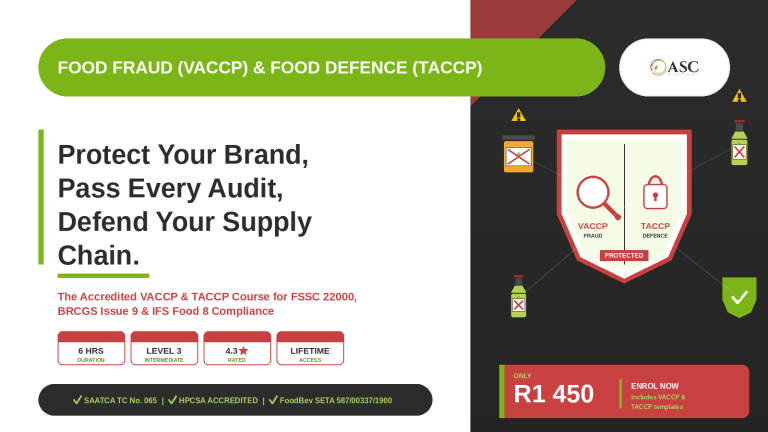
Inside the food fraud and food defence course
Food fraud and food defence training FAQs
What is food fraud?
Food fraud is the deliberate deception of consumers or businesses for economic gain. It may include substitution, dilution, adulteration, counterfeiting, mislabelling or misrepresentation of food products, ingredients or packaging.
What is food defence?
Food defence is the protection of food from intentional contamination, tampering, sabotage or malicious acts. It focuses on deliberate threats rather than accidental food safety hazards.
What is VACCP?
VACCP stands for Vulnerability Assessment Critical Control Point. It is used to assess food fraud vulnerabilities and identify mitigation strategies that reduce the likelihood of economically motivated adulteration or deception.
What is TACCP?
TACCP stands for Threat Assessment Critical Control Point. It is used to assess intentional threats to food products, ingredients, processes or facilities and to develop a food defence plan.
Who should complete this course?
This course is suitable for QA managers, QC managers, HACCP teams, HACCP team leaders, internal auditors, food safety teams, managers and supervisors.
Does the course include practical exercises?
Yes. The course includes practical exercise files and demonstration videos for VACCP and TACCP, as well as assignments linked to food fraud and food defence.
What is the difference between this course and the coordinator courses?
This course is the introduction. It explains what food fraud and food defence are, how VACCP and TACCP differ and what the schemes expect. The two coordinator courses are the advanced, practical step: you build a threat assessment or a vulnerability assessment yourself, a person marks it against a rubric, you receive coaching notes and then a second attempt. Most delegates take this course first, then the coordinator course for whichever side of the work sits on their desk.
What qualification does a food fraud or food defence coordinator need?
None is prescribed. GFSI Benchmarking Requirements version 2024 requirement FSM 8.5 says appropriate knowledge and expertise shall be used, and FSSC 22000 Version 7 clause 2.5.4 (a) requires the assessment and plan to be developed by personnel with appropriate knowledge and competence. Neither names a course, a syllabus, a level or a number of hours, so how you evidence that competence is left to you and your certification body. A training record specific to the method carries more weight in that file than a general food safety certificate.
Do the coordinator courses cover FSSC 22000 Version 7?
Yes, and Version 6 as well. Version 7 was published in May 2026 and moved the food fraud method out to ISO 22002-100:2025 clause 16.3, leaving only the additional requirements in clause 2.5.4. Version 6 audits are permitted until 30 April 2027, so both versions are live in the market during the transition and both are taught.
Will I receive a certificate?
Yes. Learners who complete the course requirements receive a downloadable certificate of completion.
Can I take the courses from outside South Africa?
Yes. The courses are online, self-paced and in English, and the schemes they cover are international. Prices are shown in South African rand with indicative conversions, and card payments convert at your bank’s rate. The Food Defence Coordinator course also covers the US FDA intentional adulteration rule for exporters.
Be ready when the auditor asks to see both plans
Start with the overview, or go straight to the coordinator course for the plan you own.