
Home / Courses / Food microbiology training
Food microbiology · Pathogens · EMPFood Microbiology Training and Food Safety Microbiology Explained
What grows in food, why it grows, and what stops it. Four online courses for food handlers, QA teams and laboratory staff, from the basics to running a Listeria environmental monitoring programme.
What is food microbiology?
Food microbiology is the study of the bacteria, yeasts, moulds, viruses and parasites that live in and on food. It explains which of them make food, which spoil it, and which make people ill, and it gives food businesses the controls to tell the three apart and keep the harmful ones out.
The ones that make food
Fermentation is controlled microbial growth.
- Lactic acid bacteria turn milk into yoghurt and cabbage into sauerkraut
- Yeast raises bread and ferments beer
- Penicillium moulds ripen blue and white-rind cheeses
The ones that spoil it
Spoilage costs money and shelf life, rarely lives.
- Pseudomonas in chilled meat, poultry and milk
- Yeasts and moulds in juice, bread and fruit
- Lactic acid bacteria souring vacuum-packed meats
The ones that make people ill
Pathogens often cause no smell, taste or visible change.
- Salmonella in poultry and eggs
- Listeria monocytogenes in ready-to-eat foods, growing even in the fridge
- Bacillus cereus in cooked rice, Staphylococcus aureus toxin from hands
- Norovirus and hepatitis A, carried by people rather than grown in food
deaths in South Africa’s 2017 to 2018 listeriosis outbreak, from 1 060 confirmed cases. It was traced to ready-to-eat processed meat from a single factory and is the largest listeriosis outbreak on record. It is why retailers and auditors in South Africa now ask hard questions about how a site looks for Listeria.
Four online food microbiology courses
Three levels of microbiology, plus a practical course on environmental monitoring. No science degree needed to start; each level builds on the one before.
Prices are in South African rand. The smaller figures under each price are indicative conversions at today’s exchange rate; you pay in rand and your bank sets the final rate.
Introduction to Food Microbiology (for Non-microbiologists)
For food handlers, supervisors, QA assistants and business owners with no science background.
- Microorganisms in food handling and spoilage
- What they need to grow, and how fast they multiply
- Microbial diversity in food
- The GMPs that control contamination
R1 195About 8 hours · HPCSA CPD
View the course
Intermediate Food Microbiology: Principles and Application
For QA and QC staff who read lab results and set controls.
- How different microorganisms multiply
- Identification of microorganisms
- Foodborne diseases and their causes
- Indicator organisms, preservation, sampling and testing
R1 450About 8 hours
View the course
Advanced Food Microbiology
For technologists, lab staff and QA managers responsible for microbiological criteria.
- Microorganisms in the food handling environment
- Growth and reproduction in depth
- Indicator organisms
- Sampling, enumeration and testing
- Microbiological quality and safety of food
R1 750About 8 hours
View the course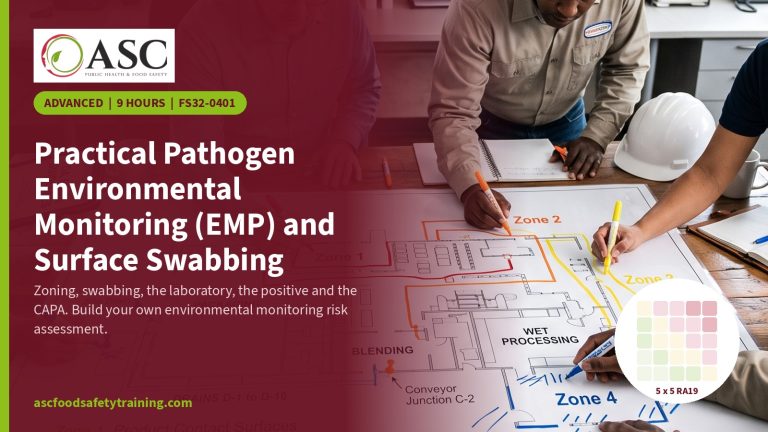
Practical Pathogen Environmental Monitoring (EMP) and Surface Swabbing
For QA managers and HACCP team leaders who own the Listeria and Salmonella programme.
- The rules and schemes that require monitoring
- Zoning and mapping the plant
- Swabs, sponges, technique and the lab
- Reading the data and acting on a positive
- Workshop: build your own EMP
R1 750About 9 hours
View the courseFood microbiology bundle: all four courses for R4 302 instead of R6 145, a saving of R1 843.
View the bundle| Your job | Start with | Why |
|---|---|---|
| Food handler, cook or supervisor | Introduction | The habits that stop growth and cross-contamination, explained without the chemistry. |
| QA or QC assistant | Introduction, then Intermediate | You will be reading lab results and need to know what each count means. |
| Lab analyst or food technologist | Intermediate or Advanced | Identification, indicators, enumeration and microbiological criteria. |
| QA manager or HACCP team leader | Environmental monitoring | You own the Listeria programme and the decision after a positive. |
| Whole QA team | The bundle | One pathway from the basics to the EMP, at a lower price. |
What makes microorganisms grow in food?
Bacteria do not grow steadily. They double, so a small lapse in time or temperature turns into a very large number very quickly. Every control in a food business works by taking away one of the things growth needs.
One cell, doubling every 20 minutes
Ideal conditions, three doublings an hour. Bar heights are on a log scale.
Where temperature puts you
The danger zone is where most pathogens multiply fastest.
Food
Moist, protein-rich foods such as meat, poultry, dairy, cooked rice and cut produce give bacteria what they need.
Acidity
Most pathogenic bacteria grow poorly below pH 4.6, which is why acid foods and pickling have been used to preserve food for centuries.
Time
Short exposures add up. Time out of the fridge on a busy shift is time for doubling.
Temperature
Keep cold food at 5 °C or below and hot food at 60 °C or above. Cool cooked food through the danger zone fast.
Oxygen
Some organisms need air, some do not. Clostridium botulinum can grow in vacuum packs and C. perfringens in the middle of a large pot.
Moisture
Measured as water activity. Most bacteria need more than about 0.91; Staphylococcus aureus grows down to about 0.86 and moulds lower still.
Food spoilage, pathogens and indicator organisms
A lab report can list all three, and they mean different things. Mixing them up is how sites panic over a harmless count, or relax over a result that was telling them something.
| Spoilage organisms | Pathogens | Indicator organisms | |
|---|---|---|---|
| What they tell you | The product is losing quality and shelf life | The product can make someone ill | Something went wrong with hygiene or process |
| Examples | Pseudomonas, lactic acid bacteria, yeasts, moulds | Salmonella, Listeria monocytogenes, E. coli O157, S. aureus, B. cereus | Total viable count, coliforms, Enterobacteriaceae, generic E. coli |
| Can you see it? | Usually: smell, slime, gas, mould | Usually not. Food can look and smell normal | No. Only the lab result shows it |
| What you do | Review storage, shelf life and cold chain | Hold product, investigate, and consider withdrawal or recall | Check cleaning, handling and process controls before it becomes a pathogen problem |
How food businesses control microbiological contamination
Four jobs, in this order. Most failures are the first job being left to the third: relying on cooking to fix what hygiene let in.
Keep it out
Supplier approval, personal hygiene, cleaning, pest control, zoning and separating raw from ready-to-eat.
GMP trainingStop it growing
Chilling, freezing, acidity, salt, sugar, drying and packaging that limit time, temperature, pH and water activity.
Microbiology of preservationKill it
Cooking, pasteurisation and other validated kill steps, set as critical control points in the HACCP plan.
HACCP trainingProve it works
Product testing, environmental monitoring and trending, so you find the problem before a customer does.
Environmental monitoring courseListeria lives in the factory, not just in the food
Listeria monocytogenes settles in wet, hard-to-clean places such as drains, floor cracks, conveyor frames and the inside of equipment, and it grows at fridge temperatures. An environmental monitoring programme (EMP) swabs the plant by zone to find it before it reaches a food-contact surface.
- Zone 1Surfaces the food touches. A positive here puts product at risk.
- Zone 2Right next to food contact. Early warning for zone 1.
- Zone 3Elsewhere in the processing area. Where most harbourage sites are found.
- Zone 4Outside processing. Stops the organism being walked or wheeled in.
Microbiology guides and related training
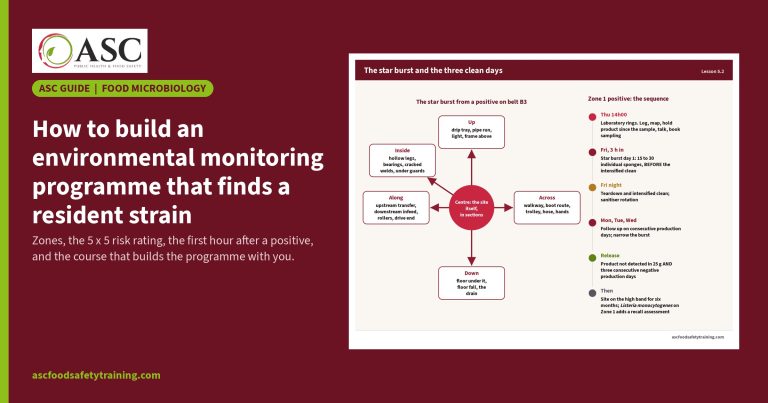
Environmental monitoring programme for Listeria
How to zone a plant, set frequencies and respond to a positive.
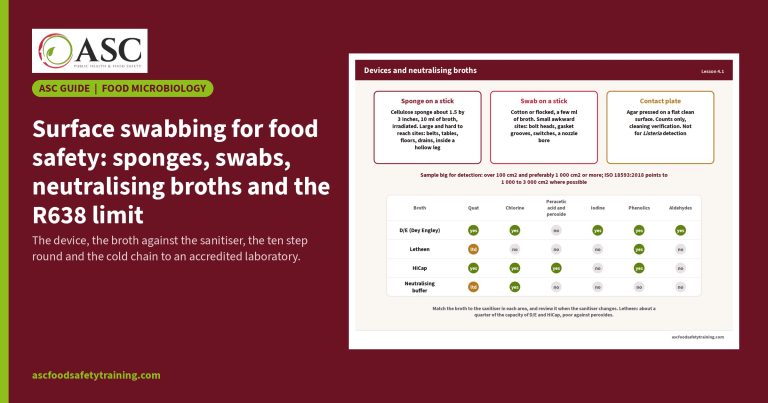
Surface swabbing: sponges, swabs and neutralising broth
Choosing the right sampling device and getting a result the lab can use.
GMP training
The prerequisite programmes that keep microorganisms out in the first place.
HACCP training
Kill steps, critical limits and monitoring for microbiological hazards.
Food microbiology training FAQs
What is food microbiology?
Food microbiology is the study of the bacteria, yeasts, moulds, viruses and parasites found in food. It covers the ones used to make food, the ones that spoil it and the ones that cause foodborne illness, and the conditions and controls that decide which of them grow.
Why is food microbiology important?
Most foodborne illness is caused by microorganisms, and many pathogens cause no visible change to the food. Understanding how they get in, grow and survive is what lets a food business set the right controls, read laboratory results correctly and act before a customer is harmed.
Who should complete food microbiology training?
Food handlers and supervisors need the basics of contamination and growth. QA and QC staff, food technologists and laboratory analysts need the intermediate or advanced level to interpret results and set microbiological criteria. QA managers and HACCP team leaders who run environmental monitoring should take the practical EMP course.
Do I need a science background?
No. Introduction to Food Microbiology is written for non-microbiologists and explains every concept in plain language with food examples. The intermediate and advanced courses assume you have completed the introduction or have equivalent knowledge.
What microorganisms are found in food?
Bacteria, yeasts, moulds, viruses and parasites. Some are added on purpose, such as the lactic acid bacteria in yoghurt. Others cause spoilage, such as Pseudomonas in chilled meat, and some are pathogens, such as Salmonella, Listeria monocytogenes, Bacillus cereus and norovirus.
What causes microorganisms to grow in food?
Growth depends on food, acidity, time, temperature, oxygen and moisture, often remembered as FAT TOM. Most pathogens multiply fastest between 5 °C and 60 °C, grow poorly below pH 4.6 and need water activity above roughly 0.91, although some, such as Staphylococcus aureus and moulds, tolerate drier food.
What is the temperature danger zone?
The range between 5 °C and 60 °C, where most pathogenic bacteria multiply fastest. Cold food should be held at 5 °C or below, hot food at 60 °C or above, and cooked food should be cooled through the danger zone as quickly as possible. Listeria monocytogenes is an exception that can still grow slowly at fridge temperatures.
What is an environmental monitoring programme (EMP)?
A planned programme of swabbing the processing environment, by zone, to find pathogens such as Listeria and Salmonella and the places they live before they reach food. It sets where and how often to sample, what to test for, and what to do after a positive result.
Is the course accredited?
The Introduction to Food Microbiology for Non-microbiologists course is HPCSA CPD accredited. ASC is a FoodBev SETA accredited training provider (587/00337/1900) and a SAATCA registered training provider (TC 065).
Will I receive a certificate?
Yes. Learners who complete the course requirements and pass the assessments receive a downloadable certificate of completion.
Can I take the courses from outside South Africa?
Yes. The courses are online, self-paced and in English, and the microbiology applies in any country. Prices are shown in South African rand and card payments convert at your bank’s rate.
Know what is growing before the lab tells you
Start with the introduction, or go straight to the environmental monitoring course if you own the programme.