
By Mthokozisi Nkosi – Food Scientist, SAATCA Registered R638:2018 Lead Implementer (SAATCA register RG003), Lead Auditor (Exemplar Global & IRCA), Founder of ASC Food Safety Consultants. Updated for 2026.
Every spaza shop and informal food trader in South Africa is legally required, under Regulation R638 of 2018, to register its premises, hold a valid Certificate of Acceptability (COA) and ensure that the people handling food are trained in food safety – and since the 2024 foodborne-illness deaths, municipalities are enforcing this harder than at any point in the country’s history. If you own or run a spaza shop, a township takeaway, or a market stall, this guide tells you exactly what the law now demands, what inspectors look for, and the fastest, most affordable way to become fully compliant.
This article is dedicated to spaza shops and informal traders. For the full national application process across every municipality, read our Ultimate 2026 COA Compliance Guide.
Why spaza shops are suddenly under serious scrutiny
In late 2024, a wave of child illnesses and deaths linked to food and pesticides sold through informal outlets pushed food safety in spaza shops to the top of the national agenda. Government launched a countrywide spaza shop registration drive and instructed municipal Environmental Health Practitioners (EHPs) to enforce R638 in the informal sector with far greater rigour. What was, for years, rarely inspected is now actively checked – and shops without registration, a COA, or trained staff are being issued compliance notices and, in serious cases, closed.
The takeaway for owners is simple: the era of operating a food-selling spaza shop with no paperwork is over. The good news is that compliance is achievable, affordable, and protects both your customers and your livelihood.
The three legal obligations every spaza shop now carries
- Register your premises with your local municipality under the national spaza shop registration process.
- Obtain a Certificate of Acceptability (COA) – the legal permit from your municipality’s Environmental Health Department confirming your premises meets R638 hygiene standards. Operating without one is a criminal offence.
- Train your food handlers under Regulation 10(1)(b) of R638. This is the obligation the overwhelming majority of spaza owners do not know exists – and it is increasingly the one that EHPs ask about first.
“My shop is tiny – surely the law doesn’t apply to me?”
It does, fully. R638 applies to any premises where food is handled for the public, regardless of size, turnover, or whether you trade from a home, a shipping container, a shack or a formal storefront. There is no small-business exemption and no informal-trader exemption. If you sell bread, polony, eggs, dairy, cooldrinks, sweets, snacks or cooked food to the public, you are operating a food premises in the eyes of the law.
What inspectors actually check in a spaza shop
Spaza shops carry a specific risk profile, and EHPs inspect against it closely. Knowing these in advance lets you fix them before an inspection:
- Expired, damaged or counterfeit stock – selling past-date goods or fake-branded products is one of the most common findings.
- Chemicals stored with food – paraffin, pesticides, rat poison and cleaning agents kept near or above food is extremely dangerous and was central to the 2024 tragedies.
- Pest activity – droppings, insects, and rodent damage around dry goods and packaging.
- Broken cold chain – perishables such as polony, dairy, eggs and meat held at unsafe temperatures.
- No handwashing facility – a frequent and avoidable cause of failed inspections.
- Poor stock rotation – no first-in-first-out system, leading to old stock reaching customers.
Food safety training teaches owners to recognise and eliminate every one of these risks – which is precisely why the law requires it and why inspectors increasingly expect proof of it.
The training that satisfies the law for spaza shops: ASC’s FS28 course
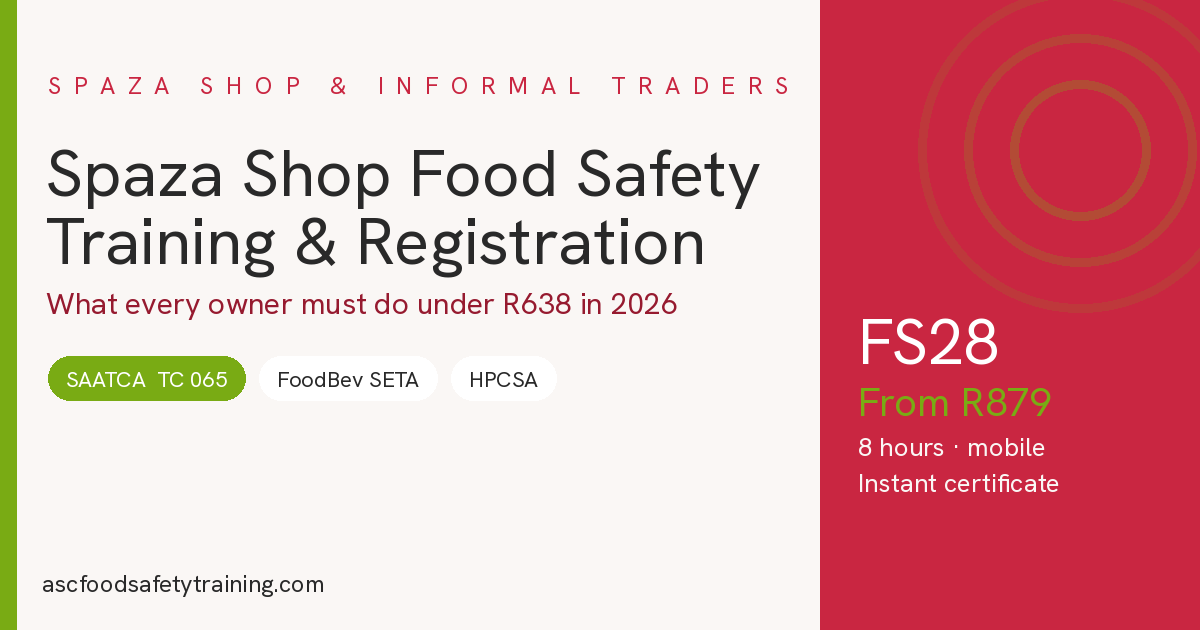
ASC Food Safety Consultants offers a dedicated course built for this exact audience: Basic Food Safety Practices for Spaza Shops and Informal Traders (FS28). It is written in plain, practical language, runs entirely on a basic smartphone, and is fully self-paced – so you can complete it between serving customers without ever closing your shop. The moment you pass, your QR-coded Certificate of Achievement is available to download.
Why accreditation is the part you must not get wrong
This is where most spaza owners waste money. A so-called “certificate of attendance” from an unaccredited workshop carries no regulatory standing, and an EHP can reject it. What matters to a municipality is genuine accreditation – and here ASC is in a category of its own.
ASC is South Africa’s only TRIPLE-accredited R638 training provider
Most providers in the market hold one accreditation, if any. ASC holds all three that matter:
- SAATCA – officially listed Training Centre No. 065 (the accreditation most EHPs look for)
- FoodBev SETA – No. 587/00337/1900
- HPCSA – Health Professions Council of South Africa accredited
Every course is designed and personally certified by Mthokozisi Nkosi – an R638:2018 implementer on the SAATCA register (RG003) in the entire country (verifiable at saatca.co.za/registered-implementers/). When your certificate carries this weight, it is accepted by every one of South Africa’s 278 municipalities.
What the spaza shop course covers
The FS28 course gives you the practical knowledge an EHP expects an informal trader to demonstrate:
- The difference between food safety and food quality, and why it matters for your customers
- The four hazard types – biological, chemical, physical and allergens – in everyday spaza terms
- Safe storage and separating chemicals from food (the lesson that saves lives)
- Basic temperature control for perishable stock and the cold chain
- Personal hygiene and proper handwashing
- Cleaning, sanitising and keeping pests out
- Safe receiving, stock rotation (FIFO) and spotting expired or counterfeit goods
- A basic introduction to traceability and product recall
The price advantage: compliance you can actually afford
Food safety training should not be a luxury reserved for big franchises. ASC’s pricing is built for the informal sector and is the same nationwide – no travel surcharges, no per-province fees, no “classroom upgrade” costs:
- Spaza Shops & Informal Traders course (FS28): from R1 699, with lifetime access included (most competitors charge per year)
- Pair it with the Basic Food Hygiene course (FS02) for any staff who help you, from R420
Compare that to the R1 200 to R1 500 typically charged elsewhere for R638-level training, often without lifetime access and rarely with triple accreditation. You are getting the country’s most credible food safety training at the most accessible price in the market.
Step-by-step: getting your spaza shop fully compliant
- Train first. Complete the FS28 spaza shop course online, on your phone, and download your QR-coded certificate.
- Fix the basics. Add a handwashing point, separate all chemicals from food, clear expired stock, set up simple pest control, and get a fridge thermometer.
- Register and apply for your COA at your local municipality, certificate in hand.
- Keep records. Hold your certificate, supplier slips and a basic cleaning checklist ready for inspection.
Protect your shop, your customers and your future
Join thousands of South African food businesses – from township spaza shops to brands like Spur, KFC and Clicks – who trust ASC for accredited food safety training. Triple-accredited. Mobile-friendly. Instant certificate. Same price nationwide.
Enrol in the Spaza Shop Course – R1 699
Questions? WhatsApp us on +27 61 483 0381 for enquiries, sales and quotes.
Frequently asked questions
Do spaza shops legally need to be registered in South Africa?
Yes. Under the national spaza shop registration drive and Regulation R638 of 2018, spaza shops must register with their local municipality and hold a valid Certificate of Acceptability to trade in food legally.
Do spaza shop owners and staff need food safety training?
Yes. Regulation 10(1)(b) of R638 requires everyone handling food for the public, including spaza shop owners and their staff, to receive basic food safety training from an accredited provider.
How much does spaza shop food safety training cost?
ASC’s dedicated Spaza Shops and Informal Traders course (FS28) starts from R1 699 with lifetime access included, and the price is the same nationwide with no hidden fees.
Can I do the spaza shop course on my phone?
Yes. The course is fully mobile-friendly and self-paced, designed to run on a basic smartphone, with an instant QR-coded certificate downloadable on completion.
Will the certificate be accepted by my municipality?
Yes. ASC is triple-accredited by SAATCA (TC No. 065), FoodBev SETA and the HPCSA, and its certificates are verifiable by any environmental health practitioner in South Africa.
Why does the chemicals-and-food separation matter so much?
Storing pesticides, paraffin or cleaning products near food was central to the 2024 informal-sector poisonings. The course teaches safe separation and storage as a core, life-saving lesson.