
Allergen management training that holds up when the auditor says “show me”.
Seven online courses, from a five-hour briefing for the people on the line to a forty-hour validation programme for the person who signs the release. Written to R146 of 2010, Codex CXC 80-2020 and BRCGS Issue 9 clause 5.3, by trainers who have been in the room when a clean failed.
Self-paced · start today · certificate verifiable online · no VAT charged
FoodBev SETA Accredited Provider No. 587/00337/1900 · SAATCA registered training provider TC 065 · HPCSA CPD accredited
The pathway
Seven courses. Start where your job actually is.
Most sites buy the wrong level first. A QA manager does not need the five-hour briefing, and a packer does not need forty hours on swab recovery. The ladder below runs from the person who touches the product to the person who signs the release.

Level 1 · Awareness
Allergen Awareness for Food Handlers
For the people who actually carry the controls: line operators, cleaners, packers, chefs and kitchen staff, and anyone starting this week.
- Why a crumb can be enough, in plain language
- The eight groups R146 makes you declare
- Hands, gloves, scoops, colours and storage
- Why hand gel does nothing to an allergen
 Most enrolled
 Level 2 · Foundation
Allergen Management in the Food Supply Chain
For supervisors, QA assistants and anyone who has to find the allergens on a site and say what is being done about them.
- Allergy, coeliac disease and intolerance, properly separated
- The seven routes an allergen travels through a plant
- Mapping a real site and scoring likelihood honestly
- R146, the Codex two-tier list and why sesame and soy swap places

Level 2 · Food service
Allergen Management for Food Service, Retail and Catering
For restaurants, canteens, delis, retail counters and catering teams: the people who answer the question at the table, and the people who cook the dish that follows it.
- Taking an allergen request, and writing it down
- Separation when the kitchen has no spare space
- Buffets, counters, the pass and delivery
- What to do the moment a customer reacts

Level 3 · Specialist
Allergen Labelling and Artwork Control
For technical, QA, NPD and packaging teams who own the declaration: the people who decide what goes on the pack and sign the artwork off.
- What R146 requires, and the derivative problem
- When a precautionary statement is justified
- Action levels, calculated and defended
- One product, several markets, one change log

Level 4 · Advanced, Part 1
Risk Assessment and Cleaning Validation
Modules 1 to 5 of the advanced programme, sold on its own for people whose job is the validation evidence rather than the regulation.
- Action levels from published reference doses
- Worst-case selection and the three-run rule
- Swab recovery studies and recovery correction
- ELISA, PCR, LC-MS/MS and what each cannot tell you
Level 4 · Advanced, Part 2
Removal Science, Compliance and Crisis Management
Modules 6 to 9. Incident and recall, the science behind removal claims, and the law here and in your export markets.
- Complaint to recall, and the records that decide it
- Removal, allergenicity reduction and destruction of the analyte
- R146 in force, draft R3337 on the horizon
- Export declarations across the major destination markets

Level 4 · Advanced, complete
Advanced Allergen Management and Validation
Both parts together, nine modules, and the qualification most QA managers are actually being asked for. Cheaper than the two parts bought separately.
- Everything in Parts 1 and 2, in one enrolment
- The ASC Allergen Validation Toolkit (Excel)
- Cleaning Validation Protocol template (Word)
- Learner manual, glossary and reference dose tables
The whole pathway, for a team
The foundation course plus Advanced Parts 1 and 2 covers everyone from a new starter to the person defending clause 5.3 at audit. Bought as a bundle that is R4,313 rather than R5,750, because three courses together carry 25 per cent off. Two courses take 20 per cent and four take 30.
For ten seats or more we quote per site rather than per head, with a manager dashboard and one invoice.
The short answer
What is allergen management training?
Allergen management training teaches food businesses to identify every allergen that enters a site, work out how it could reach a product that does not declare it, put controls in place that stop it, prove those controls work, and declare the allergen correctly on the label.
It exists because an allergen is the only food safety hazard with no kill step. A pathogen is dangerous to everyone and you reduce it with heat. An allergen is harmless to roughly ninety-eight people in a hundred, and for the other two a quantity too small to see can cause anaphylaxis. Cooking does not destroy it. Roasting makes peanut more potent, not less. Codex CXC 80-2020 is explicit that processes which degrade proteins, such as enzymatic or acid hydrolysis, should not be relied upon to eliminate allergenic proteins.
In South Africa the labelling requirement comes from R146 of 2010, which names eight allergen groupings plus sulphur dioxide. Draft R3337 would replace it but is not yet in force. Internationally the reference lists sit in Codex CXS 1-1985 across two tiers, and the certification standards audit it. BRCGS Issue 9 makes allergen management a fundamental requirement at clause 5.3, which means a serious failure ends the audit rather than producing a non-conformity to close out later.
A pathogen
Heat is the control. Check the temperature and the hazard is dealt with.
An allergen
No temperature removes it, and roasting can make peanut more allergenic. The controls are keeping it out, cleaning it off and declaring it.
Who needs it, and at what depth
Everyone who touches food needs the awareness level: what an allergen is, why a crumb matters, and the handful of habits that stop it moving. Only a much smaller group needs the quantitative work: action levels, validation protocols, recovery correction, method selection. Buying forty hours of validation science for a packing hall is how training budgets get wasted and how people stop turning up.
What it is not
These are non-credit-bearing short courses. They carry no NQF credits and they are not a qualification. What they carry is a dated certificate with a verification ID, the underlying content written to the current standards, and an assessment somebody actually had to pass. If a provider tells you a two-hour online course gives you a qualification, check the claim before you pay for it.
On the floor
What the controls look like when an auditor walks the site
Every course is built around things an auditor can see, pick up or ask for. These six come up on almost every site we train.
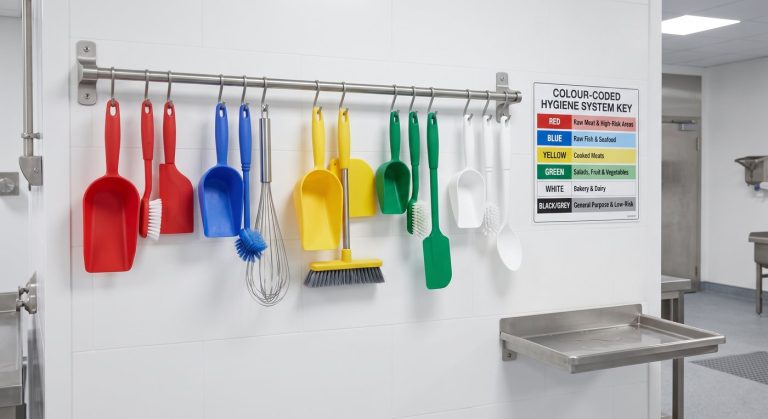
Colour-coded utensils
One colour for the allergen product, used for nothing else and stored apart from the rest.
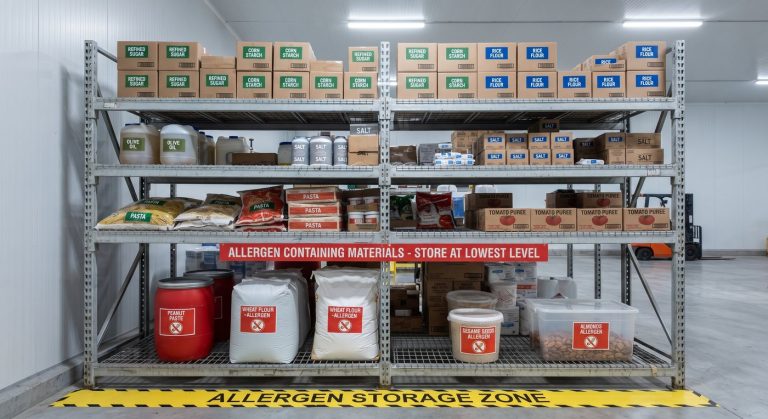
Covered in Allergen AwarenessAllergens on the lowest shelf
Allergen ingredients kept low and in a marked zone, so a split bag cannot fall into anything else.
Covered in the Foundation course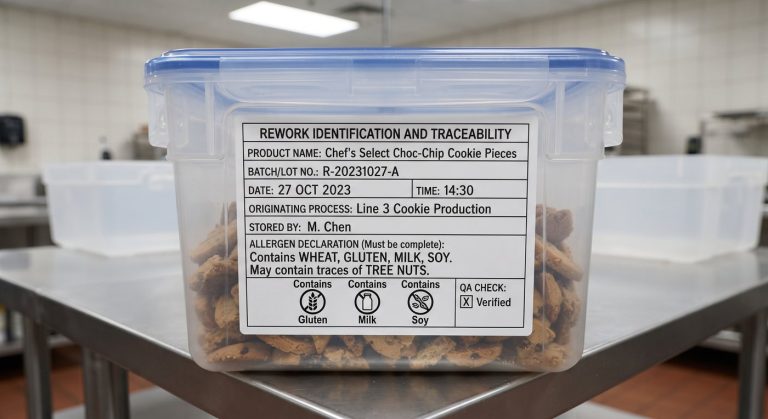
Rework that stays identified
Rework labelled with what it contains, so it only goes back into a product that declares the same allergens.
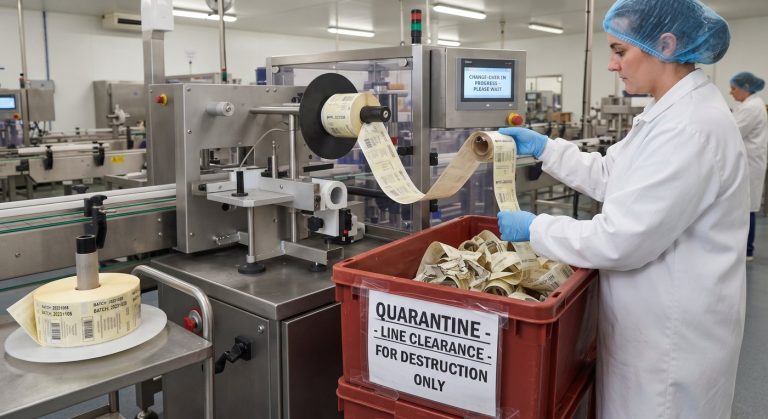
Covered in the Foundation courseLine clearance at changeover
Old labels and packaging cleared and quarantined before the next product starts, with a signature to prove it.
Covered in Labelling and Artwork Control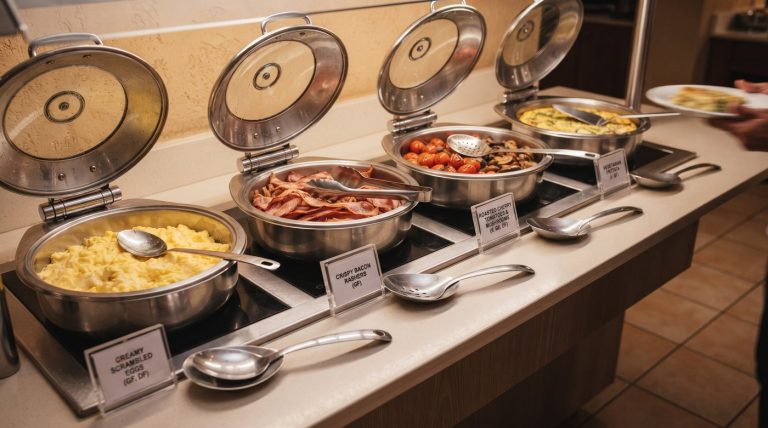
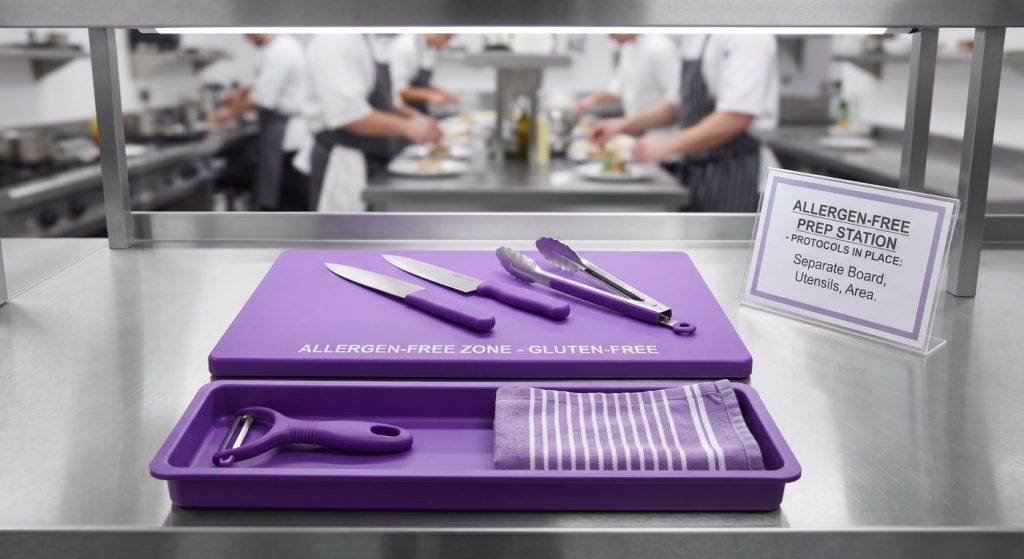
Dish cards on the counter
Every dish named with its allergens, and each serving spoon kept to its own dish.
Covered in the Food Service course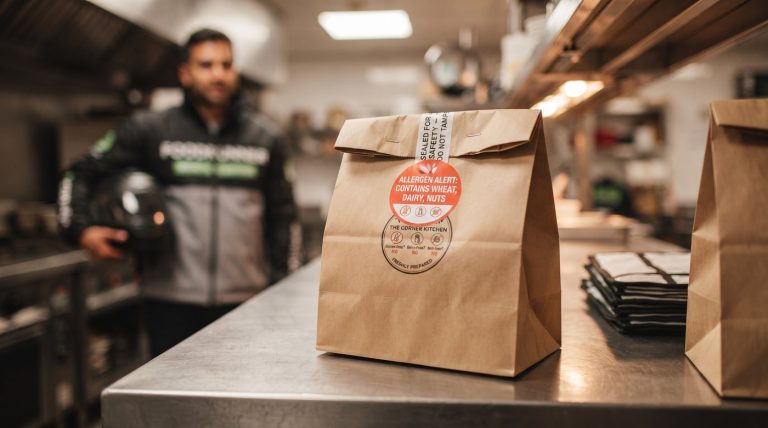
Sealed, labelled deliveries
An allergen order sealed and stickered in the kitchen, so it reaches the door the way it left.
Covered in the Food Service courseCourse selector
Which allergen course should I take?
Three questions. It will not sell you the expensive one if you do not need it.
1. What do you actually do with product?
2. Does your job involve proving a control works: validation, testing, protocols?
3. Do you answer to an auditor, a customer specification or an export market?
| Your job | Start here | Why |
|---|---|---|
| Line operator, packer, cleaner | Awareness, 5 hours | You need the habits, not the science. Five hours covers every decision you actually make. |
| Chef, cook, kitchen assistant | Awareness, 5 hours | Same controls, different room. Separation, utensils and communication matter more than paperwork. |
| Team leader, shift supervisor | Foundation, 7 hours | You brief the awareness level and have to answer the questions it raises. |
| QA assistant, food safety officer | Foundation, 7 hours | Finding allergens on a site, mapping them, and scoring likelihood with evidence behind it. |
| QA or technical manager | Advanced, 40 hours | You sign the risk assessment and defend clause 5.3. This is the level auditors probe. |
| Sanitation lead, hygiene manager | Advanced Part 1 | Worst-case selection, the three-run rule, swab recovery and what a clean actually proves. |
| QC technician, laboratory staff | Advanced Part 1 | Method selection and result interpretation: protein versus commodity basis, LOD, LOQ, matrix effects. |
| Labelling, artwork, packaging | Advanced Part 2 | Compound ingredients, derivative naming, precautionary decisions and export declarations. |
| NPD and formulation | Foundation, then Advanced | Designing allergen risk out at recipe stage is cheaper than validating it out afterwards. |
| Auditor or consultant | Advanced, 40 hours | You need to be able to test a client’s claim, not just receive it. |
| New to the industry | Awareness, then Foundation | The ladder exists for exactly this. Five hours, then seven, then decide. |
The law, side by side
What does South African law require, and where does it differ?
This is the table people screenshot. R146 of 2010 names eight groupings. The European list names fourteen. The United States names nine. Codex runs two tiers, and soy and sesame sit on opposite sides of them. If you export, the differences are the whole job.
- Cereals with gluten
- Crustaceans and molluscs
- Eggs
- Fish
- Milk
- Peanuts
- Soybeans
- Tree nuts
- Sulphites
The eight groups R146 of 2010 makes you declare, plus sulphur dioxide and sulphites. The table below shows where other markets differ.
| Allergen | South Africa, R146 of 2010 | EU 1169/2011 Annex II | United States, post-FASTER Act | Codex CXS 1-1985 |
|---|---|---|---|---|
| Cereals containing gluten | Declare: wheat, rye, barley, oats, spelt, kamut | Declare | Wheat only | 4.2.1.4 mandatory |
| Crustaceans | Declare, grouped with molluscs | Declare | Declare | 4.2.1.4 mandatory |
| Molluscs | Declare, grouped with crustaceans | Declare, separately | Not listed | 4.2.1.5 discretionary |
| Eggs | Declare | Declare | Declare | 4.2.1.4 mandatory |
| Fish | Declare | Declare | Declare | 4.2.1.4 mandatory |
| Peanuts | Declare | Declare | Declare | 4.2.1.4 mandatory |
| Soybeans | Declare | Declare | Declare | 4.2.1.5 discretionary |
| Milk | Declare | Declare | Declare | 4.2.1.4 mandatory |
| Tree nuts | Declare | Declare | Declare | 4.2.1.4 mandatory |
| Celery | Not separately named | Declare | Not listed | 4.2.1.5 discretionary |
| Mustard | Not separately named | Declare | Not listed | 4.2.1.5 discretionary |
| Sesame | Not separately named | Declare | Declare, from 1 Jan 2023 | 4.2.1.4 mandatory |
| Sulphur dioxide and sulphites | Declare at or above the specified level | Declare above 10 mg/kg or 10 mg/L | Not a major allergen | 4.2.1.4 mandatory |
| Lupin | Not separately named | Declare | Not listed | 4.2.1.5 discretionary |
Three things this table is telling you.
Sesame is mandatory under Codex, in the EU and in the US, and is not separately named in R146. Soy is the mirror image: discretionary internationally, required here. Declare both, wherever you sell: declaring more than the minimum has never been the offence.
Codex CXC 80-2020, the code of practice, contains no allergen list of its own. It points back to CXS 1-1985. A site procedure citing the code of practice as the source of its allergen list is citing the wrong document, and an auditor who knows the texts will say so.
A blanket “may contain all allergens” applied without a documented risk assessment is not a legal defence in South Africa. If an undeclared allergen reaches a consumer, the question will be what you assessed and what you controlled, not what you printed.
Summarised for training. Confirm the current requirement for any market before it appears on a label. R638 of 2018 covers premises hygiene, not labelling. Do not cite it for a declaration question.
Free, no sign-up
Three tools you can use before you buy anything
These are the calculations and checks our learners do most often. They are free, they need no account, and they work on a phone in a factory corridor. If they are useful on their own, the courses will be too.
An action level is the concentration limit that applies to your product. It is the reference dose divided by the amount a person eats in one sitting. Change the serving size and the action level changes with it, but the reference dose does not.
The realistic amount consumed on one eating occasion, not the pack size.
Paste an ingredient list. This checks it against the eight groupings South Africa requires under R146 of 2010, the European fourteen, the United States nine and the two Codex tiers, and flags the wording that hides an allergen rather than declaring it.
Six questions about one product and one allergen it does not declare. The output is the likelihood you could defend to an auditor, and whether a precautionary statement is justified or whether you have a control to fix first.
How to use these. They are teaching tools built on published reference doses and declaration lists, and they do not replace your own risk assessment, your site’s validation evidence or professional advice. Reference doses are milligrams of total allergen protein. Codex publishes its own reference doses in the annexes to CXC 80-2020. Check the values that apply in your market before releasing product against a number. Built by ASC Food Safety Training.
Before you spend anything
Watch a lesson
Three real lessons from the foundation course, not a trailer. If the style does not suit you, better to find out here.
What is a food allergy?
Foundation, Module 1. Sensitisation, elicitation, and why the damage is done by the consumer’s own immune system rather than by the food.
Sources of cross-contact
Foundation, Module 2. The seven routes, and the one nobody puts on the risk assessment: processing aids and dusting powders.
Cleaning for allergens
Foundation, Module 4. Why hot water first is the classic error, and what alkaline chemistry is actually doing to the protein.
Assessment and certificate
How you are assessed, and what the certificate is worth
Different levels are assessed differently. The awareness course is a knowledge check. The advanced programme is a proctored examination with a question bank large enough that a re-sit is a genuinely different paper.
| Course | Questions in the paper | Time | Pass | Proctored |
|---|---|---|---|---|
| Awareness, 5 hours | 30 | 35 min | 70 per cent | No |
| Foundation, 7 hours | 25 final, 15 per module | 30 min | 70 per cent | No |
| Advanced Part 1 | 50 | 85 min | 80 per cent | Yes |
| Advanced Part 2 | 40 | 70 min | 80 per cent | Yes |
| Advanced, complete | 90 | 150 min | 80 per cent | Yes |

What happens when you pass
- 1The certificate issues immediatelyDated, in your name, with the course title and level, and downloadable from your dashboard the moment the result posts.
- 2It carries a unique verification ID and a QR codeBoth resolve on ascfoodsafetytraining.com. An employer or an auditor can check it in seconds without phoning anyone.
- 3If it does not verify online, it was not issued by usThat is the whole point of the ID. The image alongside is a specimen and is watermarked so it cannot be passed off as an issued certificate.
- 4It is a short-course certificate, not a qualificationNon-credit-bearing, no NQF credits. It records that you completed the content and passed the assessment, which is what a customer questionnaire and an auditor actually ask for.
Proctored examinations are monitored by camera, microphone and screen for the full duration, and copy and paste are blocked. You sit it alone. One re-sit is included, and it draws a different paper from the bank.
Pricing
How much does allergen training cost?
Once-off payment, no subscription, no VAT charged. Enrolment does not expire while the course is live, and every update to the content reaches you at no extra cost.
| Course | Hours | Lessons | Price | Best for |
|---|---|---|---|---|
| Allergen Awareness for Food Handlers | 5 | 12 | R690 | Everyone who touches product |
| Allergen Management in the Food Supply Chain | 7 | 20 | R1,450 | Supervisors and QA assistants |
| Allergen Management for Food Service, Retail and Catering | 6 | 19 | R1,450 | Chefs, servers, counter and catering staff |
| Allergen Labelling and Artwork Control | 6 | 14 | R1,650 | Technical, QA, NPD and packaging |
| Advanced Part 1: Risk Assessment and Cleaning Validation | 20 | 77 | R2,150 | Sanitation leads, QC technicians |
| Advanced Part 2: Removal Science and Compliance | 20 | 79 | R2,150 | Labelling, compliance, export |
| Advanced Allergen Management and Validation | 40 | 156 | R3,450 | QA and technical managers |
Buying more than one
Bundles take 20 per cent off two courses, 25 off three and 30 off four. The two advanced parts bought separately come to R4,300 against R3,450 for the complete course, so the parts only make sense if you genuinely need one half.
Teams and sites
From ten seats we quote per site rather than per head, on one invoice, with a manager dashboard showing who has completed what and a certificate register you can hand to an auditor. That is usually the cheaper route for a production team.
Who this is for
Built for the people who get asked “show me”
Questions
Frequently asked questions
Which allergen course should I take first?
Start at the level your job actually sits at. If you handle product, the five-hour awareness course covers every decision you make. If you supervise, check or brief other people, start at the seven-hour foundation course. If you sign the risk assessment or answer to an auditor, go to the advanced programme. The selector higher up this page asks three questions and will not push you to the expensive one if you do not need it.
Is this training accredited?
ASC is a FoodBev SETA accredited provider, number 587/00337/1900, and is SAATCA registered under TC 065. The courses are also HPCSA CPD accredited. That said, these specific courses are non-credit-bearing short courses: they carry no NQF credits and they are not a qualification. They produce a dated certificate with an online verification ID, which is what customer questionnaires and auditors actually ask to see.
What does allergen management training cost, and how long does it take?
From R690 for the five-hour awareness course to R3,450 for the forty-hour advanced programme, paid once with no VAT charged and no subscription. Everything is self-paced, so the hours are study time rather than a fixed schedule. Most people finish the awareness course in a single sitting, the foundation course over a week, and the advanced programme in six to eight weeks alongside normal duties.
How are the courses assessed?
Every course ends in a multiple-choice assessment drawn at random from a question bank, so a re-sit is a different paper. The awareness and foundation courses are open-access at a 70 per cent pass mark. The advanced courses are sat under proctoring at 80 per cent, monitored by camera, microphone and screen, with copy and paste blocked. One re-sit is included.
Can an employer check that a certificate is genuine?
Yes, and that is the point of it. Every issued certificate carries a unique verification ID and a QR code that resolve on ascfoodsafetytraining.com. If a certificate does not verify online, it was not issued by us. The specimen shown on this page is watermarked precisely so it cannot be cropped into something that looks issued.
Does this cover R146 of 2010 and the new draft regulation?
R146 of 2010 is the regulation currently in force for allergen labelling in South Africa, and it is the baseline throughout every course. Draft R3337, published for comment in late 2023, is covered as a readiness item: what it would change, and how to design artwork now so it survives the change. We are explicit that it is not in force. Do not label to a draft.
Do the courses cover Codex, BRCGS and FSSC 22000?
Yes. The allergen lists come from Codex CXS 1-1985 across its two tiers, and the practice comes from CXC 80-2020. BRCGS Issue 9 clause 5.3 is treated as the audit hook it is: a fundamental requirement where a serious failure ends the audit. FSSC 22000 Version 7, published May 2026, and SQF Edition 9 are covered for where allergen management sits in each.
What is the difference between the advanced course and its two parts?
No difference in content. Part 1 is modules 1 to 5, on risk assessment, cleaning validation, analytical methods and engineering controls. Part 2 is modules 6 to 9, on incident management, removal science and the regulatory frameworks. The complete course is both, at R3,450 against R4,300 for the parts bought separately, so the parts are only worth it if you genuinely need one half.
Is this relevant if I work in a restaurant or a deli rather than a factory?
Partly. The awareness course applies directly: the controls are the same, and the lessons on separation, utensils, storage and speaking up translate straight into a kitchen. The foundation and advanced courses are written around manufacturing, so some of the validation content will not match your operation. A dedicated food service and catering course is in development.
Can you train a whole team or run this on site?
Yes. From ten seats we quote per site rather than per head, on a single invoice, with a manager dashboard showing completion and a certificate register. We also deliver the foundation course as a facilitated one-day classroom programme with workshops and a written assessment, which suits teams who learn better in a room than on a screen.
Does cooking destroy allergens?
No. This is the most common and most expensive misunderstanding in food manufacturing. Heat is a kill step for bacteria, not for allergens. Some proteins are altered by cooking and a few become less reactive, but others become more so: roasting increases the allergenic potency of peanut. Codex CXC 80-2020 states that processes which degrade proteins, such as enzymatic or acid hydrolysis, should not be relied upon to eliminate or completely destroy allergenic proteins. Assume the allergen survives your process unless you have evidence it does not.
Is a “may contain” statement enough to protect us?
Not on its own, and not if it was applied without a risk assessment. A precautionary statement is justified only where cross-contact is genuinely unavoidable after all reasonable controls and the residual could be significant. Applied everywhere it devalues the warning for the consumers it is meant to protect, and a blanket “may contain all allergens” with nothing behind it is not a legal defence. If the real problem is an unvalidated clean, the statement is a written record that you knew.
What equipment do I need?
A phone, tablet or computer and an internet connection. The courses work on a phone and can be stopped and restarted. The proctored examinations need a working camera and microphone and a quiet room where you are alone, so a phone is possible but a laptop is easier.
Do you issue an invoice for company payment?
Yes. Courses can be paid by card at checkout or invoiced to a company, and team enrolments are invoiced as standard. No VAT is charged.
The clean either worked or it did not. Be able to prove which.
Start at the level your job sits at, finish at your own pace, and come out with a certificate an auditor can verify in ten seconds.