
Food Labelling Claims Training for Food Manufacturers
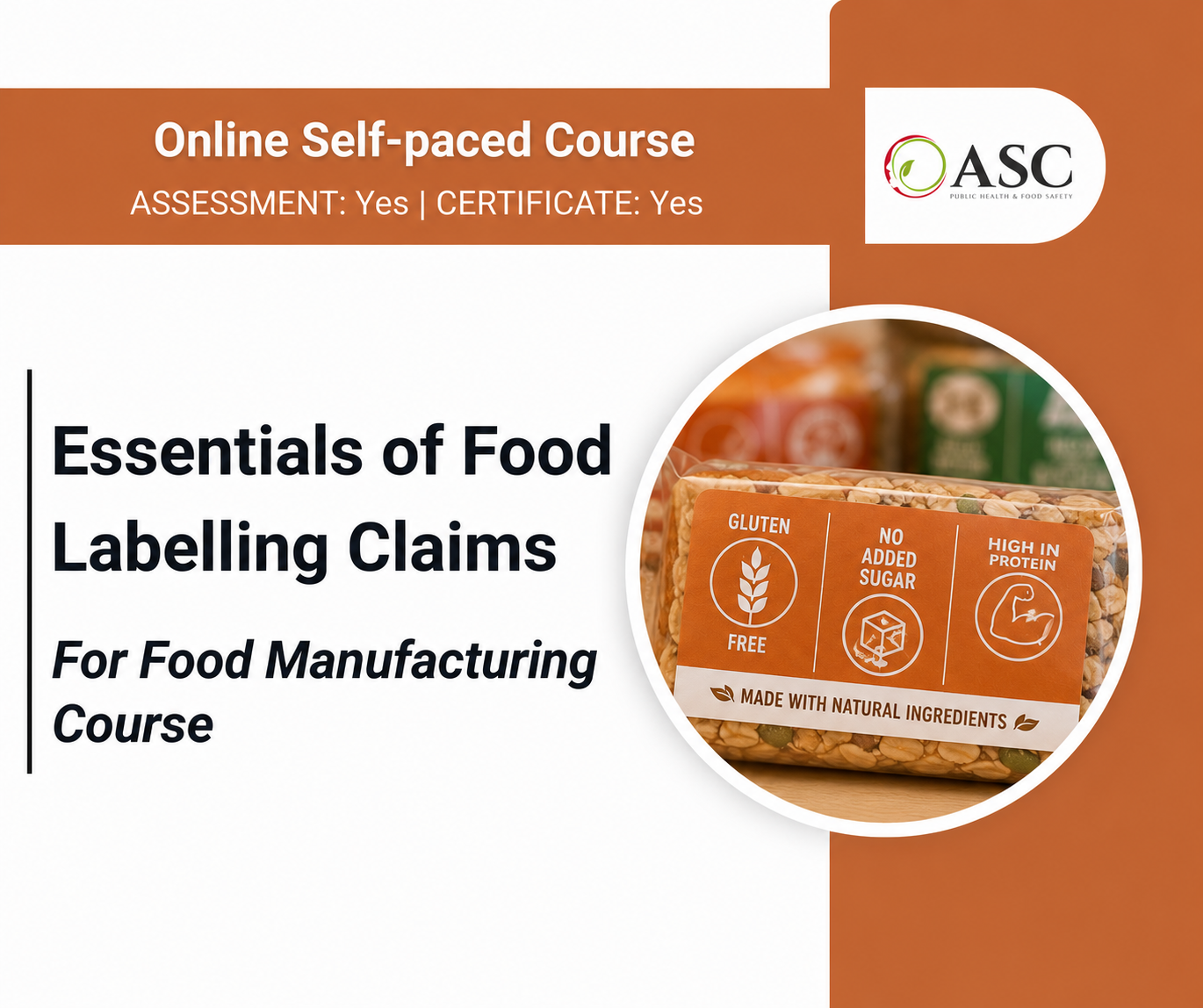
Learn how to build food labels that are legal, accurate and trusted. This practical, self-paced online course — Essentials of Food Labelling Claims for Food Manufacturing — explains what a compliant label must contain, how to declare allergens, and how to make nutrition, health and marketing claims correctly under South African food labelling law.
Enrol in the food labelling claims course
The course is online, self-paced, mobile-friendly and designed for practical application on real food product labels — from ingredient lists and allergens to nutrition and marketing claims.

Training a whole team or multiple sites? Talk to ASC about group enrolment and managed client groups →
What is food labelling?
Food labelling is all of the information a food business presents on a product’s packaging — and it is a legal responsibility, not a marketing afterthought. A label must tell the consumer, truthfully and clearly, what the product is, what is in it, and how to use it safely.
In South Africa, food labelling is regulated mainly under the Foodstuffs, Cosmetics and Disinfectants Act 54 of 1972 and the Regulations relating to the Labelling and Advertising of Foodstuffs (R146 of 2010), with a revised draft (R3337) in progress. Product-specific rules also fall under the Agricultural Product Standards Act 119 of 1990. Getting labels wrong can mean product recalls, rejected consignments, blocked exports and loss of retailer listings.
In plain English: a compliant label protects the consumer and the business. It declares allergens that can harm people, prevents misleading claims, and gives inspectors, retailers and customers the information the law requires.
📋 Mandatory information
The name of the food, ingredient list, allergen declaration, net contents, date marking, storage and preparation instructions, country of origin and manufacturer details.
📈 Nutrition & health claims
Nutrition information and any claim about the nutritional value or health benefit of a food — each subject to strict conditions and substantiation requirements.
⚠️ Allergens & warnings
Clear declaration of allergens and cross-contact, plus mandatory warning statements where they apply. Getting this wrong is one of the most common causes of recalls.
Key South African food labelling legislation
Food labelling in South Africa is shaped by several instruments. The course explains how they fit together so your labels stay compliant as the rules evolve.
| Legislation / Standard | What it governs | Applies to |
|---|---|---|
| Foodstuffs, Cosmetics and Disinfectants Act 54 of 1972 | The overarching framework for the safety, labelling and advertising of foodstuffs. | All foodstuffs sold in South Africa. |
| R146 of 2010 – Labelling & Advertising of Foodstuffs | Mandatory label information, prohibited and permitted claims, and advertising rules. | Pre-packaged foodstuffs and their advertising. |
| Draft R3337 (in progress) | Proposed revised labelling rules, including front-of-pack warning labels for products high in sugar, salt and saturated fat. | Pre-packaged foods — monitor for finalisation. |
| Agricultural Product Standards Act 119 of 1990 | Product-specific grading, composition and marking rules (e.g. dairy, meat, fruit & vegetables). | Regulated agricultural products. |
| Allergen declaration requirements | Clear declaration of allergens and cross-contact to protect sensitive consumers. | Any product containing or exposed to allergens. |
For the full regulatory picture, see the ASC food safety legislation resources →
The three building blocks of a compliant food label
A food label does three jobs at once. The course explains how each block works so your team can build labels that are legal, safe and honest.
1. Mandatory information
Product name and true nature, ingredient list, net contents, date marking, storage and use instructions, country of origin and manufacturer or importer details.
2. Allergens & warnings
Correct allergen declaration, cross-contact statements and any mandatory warnings — the information that most directly protects consumer health.
3. Claims & marketing
Nutrition claims, health claims and marketing claims such as “free-from”, “natural” and “high in” — each of which must be permitted and substantiated.
What food labelling law expects you to control
A compliant label depends on getting many details right at once. The course helps learners understand the areas inspectors, retailers and certification auditors focus on.
Food labelling readiness checklist
Use this quick self-assessment to spot gaps in your product labels before an inspector, retailer or customer does.
Label compliance self-check
Tick each item you already have in place. Unticked items are action points for your labelling and QA team.
Why train with ASC for food labelling?
ASC’s labelling course is not a generic slide deck. It is built around the way labels are actually drafted, checked and defended in real food businesses and audits.
Experienced instructors
Compiled by professionals who review labels, advise on claims and audit food safety compliance.
Plain-English clarity
Legal requirements and claim rules are explained briefly, practically and with real examples.
Certificate of completion
Learners found competent receive a downloadable certificate as training evidence.
How your food labelling training works
Learn online, track your progress, complete knowledge tests and download your certificate once the course requirements are met.
Enrol online
Register for the Essentials of Food Labelling Claims course from any device.
Learn online
Work through text, audio and video-based lessons from your learner dashboard.
Complete tests
Knowledge tests are included throughout the course, plus final assessment requirements.
Download certificate
Once competent, download your certificate of completion for training evidence and audit records.
Food labelling training for manufacturers, QA teams and product developers
This course is ideal for anyone who designs, checks, approves or markets food product labels.
Course content developed by experienced food safety professionals

Mthokozisi Nkosi
ASC’s food labelling training is guided by practical experience of reviewing labels and advising food manufacturers on claims and compliance. The aim is to help learners understand not only what the rules say, but how to apply them to a real product label.
The course is especially useful for teams preparing product launches, responding to retailer or inspector queries, or tightening up existing labels. Learners work through lessons, knowledge tests and assessment activities designed to build practical understanding and documented training evidence.
Food labelling training frequently asked questions
Quick answers to the questions learners and food safety managers ask most often.
What is food labelling?
What does this course cover?
Which South African laws apply to food labelling?
Do I receive a certificate after completing the course?
What is the pass mark?
Is this course legal advice?
Can ASC review my product labels?
Need help getting your food labels right?
Start with the Essentials of Food Labelling Claims course to build your team’s labelling knowledge. For a review of your specific product labels, claims or artwork, speak to ASC Food Safety Consultants.
Browse all ASC food safety courses
Every accredited online course we offer, including food handler, R638, HACCP, GMP, FSSC 22000, ISO 22000, BRCGS, GLOBALG.A.P., microbiology, allergen, labelling, auditing and more.














Build labels your customers — and the regulator — can trust
Strengthen your team’s food labelling knowledge, reduce the risk of recalls and rejected products, and create training evidence for your food safety system.