
Home › Specialist and Short Courses
Online Specialist & Short Food Safety Courses for Focused Technical Skills
Sharpen the specific, practical skill your food safety and quality team needs this week, without signing up for a full standards programme. Each short course is online and self-paced, most finish inside a working day, and each ends with a downloadable certificate of completion.
- Root cause analysis
- Food labelling
- Prerequisite programmes
- Allergens
- Hygienic design
How long each short course takes
Hours of self-paced study. The dashed line marks one working day.
Start from the problem in front of you
Most teams come to a short course because something specific keeps going wrong. Find the problem that sounds like yours, and take the course built to fix it.
Prices are in South African rand. The smaller figures under each price are indicative conversions at today’s exchange rate. You pay in rand and your bank sets the final rate.
The same non-conformance keeps coming back after every audit.
An Overview of Root Cause Analysis
Why five whys and fishbone fail when used badly, and how to close a finding so it stays closed.
R649About 4 hours · online
We are launching a product and the label has to be right first time.
Essentials of Food Labelling Claims for Food Manufacturing
What a compliant South African label must contain, allergen declaration and the rules for claims under R146 of 2010.
R1 250About 4 hours · online
Nobody can explain where our best-before date came from.
Overview of Conducting a Shelf-Life Study
Plan and run a shelf-life study, and build the microbiological, physicochemical and sensory evidence behind the date.
R799About 4.5 hours · online
The auditor wants our prerequisite programmes measured against the 2025 standard.
ISO 22002-100:2025 The PRP Standard Requirements
The prerequisite programme requirements for the food, feed and packaging supply chain, with the sector-specific parts.
R1 500About 8 hours · online
Repairs leave swarf, loose parts and temporary fixes behind on the line.
Food Safety for Engineering and Maintenance Teams
Tool and parts counts, clean, inspect and release after work, CCP equipment, contractors, permits and change control.
R1 399About 5 hours · online
The same machine fails the same swab, month after month.
Hygienic Design Essentials for Food Industry Professionals
Where microorganisms live on a machine, the ten hygienic design rules and a thirty point walk you run on your own line.
R2 400About 5 hours · online
Front-of-house staff cannot answer a customer’s allergen question.
Allergen Management for Food Service, Retail and Catering
Allergen controls for kitchens, counters and deliveries, from the menu and dish cards to the order that leaves the building.
R1 450About 6 hours · online
An inspection or customer audit is coming and the floor is not ready.
Food Safety Inspections and Audit Readiness for QCs and HACCP Teams
Run your own inspections, write findings that get fixed and prepare the site and the records before the auditor arrives.
R1 699About 9 hours · online
The paperwork looks right, but nobody has asked whether the ingredient is genuine.
Food Fraud (VACCP) and Food Defence (TACCP)
How food fraud and deliberate tampering happen, and how vulnerability and threat assessments work in practice.
R1 450About 6 hours · online
Every short course, by skill
All of ASC’s standalone short courses in one list, with the time each takes and its price. The topic page link takes you to the full series for that subject, including longer and more advanced courses.
Root cause analysis in three steps: overview, one day, two days
Corrective action only works when it removes the real cause. Start with the overview, move to the one-day course to work a finding through, and take the two-day course if you lead investigations or answer for them at audit.

An Overview of Root Cause Analysis
- What root cause analysis is and why it matters
- RCA and continuous improvement
- The main methods and techniques
- Teamwork in an investigation
R649About 4 hours · online
View the course
Root Cause Analysis 1-Day Course
- Work a real food safety finding from start to finish
- The tools, applied rather than described
- A corrective action that holds
- Assessment and certificate
R1 250About 8 hours · online
View the course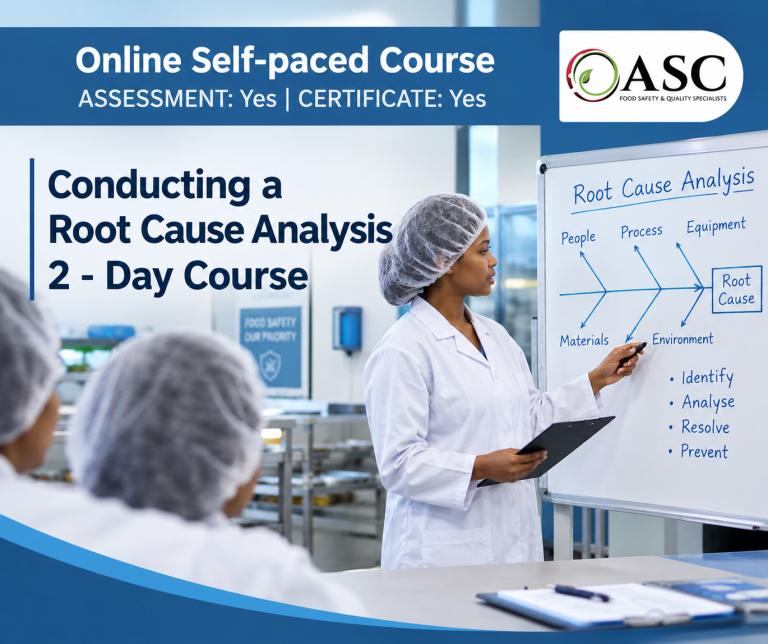
Conducting a Root Cause Analysis (2 days)
- Why RCA fails, and what the standards and the law require
- Evidence, timelines, human factors and interviewing
- Fishbone, 5 whys, fault trees, barriers and change analysis
- Verifying the cause and CAPA that works
R2 350About 16 hours · online
View the courseRoot cause analysis bundle: overview and one-day course
R1 519 instead of R1 899 for both courses, a saving of R380.
Compare the three levels side by side on the root cause analysis training page.
How these skills fit into your food safety system
Each short course supports a specific part of a working food safety management system. Together they close the gaps that most often lead to complaints, recalls and repeat audit findings.
Root cause analysis drives corrective action
Corrective action and continual improvement are requirements of HACCP-based systems and the GFSI-benchmarked standards. Without a real root cause, the same non-conformances recur and audit findings pile up.
Labelling protects the consumer and the listing
Accurate labels, allergen declarations and substantiated claims keep products legal and on the shelf. A defensible date mark needs a shelf-life study behind it.
Prerequisite programmes are the foundation
HACCP plans sit on top of prerequisite programmes. The 2025 PRP standard sets out what cleaning, maintenance, pest control, supplier and personnel controls must cover.
Hygienic design stops problems being built in
Equipment that cannot be cleaned will keep failing swabs whatever the chemical or the team. Engineers and maintenance staff decide what gets installed and repaired.
Who are these short courses for?
These focused courses suit anyone who needs a specific technical skill quickly, without committing to a full standards programme.
- QA and QC teamsInvestigate non-conformances properly and verify that products and labels meet requirements.
- Food safety team membersStrengthen the corrective-action, labelling and prerequisite skills your FSMS depends on.
- Internal auditorsGet to the true root cause of findings and judge whether corrective actions really work.
- Engineers and artisansKeep repairs, modifications and new equipment from creating food safety hazards.
- Production supervisorsBuild one practical skill for your line without leaving the floor for days.
- Food service and hospitality managersTrain front-of-house and support staff on allergens, service and hygiene.
Free guides that go with the short courses
Frequently asked questions
What is a specialist short course?
A specialist short course teaches one practical food safety skill, such as root cause analysis, food labelling, prerequisite programmes or allergen control, in a few hours rather than across a full standards programme. It suits people who need the skill for a specific task now, and it can be the first step into a longer series on the same topic.
How long do the short courses take?
The courses on this page take between about 4 and 9 hours of self-paced study, and most can be finished inside a working day. Because they are self-paced, you can pause and come back at any time, so learners usually spread a course over a few shorter sessions around production.
What is root cause analysis in a food safety context?
Root cause analysis is a structured way of investigating a problem, such as a non-conformance, customer complaint or food safety incident, to find the real underlying cause rather than just the symptom. Correcting the true root cause stops the problem recurring, which is why it is central to effective corrective action and continual improvement in a food safety management system.
Why do food labelling claims matter for manufacturers?
Food labels carry legal information and claims that consumers rely on to make safe and informed choices, including for allergens and specific product claims. Inaccurate or misleading labelling can breach regulations, mislead consumers and trigger complaints or recalls, so getting labelling and claims right is a core manufacturing responsibility.
Where can I find the shelf-life study and the advanced labelling courses?
All four labelling courses, Essentials of Food Labelling Claims, Labelling Claims and Regulatory Framework, Advanced Food and Beverage Labelling, and Overview of Conducting a Shelf-Life Study, are compared on the food labelling training page, together with the food labelling bundle.
Can I take just one of these short courses?
Yes. Every course on this page is a separate, standalone course. You can enrol in only the one you need, or take several to broaden your technical skills. Where a bundle exists, such as the root cause analysis bundle, it costs less than buying the courses separately.
Are the courses online and self-paced?
Yes. All of the specialist short courses are delivered fully online and are self-paced, so you can study around your production schedule and complete each course in your own time.
Do I receive a certificate?
Yes. Each course ends with a downloadable Certificate of Completion that you can use to demonstrate the skill to your management, customers and auditors.
Are the short courses accredited?
ASC Food Safety Training is a FoodBev SETA accredited training provider (587/00337/1900), a SAATCA registered training provider (TC 065) and HPCSA CPD accredited. Each course page shows the accreditation and any CPD that applies to that course.
Can I take these courses if I work outside South Africa?
Yes. The courses are online, self-paced and in English, so you can study from any country. Most skills, such as root cause analysis, hygienic design, prerequisite programmes and allergen control, apply wherever you work. The labelling courses teach South African law, so check your own market’s rules as well. Prices are in rand, with indicative conversions shown on this page.
Can I enrol a whole team?
Yes. ASC runs group enrolment and managed client groups for teams and multiple sites, with progress reporting for managers. Contact ASC to set up a group.
Focused food safety skills, one short course at a time
Need more than one skill? Every accredited online course ASC offers, from food handler and R638 training to HACCP, FSSC 22000, ISO 22000, BRCGS and GLOBALG.A.P., is listed with its price on the all courses page.
- Choose a coursePick the problem or skill that matches your need.
- Enrol onlinePay in rand and start straight away from any device.
- Learn at your paceLessons, diagrams and knowledge checks you can pause.
- Download your certificateEvidence for training records and audits once you are competent.
ascfoodsafetytraining.com is ASC’s online training website for courses, assessments and certificates. For consulting, FSMS implementation and document support, visit our main website ascfoodsafety.com.