
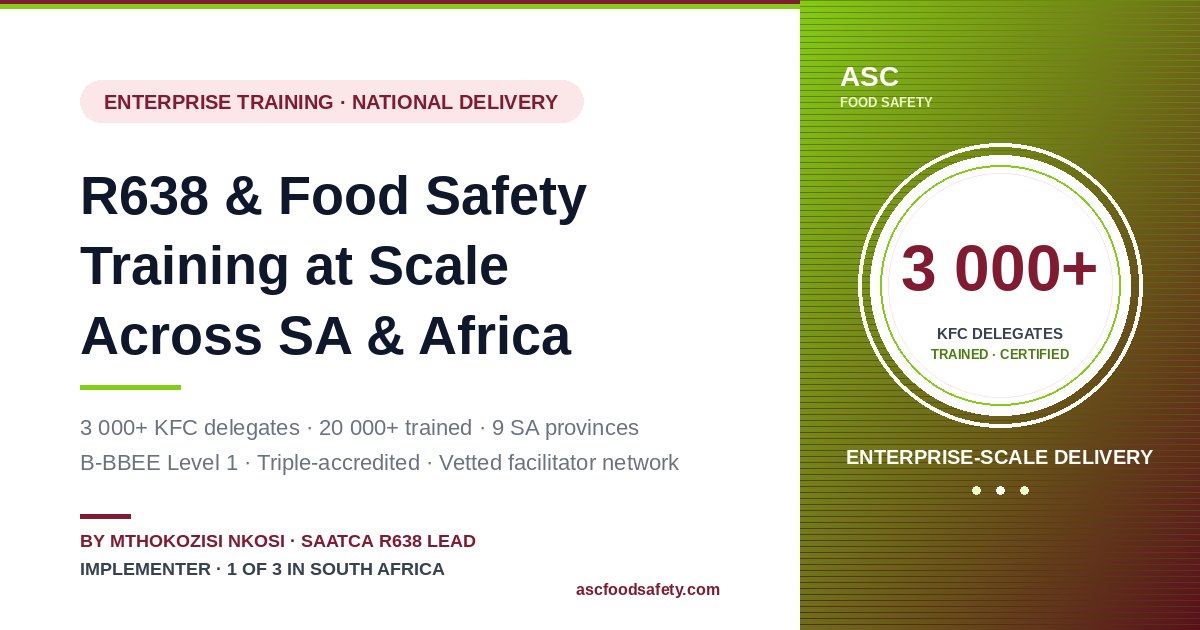
Enterprise R638 & Food Safety Training in South Africa: How ASC Trains Thousands at Scale Across 9 Provinces and Africa
When KFC Africa needed to train and certify more than 1 800 KFC persons in charge across their restaurant network under Regulation R638, they did not choose a single-classroom training provider. They chose ASC Food Safety Consultants. This is the operational story of how ASC delivers enterprise-scale food safety training across all nine South African provinces and into the African continent, with the named clients, the verifiable numbers, and the delivery model that makes scale possible.
online · classroom · on-site · blended · TTT
scales without limit
mobilisation time
instructor-led cohorts
1. Can ASC Train Hundreds: Or Thousands: at Once?
This is the question every procurement officer asks first, and the honest answer matters. South Africa’s food safety training market includes excellent boutique providers that work brilliantly with single-site clients but cannot scale to the volume and geographic spread that a national restaurant chain, a multi-site manufacturer, or a pharmaceutical group requires. ASC is structured differently.
ASC was built from inception to scale, both vertically (online infrastructure that can process thousands of concurrent enrolments) and horizontally (a national facilitator network for instructor-led requirements that physically cannot be done online). The combination of these two delivery modes, backed by a Lead Implementer-controlled QA framework that keeps every facilitator delivering the same content to the same standard, is what enables enterprise scale.
The proof is in the delivered programmes. The single largest sustained client programme to date is 1 800+ KFC Africa delegates. The cumulative total trained across all clients exceeds 20,000 food safety professionals nationally. Both numbers are verifiable through ASC’s certificate records and through individual learner enquiries with KFC Africa franchise operators directly.
Most R638 training providers can deliver a course. Few can deliver an enterprise programme: with cohort-level reporting, multi-province coordination, branded learner portals, QR-coded certificates at volume, and the operational discipline to repeat that delivery quarter after quarter without quality drift.
2. The KFC Africa Case Study: 1 800+ Persons in Charge Certified
The KFC programme is not a one-off. It is the operational template ASC applies to other enterprise clients, adapted to each client’s specific industry, franchise structure, and geographic footprint. The programme demonstrates that ASC can: (a) handle multi-thousand-learner volumes; (b) coordinate intake across multiple provinces simultaneously; (c) produce consistent, audit-ready certification records; and (d) sustain the programme across multiple quarters and intake cohorts without the typical “first cohort excellent, fifth cohort tired” quality drift.
3. ASC’s Enterprise Client Roster
Across restaurant chains, food manufacturers, pharmaceutical groups, hospitality operators and tertiary education, ASC’s enterprise client portfolio spans every major SA food-handling sector. A representative sample:
KFC Africa
The largest sustained R638 PIC training programme in ASC’s history, 1 800+ persons in charge trained and certified across the South African franchise network.
Spur Corporation
Multi-brand restaurant group (Spur Steak Ranches, Panarottis, John Dory’s, RocoMamas, Hussar Grill, Casa Bella, The Spur), food safety implementation, training and audit support.
Adcock Ingram
One of South Africa’s leading pharmaceutical manufacturers. Pharma-grade food handling and hygiene training delivered to manufacturing teams handling consumable products.
AB-InBev
Global brewing group. Food safety training and audit support for SA operations.
McCain Foods
Global frozen food manufacturer. Gap analysis audits and food safety training support across SA manufacturing sites.
Cerebos
Salt, seasonings and culinary ingredient manufacturer. Training delivery and food safety system implementation.
Wits University
University of the Witwatersrand. Food safety training and FSMS implementation support for campus food service operations.
Panarottis
Italian-themed family restaurant chain (Spur Corporation). Multi-site R638 PIC and food handler training across franchise network.
John Dory’s
Family seafood restaurant chain. R638 PIC training, HACCP for kitchen team leaders, food handler training.
Hussar Grill
Premium steakhouse restaurant chain. R638 PIC and HACCP training plus food safety culture implementation.
RocoMamas
Smash burger casual dining chain. R638 PIC and food handler training across the restaurant network.
Chateau Gateaux
Premium bakery and dessert specialist. Food handler training and HACCP support across retail outlets.
When a procurement officer at a tier-1 SA company asks “have you delivered at our scale before?”: the answer is yes, repeatedly, across multiple industries, with verifiable certification records.
4. National Coverage: 3 ASC Offices + 9-Province Facilitator Network
ASC’s national reach is anchored by three physical offices in three different provinces (Gauteng (Randburg), Eastern Cape (Gqeberha HQ) and Western Cape (Cape Town)) plus a national facilitator network of SAATCA registered and HPCSA registered assessors operating across all nine SA provinces.
Gauteng: Randburg Office
272 Oak Avenue, Ferndale · +27 10 500 4661 · Serving Joburg, Sandton, Soweto, Pretoria, Tshwane, Ekurhuleni, Vereeniging, Vanderbijlpark and the entire province.
Eastern Cape: Gqeberha HQ
14 Brickmakers Kloof Road, South End · +27 41 004 0382 · Serving Gqeberha, Uitenhage, Despatch, East London, Mthatha and broader EC.
Western Cape: Cape Town Office
183 Albion Springs, Rondebosch · +27 21 300 4024 · Serving Cape Town CBD, V&A, Sea Point, Stellenbosch, Paarl, Franschhoek, Hermanus, George.
KwaZulu-Natal: Network Facilitators
Network facilitators serving Durban, Umhlanga, Pinetown, Ballito, Pietermaritzburg, Richards Bay, Port Shepstone and Newcastle.
Free State: Network Facilitators
Network facilitators serving Bloemfontein, Welkom, Sasolburg, Bethlehem and Mangaung Metro.
Limpopo: Network Facilitators
Network facilitators serving Polokwane, Tzaneen, Phalaborwa, Hoedspruit, Musina and lodge-tourism precincts.
Mpumalanga: Network Facilitators
Network facilitators serving Mbombela, Witbank (Emalahleni), Secunda, Middelburg, White River and Hazyview.
North West: Network Facilitators
Network facilitators serving Rustenburg, Klerksdorp, Mahikeng, Brits and the platinum mining belt.
Northern Cape: Network Facilitators
Network facilitators serving Kimberley, Upington, Springbok and the agri-business and mining catchment.
The result: enterprise clients can deploy a single training programme across all nine provinces simultaneously, with consistent curriculum, consistent assessment, and consistent QR-coded certificate output, coordinated from ASC’s three regional offices and delivered locally by network facilitators where instructor-led delivery is required.
5. The Facilitator Network Model: Quality at Scale
The single biggest risk in scaled training delivery is quality drift, the gap between what the lead provider designs and what the front-line facilitator actually delivers in a classroom in another city. ASC’s facilitator network model is structured specifically to close that gap.
1Lead Implementer-Designed Curriculum
Every training course in ASC’s portfolio is designed and certified personally by Mthokozisi Nkosi, an R638:2018 implementer on the SAATCA register (RG003). Facilitators do not improvise content. They deliver Lead Implementer-validated material with Lead Implementer-validated assessments.
2Facilitator Competency Assessment
Every facilitator in the network completes ASC’s internal facilitator competency assessment before being authorised to deliver ASC training. The assessment covers content mastery, assessment methodology, and learner-engagement standards.
3Live Zoom Final Assessment by ASC Assessor
Regardless of who delivers the classroom or self-paced content, every learner completes a final live Zoom video-call assessment with a SAATCA-credentialed ASC assessor, not the facilitator who delivered the course. This separation ensures the final certification judgement is independent of the training delivery.
4QR-Coded Certificate Issued Centrally
Certificates are issued centrally by ASC head office, not by individual facilitators. Every certificate has a unique QR code that links to ASC’s central verification system. EHPs can scan the code at inspection and confirm the learner’s identity, assessment date, and certification validity instantly.
5Periodic Facilitator Audit
Facilitators are periodically audited by ASC’s QA team. Underperforming facilitators are coached, retrained, or removed from the network. The model ensures every learner receives the same standard of training regardless of which facilitator delivered their course.
6. Vetted Overflow Capacity: For Surge Requirements
For enterprise mandates that exceed ASC’s standing facilitator capacity (for example, a multi-site rollout requiring simultaneous classroom delivery at 15 sites in a single week) ASC maintains a panel of vetted external facilitators who can be activated under ASC’s QA framework.
These overflow facilitators are not unrelated third parties subcontracted blindly. They are:
- Pre-vetted against ASC’s facilitator competency standard: same assessment as standing-network facilitators
- Audited annually for content mastery and delivery quality
- Supervised by ASC’s Lead Implementer during every surge engagement
- Required to deliver Lead Implementer-validated curriculum only: no off-script content
- Issued certificates centrally through ASC: no facilitator-issued certificates
- Available within 7–14 working days for surge mobilisation
This model means there is effectively no upper limit on the enterprise volume ASC can deliver. The surge capacity scales with the mandate. Standing capacity handles the steady-state programme; vetted overflow handles peaks.
7. Five Enterprise Delivery Modes
ASC’s enterprise training is delivered through five distinct modes, selected per client according to their geographic spread, learner profile, time-to-certification requirement, and budget.
1. Online Self-Paced
Learners enrol through ASC’s online platform and complete courses at their own pace. Live Zoom assessment scheduled within 14 days. QR-coded certificate issued on pass. Most cost-efficient mode for large volumes.
2. Instructor-Led Classroom
Cohort training at ASC offices (Randburg, Gqeberha, Cape Town) or at hired training venues nationwide. Suitable for learners who prefer in-person classroom learning.
3. On-Site at Client Premises
ASC facilitators travel to the client’s premises, restaurant, factory, hotel, hospital, lodge. Minimises learner travel costs and allows training to be tailored to the actual operational context.
4. Blended Cohorts
Combination of online self-paced (theory) and instructor-led on-site (practical application + live assessment). Most engaging for adult learners. Best balance of cost and learning outcomes.
5. Train-the-Trainer (TTT)
ASC certifies the client’s internal trainers to deliver R638 and food handler training in-house under ASC’s accreditation framework. Best for multi-site clients needing perpetual in-house capacity.
8. Train-the-Trainer: In-House Capacity Building
For multi-site clients with perpetual training needs (large restaurant groups, multi-province manufacturers, retail chains with continuous staff turnover), running every training cohort through ASC may not be the most cost-efficient model. The alternative is train-the-trainer: ASC certifies the client’s internal trainers to deliver R638 and food handler training in-house, under ASC’s SAATCA registered and HPCSA CPD accredited framework.
How the TTT model works:
- 5-day TTT certification programme: the client’s nominated trainers complete an intensive certification under the Lead Implementer’s supervision
- Learner-manual licensing: the client licenses ASC’s Learner Manual, R638 PDF, and assessment materials for internal use
- QR-coded certificate issuance through ASC: even though training is delivered in-house, certificates are still issued through ASC’s central QR-verification system, maintaining the regulatory credibility of the certificate
- Annual recertification of in-house trainers: to maintain accreditation alignment
- Ongoing QA support: ASC’s Lead Implementer is available for content questions, curriculum updates, and complex compliance scenarios
- Per-learner certification fee: cost-efficient for high volumes
9. Pan-African Reach: Beyond South Africa
While R638 specifically is South African legislation, food safety training extends across Sub-Saharan Africa, and ASC delivers across the continent through three operational channels.
Channel 1: Online Self-Paced (Universal Access)
ASC’s online learning platform is accessible from any country with internet connectivity. Learners across Botswana, Namibia, Zimbabwe, Mozambique, Lesotho, Eswatini, Zambia, Malawi, Kenya, Uganda, Tanzania, Nigeria and Ghana can enrol and complete ASC’s HACCP, Advanced HACCP, BRCGS, FSSC 22000 and Food Safety Culture courses, all delivered against internationally recognised standards (Codex Alimentarius, GFSI-recognised certification schemes) that apply across the continent.
Channel 2: Virtual Instructor-Led for Cross-Border Teams
For corporate clients with operations spanning multiple African countries, ASC delivers virtual instructor-led training via Zoom, MS Teams or client-preferred platforms. The Lead Implementer or a network facilitator delivers live training to a geographically distributed cohort, same content, same assessment, same QR-coded certificate.
Channel 3: Scheduled In-Country Missions
For major enterprise clients with concentrated operations in a specific country, ASC mobilises in-country training missions, facilitators travel to deliver classroom or on-site training in the client’s home market. This mode is most cost-efficient for cohorts of 20+ learners in a single location.
10. B-BBEE Level 1 Procurement Advantage
For South African enterprise clients with B-BBEE-conscious procurement strategies, ASC’s B-BBEE Level 1 status delivers material procurement advantage:
- 135% procurement recognition: every Rand spent with ASC counts as R1.35 toward the client’s BEE preferential procurement scorecard
- Highest possible B-BBEE tier: Level 1 is the top contributor band
- Critical for tier-1 listed companies and state-owned enterprises: both have aggressive BEE procurement targets
- Available to verify: ASC’s B-BBEE certificate is issued by a SANAS-accredited verification agency and available on request
For procurement officers, this transforms training spend from a cost line into a BEE scorecard contribution. Many enterprise clients have explicit policies favouring B-BBEE Level 1 suppliers; ASC qualifies.
11. The Complete Enterprise Training Stack
ASC’s enterprise training stack covers the full R638 → HACCP → FSSC 22000 / BRCGS pathway. Volume pricing applies across all courses.
Food Safety Practices for Persons in Charge of Food Premises
R1 699 · enterprise volume pricing from 10 enrolments
8-hour course · 4 modules · Lead Implementer-designed · live Zoom assessment · WhatsApp support · QR-coded HPCSA CPD accredited certificate · lifetime access · branded landing pages available for enterprise clients
The legally required PIC training under R638 Section 10(1)(a). The course delivered to 1 800+ KFC Africa delegates and used across ASC’s enterprise client portfolio.
Basic Food Hygiene Awareness for Food Handlers
R420 per handler · volume pricing from 10 enrolments
HPCSA CPD accredited · self-paced · per-staff certification · printable assessment records · branded learner portal available
For every food handler in the client’s operation, kitchen staff, line cooks, dishwashers, baristas, front-of-house staff who touch glasses, plates or cutlery. Required by R638 Section 10(1)(b). Volume pricing typical for kitchen teams of 10+.
HACCP for Supervisors and HACCP Teams
R2 730 · enterprise volume pricing available
Codex 7 HACCP principles · designed by Lead Auditor (Exemplar Global · IRCA) · CCP determination · validation methodology
For head chefs, kitchen managers, HACCP team leaders and any staff member overseeing HACCP-based food safety controls. Essential for restaurants serving high-risk foods, food manufacturers, hotel central kitchens and corporate-supplier operations.
Advanced HACCP System Implementation
R3 950 · enterprise pricing for QA team cohorts
Validation methodology · environmental monitoring trend analysis · audit defence · real-world SA case studies
For QA managers, senior food safety specialists, and HACCP team leaders at food manufacturers and central production kitchens. Real-world case studies: persistent Listeria findings in RTE environments, allergen mislabelling, repeated CCP deviations, cooling validation failures.
Food Safety and Quality Culture (FSQC)
Self-paced · enterprise pricing for management cohorts
Aligned to BRCGS Clause 1.1.2, FSSC 22000 V7 Clause 2.5.8 and SQF 2.1.1.2. The 5 GFSI culture dimensions: Vision & Mission · People · Consistency · Adaptability · Hazards & Risk Awareness. Required by GFSI-recognised certification schemes.
12. How to Engage ASC for Enterprise Training
ASC’s enterprise engagement model is procurement-friendly and operationally fast. The typical workflow:
1Initial Discovery Call (30–45 minutes)
A no-obligation discovery call with ASC’s enterprise team to understand the client’s training requirement, learner count, geographic spread, time-to-certification deadline, delivery mode preference, B-BBEE procurement requirements, and integration with existing client systems.
2Written Proposal (within 5 working days)
A detailed written proposal covering scope, delivery mode, facilitator allocation, cohort structure, timeline, per-learner pricing, total programme cost, B-BBEE recognition value, contract terms, and milestone deliverables. Procurement-ready for vendor onboarding processes.
3Vendor Onboarding (parallel with contract)
ASC provides company registration, tax clearance, B-BBEE certificate, SAATCA / HPCSA / FoodBev SETA accreditation certificates, insurance certificates, and bank confirmation letters for the client’s vendor onboarding system. Most enterprise clients complete onboarding within 2 weeks.
4Contract Sign-Off & Mobilisation
On contract sign-off, online enrolment is enabled within 24 hours. For instructor-led delivery, facilitator allocation is finalised within 7–14 working days and the first cohort begins within 2–4 weeks depending on geographic spread.
5Cohort Delivery with Per-Cohort Reporting
Each cohort is delivered with structured reporting, daily attendance, assessment outcomes, certificate issuance, and exception flagging. Reports are delivered to the client’s nominated programme manager weekly during active delivery.
6Programme Closure & Quarterly Reviews
At programme closure, ASC provides a comprehensive completion report covering all learners trained, certificates issued, exception cases, and recommendations for ongoing food safety culture support. For multi-quarter programmes, quarterly reviews with the client’s leadership are standard.
13. Enterprise Frequently Asked Questions
Can ASC train large corporate groups?
Yes. ASC has trained more than 20,000 food safety professionals nationwide, including over 3,000 delegates from KFC Africa alone in a single sustained programme. Other enterprise clients include Spur Corporation, Adcock Ingram, AB-InBev, McCain Foods, Cerebos and Wits University. National facilitator network from three offices plus vetted overflow capacity.
How many delegates can ASC train simultaneously?
For online enrolment, no practical upper limit, the platform scales horizontally. For instructor-led delivery, ASC’s standing facilitator panel covers all 9 SA provinces. For surge requirements above standing capacity, vetted overflow facilitators can be mobilised within 7–14 working days. Largest single client programme to date: 1 800+ KFC Africa delegates.
Does ASC train clients in countries outside South Africa?
Yes: across Sub-Saharan Africa via three channels: online self-paced (universal access from any African country); virtual instructor-led for cross-border teams; scheduled in-country missions for major enterprise clients. ASC’s HACCP, Advanced HACCP, FSSC 22000 and BRCGS courses apply internationally; R638 specifically is SA legislation.
What is ASC’s largest training programme to date?
The KFC Africa Persons in Charge programme, over 3,000 delegates trained and certified through ASC’s R638 curriculum across multiple intake cohorts. One of the largest sustained corporate food safety training programmes in South Africa by any provider.
How does ASC maintain quality at scale?
Three structural controls: Lead Implementer-designed curriculum delivered consistently by all facilitators; Live Zoom assessment by a SAATCA-credentialed assessor independent of the training facilitator; Centrally-issued QR-coded certificates. Facilitator network audited periodically; overflow facilitators vetted against same standard.
Does ASC offer B-BBEE preferential procurement?
Yes. ASC is a B-BBEE Level 1 contributor, 135% procurement recognition. Every Rand spent counts as R1.35 toward the client’s preferential procurement scorecard. Critical for tier-1 listed SA companies and SOEs.
What is ASC’s train-the-trainer programme?
5-day TTT certification programme that authorises the client’s internal trainers to deliver ASC’s R638 and food handler training in-house, with ongoing QA support and centrally-issued QR-coded certificates. Best for multi-site clients needing perpetual in-house training capacity while preserving accreditation credibility.
How quickly can ASC mobilise for an enterprise training programme?
Online: 24-hour mobilisation from contract sign-off. Instructor-led classroom or on-site: 2–4 weeks for first cohort depending on geographic spread. Surge facilitator mobilisation: 7–14 working days.
Are ASC certificates accepted at every SA municipality?
Yes. ASC’s HPCSA CPD accredited certificates are accepted at every Environmental Health Department across all 278 SA municipalities for R638 Person in Charge certification. The QR-code on each certificate is verifiable instantly by inspecting EHPs.
Can ASC integrate training records into client HR systems?
Yes. For enterprise clients with HR/LMS integration requirements, ASC supports CSV/API exports of learner enrolment, assessment outcome and certificate data into common HR platforms (Sage, SAP SuccessFactors, Workday) and learning management systems.
Planning food safety training across several sites?
Triple-accredited (SAATCA · HPCSA · FoodBev SETA). Led by SAATCA R638:2018 Lead Implementer Mthokozisi Nkosi (register RG003). 3 600+ course enrolments including 1 800+ KFC Africa delegates. Clients include Spur Corporation, Adcock Ingram, AB-InBev, McCain Foods, Cerebos and Wits University. B-BBEE Level 1 (135% procurement). Five delivery modes. Nine-province facilitator network plus vetted overflow capacity. Pan-African delivery capability.
Book Enterprise Discovery Call
Request Enterprise Proposal
View Course Bundles
Three offices · enterprise enquiries on each: Gqeberha (HQ) +27 41 004 0382 · Randburg +27 10 500 4661 · Cape Town +27 21 300 4024 · WhatsApp the same numbers · info@ascfoodsafety.com
Related ASC Articles
© ASC Food Safety Consultants · SAATCA TC No. 065 · HPCSA · FoodBev SETA 587/00337/1900 · BBBEE Level 1.