
Food safety and quality culture · FSSC 22000 · BRCGS
Online food safety and quality culture training, from the boardroom to the packing line.
Culture is on the audit now, and the findings read the same from site to site: objectives without baselines, a plan without measures, the night shift never reached. ASC has two online courses: one where managers build the culture programme itself, and one for the food handlers whose habits are the culture an auditor actually sees.
Why culture, when the system is documented
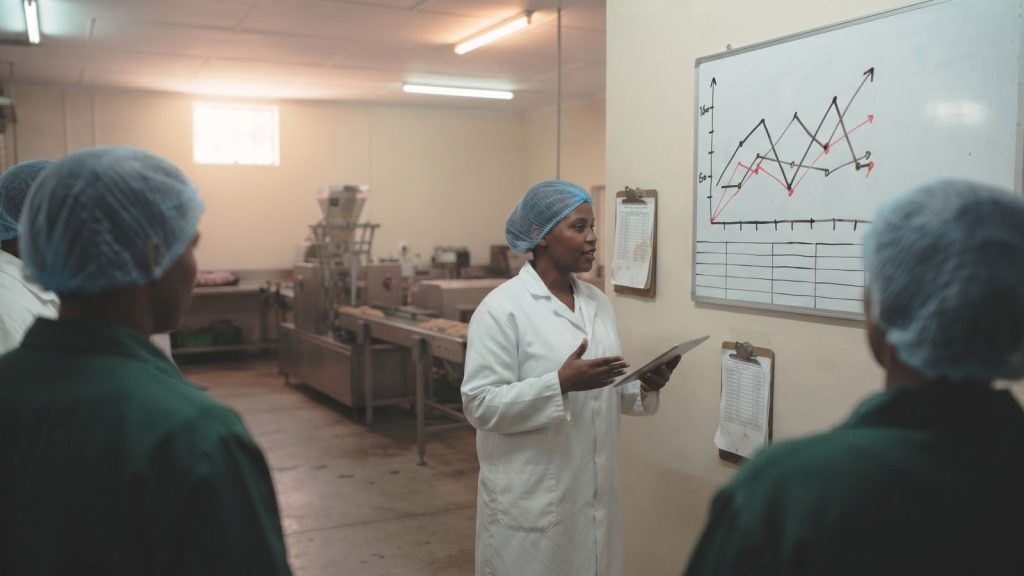
Culture is on the audit now.
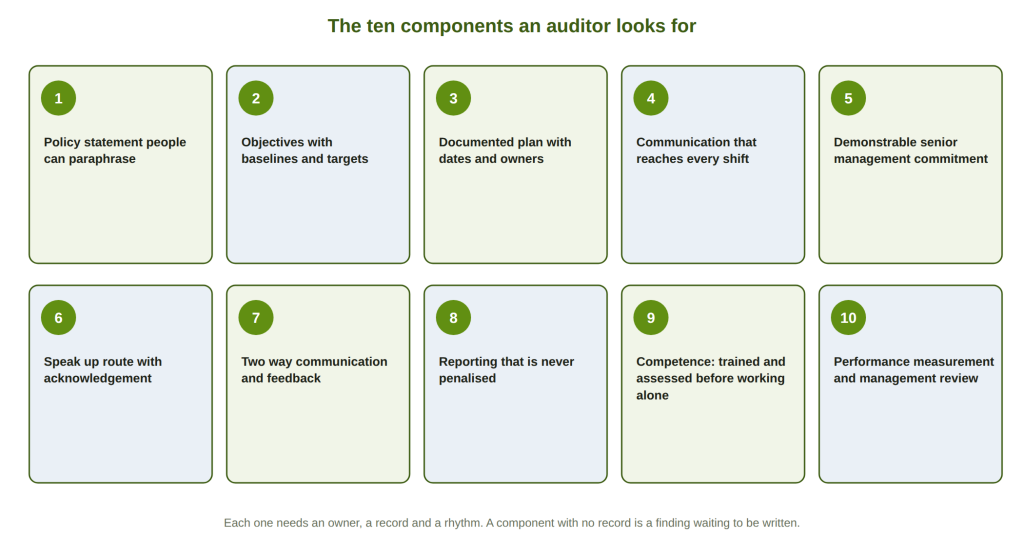
FSSC 22000 Version 7 (2.5.8) and BRCGS Food Safety Issue 9 (1.1.2) require a food safety and quality culture plan, visible senior management commitment, and proof that it is measured and improved. An auditor no longer asks whether you have a culture. They ask for the evidence.
Free tools from the course
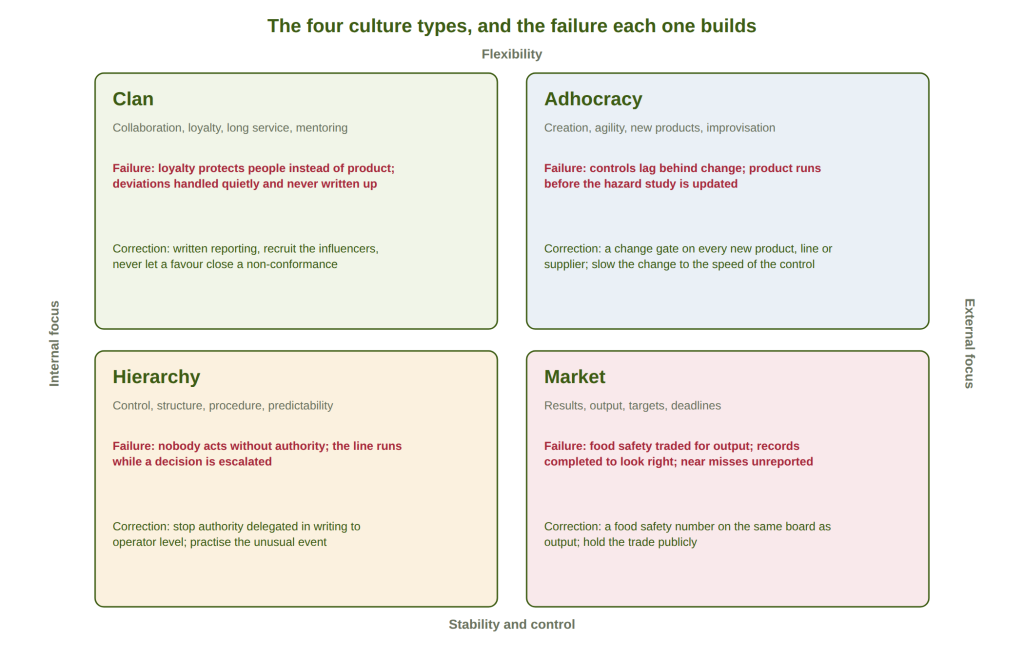
Which culture is yours?
Every culture type fails in its own predictable way. The management course gives you four working tools to find yours, cost it, measure it and plan it. Try them now, free.
The two courses
One to build the programme. One for the people who live it.

Food Safety and Quality Culture for Management and Supervisors
For production and QA managers, shift supervisors, HR and training, engineering and the site leader. You build the programme on a case study site with the document set ASC installs on client sites, and keep the tools.
- Foundations of a mature food safety and quality culture5 lessons
- Culture, the business case and the words that matter6 lessons
- Measuring your culture with evidence5 lessons
- Leading behaviour, managing crisis and sustaining the gain7 lessons
- Building and running the culture programme10 lessons
- Final assessment and feedbackAssessed

Food Safety and Quality Culture for Food Handlers
For operators, packers, cleaners, storemen and drivers. Twenty short lessons, five animated videos and twelve timed games, on any phone, with a supervisor observation form for your culture file.
- Food safety, quality and the culture we work in7 lessons
- Audits, customers and me3 lessons
- My job every day, and speaking up9 lessons
- The records I use4 lessons
- Assessment and QR verified certificateAssessed
Inside the management course
The frameworks you take back to site.
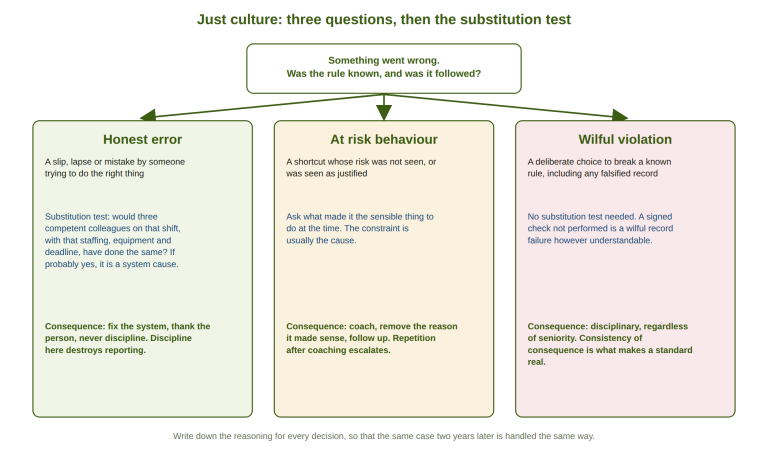
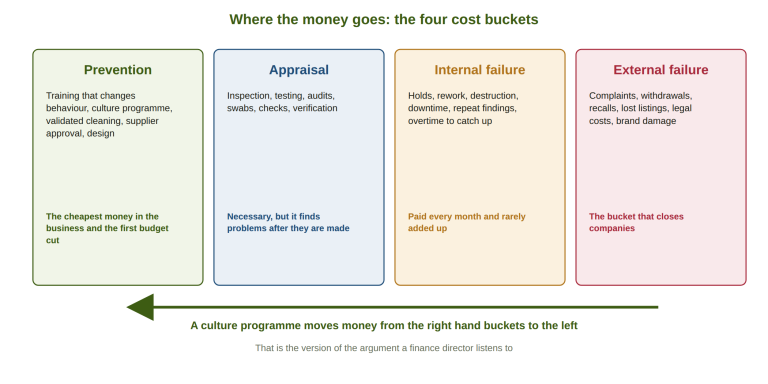
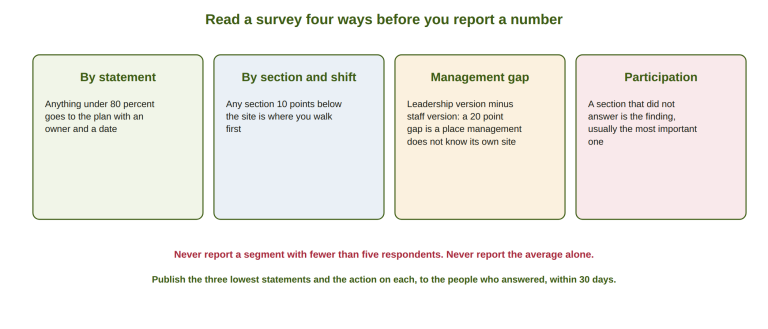
What auditors find
The culture findings auditors write, again and again.
These six come up on site after site. The management course is built so that you leave with the evidence for each one.
No baseline
Culture objectives with no starting measure, so nobody can show improvement.
A plan with no measures
Activities listed, but nothing that shows whether any of them worked.
Night shift not reached
Surveys, talks and posters that only ever happen on day shift.
A survey, then silence
Results reported as an average and never fed back to the people who answered.
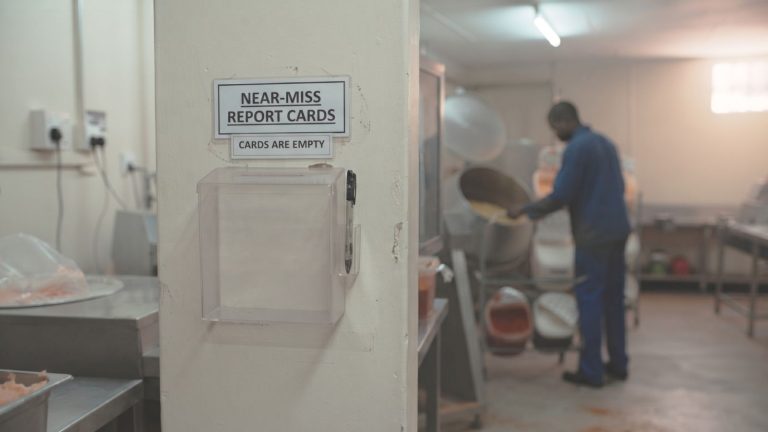
An empty near-miss box
No reports is not good news. It usually means people do not believe anything will happen.
Leaders not seen
Commitment on paper, but no manager on the floor asking about food safety.

After the course: measure it
The Culture Pack, R750 per site per year.
The tool your managers use to run the programme the course teaches, in a browser on ascfoodsafety.com.
- Anonymous worker and manager questionnaires on a QR code
- A manager dashboard for training, feedback, GMP inspections, observations and maturity
- Suggested actions drafted from the evidence
- A one click, audit ready report with an action plan
- Mapped to FSSC 22000 2.5.8, BRCGS 1.1.2, SQF, IFS and the GFSI culture paper
Which course do I need?
Find yourself in the left column.
Most sites put managers and supervisors on the management course and everyone on the floor on the food handler course. For five or more learners, ask for a group arrangement.
KFC team members trained through ASC. Group managers track every learner’s progress and certificate on the ASC manager dashboard.
| If this is you | The course | Price |
|---|---|---|
| I own the culture plan for our FSSC 22000 or BRCGS site | Management and Supervisors | R1 195 |
| I am a production, QA, HR or engineering manager | Management and Supervisors | R1 195 |
| I run a shift and my team is who the auditor talks to | Management and Supervisors, and put your team on Food Handlers | R1 195 |
| I am the site leader and will be asked about commitment | Management and Supervisors | R1 195 |
| I work on the line, pack, clean, store or drive | Food Handlers | R560 |
| We need evidence, per person, for the culture file | Food Handlers: certificate plus signed observation form | R560 |
| We are training the whole site | Culture bundle: both courses | R1 404 |
Better value, and free reading
The bundle, and three guides.
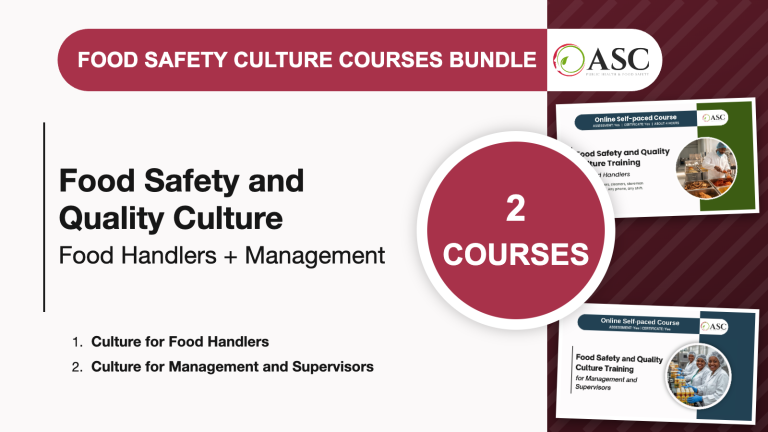
Both culture courses
Management and food handlers together, for less than buying each one separately.
See the bundle →
What culture training food handlers need
What FSSC 22000 and BRCGS expect, and what actually changes behaviour on the floor.
Read the guide →Near-miss reporting: getting staff to speak up
Why the box stays empty, and what makes people report.
Read the guide →How to measure food safety culture
The method behind the Culture Pack, for FSSC 22000, BRCGS, SQF and IFS.
Read the method →Questions people ask
Before you enrol.
Still unsure which course fits? A person answers WhatsApp during office hours.
Is food safety culture a requirement, or just best practice?
It is a requirement. FSSC 22000 Version 7 (additional requirement 2.5.8) and BRCGS Food Safety Issue 9 (clause 1.1.2) require a food safety and quality culture plan, visible senior management commitment, and evidence that culture is measured and improved. SQF and IFS have equivalent requirements, all aligned with the GFSI position paper A Culture of Food Safety.
Which course do we need?
Managers, supervisors, QA, HR, engineering and the site leader do the Management and Supervisors course, R1 195: it builds the culture programme itself. Everyone who touches product does the Food Handlers course, R560: it builds the behaviour an auditor sees on the floor. Most sites need both, which is why there is a bundle.
How do you measure something as intangible as culture?
With four sources of evidence: a survey, observation on the floor, food safety indicators and a maturity assessment. Module 3 of the management course teaches how to run a survey that locates the section or shift that needs action, how to read the results four ways, and how to close the loop within 30 days. The Culture Pack runs the surveys and dashboard on your site afterwards.
We already have HACCP and procedures. Why do we need culture training?
Documented systems only protect consumers when people follow them on every shift and speak up when something is wrong. Culture is what turns the HACCP plan into behaviour, and it is now audited on its own. The findings read the same from site to site: objectives without baselines, a plan without measures, and the night shift never reached.
Does this apply outside South Africa?
Yes. FSSC 22000, BRCGS, SQF and IFS are international schemes and the culture requirements are the same wherever the site is. The case studies come from South African factories, packhouses, kitchens and shops, the courses are in English, and prices are in South African rand.
Is the course online?
Yes. Both courses are self paced and run on a phone or a laptop. The food handler course is about four hours in short pieces, so staff can do it without losing a production day. The management course is about ten hours.
What certificate do we get, and is ASC accredited?
Both courses end with a Certificate of Achievement that an auditor can verify by QR code, and the food handler course adds a workplace observation form for the supervisor to sign. ASC is a FoodBev SETA accredited provider (587/00337/1900), a SAATCA registered online training provider (TC No. 065), and the training is HPCSA CPD accredited.

Who writes the courses
Written by a lead auditor who assesses culture on site.
The culture courses are led by Mthokozisi Nkosi, founder of ASC and an HPCSA-registered Environmental Health Practitioner, with ASC trainers and subject experts who install culture programmes on client sites. Culture sits on top of the basics: see GMP training and HACCP training, and for the scheme itself, FSSC 22000 or BRCGS.
Train the leaders, then the team.
Management and Supervisors R1 195. Food Handlers R560. Both for R1 404. Group quotes within one working day, and a person answers WhatsApp during office hours.