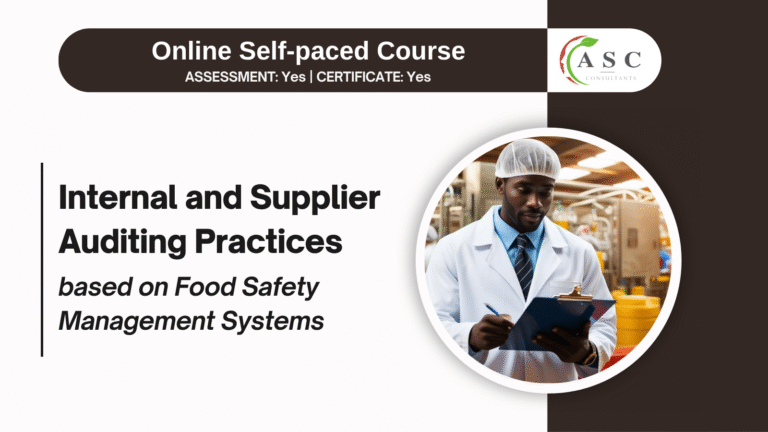
Master Internal and Supplier Auditing for Food Safety Management Systems

Published: April 2026 | Category: Food Safety Training, Professional Development, FSMS Certification | Author: ASC Food Safety Training Team

COURSE SPOTLIGHT: Become a certified internal and supplier auditor for food safety management systems with our comprehensive 20-hour online course. Gain practical auditing skills, proven templates, and hands-on case study experience – all for R3,500 with lifetime access. Recognized across South Africa from Cape Town to Polokwane, Johannesburg to Durban.


Why Every Food Business in South Africa Needs Qualified Internal Auditors

If you’re a QA Manager in Johannesburg, a Production Manager in Cape Town, a Quality Controller in Durban, or a Food Safety Team Member anywhere across South Africa’s nine provinces – this message is for you.

Here’s the reality: Your food business cannot achieve or maintain FSSC 22000, BRCGS, ISO 22000, IFS Food, or GlobalG.A.P. certification without effective internal auditing. It’s not optional – it’s a mandatory requirement written into every major food safety standard.

But here’s the question that keeps food safety professionals up at night:

“Is your internal auditing programme actually effective? Are your auditors adequately trained and motivated to identify real food safety risks – or are they just ticking boxes to satisfy the certification body?”

If you’re not 100% confident in your answer, you’re not alone. Across South Africa – from food manufacturing facilities in Gauteng to wine estates in the Western Cape, from citrus packhouses in the Eastern Cape to dairy processors in KwaZulu-Natal – businesses struggle with the same challenge:

Their internal audits are compliance exercises, not improvement tools.


The High Cost of Ineffective Internal Auditing

When your internal auditing programme is weak, the consequences are severe:

  • Certification audit failures – The external auditor finds non-conformances that should have been caught months ago by your internal audits
  • Corrective Action Request (CAR) overload – Minor issues become major non-conformances because internal audits didn’t identify them early
  • Lost certification opportunities – Your facility isn’t audit-ready when certification bodies visit because internal audits didn’t prepare you
  • Supplier quality failures – Supplier audits miss critical risks, resulting in product recalls, contamination incidents, or quality failures
  • Wasted resources – You’re paying for internal audits that deliver paperwork, not improvement
  • Demotivated teams – Your auditors view auditing as bureaucratic burden rather than value-adding activity
  • Food safety risks – The most serious consequence: genuine food safety hazards go undetected because auditors don’t know what to look for or how to assess risk effectively

Real example from a Johannesburg food manufacturer: “We were conducting internal audits quarterly as required by FSSC 22000. Our internal auditor – a production supervisor who received minimal training – would spend 2 hours walking through the factory, tick off a generic checklist, and report ‘no findings.’ Three months later, the FSSC 22000 certification auditor found 12 non-conformances in the first hour. We failed the audit. That failure cost us R180,000 in lost business while we addressed the issues and rescheduled the audit. All because our internal auditor didn’t know how to audit effectively.”


The Solution: Professional Internal Auditor Training That Actually Works

What if your internal auditors could:

  • Identify real food safety risks – not just tick boxes on generic checklists
  • Conduct audits that certification bodies respect – using the same methodologies and standards as external auditors
  • Write clear, actionable audit findings – that drive genuine corrective actions, not defensive arguments
  • Evaluate suppliers objectively – identifying critical risks before they become product failures or recalls
  • Verify corrective actions effectively – ensuring problems are solved, not just documented
  • Add genuine value to your business – making internal audits a competitive advantage, not a compliance burden

That’s exactly what our Internal and Supplier Auditing Practices course delivers.


Course Overview: What You’ll Master in 20 Hours

This isn’t generic auditor training. This is practical, hands-on, immediately applicable training designed specifically for food safety professionals working with ISO 22000, FSSC 22000, BRCGS, IFS Food, and GlobalG.A.P. standards across South Africa.

Module 1: Relevant Standards, Requirements and the Importance of FSMS

Duration: 3 lessons + knowledge test

What you’ll learn:

  • Comprehensive overview of food safety auditing requirements across all major FSMS standards
  • Why internal auditing is critical for food safety performance – not just certification compliance
  • The regulatory and legal context for internal auditing in South African food businesses
  • How internal audits integrate with your overall food safety management system

Why this matters: You can’t audit effectively if you don’t understand the standards you’re auditing against. This module ensures you have solid foundational knowledge of FSMS requirements and why auditing matters.

Module 2: An Overview of Different Process-Based Food Safety Management Systems

Duration: 10 lessons + 2 knowledge tests

What you’ll learn:

  • ISO 22000 – Structure, requirements, and specific internal audit clauses
  • FSSC 22000 – Additional requirements beyond ISO 22000, internal audit programme expectations
  • BRCGS Food Safety – Comprehensive coverage of internal audit requirements (Clause 3.5), senior management responsibilities, audit frequency, scope, and competence requirements
  • IFS Food – Internal audit expectations, self-assessment requirements
  • GlobalG.A.P. – Internal audit and self-assessment requirements for agricultural operations
  • How internal audit impacts food safety performance and management system effectiveness
  • Comparing audit requirements across different standards

Why this matters: Different standards have different audit requirements. Whether you’re implementing FSSC 22000 for a Johannesburg beverage manufacturer, BRCGS for a Cape Town bakery exporting to UK retailers, or GlobalG.A.P. for a Limpopo avocado packhouse – you need to know the specific audit requirements for YOUR standard.

Practical insight: This module includes detailed breakdowns of audit clauses in each standard, so you know exactly what certification auditors will be looking for when they assess your internal audit programme.

Module 3: The Audit Process (Templates Included)

Duration: 11 lessons + 2 knowledge tests + practical activities

This is where theory becomes practice. You’ll learn the complete audit process from start to finish:

Planning Phase:

  • Compiling an audit programme – Annual planning, resource allocation, scope determination (includes practical template example)
  • Creating audit plans – Detailed audit schedules, checklists, resource preparation (includes practical template example)
  • Defining audit objectives, scope, and criteria for each audit
  • Selecting appropriate auditors and avoiding conflicts of interest

Execution Phase:

  • Conducting opening meetings – Setting the tone, explaining scope, securing cooperation (includes practical example)
  • Conducting the audit – Evidence gathering, interviewing techniques, observation methods, objective assessment (includes two practical examples)
  • Audit principles: integrity, fair presentation, due professional care, confidentiality, independence, evidence-based approach
  • Conducting closing meetings – Presenting findings, classifying non-conformances, agreeing timelines (includes practical example)

Competence Development:

  • Requirements for food safety auditors – knowledge, skills, personal attributes
  • How to develop auditor competence over time
  • Maintaining objectivity and professional skepticism

PRACTICAL TEMPLATES INCLUDED:
You receive actual, field-tested audit templates you can use immediately in your facility:

  • ✔ Annual Audit Programme Template
  • ✔ Individual Audit Plan Template
  • ✔ Audit Checklist Templates (customizable for different FSMS standards)
  • ✔ Non-Conformance Report Templates
  • ✔ Audit Report Templates
These aren’t theoretical examples – they’re professional tools used by experienced auditors across hundreds of South African food facilities.

Case Study Assessment:

You’ll conduct a complete audit based on a realistic case study, demonstrating your ability to:

  • Plan an audit from scratch
  • Identify non-conformances against specified standards
  • Write clear, evidence-based audit findings
  • Classify findings appropriately (major vs. minor vs. observations)
  • Recommend practical corrective actions

Why this matters: This is the most valuable module. You’re not just learning theory – you’re practicing auditing in a risk-free environment before you audit your own facility. By the time you complete this module, you’ll have conducted a complete audit and received feedback on your performance.

Module 4: Report and Follow-Up – Addressing Corrective Actions

Duration: 7 lessons + knowledge test + practical activities

What you’ll learn:

  • The critical difference between correction, corrective action, and preventive action – Many auditors confuse these, resulting in ineffective follow-up
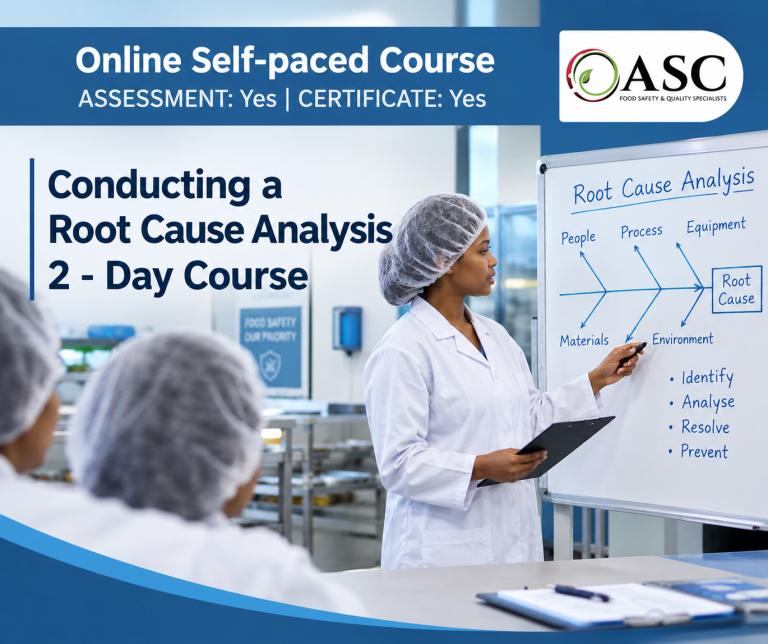
  • The problem-solving process – Systematic approaches to root cause analysis
  • The Five Whys technique – Drilling down to true root causes, not superficial symptoms
  • Writing effective corrective action requests – That get results, not defensiveness
  • Verifying corrective action effectiveness – How to confirm problems are actually solved
  • Certificate suspension, withdrawal, or scope reduction scenarios – When findings are serious enough to threaten certification

Practical insight: An audit is only valuable if it drives improvement. This module ensures your audits result in genuine corrective actions that strengthen your food safety system – not just paperwork that satisfies certification bodies.

Practical Activities – Non-Conformities:

You’ll practice:

  • Identifying real non-conformances vs. observations vs. opportunities for improvement
  • Writing non-conformance reports that are clear, specific, and actionable
  • Conducting root cause analysis on realistic food safety scenarios
  • Evaluating proposed corrective actions for effectiveness

Why this matters: The worst outcome from an internal audit is identifying a real food safety risk but writing such a vague finding that corrective action doesn’t address the root cause. This module ensures your audit findings drive real improvement.


Who Should Take This Course?

This advanced-level course is designed for food safety professionals across South Africa who need to conduct internal audits or supplier audits as part of their role:

✔ Internal Auditors

You’ve been assigned to conduct internal audits for FSSC 22000, BRCGS, ISO 22000, or other FSMS standards – but you need proper training to do it effectively.

✔ Supplier Auditors

You’re responsible for auditing ingredient suppliers, co-packers, or contract manufacturers – and need systematic methods to assess supplier food safety risks objectively.

✔ QA Managers

You oversee the entire quality assurance function and need to ensure your internal audit programme meets certification requirements and drives continuous improvement.

✔ QC Managers

You manage quality control and need auditing skills to verify that quality systems are functioning as designed.

✔ Production Managers

You’re responsible for manufacturing operations and need to understand how internal audits identify production-related food safety risks.

✔ HACCP/Food Safety Team Members

You’re part of the food safety team and need auditing skills to verify HACCP plan effectiveness and identify hazards during facility inspections.

Prerequisites

This is an advanced-level course. To get maximum value, you should have:

  • Successfully completed implementation training for at least one FSMS standard (ISO 22000, FSSC 22000, BRCGS, IFS Food, GlobalG.A.P., etc.), OR
  • Equivalent knowledge and/or practical experience working with food safety management systems

Recommended prerequisite courses:


What Makes This Course Different?

1. Practical Focus – Not Just Theory

This isn’t an academic course about auditing principles. This is practical, hands-on training where you:

  • Watch real audit examples (opening meetings, audit execution, closing meetings)
  • Use professional audit templates immediately
  • Conduct a complete audit as part of your assessment
  • Practice writing non-conformance reports
  • Learn root cause analysis techniques you can apply tomorrow

2. Multi-Standard Coverage

Most auditor training focuses on one standard. This course covers all major FSMS standards:

  • ISO 22000:2018
  • FSSC 22000 Version 6
  • BRCGS Food Safety Issue 9
  • IFS Food Version 8
  • GlobalG.A.P.

Why this matters: Your facility might be certified to FSSC 22000 now, but next year you might pursue BRCGS for UK market access. This course prepares you for multiple standards, making you more valuable to your employer.

3. Professional Templates Included

You receive ready-to-use templates that have been refined through hundreds of real audits across South African food facilities. No need to create audit tools from scratch – customize our proven templates for your specific needs.

4. Self-Paced Online Learning

Study when it suits you:

  • 20 hours of comprehensive content – Complete in 1 week or spread over several months
  • 24/7 access – Study early morning before your shift, evenings after work, or weekends
  • Lifetime access – Revisit materials anytime you need to refresh your knowledge
  • Learn from anywhere in South Africa – No travel to Cape Town, Johannesburg, or Gqeberha required
  • Mobile-friendly – Access on smartphone, tablet, laptop, or desktop

5. Affordable Investment

R3,500 for 20 hours of advanced training + templates + lifetime access + certificate

Compare that to:

  • 2-day in-person auditor courses: R8,000 – R12,000 + travel + accommodation
  • International auditor certification programmes: R15,000 – R25,000
  • Hiring external consultants to train your auditors: R15,000+ per day

This course delivers professional-level training at a fraction of traditional training costs.

6. Certificate of Achievement

Upon successful completion (passing knowledge tests and final assessment), you receive a Certificate of Achievement recognized across South Africa’s food industry. This certificate demonstrates to certification bodies, employers, and clients that you have formal auditor training.


Real Results: How This Course Transforms Internal Auditing Programmes

Case Study: Cape Town Bakery (BRCGS Certification)

The Challenge: A Cape Town bakery supplying UK retailers needed to improve its internal audit programme to satisfy BRCGS requirements. Their previous internal audits were superficial – the internal auditor (production supervisor) would complete audits in 90 minutes, rarely finding any issues. The BRCGS certification auditor repeatedly noted in surveillance audits that “internal audit depth is insufficient” and “internal audits do not adequately verify system effectiveness.”

The Solution: The QA Manager completed this Internal and Supplier Auditing course, then trained two production supervisors using the course materials and templates.

The Results:

  • Audit quality improved dramatically – Internal audits now take 4-6 hours and identify 15-20 findings per audit (mix of major non-conformances, minor non-conformances, and observations)
  • Certification audit performance improved – The next BRCGS surveillance audit found zero new non-conformances – everything had been caught by internal audits first
  • Food safety culture strengthened – Production staff now view internal audits as helpful improvement tools, not punitive compliance exercises
  • Cost savings – Identified and corrected a CCP monitoring failure during internal audit that would have resulted in product hold and potential recall if discovered during certification audit

“Before this course, I was doing audits because BRCGS requires them. Now I understand WHY we audit and HOW to audit effectively. The templates alone were worth the course fee – we use them for every audit now.” – QA Manager, Cape Town Bakery

Case Study: Johannesburg Beverage Manufacturer (FSSC 22000 Certification)

The Challenge: A Johannesburg soft drink manufacturer with FSSC 22000 certification struggled with supplier quality issues. Their supplier audits were tick-box exercises using generic checklists. Multiple ingredient quality failures occurred because supplier audits didn’t identify risks.

The Solution: The Technical Manager and Procurement Manager both completed this course, focusing particularly on Module 3 (audit execution) and Module 4 (corrective actions).

The Results:

  • Supplier audit programme completely redesigned – Using course templates, they developed comprehensive supplier audit checklists specific to each ingredient category
  • Risk-based approach implemented – High-risk suppliers (sugar, flavoring, packaging materials) now receive annual audits; low-risk suppliers receive audits every 2 years
  • Audit findings increased 300% – Not because suppliers got worse, but because auditors now knew what to look for and how to assess objectively
  • Supplier quality improved – Corrective action requests from supplier audits resulted in genuine supplier improvements; ingredient quality failures dropped 60% year-over-year
  • Certification body confidence increased – FSSC 22000 auditor specifically commended the supplier audit programme during recertification audit

“The Five Whys technique from Module 4 completely changed how we approach corrective actions. We’re now solving root causes instead of treating symptoms. Our supplier audit programme is now one of our competitive advantages.” – Technical Manager, Johannesburg Beverage Manufacturer


Course Logistics: Everything You Need to Know

Investment

R3,500.00

Includes:

  • 20 hours of video content
  • Comprehensive learner guide (downloadable PDF)
  • Professional audit templates (editable documents)
  • Knowledge tests after each module
  • Final comprehensive assessment
  • Certificate of Achievement upon successful completion
  • Lifetime access – Revisit materials anytime

Duration & Time Commitment

  • Total content: 20 hours
  • Suggested pace: 4-5 hours per week = complete in 1 month
  • Intensive option: 6-8 hours per day = complete in 1 week
  • Flexible option: 2 hours per week = complete in 10 weeks
  • Enrollment validity: Lifetime – no pressure to rush

Technical Requirements

  • Internet connection (for streaming video content)
  • Computer, tablet, or smartphone
  • PDF reader (for learner guide and templates)
  • Microsoft Word or compatible software (for editing audit templates)
  • No specialized software required

Assessment & Certification

  • Knowledge tests after each module (must pass to progress)
  • Practical activities – auditing exercises and non-conformance writing
  • Final comprehensive assessment covering all modules
  • Case study audit – demonstrate practical auditing competence
  • Pass mark: 70% on all assessments
  • Unlimited attempts – Retake assessments if needed at no additional cost
  • Certificate of Achievement issued immediately upon successful completion (downloadable PDF with QR code verification)

Support

  • Email support for technical or content questions
  • Course forum for peer discussion and knowledge sharing
  • Typical response time: 24-48 hours

Perfect for Food Professionals Across South Africa

Whether you’re working in:

  • Western Cape: Wine estates (Stellenbosch, Paarl, Franschhoek), fruit packhouses (Ceres, Worcester), seafood processors (Hout Bay, Saldanha), Cape Town food manufacturing, hospitality industry
  • Gauteng: Johannesburg food manufacturing, Pretoria/Tshwane processing facilities, Midrand distribution centers, corporate catering operations, fast food franchises
  • Eastern Cape: Gqeberha (Port Elizabeth) automotive catering, citrus packhouses (Sundays River Valley), dairy processors, emerging food businesses
  • KwaZulu-Natal: Durban port-related food businesses, sugar processing, Pietermaritzburg food manufacturing, coastal hospitality
  • Mpumalanga: Nelspruit/Mbombela subtropical fruit packhouses, Kruger tourism catering, mining sector food services
  • Limpopo: Polokwane vegetable packhouses, Tzaneen citrus/avocado export facilities, agricultural processing
  • Free State: Bloemfontein food manufacturing, agricultural processing (maize, sunflower, dairy)
  • North West: Rustenburg mining catering, Mahikeng agricultural operations, food manufacturing
  • Northern Cape: Upington table grape packhouses, Kimberley hospitality, agricultural operations

This online course brings professional auditor training to every province, every city, every food facility across South Africa – no travel required, no time away from work, no accommodation costs.


Frequently Asked Questions

Can I use this training to satisfy internal auditor competence requirements in FSSC 22000, BRCGS, or ISO 22000?

Yes. All major FSMS standards require internal auditors to be “competent” based on education, training, and experience. This 20-hour course with practical assessment demonstrates formal training in auditing principles, techniques, and food safety management systems. Combined with practical auditing experience at your facility, this course satisfies auditor competence requirements.

Does this course cover supplier auditing as well as internal auditing?

Yes. The principles and techniques are identical whether you’re auditing your own facility (internal audit) or a supplier’s facility (supplier audit or second-party audit). The course explicitly addresses both contexts, and the templates can be customized for either purpose.

I work for a small food business with limited budget. Can we train multiple people from the same company using one enrollment?

Each person who wants to receive a certificate must enroll individually. However, companies training 3+ employees qualify for corporate group discounts. Contact us at info@ascfoodsafetytraining.com for group pricing.

How current is the content? Does it cover the latest versions of FSSC 22000 and BRCGS?

The course was last updated in April 2026 and covers:

  • FSSC 22000
  • BRCGS Food Safety
  • ISO 22000:2018 (current version)
  • IFS Food
  • GlobalG.A.P. current requirements

Can I download the videos for offline viewing?

Videos are streamed online for copyright protection. However, the learner guide and all templates are downloadable PDFs/documents that you can keep permanently.

What happens if I don’t pass the assessments?

You have unlimited attempts at all knowledge tests and the final assessment at no additional cost. If you’re struggling with specific content, review the relevant lessons and try again when ready. Most learners pass on their first or second attempt.

Is the certificate recognized by certification bodies?

The Certificate of Achievement demonstrates formal training in internal auditing practices. Certification bodies (SGS, Bureau Veritas, TUV SUD, Intertek, LRQA, etc.) accept evidence of auditor training when assessing internal auditor competence during FSMS certification audits. This certificate, combined with practical auditing experience, satisfies typical competence requirements.

How long do I have access to the course materials?

Lifetime access. Once enrolled, you can revisit the course materials as many times as you want, for as long as the platform exists. No expiry date, no annual renewal fees.


Transform Your Internal Auditing Programme Today

Stop conducting audits that just satisfy certification bodies.
Start conducting audits that genuinely improve food safety and business performance.

R3,500 | 20 Hours | Lifetime Access | Professional Templates Included

13 food safety professionals across South Africa have already enrolled.
Join them in mastering professional internal and supplier auditing skills.


Related Training & Services

Maximize your food safety competence with these complementary courses and services from ASC Food Safety Solutions:

FSSC 22000 Implementation

Learn how to implement FSSC 22000 from scratch – perfect prerequisite before learning to audit FSSC 22000 systems.

View Course »

BRCGS Food Safety Training

Comprehensive BRCGS training covering all requirements including internal audit expectations.

View Course »

Advanced HACCP Implementation

Master HACCP system development – essential knowledge for auditing HACCP effectiveness.

View Course »

Certification Consulting

Need help implementing FSMS before you can audit it? Our consulting team provides hands-on implementation support.

Explore Services »

In-Person Training Courses

Prefer classroom training? Explore our full range of in-person food safety courses delivered across South Africa.

View All Training »


About ASC Food Safety Training:
This course is developed and delivered by ASC Food Safety Consultants, South Africa’s most trusted food safety consultancy. Our training programmes are informed by real-world certification consulting experience across hundreds of South African food facilities – from single-restaurant operators to multinational manufacturers.

Why trust ASC training?

  • 20,000+ professionals trained across all nine South African provinces
  • 8,000+ online students have completed our self-paced courses
  • 100% first-time certification success rate for consulting clients
  • SAATCA & HPCSA accredited training programmes
  • Led by qualified Food Scientists with MPH, MBA, and Lead Auditor credentials
  • 4.92/5 average rating from 1,260+ verified student reviews

Learn more about ASC Food Safety Consultants »


Categories: FSMS Training | Internal Auditing | Supplier Auditing | Professional Development | FSSC 22000 | BRCGS | ISO 22000 | Food Safety Certification

Tags: internal auditing course South Africa, supplier auditing training, FSMS auditor training, FSSC 22000 internal audit, BRCGS internal audit requirements, ISO 22000 auditor training, food safety auditor course, internal audit templates, HACCP auditing, GlobalG.A.P audit training, online food safety training South Africa, Cape Town food safety training, Johannesburg auditor course, Durban FSMS training, Gqeberha food safety, professional auditor training, quality assurance training, QA manager training, food safety certification preparation

Leave a Comment