
Food Loss and Waste Essentials
About Course
Your line loses money in a bin every shift. This course teaches the people standing next to it what to do about it.
South Africa loses or wastes about 10.2 million tonnes of food a year, and close to half of that never reaches a household. It happens inside a fence, on a line, with a shift working. This course is for the people on that line.
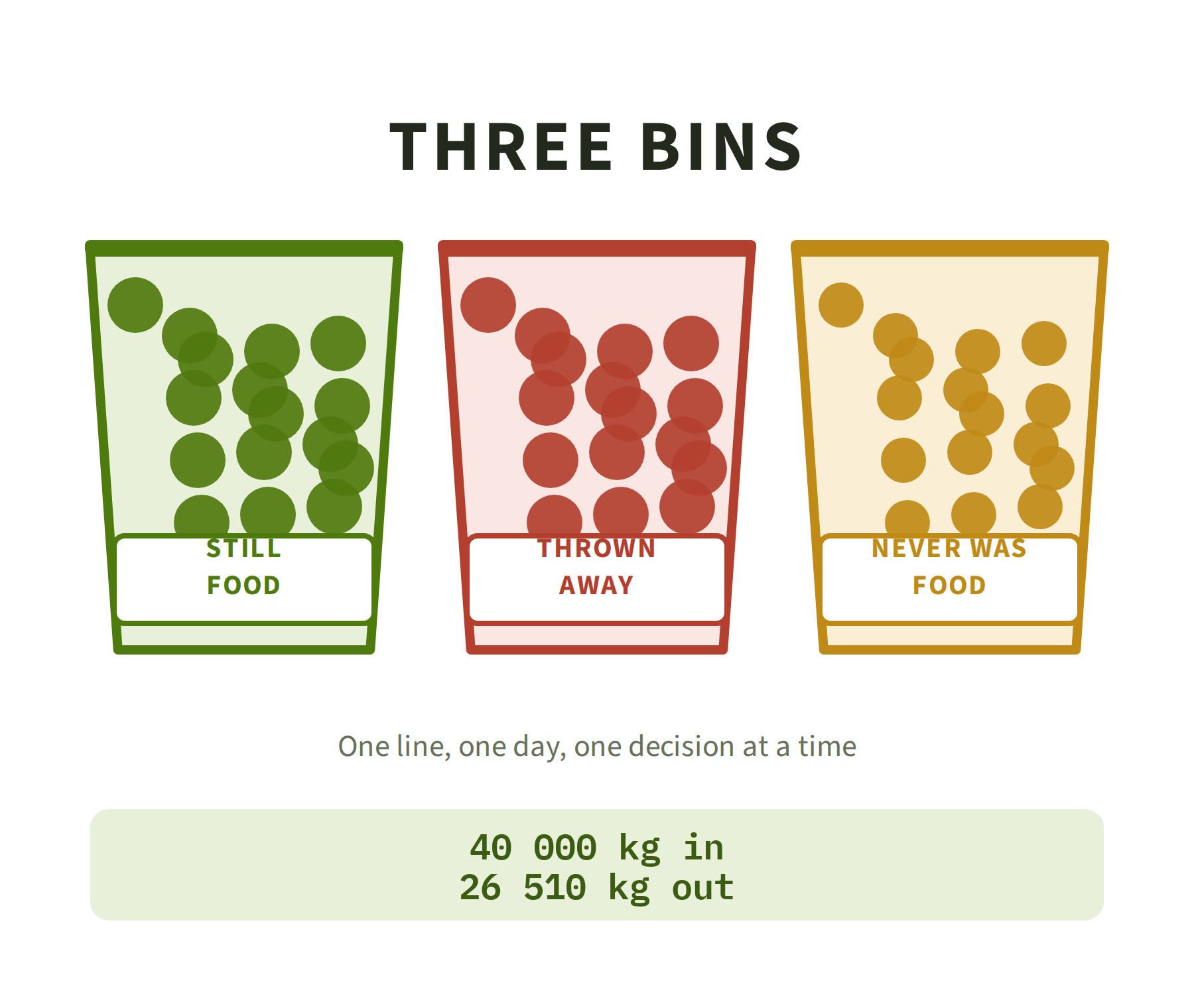
It is built on one real production day at a vegetable freezing plant in Tzaneen: 40 000 kg of butternut in at the gate, 26 510 kg of frozen diced product out at the end. Every lesson, diagram, quiz and calculation follows that same lot from the weighbridge to the pallet, so nothing is abstract. By the end a learner can look at a bin and say which of three piles it is, what it cost, and who they tell.
For employers and QA managers
- Audit evidence, per person. FSSC 22000 additional requirement 2.5.16 asks a site to set objectives to reduce food loss and waste, to train personnel on it, and to keep records. Every learner gets a certificate with QR verification. File it against 2.5.16 b.
- The money is on the floor, not in the report. The worked day in this course shows 2 880 kg of good food leaving the chain in one shift and what it cost the site. The skip invoice was 5 percent of it. Your staff are standing next to the other 95 percent.
- No lost production day. About five hours in total, in short pieces on any phone, during quiet time or at home.
- Written by an auditor. Mthokozisi Nkosi, ASC’s founder and an FSSC 22000 and BRCGS lead auditor, built this course from what he sees on site.
- Teams of five or more: contact us for a team rate and one invoice.
For learners
Special offer: R599 instead of R899. Enrol today and start your first lesson in two minutes.
Enrol now, R599 (normally R899)
Questions people ask before they enrol
Who is this food loss and waste course for?
Operators, supervisors, packers, warehouse and hygiene staff in South African food manufacturing, packhouses and cold stores. No prior training is needed and no maths beyond adding and subtracting kilograms.
How long does it take?
About five hours in total including the quizzes. It works on any phone and you can stop and continue later.
Do I need to work at a factory to do the activities?
No. Every activity and case pack in this course is built to be completed on the course case study, a vegetable freezing plant in Tzaneen, so you can do the whole course without an employer.
Does this help with FSSC 22000?
Yes. FSSC 22000 additional requirement 2.5.16 is the only GFSI benchmarked scheme requirement that asks a site to reduce food loss and waste, and 2.5.16 b asks for personnel to be trained on it. This course, and the certificate each learner gets, is that evidence. BRCGS Food Issue 9 clause 4.12 and SQF clause 11.8 deal with waste handling, which the course also covers.
Is there a certificate?
Yes. Everyone who passes every quiz and the final assessment at 70 percent receives a Certificate of Achievement with a QR code and verification ID that anyone can check online.
What does it cost?
R599 per learner on the current special, normally R899. Payment is by card or EFT through PayFast. Enrol five or more and contact ASC for a team rate and one invoice.
Course Content
Start here
-
Welcome, and how this course works
Module 1: Why food gets thrown away, and why it matters here
Module 2: Where it happens on your line
Module 3: What you can do about it, shift by shift
Module 4: Sorting, segregating and recording it correctly
Module 5: Putting it together
Final assessment
Student Ratings & Reviews
