
Measuring Food Loss and Waste
About Course
Your number for food loss and waste is either defensible or it is not. This course teaches you how to build the kind that survives an auditor’s question.
Every site that reports a food loss and waste figure has already made six decisions that fix what that number means, whether anyone wrote them down or not. This course makes you take those decisions on purpose, in this order: what counts, how you will measure it, and how you prove the number is right.
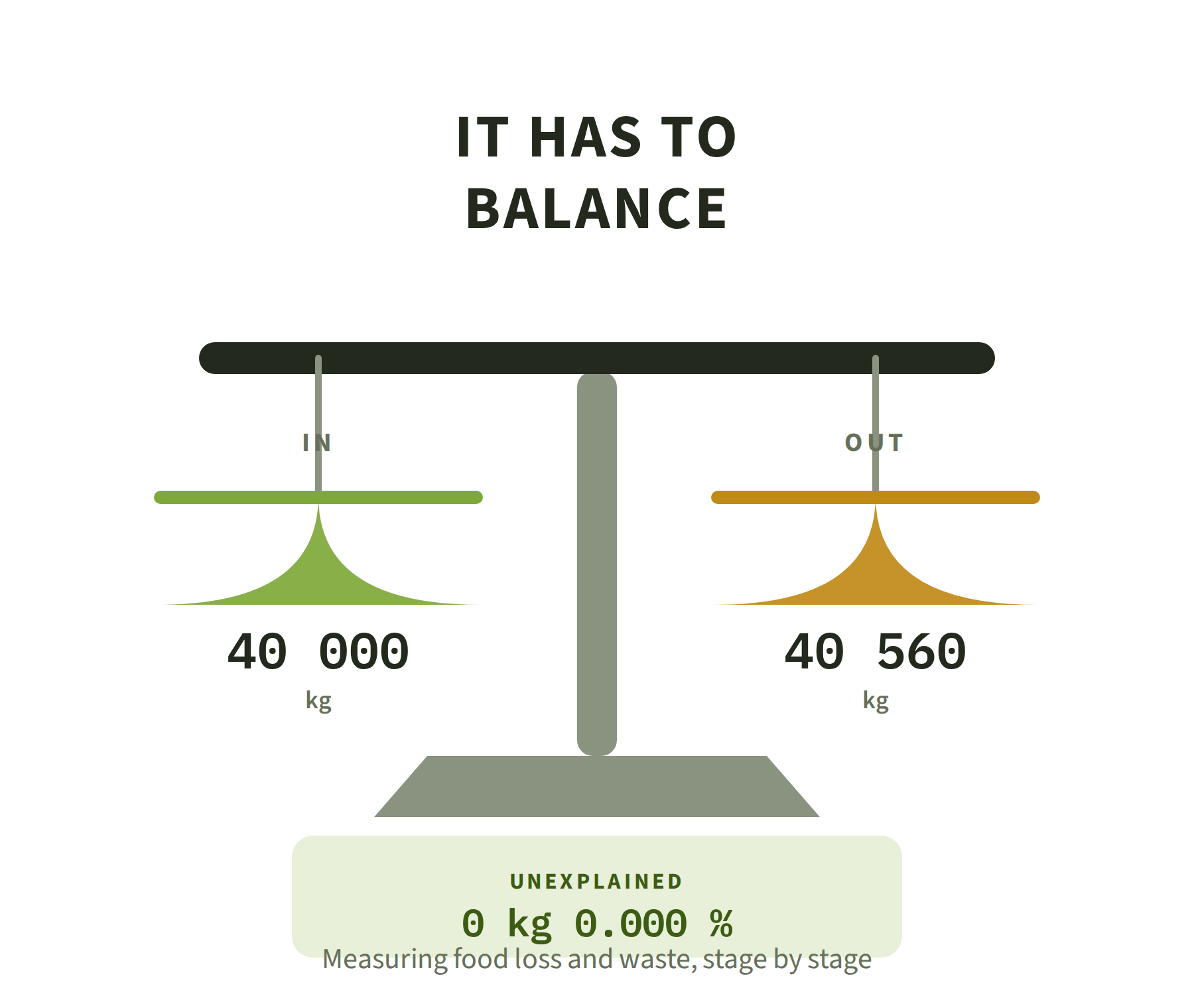
It runs on the same case study as Course 1: a vegetable freezing plant in Tzaneen, one production day, 40 000 kg of butternut in at the gate. Here you walk that same lot stage by stage, calculate the loss, the stage yield and the cumulative yield at every point, classify every stream the moment it is generated, and close the whole line’s mass balance to within plus or minus 5 percent. A practical workshop then has you build a defensible baseline for a line of your own, using the same method.
For employers and QA managers
- A baseline that survives an audit. FSSC 22000 clause 2.5.16 asks for a defensible figure, not a guess. This course teaches the scope, method and mass balance discipline an auditor tests when they ask where a number came from.
- Built by the people who will use it. The learner leaves with a completed baseline workbook for a real line, built stage by stage, ready to be repeated on your own site.
- No lost production day. About seven hours in total, in short pieces on any phone, during quiet time or at home.
- Written by an auditor. Mthokozisi Nkosi, ASC’s founder and an FSSC 22000 and BRCGS lead auditor, built this course from what he sees on site.
- Teams of five or more: contact us for a team rate and one invoice.
For learners
Special offer: R995 instead of R1695. Enrol today and start your first lesson in two minutes.
Enrol now, R995 (normally R1695)
Questions people ask before they enrol
Who is this measuring food loss and waste course for?
QA and technical managers, FSMS implementers and production managers in South African food manufacturing who need to build or defend a food loss and waste figure. Comfort with percentages and simple formulas is assumed, nothing more advanced.
Do I need to complete Course 1 first?
No, this course stands alone and defines its own terms. Course 1, Food Loss and Waste Essentials, is aimed at line staff and covers the same vocabulary at a simpler level, so the two work well together on one site.
How long does it take?
About seven hours in total including the quizzes and the workshop. It works on any phone and you can stop and continue later.
What is the practical workshop?
A hands on sitting where you build a complete, defensible baseline for a production line: scope declaration, a classified process walk, a closed mass balance and an annualised figure split by destination and material type. Do it on the course case study, or bring your own site’s numbers.
Does this help with FSSC 22000?
Yes. FSSC 22000 additional requirement 2.5.16 is the only GFSI benchmarked scheme requirement that asks a site to reduce food loss and waste, and this course teaches the measurement method a defensible 2.5.16 baseline is built on. BRCGS Food Issue 9 clause 4.12 and SQF clause 11.8 deal with waste handling, which the course also covers.
Is there a certificate?
Yes. Everyone who passes every quiz and the final assessment at 70 percent receives a Certificate of Achievement with a QR code and verification ID that anyone can check online.
What does it cost?
R995 per learner on the current special, normally R1695. Payment is by card or EFT through PayFast. Enrol five or more and contact ASC for a team rate and one invoice.
Course Content
Start here
-
Welcome, and how this course works
Module 1: What counts, what does not, and who is asking
Module 2: Scoping and baselining: deciding what you are going to count
Module 3: Walking the process, start to finish
Module 4: The practical workshop: baseline the line
Final assessment
Student Ratings & Reviews
