
Food Defence Coordinator Course: TACCP, FSMA and the Food Defence Plan
About Course
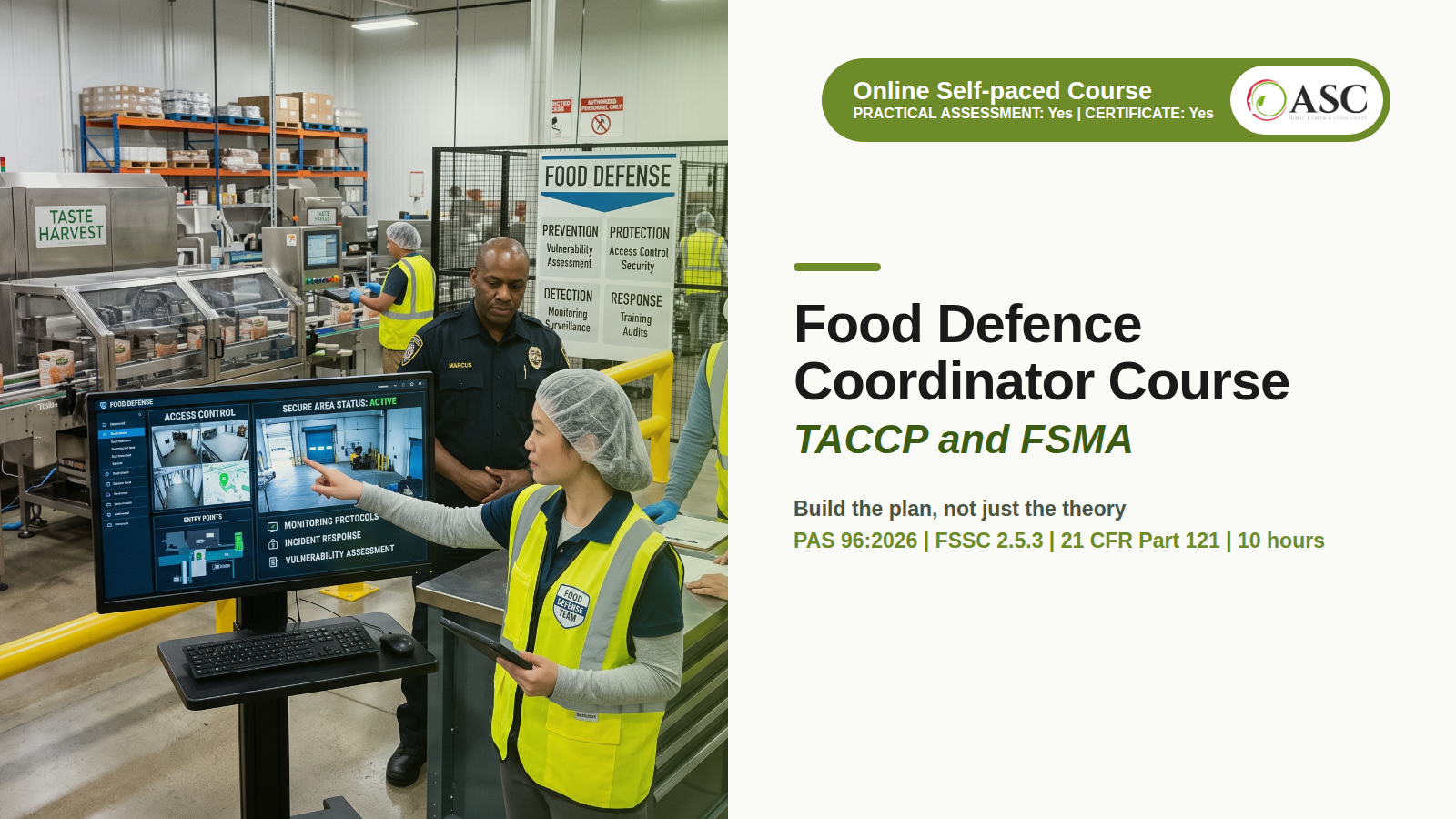
A food defence coordinator course that takes you from a blank page to a finished, audit ready food defence plan. It is built on TACCP and PAS 96:2026, mapped to FSSC 22000 clause 2.5.3, BRCGS Food Safety Issue 9 clause 4.2, SQF Edition 10 element 2.7.1 and IFS Food version 8 requirement 4.21, and to the FDA Intentional Adulteration rule at 21 CFR Part 121 for sites exporting to the United States.
Most food defence training explains what food defence is and stops there. You already know what it is. What you need is the method: how to score a threat assessment so it holds up, how to write mitigation that an auditor accepts, and how to run the programme through a year without it drifting. That is what this course teaches, and then it makes you do it.
You do not sit an exam. You build a threat assessment and a person marks it
Module 4 gives you a full site brief for a chilled ready meals manufacturer and asks you to score four threat actor and access point pairings: the insider at the open line, the contractor at the chemical store, the outsider at the bulk intake, and the cyber actor at the recipe and label system. You do it online, in the browser. Nothing about the case can be downloaded or copied, so the work is yours.
Your submission is then marked against a rubric built from the faults auditors actually raise, and you get coaching notes rather than a memorandum: notes telling you what to look at again, attached to the specific pairing they belong to, so the correction comes from your own thinking. Then you get a second attempt. A facilitator can see your full submission and the reasoning behind every mark, so if you disagree with something there is a person to ask. When your second attempt is marked, your own completed threat assessment is yours to download. It is the only downloadable thing in the course.
What the five modules cover
- Getting ready. Why a threat assessment is not a hazard analysis, the four success factors from PAS 96:2026, building a Food Defence Team that is not your HACCP team, the nine pieces of site information every score has to be defensible from, and the Plan, Do, Check, Act rhythm the plan runs on.
- Scoring the threat. Six threat actors mapped against the seven PAS 96 describes, fourteen access points, threats at organisation, operations and product level, the three factors scored against the workbook’s own 1 to 5 definitions, how likelihood is derived, and how to write a scenario that can actually be scored.
- From score to plan. Proportionate mitigation across deter, deny, detect and respond and across the six kinds of measure PAS 96 recognises, the residual scoring discipline, verification that tests behaviour rather than paperwork, incident response including cyber, confidentiality of the assessment itself, and the eleven questions auditors are told to ask.
- The graded practical. Four pairings scored on a real site brief, marked by a person, with coaching notes and a second attempt.
- The coordinator’s wider brief. What the role actually owns, FSMA and 21 CFR Part 121, the FDA vulnerability assessment method with its three fundamental elements and four Key Activity Types, actionable process steps and the monitoring, corrective action and verification the rule requires behind every mitigation strategy, training and records and reanalysis, how one plan serves every scheme you are audited against, and a working calendar for the year.
Who it is for
Food defence coordinators and food defence team leaders, food safety and quality managers who have picked up the food defence brief, HACCP and food safety team members, internal auditors, and consultants who have to produce or defend a food defence plan. If your site exports to the United States, the Module 5 material on the Intentional Adulteration rule is written for you specifically.
You do not need to be employed on a site to complete it. Every activity works against the course case study as well as against your own site, so a consultant or someone between roles can finish the whole course including the graded practical.
Why this one rather than another
- It is assessed on work you produce, not on a multiple choice exam. Anyone can pass a quiz on food defence. Far fewer people can build a threat assessment that survives an audit, and this course proves you can.
- It teaches both frameworks. TACCP and PAS 96:2026 for your certification scheme, and the FDA Intentional Adulteration rule for your American customers, with the differences between the two methods made explicit rather than glossed over.
- Every clause is cited and current: FSSC 22000 2.5.3, BRCGS Issue 9 4.2, SQF Edition 10 2.7.1, IFS Food 8 4.21, and the sections of 21 CFR Part 121 themselves.
- The exercises are interactive rather than decorative. You score real pairings against the workbook’s own scales and the tool computes the rating the way the sheet does, so you learn the method by using it.
- It costs R1750. That is a fraction of what a comparable coordinator programme costs internationally, and you leave with marked work rather than an exam score.
- It is written by a practising food safety consultancy that implements these plans on real sites, in plain language, by people who have sat on both sides of the audit.
How long it takes, and where the ten hours actually go
Ten hours sounds like a lot until you see where they go. Seven of them are the taught modules, and those arrive as thirty lessons of ten to twenty minutes each, so you can take one in a tea break and still finish the thought. The other three are you working: scoring the assessment, reading your coaching notes, and correcting your own scores on a second attempt. That is time spent producing something, not time spent watching a slide advance.
- About seven hours of lessons. Thirty of them, ten to twenty minutes each, self-paced, with the course remembering where you stopped.
- Four knowledge checks and four games built into the modules, drawn at random from banks, so a retake is a fresh set of questions rather than the same ones again.
- About two hours on the graded practical. Four threat actor and access point pairings scored on a real site brief, marked by a person against a rubric.
- Around an hour on your coaching notes and your second attempt. This is the part where the learning actually lands, and it is the part most courses leave out.
- A final assessment drawn from a large bank to close the course out.
None of it is padding. There is no video of somebody reading the standard aloud and no module that exists to make the number look bigger. If you already know a section, its knowledge check will tell you so in ninety seconds and you can move on. Most delegates do it across two or three weeks, a lesson or two at a time, and finish with a threat assessment they can take straight back to their own site.
Five modules, thirty lessons, four knowledge checks, four games, a graded practical assessment marked by a person, and a final assessment. Approximately ten hours, self-paced, with a certificate of completion.
Course Content
Module 1: Getting Ready to Build a Threat Assessment
-
1.1 Why a Threat Assessment Is Not a Hazard Analysis
-
1.2 Building the Food Defence Team
-
1.3 Collecting Your Site Information Before You Start
-
1.4 The Rhythm the Plan Runs On: Plan, Do, Check, Act
-
Module 1 Knowledge Check
Module 2: Scoring the Threat: Actors, Access Points and the Three Factors
Module 3: From Score to Plan: Mitigation, Residual Risk and Verification
Module 4: Practical Assessment: the Mzansi Fresh Meals Threat Assessment
Module 5: The Coordinator’s Wider Brief: FSMA, the Schemes and Running the Programme
Student Ratings & Reviews
