
Hygienic Design Essentials for Food Industry Professionals
About Course
Cleaning cannot correct a design fault, and your site pays for that every night
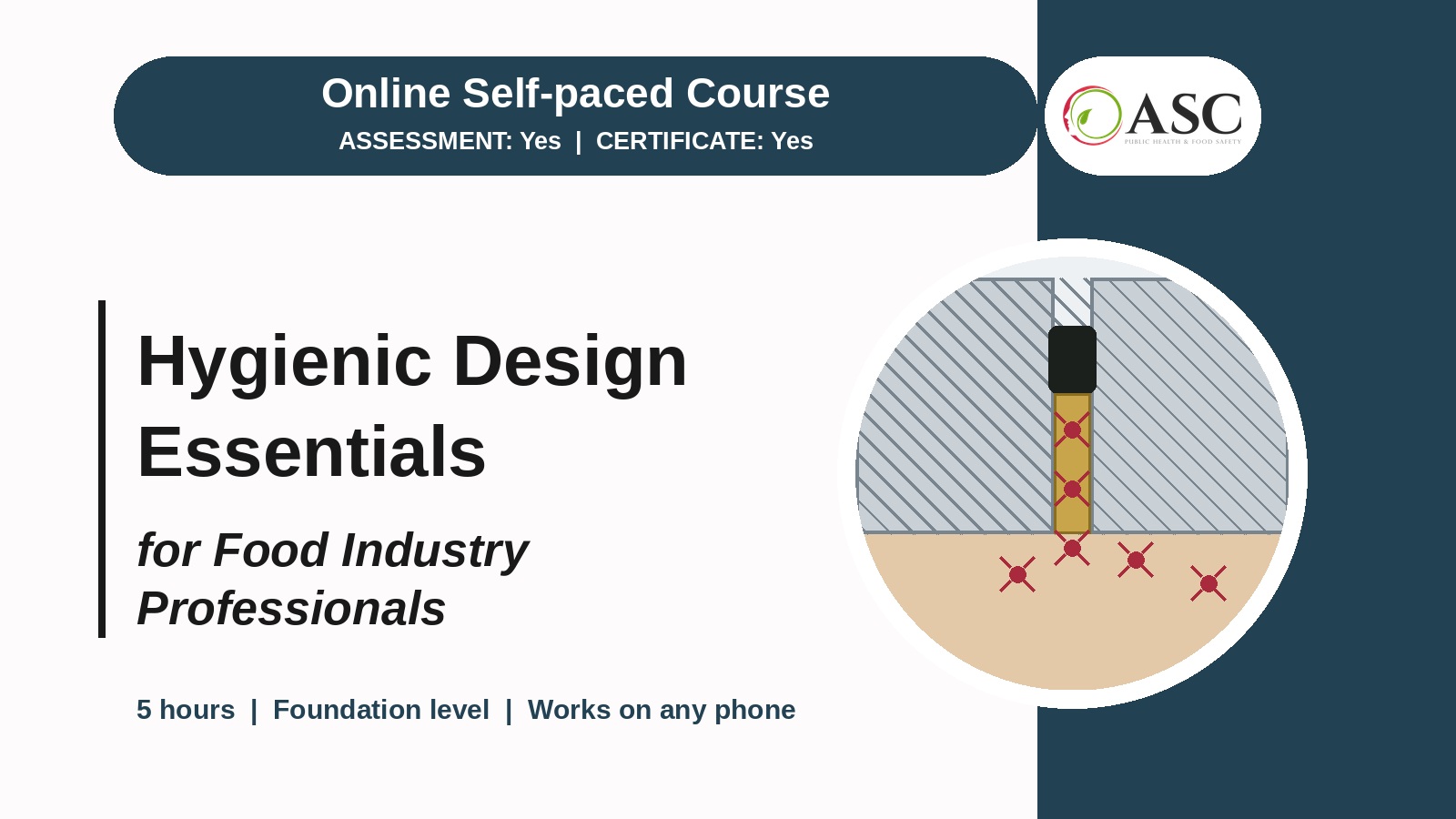
A crevice under a badly seated seal, a hollow frame with the end cap missing, a kettle outlet sitting 40 mm above the bottom of the bowl: no chemical reaches any of them, no matter how long the hygiene team scrubs or how strong the caustic. The cost shows up every night in water, chemicals, hours and a late start, and eventually on a swab report. This course teaches the people who clean, maintain, inspect and buy equipment to see the design fault behind the failure, score it, and raise the job card that actually fixes it.
Hygienic Design Essentials for Food Industry Professionals. Document code FS32-0301. Foundation level, 5 hours, self paced, online, on any phone. R1,350.
Who it is for
- QA and QC officers and technologists
- Production supervisors and line leaders
- Hygiene team leaders and sanitation supervisors
- Artisans, fitters and maintenance staff
- Buyers and procurement staff who sign equipment orders
- Food technologists and product developers
- New food safety practitioners and anyone preparing for a first audit
- Consultants and auditors who need the vocabulary and the numbers
No engineering background is assumed. Every term is defined the first time it is used, with an example off a real machine.
What you will be able to do after it
- Explain, to an engineer or a site director, why cleaning cannot correct a design fault, using the sequence of ingress, accumulation and growth at one crevice.
- Classify any surface on a machine as food area, splash area or non food area using the EN 1672-2 definitions, and tell open equipment from closed equipment on a certificate.
- Judge material and surface finish against the EHEDG Guideline 8 numbers and the words in R638 regulation 7: where 304 stops and 316 starts, what Ra 0.8 micrometre means, and why pitting cannot be rinsed clean.
- Measure a corner, a slope and a dead leg against the rules: a 3 mm radius at internal angles of 135 degrees or less, a slope of at least 3 degrees, and a length to diameter ratio you can calculate on the floor.
- Tell a continuous weld from a stitch weld, a front flush gasket from a recessed one, and a sealed hollow frame from a capped one, on sight.
- Walk a conveyor in six stops, check a tank, hopper, pipe, pump or valve for the four faults that keep product behind, and check floors, drains, walls, ceilings, doors and lighting against R638 regulations 5 and 6.
- Run the 30 point hygienic design walk on your own line or room, score each point 0, 1 or 2, and turn every zero into a job card with a priority.
- Write a one page hygienic purchase specification and list the evidence to demand from a supplier before the machine is delivered, not after it is bolted down.
What is inside: 4 modules, 15 lessons
Module 1: Why hygienic design decides food safety. What hygienic design is, and why cleaning cannot fix it. Where microbes hide: harbourage, niches and biofilm. Food area, splash area, non food area; open and closed equipment.
Module 2: The ten rules of hygienic design. Rules 1 and 2, materials and surfaces. Rules 3 to 5, radii, drainability and dead spaces. Rules 6 to 8, joints, seals and fasteners. Rules 9 and 10, installation and access.
Module 3: Spotting bad design on the floor. Conveyors. Tanks, hoppers, pipes, pumps and valves. The building: floors, drains, walls, ceilings, doors and lighting. The hygienic design walk.
Module 4: Making it stick. Cleaning and design are two sides of one coin. Maintenance, modifications and temporary repairs. Buying equipment: what the law and the schemes ask. Your action plan and the workshop.
Alongside the lessons you get four practice games, one per module, drilling the judgement the job needs: Spot the harbourage, Food area, splash or non food?, Which rule is broken?, and Fix it or stop the line? Each one puts you on a South African site at the moment somebody has to decide.
There are 14 original diagrams drawn for this course, most of them the same object drawn badly and then well, so the difference is visible rather than described: the crevice that cleaning passes over, ingress and growth inside a hollow frame tube, food, splash and non food area on one open kettle, six stops on a conveyor, four shapes that keep product behind, one high care room with six building faults, and the purchase path with its evidence gates.
The Hygienic Design Walk tool. A scored 30 point inspection of one line or one room, built to run on a phone at the end of the cleaning window. Ten rules, three checks each, scored 0, 1 or 2, with a running total out of 60, a count of zeros, and a flag for any zero in the food area of post cook equipment or within reach of a recent positive swab. It gives you a band, the three weakest rules, and a job card list with the priority zeros first. Then it exports a spreadsheet with three sheets, Summary, Scores and Job cards, that you can hand to engineering or attach to a management report. The tool also runs standalone on a phone, so you use it on the floor rather than at a desk.
The case study, so you can do the course without a factory
Every activity, case pack and workshop sitting works on a provided case site, so a delegate between jobs, studying, consulting or working off site can complete the whole course and the assignment. The main site is Mzansi Fresh Meals in Gauteng: 400 people on two shifts, chilled ready meals with a 12 day shelf life, a 22 person hygiene team, and ten pieces of equipment with named faults, complete with its swab history, its open job cards, its water use and its cost of a late start. Other short cases take you into a bakery, a citrus packhouse, a juice plant and a spaza supplier kitchen, so people outside ready meals see their own plant.
The cases are training scenarios built from patterns that real investigations and audits keep finding. No company is named in any of them.
Why it matters commercially
Hygienic design is not a nice to have on an audit report. Equipment clauses are where sites lose points, and commonly cited industry reporting puts BRCGS clause 4.6.2 on equipment design and construction among the most common minor non conformances raised under Issue 9. The course teaches the requirements you will be asked about:
| Standard or scheme | Clause | What it asks for |
|---|---|---|
| FSSC 22000 Version 6 and Version 7 | 2.5.15 Equipment management | A documented purchase specification covering hygienic design, legal and customer requirements and intended use; supplier evidence of meeting it before installation; risk based change management with commissioning evidence |
| BRCGS Food Safety Issue 9 | 4.6.1 to 4.6.4 | Purchase specification and authorisation, design and construction based on risk, installation and commissioning, mobile equipment |
| IFS Food Version 8 | 4.17.1 to 4.17.5 | Fitness for purpose, hygienic design of product contact materials and construction, validation before use of new or modified equipment, condition monitoring, change management |
| SQF Edition 9 | Module 11 (11.1.2 premises, 11.1.7 equipment and utensils) | Flooring smooth, dense and effectively drained; drains easy to clean; walls, ceilings and doors durable, light coloured and easy to clean; equipment and utensils designed and installed to prevent food safety risks |
| ISO 22000:2018 | 7.1.3 and 8.2.4 | Infrastructure, and the suitability of equipment and its accessibility for cleaning and maintenance, plus supplier approval, when prerequisite programmes are established |
| R638 of 2018 (South Africa) | Regulations 5, 6 and 7 | Premises, facilities and equipment: surfaces smooth, rust-proof, non-toxic and non-absorbent with no open joints; nothing chipped, split or cracked; not more than 100 viable micro-organisms per square centimetre after cleaning; ventilation, 200 lux lighting, hand washing and approved waste-water disposal |
Those clauses are what an auditor or an environmental health practitioner tests. The money sits one level down. The AINIA demonstration project, adopted as a Best Available Technique in the European reference document for food, drink and milk, reported an average cleaning saving of 38 percent on the equipment it tested, and one conveyor rebuilt with drum motors, a new belt and a new frame went from almost 30 minutes of cleaning to 17. A Campden BRI study of chilled ready to eat factories found 47 percent of cleaning equipment positive for Listeria monocytogenes, which is why the course treats a brush with a missing end cap as a design problem rather than a housekeeping one. A delegate who comes back with a scored walk and a job card list has given the site something to cost.
How it is assessed, and the certificate
- Four knowledge checks, one per module, drawn at random from a larger bank so no two papers are the same. Pass mark 70 percent.
- Four games, one per module, for practice.
- A final assessment of 30 questions drawn from a bank of 65, so every attempt is different. Pass mark 70 percent, two attempts, video proctored on any phone or laptop camera.
- An assignment on the case site: the completed 30 point walk plus a note of 150 to 250 words to management.
- On completion you receive a certificate carrying your name, the course title, the document code FS32-0301 and the date, with a QR code an auditor, a retailer technologist or an HR officer can scan to confirm it. That is what makes it usable as training evidence in your file.
The series
This is course 1 of 3. Course 2, Intermediate Hygienic Design: Equipment, Materials and the Food Factory, goes into the risk based level of hygienic design, materials and corrosion, closed equipment and CIP design, open equipment and conveying in depth, the building and its services, and a hygienic design risk register. Course 3, Advanced Hygienic Design: Risk Assessment, Specification, Verification and Project Delivery, covers hygienic design risk assessment, the user requirement specification and supplier evaluation, welding and design detail, facility and HVAC engineering, commissioning and validation, and a capstone project. Sector versions for bakery, meat processing and other plants are being added to the same structure. Essentials is the entry point and the common language for all of them.
Questions people ask before they enrol
Is this course accredited? ASC Food Safety Consultants is a training provider whose courses carry HPCSA CPD accreditation. Your certificate of completion carries a QR code that verifies the holder, the course and the date. The course is built on the EHEDG guidelines, EN 1672-2, ISO 14159, the GFSI benchmarked schemes and South African law, but it is not approved or endorsed by EHEDG or by any scheme owner, and we do not claim that it is.
Do I need an engineering background? No. It is written for QA staff, supervisors, hygiene teams, artisans and buyers. Where a number matters, such as a 3 mm radius, a 3 degree slope or Ra 0.8 micrometre, the course tells you where it comes from and how to check it with a steel rule, a torch and your fingernail.
Do I need to be working at a factory? No. Every activity, including the workshop and the assignment, runs on a provided case site with full data, so you can complete the course while between jobs, studying or consulting. If you are on a site, you do the same tasks on your own line.
Will it help with my FSSC or BRCGS audit? It teaches the equipment and premises requirements directly: FSSC 22000 clause 2.5.15, BRCGS Food Safety Issue 9 clauses 4.6.1 to 4.6.4, IFS Food Version 8 clauses 4.17.1 to 4.17.5, SQF Edition 9 Module 11, ISO 22000 clauses 7.1.3 and 8.2.4, and R638 regulations 5, 6 and 7, with the purchase specification and the evidence a supplier must provide before installation. It is not a clause by clause course on one scheme, so read your own standard alongside it. The completed walk and job card list are the kind of record an auditor can look at.
Can my whole team do it? Yes, and it works better that way. The value comes from a QA officer, an artisan and a hygiene team leader walking the same line with the same 30 points and agreeing on what is a design fault and what is a cleaning fault. Teams of five or more should contact ASC for a group arrangement.
How long do I have access? The course is 5 hours of lessons, games, checks and tools, self paced, so you can do it in one sitting or over a few evenings on your phone. You can go back into the lessons and the walk tool after you have passed. If your company needs a set access period stated on a purchase order, ask ASC before you enrol and it will be confirmed in writing.
What if I fail a quiz? The pass mark is 70 percent on every knowledge check and on the final. The final allows two attempts, with different questions drawn each time.
About the trainer
Trainer: ASC Team. This course was compiled by the ASC Food Safety Consultants team with the help of a panel of industry engineers (hygienic equipment design, facilities and utilities, process and automation), food safety specialists, process controllers, quality managers and hygiene practitioners, and built on the EHEDG guidelines, EN 1672-2, ISO 14159, the GFSI benchmarked schemes and South African law.
Read the free guide first
If you want to see what the course covers before you enrol, read What is hygienic design in food manufacturing? The ten rules, and how to spot a bad machine on your own line. It sets out the ten rules with the numbers, what R638 regulation 7 already requires of your equipment, and six design faults you can find on your line this week. You can also run the free 30 point hygienic design walk before you decide.
Enrol
R1,350. Enrol now and start today, on your phone, at your own pace. You will finish with the ten rules, the eye to use them, a scored walk of your own line and a job card list somebody can act on.
Teams of five or more: contact ASC for a group arrangement and we will invoice the company against your purchase order.
Course Content
Module 1: Why hygienic design decides food safety
-
Lesson 1.1: What hygienic design is, and why cleaning cannot fix it
-
Lesson 1.2: Where microbes hide: harbourage, niches and biofilm
-
Lesson 1.3: Food area, splash area, non food area; open and closed equipment
-
Module 1 knowledge check
-
Spot the harbourage
Module 2: The ten rules of hygienic design
Module 3: Spotting bad design on the floor
Module 4: Making it stick
Student Ratings & Reviews
