
Online Hygienic Design Training for Food Manufacturing
Most food safety training tells you to clean better. This tells you why the machine cannot be cleaned at all, and what to write on the drawing so the next one can. It is a technical course series for the people who specify, buy, install, maintain, clean and audit food equipment: radii, slopes, dead legs, welds, steel grades, drains, air and the evidence gates in a purchase path. Designed with industry leading engineers and technical food safety consultants.
★ Narrated Video & Original Engineering Diagrams
★ QR Verifiable Certificate
★ Working Tools Included
Our hygienic design courses
Three levels, built to be taken in order. Essentials teaches you to see the fault and name the rule it breaks. Intermediate takes you into the engineering: steel grades and corrosion, pipework and CIP, conveyors and open equipment, floors, drains, air and the building itself. Advanced, covering validation, verification and design review at scale, is in development.
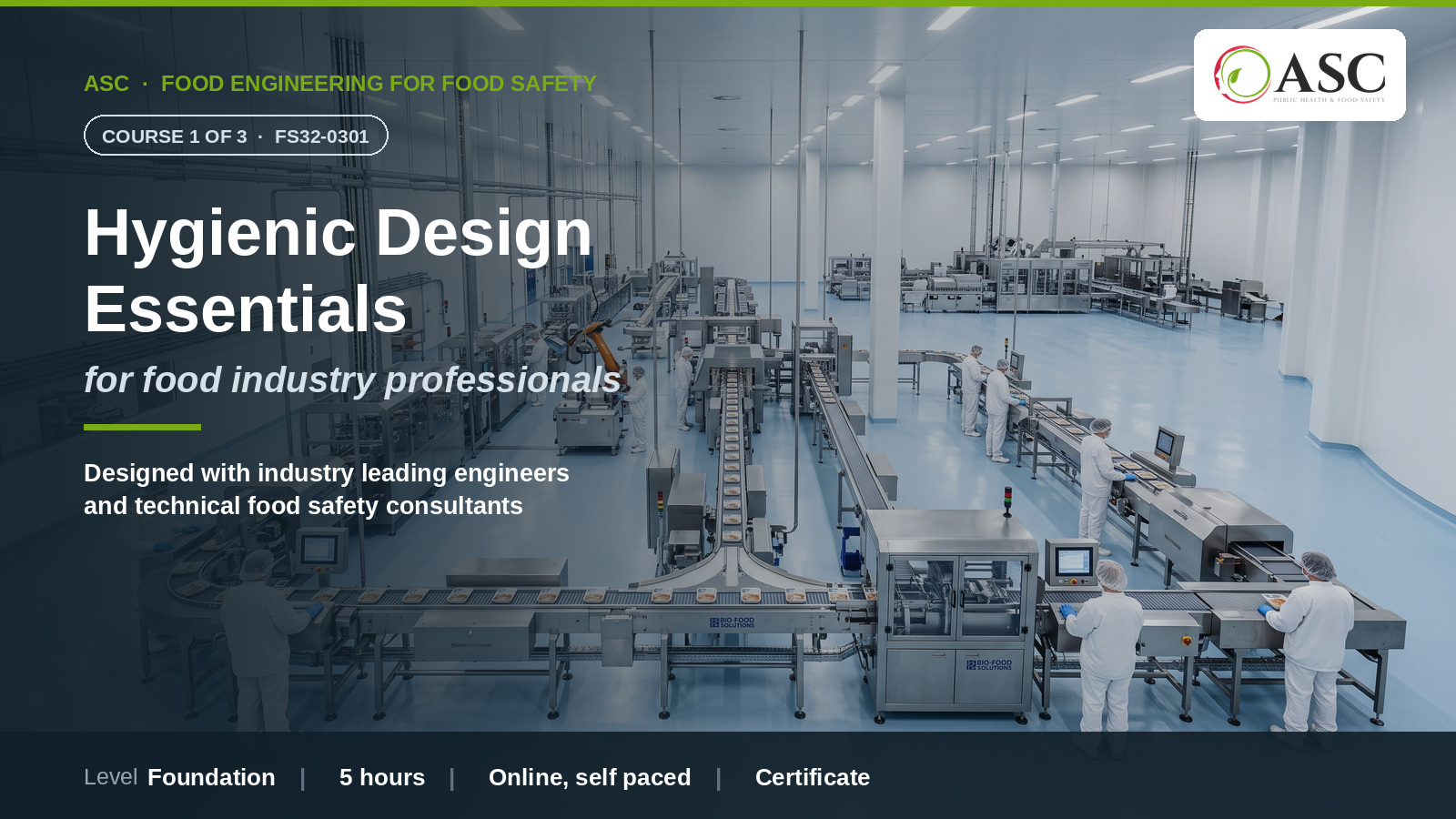
Hygienic Design Essentials for Food Industry Professionals
Why cleaning cannot correct a design fault, where microorganisms live on a machine, the ten rules of hygienic design, and a thirty point walk you run on your own line the week you finish. Four modules, fifteen lessons, fourteen original diagrams, nine assessments.
R2 400
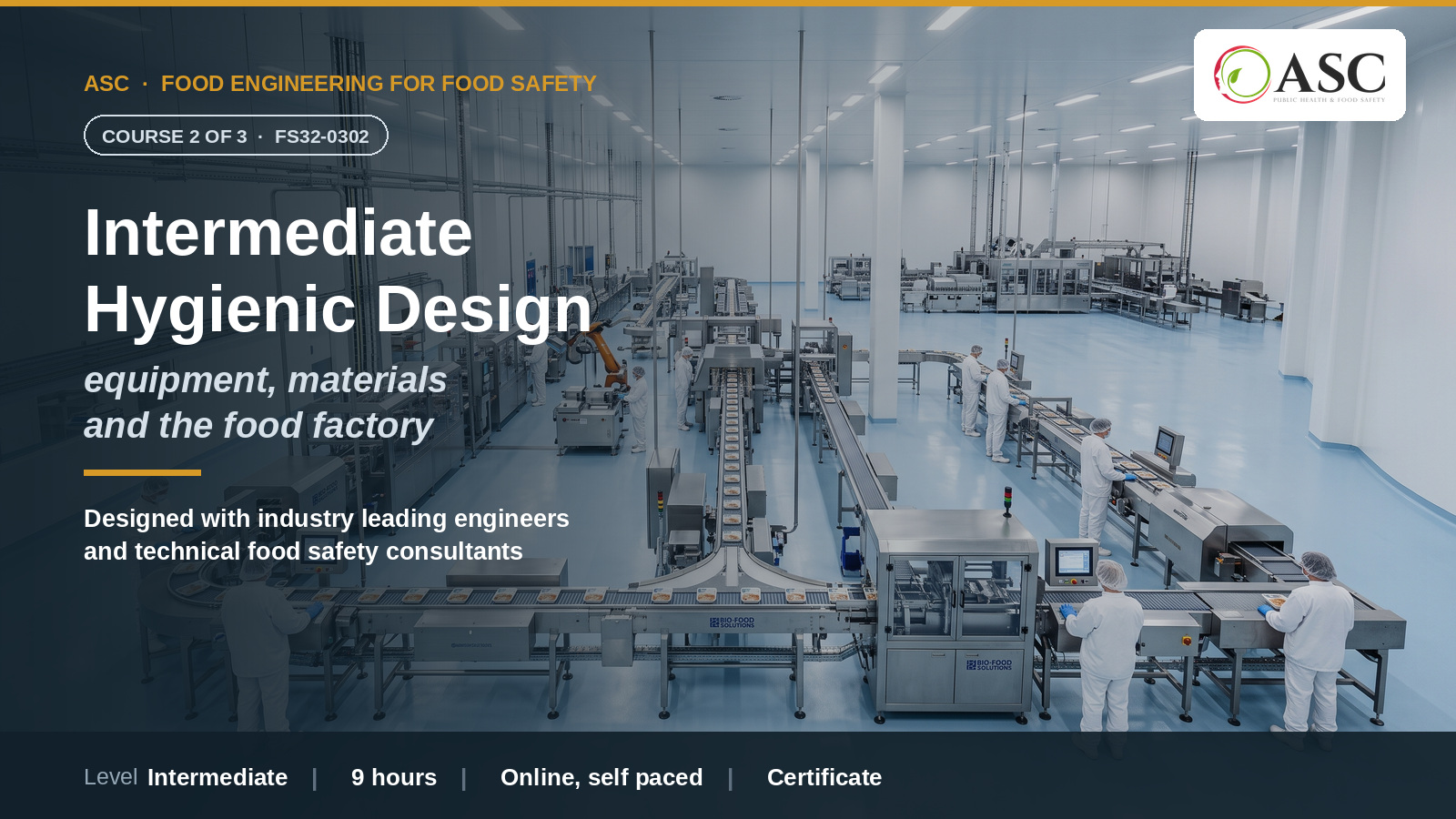
Intermediate Hygienic Design: Equipment, Materials and the Food Factory
Hygiene levels and the equipment lifecycle, stainless steels and the four corrosion mechanisms, pipework, welds, valves, tanks and CIP verification, conveyors and open equipment, then floors, drains, air and building work in a running plant. Five modules, twenty five lessons, twenty four diagrams, eleven assessments.
R2 950
Prices are in South African rand and shown in US dollars and euros on each course page for international buyers. No discounts are offered on this series.
What hygienic design actually is
Hygienic design is the practice of building food equipment and food factories so that they can be cleaned, and so that there is nowhere for soil, water or microorganisms to sit. It is decided on a drawing, long before anybody chooses a chemical. A one millimetre internal corner, a blanked branch left on a pipe, a hollow frame tube with a drilled hole in it: each is a place the cleaning solution shears past instead of entering, and no amount of caustic, temperature or scrubbing reaches inside.
That is why a swab can pass on the flat surface beside a corner that is still soiled, and why the same line fails the same test every year while the hygiene team is blamed for it. The fault is geometry. Once you can see it and name the rule it breaks, you stop arguing about cleaning chemicals and start arguing about specifications, which is an argument you can win.
Built for the people who decide what gets installed
Quality and Food Safety Managers
You sign off corrective actions on findings that cleaning cannot fix. This gives you the rule number and the drawing to change.
Engineering and Maintenance Managers
Specify radii, slopes, welds, finishes and clearances before the steel is cut, and reject a quote on hollow sections and drilled holes alone.
Project and Process Engineers
Take a line from user requirement specification to commissioning with hygienic design evidence at every gate.
Procurement and Technical Buyers
Ask suppliers for the three documents that matter at order, when you still have leverage, rather than at delivery when you have none.
Hygiene and Cleaning Managers
Prove which findings are design faults, and cost them in water, overtime and delayed starts so the capital request writes itself.
Auditors and Consultants
Raise findings that hold, against the right document, in the right words, at the right clause.
Equipment Suppliers and Fabricators
Understand what your food customers are about to start asking for, and build it in before they do.
Graduates and Career Changers
Every activity works on the built in case study, so you can complete the course and the assignment without a site of your own.
From spotting the fault to writing the specification
| Essentials, 5 hours | Intermediate, 9 hours | |
|---|---|---|
| Starting point | No engineering background needed | Essentials, or equivalent experience |
| Equipment | The ten rules, and the three areas of any machine | Pipework, welds, valves, tanks, CIP, conveyors, chutes, drives and cabinets |
| Materials | Where 304 stops and 316 starts | Grades, chlorides, temperature, four corrosion mechanisms, surface finish, elastomers and seals |
| Buildings | Floors, drains, walls, ceilings, doors and lighting | Drain profile, fall and tested capacity, the envelope, air, pressure, condensation, utilities and building work in a running plant |
| You leave with | A thirty point hygienic design walk, scored, with job cards | A scored hygienic design risk register with owners, dates and costs |
| Assessment | Knowledge checks, games and a proctored final | Knowledge checks, games, a proctored final and a workplace assignment |
You leave with something you can use on Monday
Both courses carry a working tool, built by ASC, that runs in your browser and exports a spreadsheet. They are the reason delegates tell us the course paid for itself in the first month.
The Hygienic Design Walk
Thirty scored points across a line or a room, with two override flags, photographs and job cards, exported to a spreadsheet you can hand to engineering. Included with Essentials.
The Hygienic Design Risk Register
Every finding scored on severity, likelihood and exposure, banded, with an interim control, a permanent fix, an owner and a date. Included with Intermediate, and it is the course assignment.
Your food safety management system, and the law
In South Africa, R638 regulation 7 requires food contact surfaces to be smooth, rust proof, non toxic and non absorbent, and free of open joints or seams. That is a design requirement, not a cleaning one, and no cleaning programme can deliver it on the wrong equipment.
In a certified site, hygienic design sits inside your prerequisite programmes, your maintenance and change control, and your equipment purchase process, which is where the GFSI benchmarked schemes look for it. The courses teach you to name the document behind every figure you specify, and to notice when a number in common use comes from guidance rather than from the standard being quoted at you. That habit alone changes how supplier conversations go.
Frequently asked questions
Do I need an engineering background?
Which course should I start with?
Is this recognised by FSSC 22000, BRCGS or the other schemes?
Can I do this without a factory to practise on?
How long do I have, and is it self-paced?
What does the certificate look like?
Do you offer a discount or a group price?
I am outside South Africa. Can I still enrol?
Stop paying for the same fault every night
One badly designed line costs water, chemical, overtime and delayed starts for as long as it runs. Five hours of training is the cheapest thing you will do about it.