
Intermediate Hygienic Design: Equipment, Materials and the Food Factory
About Course
The silo fails every CIP and nobody on the night shift did anything wrong
There is a 600 mm blanked stub on a 76 mm raw milk line where a sampling point used to be. Length over diameter of about eight, against a commonly cited limit of one to two. Cleaning solution sweeps past the mouth of that branch and never enters it, so it holds warm residue through every cycle, and the silo behind it comes back from CIP with high Pseudomonas counts. Somebody drew that branch, welded it, blanked it and signed for it. Every failed clean since has been a fluid dynamics problem reported as a hygiene problem.
This course is for the point where those decisions land on you. You can already see a bad weld and a hollow frame. Now you have to choose a steel grade against a chloride figure and a surface temperature, argue a length to diameter ratio on a blanked branch, set a purge and a heat tint limit before a welder starts, judge a drain against its rated flow, and write the risk register that gets three things funded out of the forty on your list. That is engineering: metallurgy, surface topography, weld metallurgy, elastomer behaviour through heat and ageing, drainage hydraulics and the pressure difference across a doorway. The course teaches the numbers, the wording and the evidence for each of those, and it names the source of every figure so you can defend it.
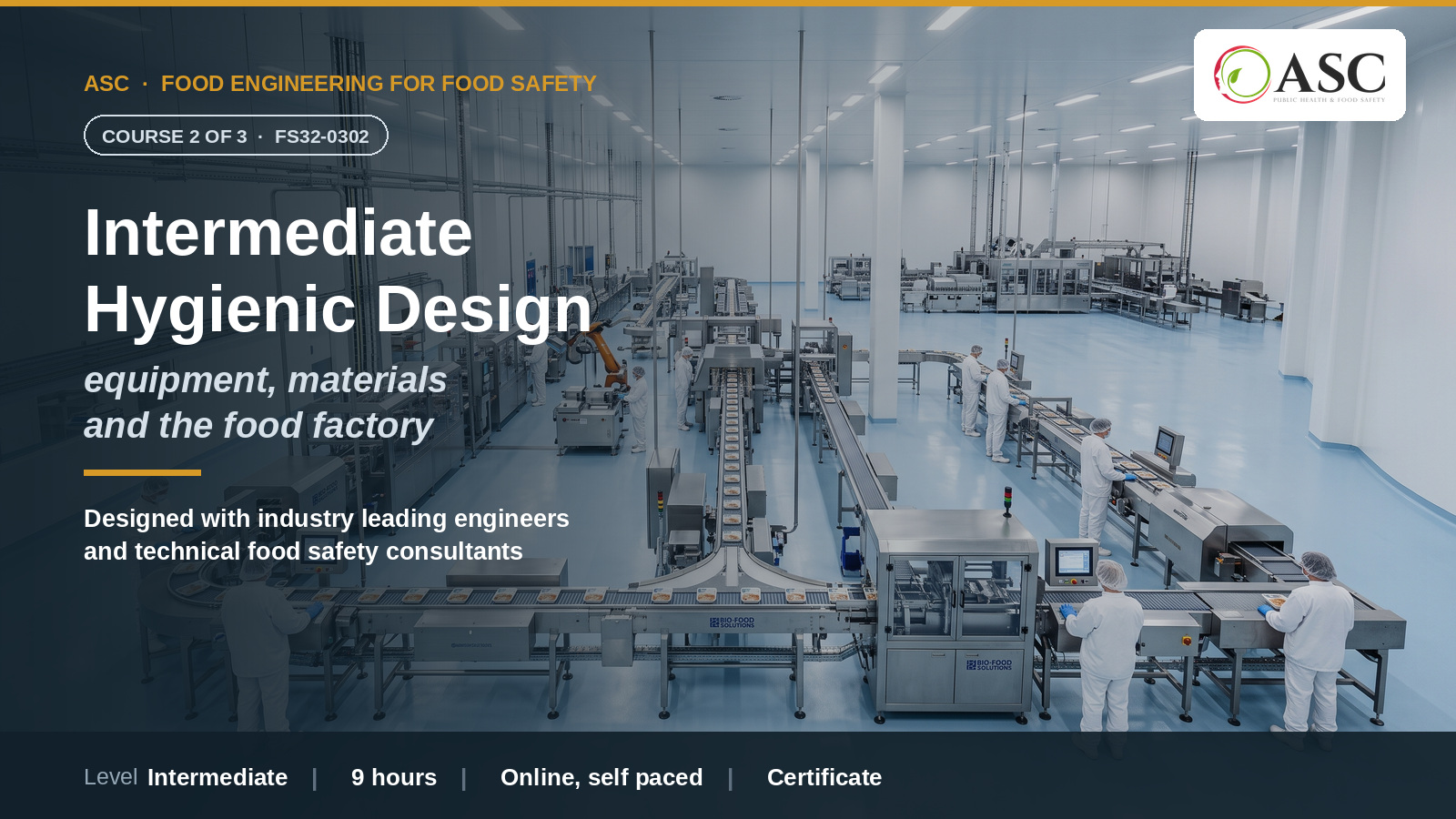
Designed with industry leading engineers and technical food safety consultants
Designed with industry leading engineers and technical food safety consultants. The panel behind the material is hygienic equipment design, facilities and utilities, and process and automation engineers, working with food safety specialists, process controllers, quality managers and hygiene practitioners. The engineers set the duty envelopes, the tolerances and the failure mechanisms. The practitioners made sure each one can be checked, specified or scored on a working site, in the hour you actually have.
Intermediate Hygienic Design: Equipment, Materials and the Food Factory. Document code FS32-0302. Intermediate level, 9 hours, self paced, online, on any phone. R2,950. No discount codes apply to the hygienic design series.
What this course is not
It is not a food safety awareness course. It is not a certificate mill, and it is not a slide deck of EHEDG logos with a quiz at the end. It teaches numbers, tolerances, materials and evidence: the chloride, temperature and pH envelope that moves you off 304, purge oxygen at most 50 ppm held until the metal is below about 250 degrees C, heat tint no darker than pale straw on the product side, ISO 5817 class C or better on a hygienic butt weld, a length to diameter ratio measured from the pipe wall, a drain rated in litres per second under a 20 mm water column, and the FSSC 22000 clause 2.5.15 wording that decides whether your supplier evidence arrives before installation or after. It also expects you to walk a line afterwards, score what you find and put a rand figure and a date next to it. If you want a wall certificate without that walk, this is the wrong course.
Buying from outside South Africa
The price is in South African rand. Indicative US dollar and euro equivalents are shown on this page by the currency converter, and payment settles in rand. The standards taught are international: EHEDG Guideline 8 and the equipment guidelines, EN 1672-2, EN ISO 14159, the EU Machinery Regulation 2023/1230, Regulation (EC) No 1935/2004 on food contact materials, 3-A Sanitary Standards and NSF, and the GFSI benchmarked schemes FSSC 22000, BRCGS, IFS and SQF. The South African law content, R638 regulations 5, 6, 7 and 10, sits in clearly marked sections. It is kept because it is a clean worked example of a hygiene regulation written as plain requirements, and because it puts a number on a cleaned surface where most schemes leave it open. It is not the spine of the course.
Who it is for
- QA and technical managers who sign purchase specifications and answer for equipment clauses at audit
- Plant, project and maintenance engineers specifying, installing or modifying food equipment
- Project teams running a new line or a brownfield upgrade inside a running factory
- HACCP and food safety team members who have to score design faults rather than list them
- Equipment buyers and procurement staff comparing a certified machine against a local fabrication
- CIP operators, process controllers and production managers who own a circuit that has to clean itself
- Hygiene managers who are tired of being blamed for a fault the drawing created
- Auditors, consultants and suppliers who need the clause, the number and the evidence in the same sentence
Who it is not for
This is not a beginner course. It assumes you already know what a food area, splash area and non food area are, what a dead leg is, why a hollow frame is a problem and what Ra 0.8 micrometre means. If any of that is new, start with Hygienic Design Essentials for Food Industry Professionals and come back. Essentials is the entry point and the common language for the whole series, and this course builds straight on top of it without repeating it.
What you will be able to do after it
- Assign a basic, medium, high or aseptic hygiene level to a machine or a room from its intended use, and defend the choice to an engineer and to an auditor.
- Name the seven stages of the equipment lifecycle and say what hygienic design evidence each stage must leave behind, then find the stage where a project on your site lost control.
- Place any document on the four layer map of South African law, GFSI benchmarked schemes, standards and guidelines, and say which one binds your site and which one is only evidence.
- Tell an EHEDG certificate with a class from a claim of compliance, and a 3-A Symbol from a supplier statement on a letterhead.
- Draw the hygiene zones of a plant, sub-classify them wet or dry, and put a barrier on every vector between them: people, air, water, drains, tools and product.
- Select 304, 316 or duplex for a stated product, chloride level, pH and temperature, and justify the price difference to the person signing the order.
- Identify pitting, crevice corrosion, stress corrosion cracking, roughing and blackness on a real surface and choose the right response: grind, passivate, change the chemistry, or redesign.
- Write a surface finish specification that covers what an Ra number cannot see: production method, defects and welds.
- Choose an elastomer family for a duty and specify a seal so it stays front flush through heating, cleaning and ageing, and ask the supplier for the food contact evidence that goes with it.
- Walk a product pipe run and find every point where liquid, air or soil stays behind after CIP, and put a length to diameter number on each dead leg.
- Specify a hygienic weld: purge, heat tint limit, inspection method, weld log and welder record, then read a weld log and find the joints nobody checked.
- Tell a mixproof intersection from a single seat valve with a procedure behind it, and say when each one is acceptable.
- Name the CIP parameters a designer must fix and a plant must measure at the right point, and diagnose a failed clean from return line data.
- Judge a frame, its feet, its hollow sections and its guards against Guideline 8 and the supplier rules, and specify the fix for each fault.
- Inspect a belt conveyor from belt edge to return roller and name every harbourage point, drive fault and transfer fault with its correction.
- Specify where motors, bearings, shaft seals, control cabinets and cables sit so nothing drips, sheds or harbours above or beside open product.
- Assess a floor and its drainage against R638 regulation 5 and the scheme clauses, and name the fault that keeps feeding a Listeria positive.
- Explain where condensation will form and drip, and turn a claimed positive pressure into a measured, logged one.
- State the hygienic quality water, steam, compressed air and refrigeration each need at the point they meet product.
- Plan building work inside a running plant so dust, water, people, tools and contractors are barriered from open product, and close the job with the evidence the schemes ask for.
- Score and rank every design fault on a line in a risk register, and present the top three with a cost argument in a note management will actually read.
What is inside: 5 modules, 25 lessons
Module 1: Hygienic design as a system
- The risk based approach: basic, medium and high hygiene levels, intended use
- The equipment lifecycle: URS, design, build, install, commission, operate, legacy review
- The standards and law map
- Hygienic zoning of the plant
This module is where the arguing stops. A level assigned from intended use, written down and agreed, settles what a machine must be able to do before anyone quotes for it. The four layer map settles which document a supplier can be held to and which one is a sales claim.
Module 2: Materials of construction
- Stainless steels: grades, chlorides, temperature, cost, duplex
- Corrosion: pitting, crevice, stress corrosion, MIC, roughing and blackness, passivation
- Surface finish and topography: Ra by method, when 0.8 is not enough
- Plastics, elastomers and seals
- Lubricants, adhesives, sealants, insulation and coatings
Most material failures on a food plant were decided at enquiry stage by somebody who wrote stainless steel and nothing else. This module gives you the duty questions to ask first: what the product does to the steel, what the cleaning chemistry does to it, what the chloride level and the surface temperature are, and what the seal, the lubricant and the insulation around it will do over four years. Read the envelope as three dials, chloride, temperature and pH, and any one of them in the red moves you off 304.
Module 3: Closed equipment for liquid products
- Pipework: slope, supports, dead legs, reducers, penetrations, pipe trains
- Couplings and welds
- Valves, pumps and mixproof intersections
- Tanks, agitators, sensors and sampling
- CIP design: circuits, flow, temperature, chemistry, spray devices, verification
A closed line hides its faults, so you read them from the drawing, the weld log and the return line data. This module teaches the length to diameter calculation on a blanked branch, the three requirements of a hygienic static seal, the four faults of a badly made coupling, the purge and heat tint limits that decide whether a weld will pit, and how to tell a real CIP from one that circulates warm water past the soil.
Module 4: Open equipment and conveying
- Frameworks, feet, hollow sections, guards and covers
- Belt conveyors in depth
- Other conveyors, hoppers, chutes, weighers and depositors
- Motors, drives, bearings, shaft seals, cabinets and cables
- Cleaning tools, utensils, mobile equipment and high pressure cleaning
Open equipment is where a wet cleaned plant loses its nights. The module works through guarding as both an Occupational Health and Safety Act duty and a cleanability problem, the conveyor from belt edge to return roller, the hazard that belongs to each conveyor type, where a motor and a cabinet may and may not sit, and why cleaning tools are food contact items with their own specification.
Module 5: The building and its services
- Floors and drainage systems
- Walls, ceilings, doors, windows and lighting
- Air handling, pressure and condensation control
- Utilities: water, steam, compressed air, refrigeration
- Building work and installation during production
- The hygienic design risk assessment and the workshop
The building is equipment too, and it is the part nobody specifies. Drainage rated in litres per second rather than guessed, a ceiling that sits below the dew point of the morning cook, a positive pressure that is claimed but never measured across the door. The module finishes with the workshop: three sittings that take the faults you logged through Modules 1 to 5 and turn them into a scored, ranked register with an interim control, a permanent fix, an owner, a date and a cost on every line.
The tools you walk away with
Most training leaves you with notes. This one is built so that the week after you finish, there is something on an engineer’s desk and something in a management meeting with your name on it.
| What you get | What it does for you on Monday |
|---|---|
| The Hygienic Design Risk Register | Scores every finding on severity, likelihood and exposure, each 1 to 3, ranks the whole list by score, holds the interim control, the permanent fix, the owner and the date on each line, drafts the note to management for you, and exports a three sheet spreadsheet: summary with the scoring key, the ranked register, and an action plan engineering can work from and track. It runs on a phone at the machine and keeps the register on that device. |
| The equipment purchase specification wording | The lines that turn stainless steel, EHEDG compliant, easy to clean into a specification an auditor accepts, written against R638 regulation 7 and FSSC 22000 clause 2.5.15, including the sentence that puts supplier evidence before installation instead of after. |
| The weld and coupling inspection criteria | What to write into the contract before a welder starts and what to check afterwards: purge, heat tint limit, weld profile, inspection method, weld log and welder record, plus the four faults of a badly made coupling and the three requirements of a hygienic static seal. |
| The CIP verification points | Which parameters a designer must fix, where each one is measured so the reading means something, and how to read a return line record and say whether the circuit cleaned or only ran. |
| 25 case packs with model answers | Tasks, real site data and the answer a competent practitioner would give, reasoned out, so you check your thinking and not your memory. |
| The learner manual | The rules, the numbers and the specification wording in writing, at the desk where you write the enquiry. |
| 24 original engineering diagrams | Most of them the same object drawn badly and then well, so you can point at the difference in a meeting instead of describing it: the dead leg and its length to diameter, the four faults of a coupling, the mixproof intersection against the single seat valve, the conveyor from belt edge to return roller, the drain in profile, the condensation path across a ceiling. |
| A QR verified certificate | Carries your name, the course title, the document code FS32-0302 and the date, with a QR code an auditor, a retailer technologist or an HR officer can scan to confirm it. |
Alongside the lessons there are five games, one per module: Name the level, Which steel?, Find the dead leg, Conveyor doctor, and Drain, wall or air? Each one puts you on a South African site at the moment somebody has to decide.
The case sites, so you can do the course without a factory
Every case pack, activity and the assignment run on a provided case site, so a delegate between jobs, studying, consulting or working off site can complete the whole course. Three sites carry the work:
- Mzansi Fresh Meals, chilled ready meals in Gauteng. 400 people on two shifts, a 12 day shelf life, a high care assembly hall with positive pressure claimed but never measured, and ten named equipment faults with their swab history, their open job cards, their water use and the cost of a late start. This is the open equipment and building site.
- Amanzi Dairy, in KwaZulu-Natal. 180,000 litres of raw milk a day, a tank farm, a pasteuriser, a UHT plant, two aseptic fillers and a three circuit CIP station, with the blanked stub, the ageing plate pack gaskets, the uninspected field welds, the wet insulation and the CIP return temperature that does not match its set point. This is the closed processing site.
- Karoo Meat Processors, in the Eastern Cape. An abattoir and processing plant with a post cook high care area and a brownfield upgrade to install while production continues. This is where installation, contractor control and verification are practised.
The cases are training scenarios built from patterns that real investigations and audits keep finding. No company is named in any of them.
The standards and the law this course teaches against
Every rule in the course is tied to the document it comes from, so you can quote it when a supplier pushes back or an auditor asks where the number came from. Where a figure is commonly cited industry practice rather than guideline text, the course says so, because a number you cannot source is a number you will lose an argument with.
| Document | What the course uses it for |
|---|---|
| EHEDG Guideline 8 and the equipment guidelines | The design principles themselves: materials and surfaces, drainability, joints and welds, seals, fasteners, supports, sealed hollow bodies, insulation and cladding, and what an EHEDG certificate with a class actually covers |
| EN 1672-2:2020 | Food area, splash area and non food area on food machinery, and the iterative hygiene risk reduction process that the course’s risk register is modelled on |
| EN ISO 14159 | Hygiene requirements for the design of machinery, and how it relates to EN 1672-2 on the same machine |
| EU Machinery Regulation 2023/1230 | What a European supplier must meet and declare, that it repeals Directive 2006/42/EC and applies from 20 January 2027, and why it does not bind a South African site |
| Regulation 1935/2004 | The general requirement for food contact materials, and the declaration of compliance a supplier must produce for plastics, elastomers and coatings |
| 3-A Sanitary Standards and NSF | United States hygienic design criteria, the difference between a 3-A Symbol verified by a third party and a supplier statement, and where NSF registration belongs on a lubricant |
| FSSC 22000, clause 2.5.15 | A documented purchase specification covering hygienic design, legal and customer requirements and intended use; supplier evidence before installation; risk based change management with commissioning evidence |
| BRCGS Food Safety Issue 9, clause 4.6 | Purchase specification and authorisation, design and construction based on risk, installation and commissioning, and mobile equipment |
| IFS Food Version 8, clause 4.17 | Fitness for purpose, hygienic design of product contact materials and construction, validation before use of new or modified equipment, condition monitoring and change management |
| SQF Edition 9, Module 11 | Premises and equipment: flooring smooth, dense and effectively drained; drains easy to clean; walls, ceilings and doors durable and easy to clean; equipment designed and installed to prevent food safety risks |
| R638 of 2018 (South Africa), regulations 5, 6, 7 and 10 | Premises and facilities; water and hand washing; equipment surfaces smooth, rust-proof, non-toxic and non-absorbent with no open joints, and not more than 100 viable micro-organisms per square centimetre after cleaning; and the records the person in charge must keep |
The course is built on the EHEDG guidelines, EN 1672-2, ISO 14159, the GFSI benchmarked schemes and South African law. It is not approved or endorsed by EHEDG or by any scheme owner, and we do not claim that it is.
How it is assessed
- Five knowledge checks, one per module: 15 questions drawn at random from a bank of 25, so no two papers are the same. Thirty seconds a question, 70 percent to pass, three attempts.
- Five games, one per module: 10 questions drawn from a bank of 12, 45 seconds a question, three attempts. Each one puts you on a South African site at the moment somebody has to decide.
- A final assessment of 35 questions drawn from a bank of 75, so every attempt is different. Thirty seconds a question, 70 percent to pass, two attempts, video proctored on any phone or laptop camera, with copy and paste blocked.
- One marked assignment, out of 20 with a pass mark of 14: a hygienic design risk register for one line or one room, built in the tool, with every finding scored, an interim control on every high scoring finding, an owner and a date on each, plus a note of 150 to 250 words to your management naming the top three findings, what each fix costs and when it happens.
The question bank behind all of this runs to 260 questions written against the lessons. The assignment is marked by a person, not by a script, and the feedback tells you where the reasoning is thin.
Read the free guide first
If you want to see the writing before you pay for it, read the free guide What is hygienic design in food manufacturing, and run the free Hygienic Design Walk on one of your own lines. The walk takes about twenty minutes at the end of a cleaning window and gives you a score, your three weakest rules and a job card list. If the walk leaves you with faults you can see but cannot yet cost, specify or argue for, this course is the next step.
Where it sits in the series
This is course 2 of 3. Course 1, Hygienic Design Essentials, teaches the ten rules and the eye to use them. Course 3, Advanced Hygienic Design: Risk Assessment, Specification, Verification and Project Delivery, takes it into the full hygienic design risk assessment method, the user requirement specification and supplier evaluation, welding and design detail, facility and HVAC engineering, commissioning and validation, and a capstone project. This course is the bridge: it is where you stop reporting faults and start specifying, selecting and defending the fix.
Questions people ask before they enrol
Do I have to do Essentials first? It is strongly recommended and it is assumed. This course does not re-teach the ten rules, the EN 1672-2 areas or the basic vocabulary; it uses them from lesson one. If you have those from experience rather than from Essentials, you will keep up. If you do not have them at all, do Essentials first and the nine hours here will be worth far more to you.
Do I need an engineering background? No, but you need to be willing to work with numbers. You will calculate a length to diameter ratio, read a chloride figure against a steel grade, compare a measured CIP return temperature with a set point and score a risk on three scales. Every method is shown on a worked example first, with the arithmetic done on the page.
Is this course accredited? ASC Food Safety Consultants is a training provider whose courses carry HPCSA CPD accreditation. Your certificate of completion carries a QR code that verifies the holder, the course and the date. The course is built on the EHEDG guidelines, EN 1672-2, ISO 14159, the GFSI benchmarked schemes and South African law, but it is not approved or endorsed by EHEDG or by any scheme owner, and we do not claim that it is.
I am outside South Africa. Will it apply to my plant? Yes. The standards, the scheme clauses and the design rules are international, and the tools and the specification wording are written against them. The South African regulation is one marked section. You pay in rand; the page shows indicative dollar and euro equivalents.
Do I need to be working at a factory? No. Every case pack, the workshop and the assignment run on the three provided case sites with full data, so you can complete the course while between jobs, studying or consulting. If you are on a site, you do the same tasks on your own line and walk out with a register for it.
Will it help with my FSSC, BRCGS, IFS or SQF audit? It teaches the equipment and premises requirements directly: FSSC 22000 clause 2.5.15, BRCGS Food Safety Issue 9 clause 4.6, IFS Food Version 8 clause 4.17, SQF Edition 9 Module 11, and R638 regulations 5, 6, 7 and 10, together with the purchase specification, the supplier evidence and the commissioning record each of them asks for. It is not a clause by clause course on one scheme, so read your own standard alongside it. A scored risk register with owners and dates on it is the kind of record an auditor can look at.
My site is dry, or I only run closed equipment. Is half of it wasted? No. Module 3 is written for closed liquid lines and Module 4 for open wet cleaned plant, and most people work in one or the other, but the materials, the zoning, the building and the services modules apply to both. Buyers and auditors in particular need both, because the machine you are asked to judge next year may not be the one you run today.
Can my whole team do it? Yes, and it works better that way. The value shows up when a QA manager, a project engineer and a hygiene manager score the same line in the same register and have to agree on which three faults get the money. Teams of five or more should contact ASC for a group arrangement.
How long do I have access, and what if I fail? The course is 9 hours of lessons, games, checks and tools, self paced, with lifetime access, so you can do it over a few evenings and go back into the lessons and the register tool afterwards. Knowledge checks allow three attempts and the final allows two, with different questions drawn each time. If your company needs a set access period stated on a purchase order, ask ASC before you enrol and it will be confirmed in writing.
About the trainer
Trainer: ASC Team. This course was compiled by the ASC Food Safety Consultants team with the help of a panel of industry engineers (hygienic equipment design, facilities and utilities, process and automation), food safety specialists, process controllers, quality managers and hygiene practitioners, and built on the EHEDG guidelines, EN 1672-2, ISO 14159, the GFSI benchmarked schemes and South African law.
Enrol
R2,950. No discount codes apply to the hygienic design series. The price is in South African rand, with indicative US dollar and euro equivalents shown on this page and payment settling in rand.
Designed with industry leading engineers and technical food safety consultants. Self paced, online, with lifetime access, so you start today and finish at your own speed. You will come out of it able to write the specification, judge what arrives against it, and rank what is already on your floor in a register somebody can fund.
Teams of five or more: contact ASC for a group arrangement and we will invoice the company against your purchase order.
Course Content
Module 1: Hygienic design as a system
-
Lesson 1.1: The risk based approach: basic, medium and high hygiene levels, intended use
-
Lesson 1.2: The equipment lifecycle: URS, design, build, install, commission, operate, legacy review
-
Lesson 1.3: The standards and law map
-
Lesson 1.4: Hygienic zoning of the plant
-
Module 1 knowledge check
-
Name the level
Module 2: Materials of construction
Module 3: Closed equipment for liquid products
Module 4: Open equipment and conveying
Module 5: The building and its services
Student Ratings & Reviews
