
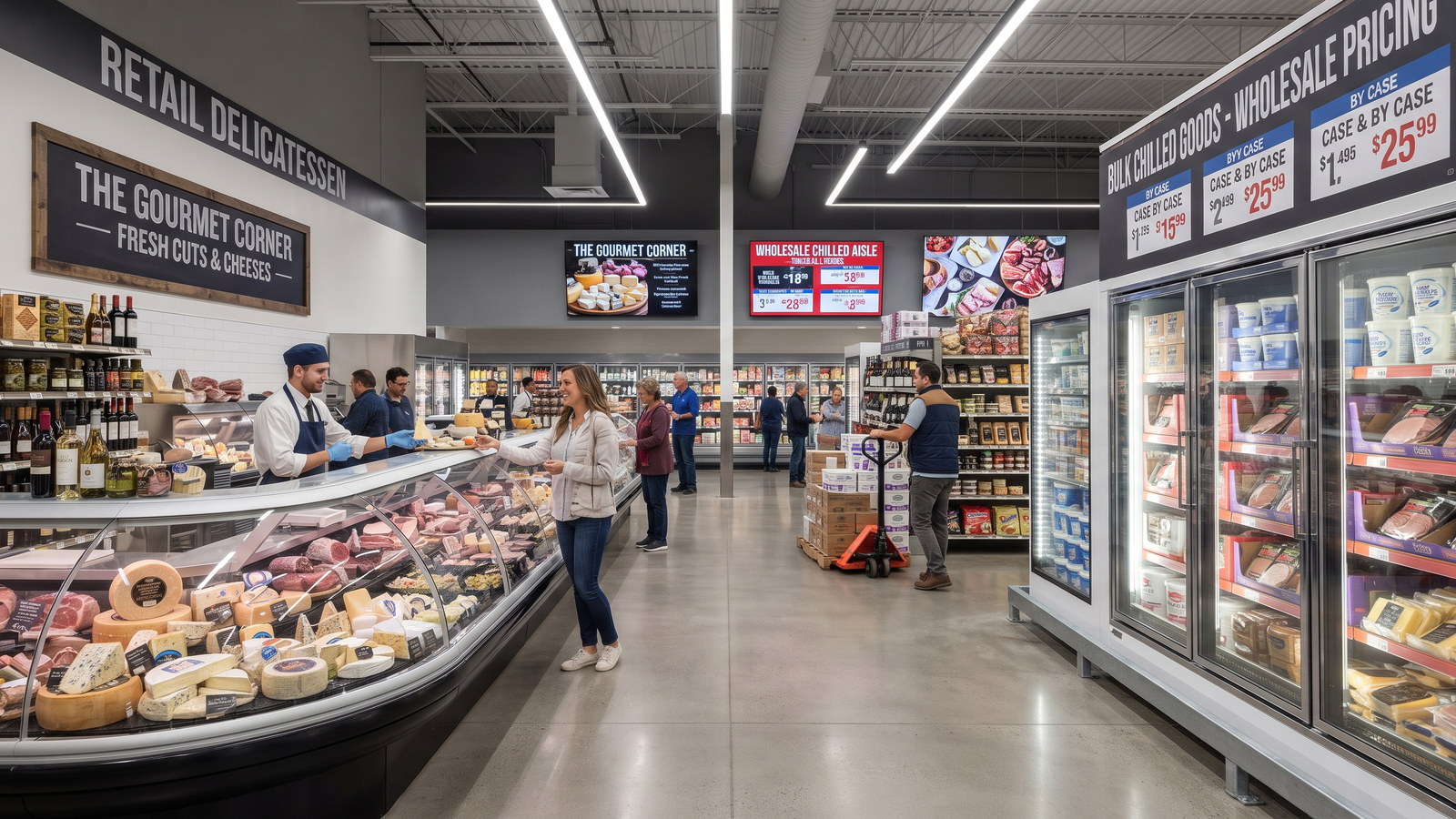
Two businesses book the same FSSC 22000 audit. One runs 22 supermarkets with delicatessen counters. The other trades containers of frozen fish it never touches. Both sit in food chain category F. One of them is audited against four documents and the other against two, and the difference is settled by a single question: do the goods physically pass through your hands?
In short
- Category F splits into FI, retail and wholesale with physical handling, and FII, brokering and trading without it.
- The scheme requires mandatory application of the ISO 22002-x series with the exception of FII. A pure broker does not apply ISO 22002-7 at all.
- For FI the audit runs against ISO 22000:2018, ISO 22002-100:2025, ISO 22002-7:2025 and the additional requirements.
- ISO 22002-7 is the most detailed part of the family: contamination split into five subclauses, allergen control in its own subclause, and Clause 18 on display, which exists nowhere else.
- The FSSC 22000 Version 7 for Retail and Wholesale course (R2 950) covers both subcategories. The Retail and Wholesale Pathway Bundle takes all three courses to R4 950.
FI or FII: the decision that settles the audit
The scheme describes FI as retail and wholesale activities and related e-commerce: the storage and provision of finished products to customers and consumers, covering retail outlets, shops and wholesalers. Importantly it includes minor processing activities, with slicing and portioning of meat or fish given as the examples. A supermarket with a delicatessen counter, a butchery or an in-store bakery finishing par-baked product is FI.
FII is food brokering, trading and e-commerce: buying and selling on your own account or as an agent, of any item entering the food chain, without physical handling. The goods never pass through your hands.
E-commerce appears in both descriptions, which trips people up. The sales channel does not decide your subcategory; physical handling does. An online grocer picking and packing from its own warehouse is handling, so FI. A marketplace passing orders to suppliers is not, so FII.
Two scoping rules are worth knowing before you quote. Manufacturers and caterers that also provide wholesale activities at the main site shall require subcategory FI in addition to their manufacturing category; you do not get to treat wholesaling as incidental. Where wholesale happens at a different location, the organization may choose separate certification to FI for that location, which is a genuine choice with cost consequences worth modelling.
Why ISO 22002-7 is the most detailed of the family
Retail is the only part of the chain where food meets the public directly, often unwrapped, handled by staff with high turnover, in a building the public walks through. The standard reflects that.
Clause 12 is split into five subclauses where other parts use one. General, microbiological, allergen, physical and chemical. Five subclauses force five separate answers, and a single procedure saying the store prevents contamination satisfies none of them.
Allergen control gets its own subclause at 12.3. In a factory, allergen management ends with a validated cleaning regime and an accurate label. In a store it ends with a colleague answering a customer’s question about a product sliced that morning on equipment also used for something else. That is a harder control, and it is substantially human. The clause names the means: cleaning and line change-over practices, product sequencing, airflow control, additional protective clothing, dedicated tools, and onsite catering control including vending machines — the route most stores have never considered. It also states that rework containing allergens may be used only in products containing the same allergens by design, or through a process demonstrated to remove or destroy the allergenic material.
Clause 18, display, exists in ISO 22002-7 and nowhere else in the ISO 22002 family. Not in manufacturing, catering, packaging, transport or feed. It exists because display is the one activity in the food chain where product is deliberately presented to the public, often unwrapped, for extended periods, in an environment designed to be attractive rather than hygienic. It requires display equipment capable of holding the correct conditions, a responsible person properly trained to identify visible infestation, detect visible defects, check expiry and minimum shelf life, carry out correct rotation and verify that display units function correctly, temperature-controlled storage, alerting and action on deviation, calibration, and heating and cooling processes able to meet the product specification.
The scenario auditors probe is the chilled promotional stack built at the end of an aisle, away from refrigeration, for a weekend. Your system needs a rule governing displays built outside the normal fixture layout, because the controls that live in the fixture do not follow the product.
Which additional requirements reach subcategory FI
2.5.18 multi-site certification is scoped to BIII, E, F and G, and retail is inherently multi-site, so this is central rather than optional. The central function becomes auditable in its own right: an internal audit programme reaching every store at least annually, auditors independent of the areas they audit and assigned centrally, defined competence, and technical review of every report. Sampling means your weakest store represents the estate.
2.5.12 names FI specifically rather than F as a whole, and requires routine site inspections and prerequisite programme checks at every site with frequency and content based on risk.
2.5.11 applies to all categories excluding FII, which is the clearest illustration of why the subcategory decision matters: the same organization, differently scoped, carries or does not carry a whole requirement.
2.5.13 names category F, landing on own-brand development and changes to counter recipes — though item e) on shelf-life trials names BIII, C, D and K, so it does not reach you.
Out of scope: 2.5.7 environmental monitoring, scoped to BIII, C, I and K. Many retailers run listeria monitoring around delicatessen and fish counters anyway, which is a sound decision and a voluntary one. And 2.5.14 traceability, subcategory C0 only.
If you are a broker
A pure FII business builds a different system. With no ISO 22002-x standard applying, you are assessed on ISO 22000:2018 in full and the additional requirements that reach you. Your hazard analysis is about the decisions you make: which suppliers you place business with, what you specify, what you verify, and what you do when something goes wrong in a chain you never physically touch. Clause 2.5.11 does not apply, which follows logically, since you cannot cross-contaminate goods you never handle. Where your risk really sits is supplier approval and verification, specification accuracy, food fraud vulnerability, traceability through paperwork alone, and the ability to execute a recall for goods that never entered your premises.
The order to learn this in
The retail course teaches only the two documents specific to category F and assumes you hold the other two. The pathway runs in three steps and the system enforces it: The ISO 22000 Standard, then ISO 22002-100:2025, then the sector layer, which unlocks on its own once the first two show as complete.
Taken separately the three come to R5 900. The Retail and Wholesale Pathway Bundle is R4 950, with a separate certificate for each course.
Common questions
Is a supermarket with a delicatessen counter FI or a manufacturing category?
FI. The description of FI expressly includes minor processing such as slicing and portioning of meat or fish. Once you are manufacturing a product rather than preparing finished goods for sale, you have moved into a manufacturing category.
We manufacture and also wholesale from the same site. What do we need?
Subcategory FI in addition to your manufacturing category. The scheme states it directly, and wholesaling is not treated as incidental to production.
Does a broker need ISO 22002-7?
No. The mandatory ISO 22002-x application carries an exception for FII. A broker’s system rests on ISO 22000 and the applicable additional requirements.
What is Clause 18 and why does it only exist here?
Clause 18 covers display: temperature through display rather than only at loading, protection from consumer contamination, separation on the same display, time limits, cleaning, and a trained responsible person. It exists only in ISO 22002-7 because no other food chain category presents unwrapped product to the public for extended periods.
Is the certificate verifiable?
Yes. Every ASC certificate carries a unique certificate number and a QR code that resolves to a verification page on this site showing the learner name, course and completion date.