
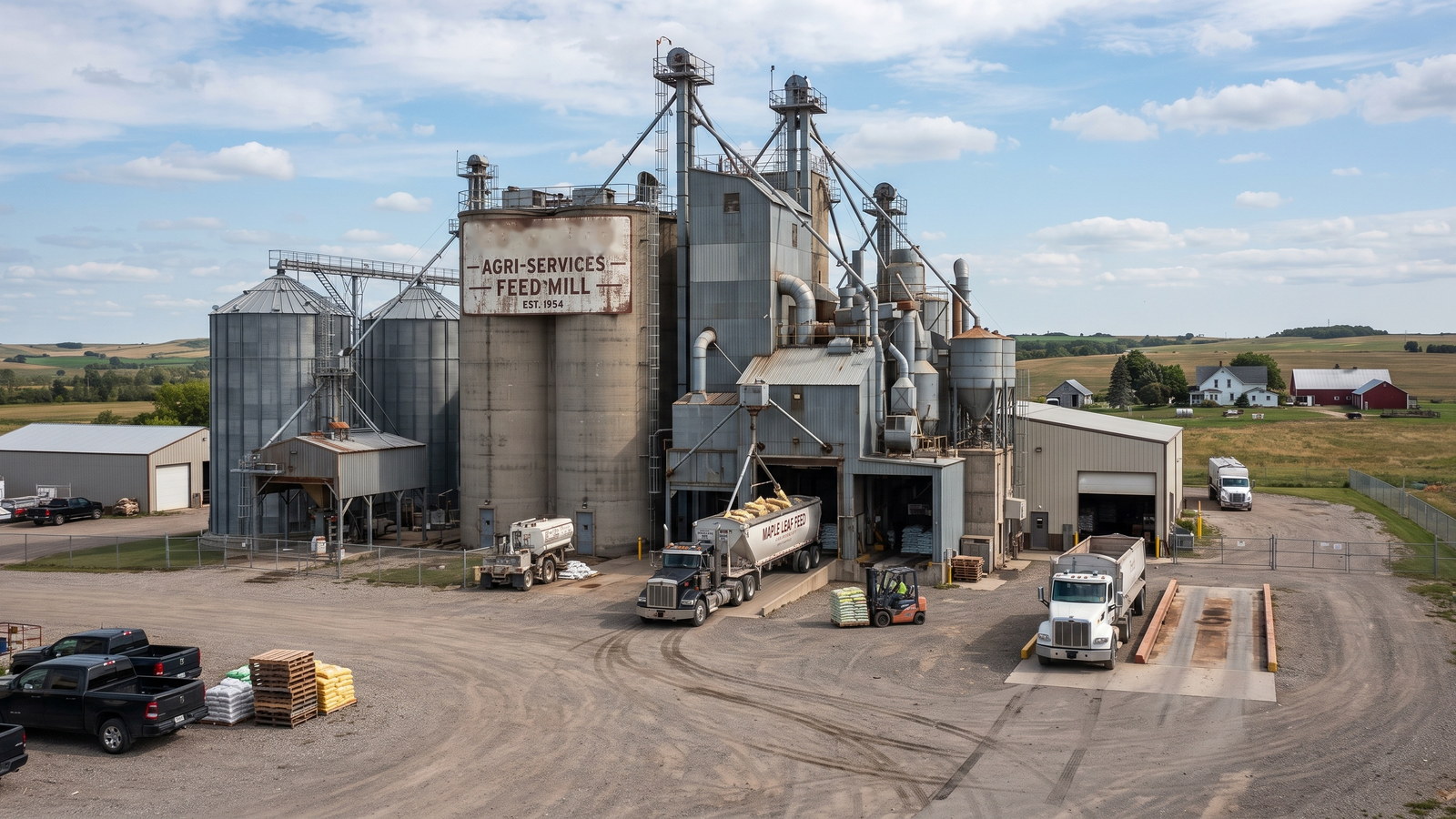
A compound feed mill hands the auditor its prerequisite programme manual. It is thorough: zoning, allergen matrices, an environmental monitoring plan. The auditor turns to the one clause that is actually written for a feed mill and asks how the sequencing rule after a medicated batch was validated. The answer is that it came from the plant the production manager worked at before. That is the audit, in one exchange.
In short
- Feed and animal food production sits in food chain category D. A category D audit is conducted against ISO 22000:2018, ISO 22002-100:2025, ISO 22002-6:2025 and the FSSC 22000 Version 7 additional requirements.
- ISO 22002-6 adds only four requirements of its own, and every one of them is about medication: storage, cross-contamination, declaration and rework.
- Clause 2.5.11 c) is written for category D alone: procedures to manage ingredients and additives containing components that can have an adverse animal health impact.
- Pet food is not category D. The definition excludes animals kept in households, so a plant making both has two scopes and two standards.
- The FSSC 22000 Version 7 for Feed and Animal Food Production course (R2 950) teaches the two documents specific to category D. The Feed and Animal Food Pathway Bundle takes all three courses to R4 950.
Where category D starts and stops
The scheme describes category D in two halves. First, processing of feed material intended for food and non-food producing animals not kept in households, with meal from grain, oilseeds and by-products of food production as the examples. Second, processing of feed mixtures, with or without additives, intended for food producing animals, with premixes, medicated feed and compound feeds as the examples.
Two things follow. The household animal exclusion puts pet food inside the food manufacturing categories rather than category D, so a business doing both has two scopes and conflating them is a scoping error the certification body will catch. And medicated feed is named expressly, which is the scheme telling you where the audit will spend its afternoon.
The reason the scheme treats feed as seriously as food is simple: the animal is not the end of the chain. Contamination entering a compound feed reaches meat, milk and eggs, and several of the most damaging food safety incidents on record entered through feed.
ISO 22002-6:2025 adds four requirements, and all four are about medication
Most of ISO 22002-6 states that the requirements in ISO 22002-100 shall apply. Four places add something:
Section 5.4, storage. Medications shall be stored in accordance with the manufacturer requirements, in a designated area, with access restricted to authorized personnel. All three elements, not one. A locked cage that ignores the manufacturer’s storage temperature meets one of the three, and a key on an open board with no authorised list meets neither of the other two.
Clause 12, cross-contamination. Cross-contamination by medication shall be prevented or minimized by use of dedicated lines, cleaning, flushing, line changeover practices and/or product sequencing. The and/or matters: the standard does not require all five, it requires you to use what works. What it does not do is tell you which sequence is safe. That judgement belongs to your hazard analysis under ISO 22000 clause 8.5.2, and the control measure you select there has to be validated under clause 8.5.3. A sequencing rule with no carry-over trial behind it is a control measure asserted rather than selected.
Clause 15, declaration. Medications present in the feed shall be declared on the product label and/or the accompanying documentation. Either route satisfies it, which recognises that most feed moves in bulk. What does not satisfy it is a medication present by carry-over that nobody declared because nobody intended it to be there.
Clause 17, rework. Rework containing medications shall be managed appropriately to avoid compromising feed safety. Deliberately outcome based, which means you have to be able to show how your rework controls achieve it. The easiest defensible position, and the one many strong mills take, is to prohibit certain streams outright: floor sweepings, aspiration dust, medicated flush into non-medicated feed. Prohibition is easy to audit and easy to train.
The requirement written for you alone
Clause 2.5.11 applies to all food chain categories excluding FII, and item c) of it is stated for category D and nothing else: in addition to ISO 22002-6:2025 clause 12, the organization shall have procedures in place to manage the use of ingredients and additives that contain components which can have an adverse animal health impact.
Read it carefully, because it widens the hazard analysis. This is not only about human food safety downstream. It asks you to control components that can harm the animal itself: an additive safe for one species and harmful to another, or an inclusion rate safe at specification and harmful above it. Copper is the paradigm case, because the tolerance gap between cattle and sheep is wide and most blending sites serve both.
Satisfying it looks like a list of the ingredients and additives concerned, defined species and inclusion limits, controls preventing use outside those limits which in practice means formulation locks and label checks, and evidence the control works, usually through mixer uniformity and carry-over testing. It sits next to carry-over because carry-over is how a controlled ingredient reaches an animal it was never intended for.
What does not reach category D
2.5.7 environmental monitoring names BIII, C, I and K. Category D is absent. Salmonella monitoring may be entirely sensible for your own risk reasons, but it is your decision rather than a scheme requirement, and what you do carry is clause 2.5.12, routine site inspections and prerequisite programme checks with frequency and content based on risk.
2.5.18 multi-site certification names BIII, E, F and G. A feed group with four mills is outside it, and each mill is certified in the ordinary way.
2.5.14 traceability is subcategory C0 only.
And one genuine carve-out worth knowing: clause 2.5.6 h) allows the allergen management section to be indicated as not applicable for category D, and for pet food in category C, where there is no allergen-related legislation in the country of sale pertaining to animal feed or pet food. The condition attached is easy to miss: unless a claim relating to an allergen status has been made on the product. Make the claim and the whole of 2.5.6 comes back into scope. Rely on the exclusion and you need a documented determination of the legal position for every country you sell into, reviewed when legislation changes.
The order to learn this in
The feed course teaches only the two documents specific to category D and assumes you hold the other two. The pathway runs in three steps and the system enforces it: The ISO 22000 Standard, then ISO 22002-100:2025, then the feed layer, which unlocks on its own once the first two show as complete.
Taken separately the three come to R5 900. The Feed and Animal Food Pathway Bundle is R4 950, with a separate certificate for each course.
Common questions
Is pet food category D?
No. The definition excludes animals kept in households, so pet food is handled within the food manufacturing categories. A plant making both livestock feed and pet food has two scopes and two standards.
How many requirements does ISO 22002-6 actually add?
Four: section 5.4 on storing medications, Clause 12 on cross-contamination by medication, Clause 15 on declaring medications and Clause 17 on rework. Everything else defers to ISO 22002-100, which applies in full.
Do we need an environmental monitoring programme?
Not under the scheme. Clause 2.5.7 names BIII, C, I and K only. Clause 2.5.12 on prerequisite programme verification does name category D and does apply.
Can we mark allergen management not applicable?
Only where there is no allergen-related legislation for the country of sale pertaining to animal feed, and only where no allergen status claim has been made on the product. Both conditions, documented.
Is the certificate verifiable?
Yes. Every ASC certificate carries a unique certificate number and a QR code that resolves to a verification page on this site showing the learner name, course and completion date.