
Hygienic design training · Series FS32 · Levels 1 to 3
Your line is not dirty. It is impossible to clean.
There is a machine on your floor that fails the same swab every year. The team is not the problem and the chemical is not the problem. A one millimetre corner, a blanked branch and a hollow frame tube are the problem, and they were decided on a drawing before anyone bought the caustic. This series teaches you to find them, name the rule they break, and write the specification that stops the next one arriving.
Written by the ASC Team against EHEDG Guideline 8, 3-A Sanitary Standards and R638 regulation 6.
The short answer
What is hygienic design training, and who needs it?
Hygienic design is the practice of designing food equipment, pipework and buildings so that soil, water and microorganisms cannot get in, cannot collect and cannot survive cleaning. It is a design control, not a cleaning control. Hygienic design training teaches food industry professionals to identify design faults on installed equipment, quote the rule and the source document each fault breaks, and write those requirements into a purchase specification before equipment is built.
ASC runs the series online and self-paced, so delegates enrol from South Africa, the wider African continent, the Gulf states, Europe, the United Kingdom, Australia, India and North America. The engineering content and the reference documents are international, drawn from EHEDG and 3-A practice. The one South African section, regulation R638, is clearly marked so delegates elsewhere can map it to their own law.
The series
Two courses live. Take them in order.
Essentials teaches you to see the fault and name the rule. Intermediate takes you into the engineering behind it. Advanced, covering validation, verification and design review at scale, is in development.
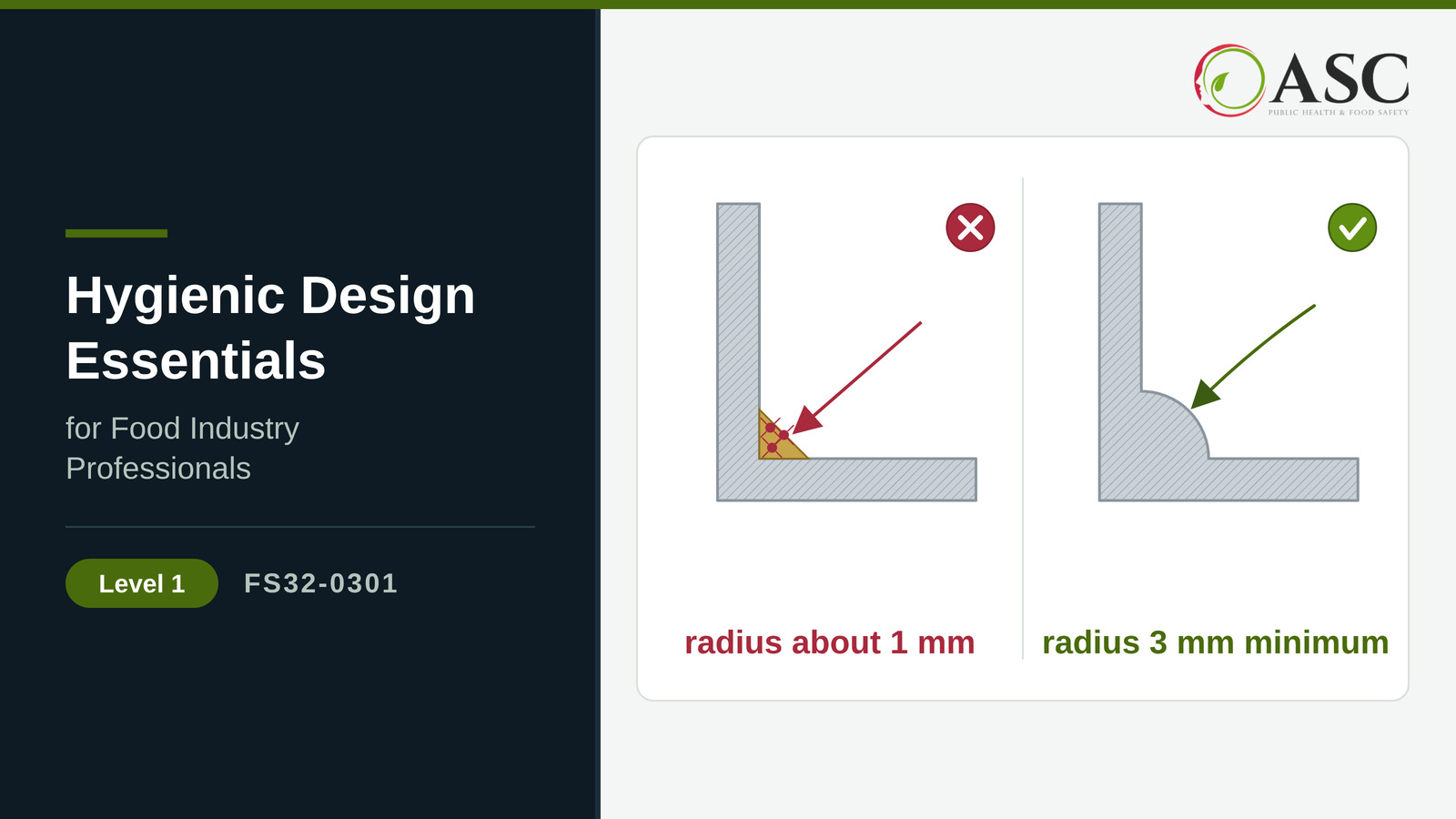
Hygienic Design Essentials
- Where microorganisms live on a machine, and why cleaning cannot follow them
- The ten rules with the real numbers
- Conveyors, tanks, pipes, valves, floors, drains and the building
- A thirty point walk you run on your own line the week you finish
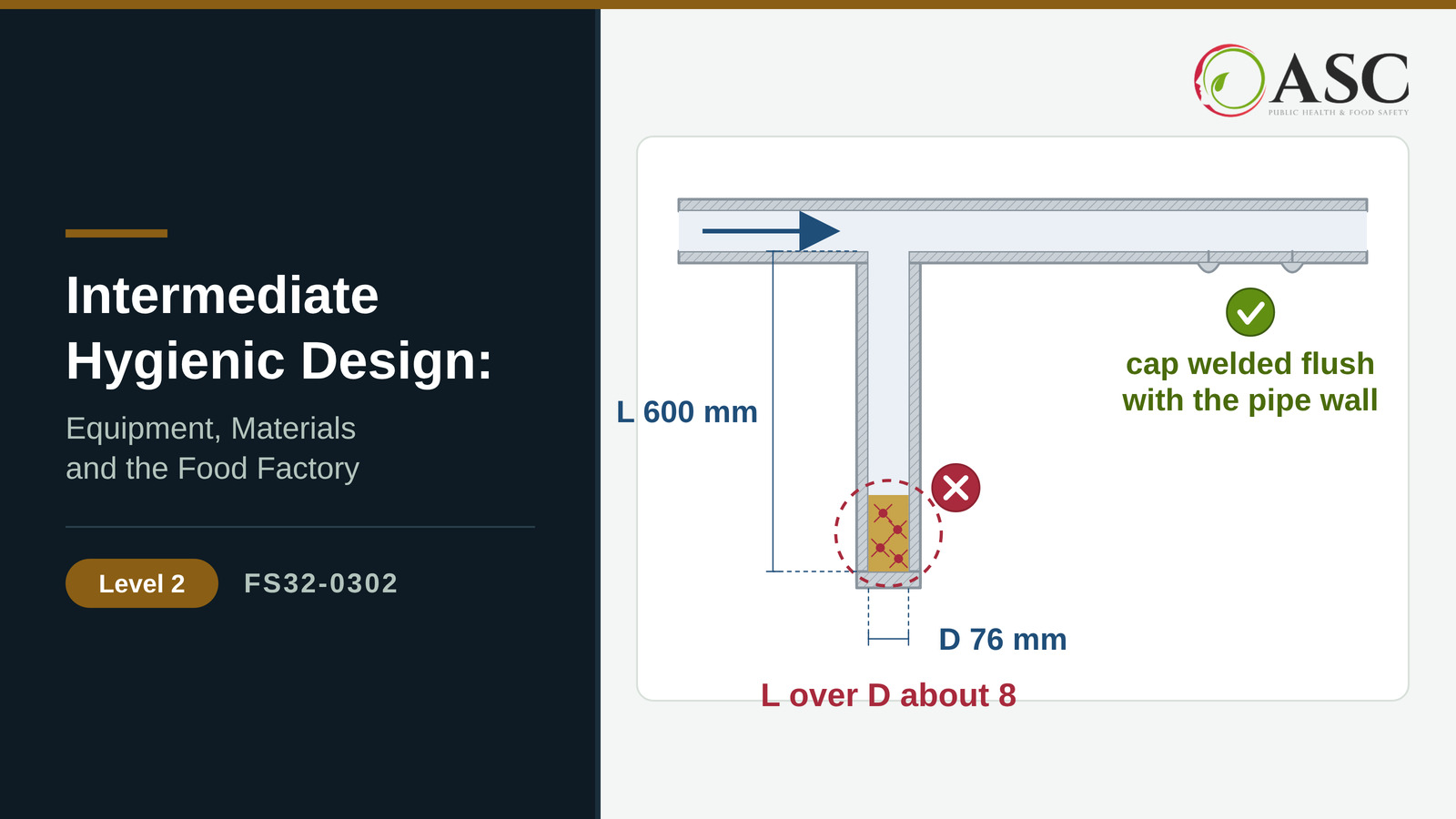
Intermediate Hygienic Design
- Steel grades, the four corrosion mechanisms, surface finish and elastomers
- Pipework, welds, valves, tanks and CIP verification at the return
- Conveyors and open equipment, stripped into six scored points
- Floors, drains, air, condensation and building work in a running plant
Priced in South African rand. Live conversion in nine currencies is shown below. No discounts apply to this series.
Inside the courses
Watch a lesson before you spend anything
Not a promotional reel. These are the actual lessons, narrated, built on original engineering diagrams drawn for this series. Eighteen of them run through the two courses.
Four minutes, from what it is to what you do on Monday. This is the teaching style, not a trailer.
The module opener. Three lessons, what you will be able to do, and how you are assessed.
Hygiene levels, the equipment lifecycle, the standards map and hygienic zoning.
Enrol from anywhere
How much does hygienic design training cost?
Delegates enrol from South Africa, the rest of Africa, the Gulf, Europe, the United Kingdom, Australia and North America. Prices are set in South African rand and the live conversion is shown below so there is nothing to work out before you decide. Payment is taken in rand and your bank converts at its own rate on the day.
Live rates load in your browser. Indicative only.
The argument this series settles
This is engineering, taught for the people who meet the machine
Hygienic design decides whether cleaning can work at all. Cleaning solution shears across the mouth of a corner and never enters it. Disinfectant follows the same path. Every batch reinoculates the surface from a place no chemical has ever reached.
That is why a swab passes on the flat beside a corner that is still soiled, and why the same line fails the same test every year while the hygiene team carries the blame.
What you will be able to quote, by number
The ten rules, and the document behind each one
Most food safety training gives you principles. This gives you figures you can put in a purchase order, with the source named, so a supplier cannot talk you out of them. It also teaches you which numbers in common use are not in the document people credit them to, which is the difference between a specification that holds and one that gets negotiated away.
EHEDG guidance figures are commonly cited. The courses name the edition and flag where a figure is industry practice rather than the guideline.
What you walk away with
Two tools that turn a walk into a funded plan
Both run in your browser and export a spreadsheet, and both are free. The spreadsheet they export is the document engineering needs to raise a capital request.
The Hygienic Design Walk
30 scored points across a line or a room, two override flags, photographs and job cards, exported to a spreadsheet you hand to engineering. Comes with Essentials, and it is free to run before you enrol.
The Hygienic Design Risk Register
Every finding scored on severity, likelihood and exposure, banded, with an interim control, a permanent fix, an owner, a cost and a date. Comes with Intermediate, and it is the assignment.
When one walk is not enough
The Hygienic Design Inspection System
The free walk scores one line, in one browser, and the next walk replaces it. If you are running this across a site, month after month, the subscription keeps every walk. Each line carries its own score history, so you can see which points keep failing and which zeros actually closed. Guidance sits against all 30 checks, with the rule, the source document, the usual cause and the line to write into a specification.
And at the end of a walk it writes the inspection report for you: the score, the priority zeros with both override flags applied, every finding against its rule and its source, the cost argument, and a one page note for management naming the top five. Print it, or take it away as a spreadsheet.
Sold on ascfoodsafety.com with the rest of the ASC automated tools. The two free tools above stay free and stay exactly as they are.
Who it is for
Built for the people who decide what gets installed
Quality and Food Safety Managers
You sign off corrective actions on findings cleaning cannot fix. This gives you the rule number and the drawing to change.
Engineering and Maintenance
Specify radii, slopes, welds and clearances before the steel is cut, and reject a quote on hollow sections alone.
Project and Process Engineers
Take a line from user requirement specification to commissioning with evidence at every gate.
Procurement and Technical Buyers
Ask for the three documents that matter at order, while you still have leverage.
Hygiene and Cleaning Managers
Prove which findings are design faults, and cost them in water, overtime and delayed starts.
Auditors and Consultants
Raise findings that hold, against the right document, at the right clause.
Equipment Suppliers and Fabricators
Understand what your food customers are about to start asking for, and build it in first.
Graduates and Career Changers
Every activity works on the built-in case study, so you can finish without a site of your own.
Read before you spend
Seven guides, free, written by the people who built the courses
If the guides are useful, the courses are the same material with the diagrams, the videos, the assessments and the tools. Start anywhere.
Straight answers
Frequently asked questions
Do I need an engineering background?
No. Essentials assumes none and teaches through drawings and photographs of real faults. Intermediate goes into materials, pipework and building services and assumes Essentials or equivalent experience. Neither course asks for any calculation beyond dividing one measurement by another.
Which one should I start with?
Essentials, unless you already specify or install equipment for a living. It teaches you to see the fault and name the rule, and Intermediate builds directly on it. An engineer already comfortable with radii, slopes and dead legs can start at Intermediate.
Is this recognised by FSSC 22000, BRCGS or the other schemes?
Hygienic design is not a standard of its own. It sits inside your prerequisite programmes, maintenance, change control and equipment purchase requirements, which is where auditors look for it. The courses quote the relevant clauses and, just as importantly, teach you which commonly used figures come from guidance rather than the standard.
Can I do this without a factory to practise on?
Yes. Every activity, tool and assignment works on the built-in case studies, which are training scenarios drawn from real audit patterns, so an unemployed or newly qualified delegate can complete the whole course and earn the certificate.
How long do I have, and is it self-paced?
Both courses are online and self-paced. Essentials is five hours of content, Intermediate is nine, and you work through them in your own time on a phone or a computer. Every lesson can be read or listened to.
What does the certificate look like?
An ASC Certificate of Achievement carrying your name, the course, the level and a verification code with a QR code, so an employer or auditor can confirm it on our website rather than taking a printed sheet on trust. 70% is needed to pass every assessment, and the final assessment is video proctored.
Is there a discount or a group price?
There are no discounts on this series. It is a technical course built with engineers and it is priced accordingly. For several seats from one company, contact us and we will deal with it directly.
I am outside South Africa. Can I enrol?
Yes, and a large share of delegates are. The courses run online and self-paced with no live sessions to attend, so time zone does not matter. The engineering content and the guidance documents referenced, including EHEDG and 3-A practice, are international. Prices are shown live in US dollars, euros, pounds, dirhams, Australian and Canadian dollars, riyals, naira and shillings, and you are charged in South African rand.
Is the content relevant outside South Africa?
Yes. Radii, slopes, dead legs, weld quality, surface finish, steel grades, drainage profiles and clearances are physics and metallurgy, not jurisdiction. One section covers South African regulation R638, and it is clearly marked so that a delegate in Nigeria, Kenya, the United Arab Emirates, the United Kingdom or Australia can map it onto their own regulation while the rest of the course applies unchanged.
Do you train teams and whole sites?
Yes. For several seats from one company, contact us and we will handle it directly, including invoicing in rand and a manager view of who has completed what. There are no discount codes on this series.
The fault is still there tomorrow
A badly designed line costs water, chemical, overtime and delayed starts for as long as it runs, and it keeps costing until somebody changes the drawing. Five hours is the cheapest thing you will ever do about it.