
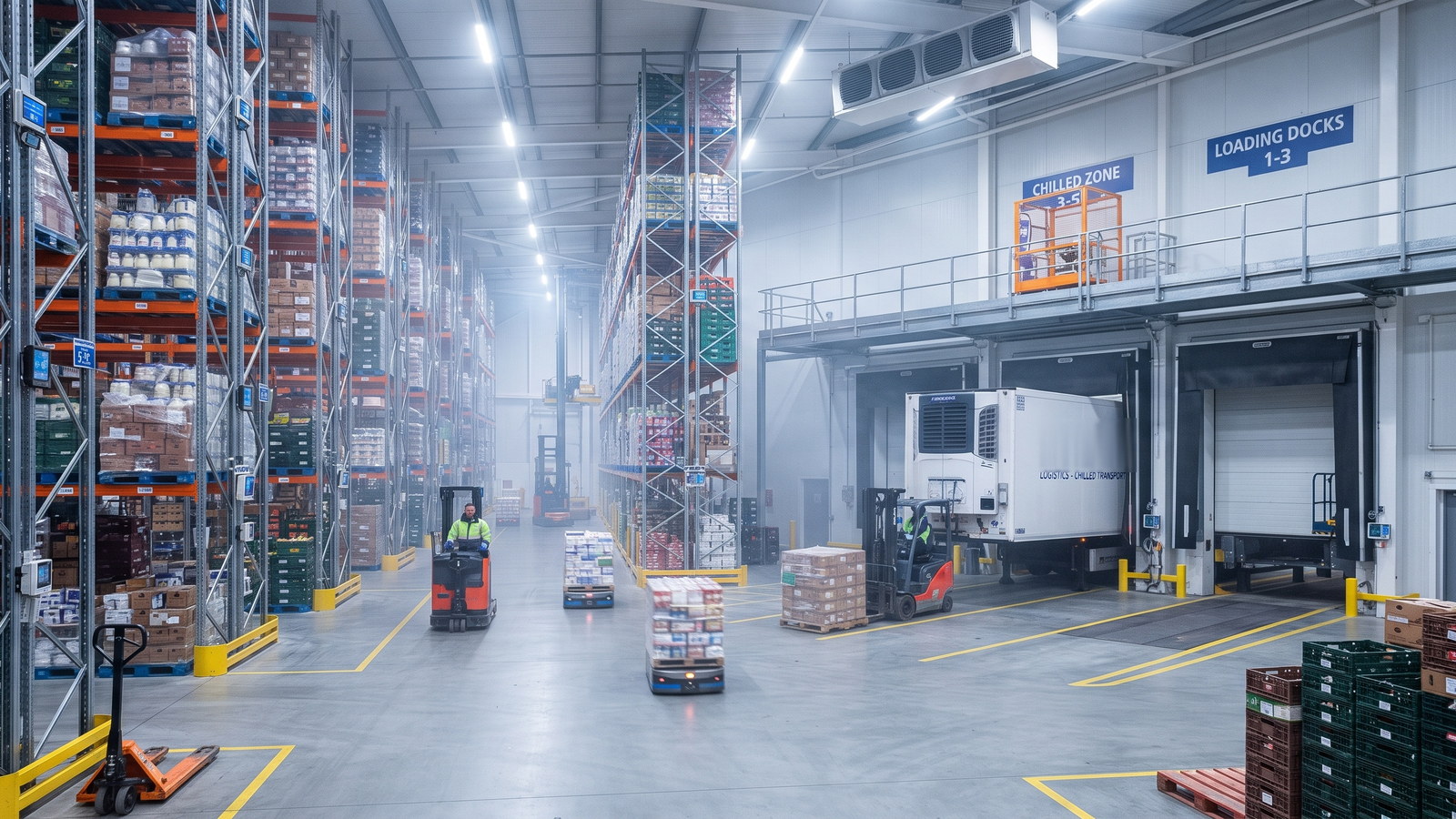
A third party cold store books its first FSSC 22000 audit and spends four months building a swabbing programme across the chilled estate, because the consultant who wrote the system had spent twenty years in food factories. The programme is competent, expensive, and not a requirement of category G at all. Meanwhile nobody has written down what the driver does when a reefer fails on the road, which is.
In short
- Transport and storage services sit in food chain category G. A category G FSSC 22000 Version 7 audit is conducted against four documents, not one.
- Those four are ISO 22000:2018, ISO 22002-100:2025, ISO 22002-5:2025 and the FSSC 22000 Version 7 additional requirements.
- Clauses 4 to 16 of ISO 22002-5 each defer to ISO 22002-100. Clause 17 is the only clause that sets requirements of its own, and it is where a category G audit concentrates.
- Three additional requirements do not reach category G: 2.5.7 environmental monitoring, 2.5.13 product design and development and 2.5.14 traceability. Two very much do: 2.5.12 and the whole of 2.5.18.
- The FSSC 22000 Version 7 for Transport and Storage course (R2 950) teaches the two documents specific to category G. The Transport and Storage Pathway Bundle takes all three courses to R4 950.
What the scheme actually puts in category G
The scheme defines category G as third party logistics service providers who physically store or transport food, feed, or food and feed packaging materials, regardless of legal product ownership. That closing phrase is deliberate. Not owning the goods removes none of your obligations.
Relabelling and repackaging sit here too, with one limit that catches growing operations out: only where open, exposed product materials are not involved. A site applying a new country-of-destination label to a sealed case is category G. The same site opening cases, decanting and repacking has stepped into a manufacturing category with a different standard and a different audit. Operators who add value-added services gradually cross that line without noticing.
There is no separate category for refrigerated or frozen distribution. Cold chain operations are category G like any other, and the temperature obligations arrive through the requirements rather than through a different scope.
Clause 17 of ISO 22002-5: the clause that exists nowhere else
Read ISO 22002-5:2025 straight through and the first surprise is how short it is. Clauses 4 to 16 each state that the requirements in ISO 22002-100 shall apply. Nothing added. Then Clause 17 arrives with three parts that have no counterpart in the catering, packaging, feed or retail standards.
17.1 Categorization. Product groups are categorized as unpacked or packed, each either condition-controlled or not. The operative requirement is the sentence that follows: the practices applied during transport and storage shall be designed, documented and implemented to maintain appropriate storage conditions and the integrity of goods. One common set of practices across an ambient hall and a chilled chamber holding both loose produce and packed retail units will struggle to demonstrate that.
17.2 Controlled conditions. Where conditions apply, a control system must be in place and monitored, a system must alert the relevant personnel on deviation, and appropriate corrections and corrective action must follow the alert. Automated recording should be used; where it is absent, monitoring at an appropriate frequency shall be carried out and retained, with the equipment calibrated. Logistic units must either achieve the conditions before loading or after loading without compromising the integrity of the goods. And documented information on managing the load in transit must be available, including what happens when the specified conditions are not achieved during transit. That last sentence is the one most cold chain operators are missing.
17.3 Goods identification. Every logistic unit and every goods picked from one carries an identifier, and that identifier must enable retrieval of seven things: goods identification and quantity, supplier identification, dates of receipt, expiry or best-before dates where applicable, the temperature and controlled condition requirements where applicable, nonconforming or quarantined status, and warnings for hazardous substances. Where you assemble logistic units, you retain the time and date, the identifiers involved and an inventory before and after. And you maintain measures to prevent the loss of identification of any part of a logistic unit, which is the requirement that catches the identifier printed on shrink wrap that is cut away at the pick face.
Cross docking has its own definition, and its own consequences
ISO 22002-5 defines cross docking as the process by which goods are unloaded, sorted, consolidated, loaded and shipped to the next destination without storage. The absence of storage is the defining feature, and Clause 1 brings it expressly into scope.
Most storage controls assume dwell time: receive, check, put away, monitor, pick, despatch. Cross docking removes the middle. In a forty minute window you still have to establish that what arrived is what was expected, that its temperature held, that identity and traceability survived consolidation, and that nothing in the yard contaminated it. Sites that run one procedure covering storage and quietly assume cross docked goods follow it are the sites that fail the traceability exercise.
What does not reach category G, and why that is worth money
2.5.7 environmental monitoring is scoped to BIII, C, I and K. Category G does not appear. You are not audited against the scheme requirement for a risk based environmental monitoring programme, and that is where the money gets wasted. You must still verify that cleaning works, under ISO 22002-100 and under 2.5.12, but that is site inspection and cleaning verification rather than a pathogen swabbing programme.
2.5.13 product design and development is scoped to BIII, C, D, E, F, I and K. Category G is absent, which follows: you do not design products.
2.5.14 traceability is scoped to subcategory C0 alone. Your traceability duties are real and demanding, but they come from ISO 22000 clause 8.3 and from section 17.3 of ISO 22002-5, not from this clause.
Put all three in your applicability table as not applicable with the scope quoted. An auditor accepts a justified exclusion; an unexplained gap looks like an oversight.
The two that matter most
2.5.10 transport, storage and warehousing applies to every food chain category, which means every manufacturer carries it too. For you it is not a peripheral clause, it is a description of your core service, and the bar is higher for a specialist than for a factory that happens to own a loading bay. Expect real time on the stock rotation requirement, which demands first expired first out in conjunction with first in first out, and on the tanker requirements at item c) if you move bulk liquids.
2.5.18 multi-site certification is scoped to BIII, E, F and G. Very few categories carry it and G is one of them, which tells you the scheme expects logistics businesses to operate as networks. The central function becomes auditable in its own right: an internal audit programme reaching every site at least annually, auditors independent of the areas they audit and assigned centrally, defined competence including a forty hour lead auditor course and FSSC scheme training, and technical review of every internal audit report. A head office that issues procedures but cannot show it reviews internal audits will fail this even where every depot looks tidy.
The order to learn this in
The transport and storage course teaches only the two documents specific to category G and assumes you hold the other two. The pathway runs in three steps and the system enforces it: The ISO 22000 Standard, then ISO 22002-100:2025, then the sector layer, which unlocks on its own once the first two show as complete.
Taken separately the three come to R5 900. The Transport and Storage Pathway Bundle is R4 950, with a separate certificate for each course.
Common questions
Is a refrigerated haulier category G?
Yes. There is no separate cold chain category. Temperature controlled transport and storage is category G, and the temperature obligations arrive through ISO 22002-5 Clause 17 and the additional requirements.
We do not own the goods. Does that change anything?
No. The scheme definition says regardless of legal product ownership. Your product is custody of somebody else’s food, and the scheme is interested in whether that custody preserves its safety and its identity.
Do we need an environmental monitoring programme?
Not under the scheme. Clause 2.5.7 names BIII, C, I and K only. You do carry clause 2.5.12, which requires routine site inspections and prerequisite programme checks with frequency and content based on risk.
We run a network of depots. Does multi-site certification help?
It can be cheaper and simpler, but clause 2.5.18 then applies in full and the central function has to be real. Read it before you choose, because the internal audit and competence requirements are specific.
Is the certificate verifiable?
Yes. Every ASC certificate carries a unique certificate number and a QR code that resolves to a verification page on this site showing the learner name, course and completion date.