
FSSC 22000 Version 7 for Transport and Storage
About Course
There is nothing to buy first and nothing to unlock. An FSSC 22000 audit at category G is conducted against four documents, and all four are taught inside this one course, in the order they build on each other. This used to be the sector layer sold on top of two separate foundation courses. It is now self-contained.
You can start the moment you enrol. Each teaching module ends with a knowledge check, and a graded final assessment leads to the certificate.
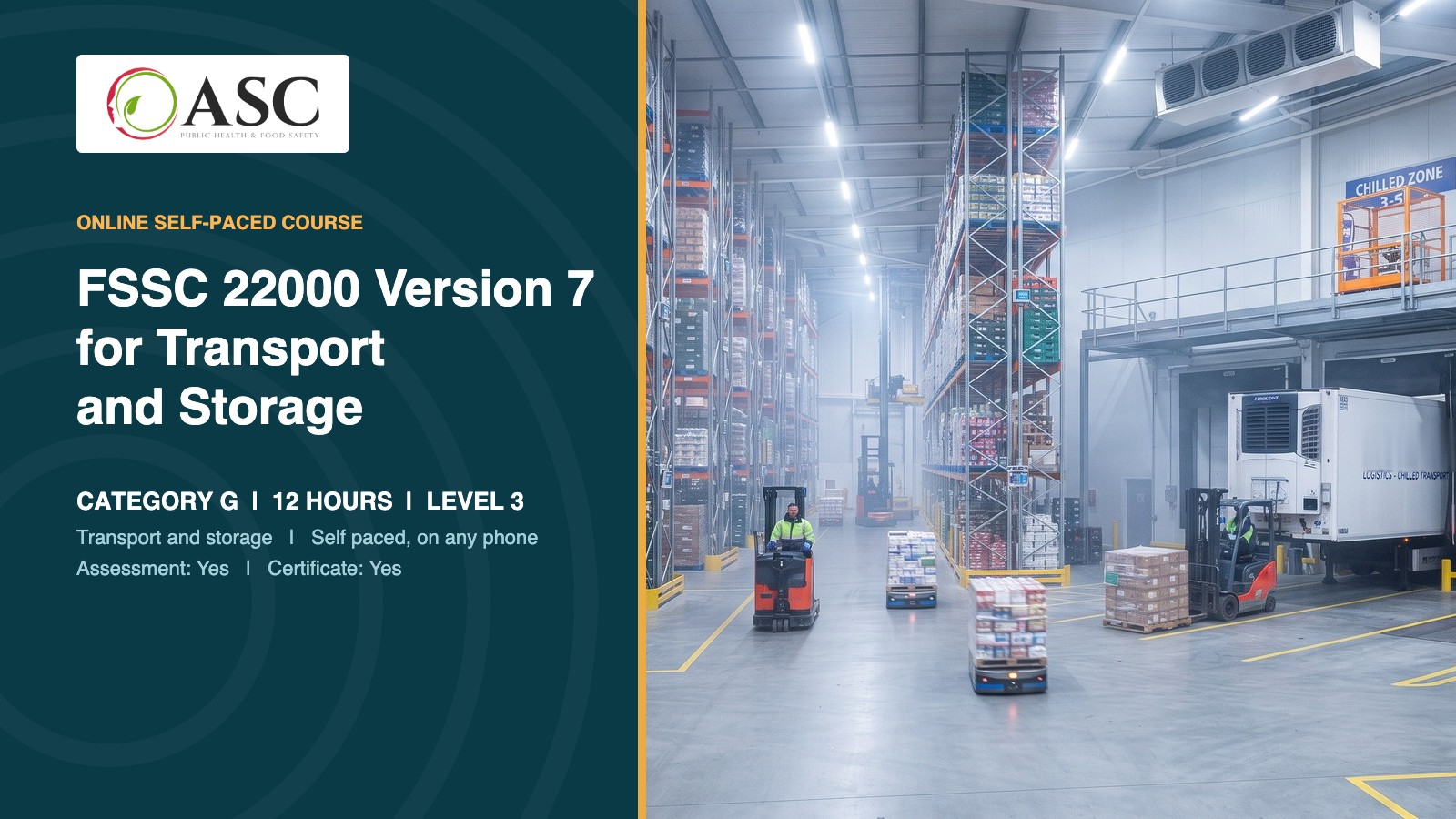
This course is the transport and storage layer of FSSC 22000 Version 7. It takes food chain category G, the provision of transport and storage services, and teaches what ISO 22002-5:2025 adds on top of ISO 22002-100:2025, together with the FSSC 22000 additional requirements at their real category G scope.
Category G is the category most often misread. A third party warehouse, a refrigerated distribution fleet, a cross docking operation and a storage site handling packaging materials all sit here, and the scheme treats them as a service provider rather than a manufacturer. Cross docking in particular has its own definition in the scheme and its own consequences for traceability, because goods are unloaded, sorted, consolidated and reloaded without ever entering storage.
The course works clause by clause through ISO 22002-5:2025, from construction and layout through utilities, pest control, waste and food loss management, equipment suitability, management of purchased materials, storage and transport itself, prevention of contamination, cleaning and disinfection, personal hygiene, product and consumer information, food defence and food fraud, and the part specific additional requirements in clause 17. Every requirement is taken at the scope that applies to a service provider, quoting the clause, naming the documented information it demands and the toolkit document that holds it.
Twenty four lessons across four teaching modules, each closing with a knowledge check, then an implementation toolkit module with two browser based tools and a final assessment module. The graded final assessment runs to four parts, 150 questions and 180 marks, with Part 4 carrying double marks. Three attempts and a pass mark of 70 percent. Every question carries a written explanation naming the clause that settles it.
Course Content
MODULE 1: THE SCHEME, CERTIFICATION AND WHAT VERSION 7 CHANGED
-
Module 1 Learning Outcomes
-
Lesson 1: Introduction to FSSC 22000 Version 7
00:00 -
Lesson 2: The Components of FSSC 22000
00:00 -
Lesson 3: How the Scheme is Structured and Certified
00:00 -
Lesson 4: Scheme Overview
00:00 -
Lesson 5: Recognition, GFSI 2024 and the Global ACI MRA
00:00 -
Lesson 6: The Scope Structure Overhaul
00:00 -
Lesson 7: Aim, Objectives and Nature, What Was Strengthened
00:00 -
Lesson 8: Category by Category Changes
00:00 -
Lesson 9: Requirements for Organizations
00:00 -
Lesson 10: The Certification Process
00:00 -
Lesson 11: Requirements for Certification Bodies
00:00 -
Lesson 12: Requirements for Accreditation Bodies
00:00 -
Lesson 13: Overview of the Scheme Changes
00:00 -
Lesson 14: Recap and Looking Ahead
00:00 -
Category or clause?
-
Module 1 knowledge check
MODULE 2: IMPLEMENTING ISO 22000:2018
MODULE 3: PREREQUISITE PROGRAMMES AND ISO 22002-100:2025
MODULE 4: CATEGORY G, AND WHAT AN AUDIT IS CONDUCTED AGAINST
MODULE 5: ISO 22002-5:2025, THE SITE AND ITS INFRASTRUCTURE
MODULE 6: ISO 22002-5:2025, THE OPERATIONAL CORE
MODULE 7: THE FSSC ADDITIONAL REQUIREMENTS AT CATEGORY G SCOPE
MODULE 8: THE IMPLEMENTATION TOOLKIT
MODULE 9: PRACTICAL EXERCISES
Course Feedback
MODULE 10: FINAL ASSESSMENT AND NEXT STEPS
Student Ratings & Reviews
