
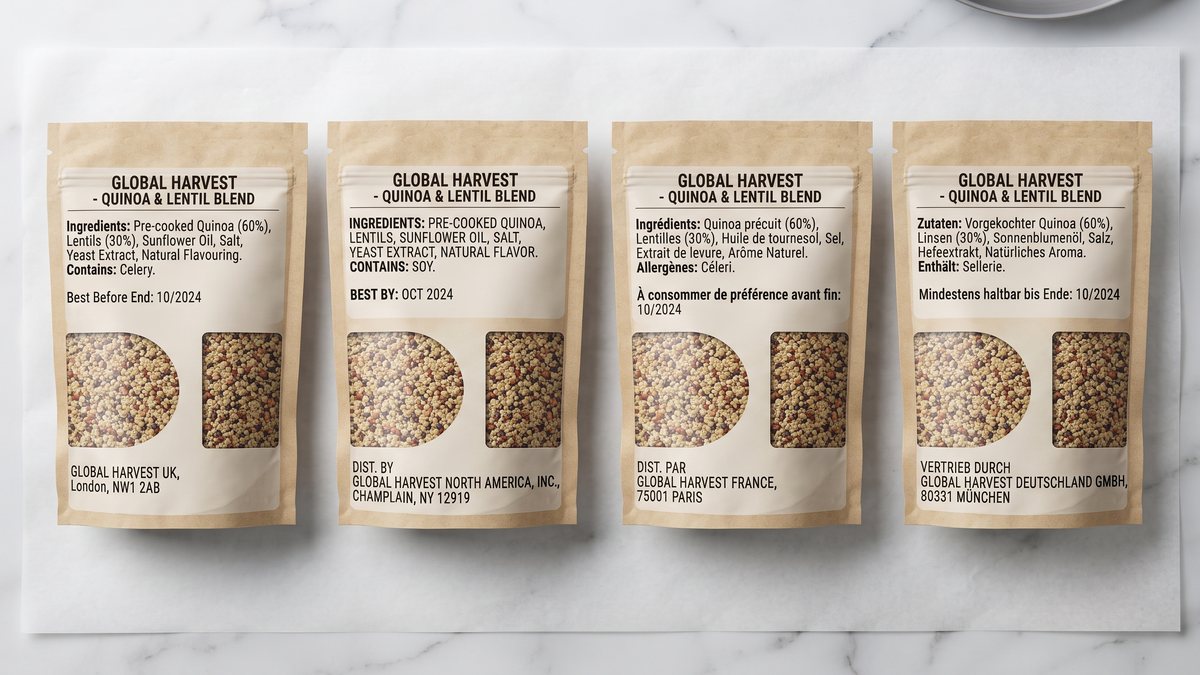
South African law does not ask a food business to guess which allergens matter. Regulation R146 of 2010 names them. What the regulation does not do is tell you where those allergens hide inside your own materials, what happens to the declaration when a supplier reformulates, or what the same recipe must say on a pack destined for Rotterdam rather than Rustenburg.
That gap is where most allergen non-conformances live. Not in a failure of science, and rarely in a failure of cleaning. In a declaration that was correct when it was written and quietly stopped being correct afterwards.
What R146 of 2010 actually requires
Eight groupings must be declared on the label of a prepackaged foodstuff when they are present as ingredients, and added sulphur dioxide must be declared once it reaches 10 mg/kg in the food as sold. A draft replacement regulation has been published for comment and is not in force, so R146 remains the rule you label against today. Labelling against a draft is a common and expensive mistake: it produces packs that are neither compliant with the current regulation nor with the one that may eventually replace it.
| Grouping | What it covers in practice |
|---|---|
| Cereals containing gluten | Wheat, rye, barley and oats, and anything made from them, including semolina, couscous, malt extract, bulgur, and many thickeners and coatings |
| Crustaceans | Prawn, shrimp, crab, crayfish and lobster, including stock, paste, powder and flavouring made from them |
| Eggs | Whole, white, yolk, dried and liquid egg, plus albumen, lysozyme, and many glazes, binders and mayonnaise-based dressings |
| Fish | Including fish gelatine, fish sauce, anchovy in a dressing or a Worcestershire-style sauce, and isinglass used as a fining agent |
| Peanuts | A legume, not a tree nut, and treated separately for a reason: the reference doses are among the lowest of any allergen |
| Soybeans | Including lecithin, hydrolysed soy protein, textured vegetable protein, miso, tempeh and a great many sauces |
| Milk | Including whey, casein, caseinate, lactose, butterfat solids, ghee, and the milk powder inside a seasoning blend |
| Tree nuts | A group, not a single nut. An allergic consumer may react to one and tolerate the rest, so the species matters |
| Sulphur dioxide and sulphites | Declared at 10 mg/kg and above in the food as sold. Common in dried fruit, wine, some juices, vinegars and processed potato products |
Note the phrase in the food as sold for sulphur dioxide. The threshold applies to the finished product, not to the concentration in the ingredient you bought. A dried fruit at 800 mg/kg used at 2% in a bakery mix contributes roughly 16 mg/kg to the finished product, which is above the threshold. The same fruit at 0.5% contributes about 4 mg/kg, which is not. The calculation belongs in the specification file, with the arithmetic shown.
The derivative problem, in detail
An ingredient can carry an allergen without carrying its name. This is the single most common cause of a declaration that is technically false, and it is not a knowledge problem so much as a reading problem: the allergen is on the specification, two pages in, under a name nobody recognised.
| Term on the specification | Allergen it usually carries |
|---|---|
| Whey, whey powder, whey permeate | Milk |
| Casein, caseinate, sodium caseinate | Milk |
| Lactose, milk solids, butterfat solids, ghee | Milk |
| Lecithin (unless specified as sunflower) | Soya |
| Textured vegetable protein, hydrolysed vegetable protein | Soya or wheat, depending on source |
| Semolina, durum, spelt, kamut, bulgur, couscous, farina | Wheat |
| Malt, malt extract, malt vinegar, brewer’s yeast | Barley |
| Albumen, lysozyme, ovalbumin, meringue, egg glaze | Egg |
| Isinglass, fish gelatine, Worcestershire-style sauce, anchovy paste | Fish |
| Surimi, shrimp paste, crustacean stock or powder | Crustaceans |
| Marzipan, praline, frangipane, nougat, nut butters | Tree nuts |
| Arachis oil, groundnut, monkey nut, beer nuts | Peanut |
| Tahini, halva, gomashio, benne seed | Sesame (not named in R146, mandatory in Codex and export markets) |
| Oyster sauce, seafood extract, snail or squid derivatives | Molluscs (not named in R146, declarable in the EU) |
Two derivatives are treated differently in different markets: wheat-based glucose syrup and highly refined soybean oil. Whichever position you take, it must be a written decision supported by the supplier specification, not an assumption carried forward from the last artwork. An auditor will ask to see the reasoning, and the reasoning is the deliverable.
Terms that conceal rather than declare
Certain words on a supplier specification tell you nothing about what is inside. Treat every one of them as an open question rather than an answer:
- Natural flavouring — ask what the flavour is carried on. Carriers are frequently lactose, maltodextrin from wheat, or a soya-based oil.
- Seasoning, spice blend, rub — frequently contains mustard, celery, milk powder or wheat as a flow agent.
- Glaze, wash, coating, dusting — egg and wheat live here.
- Batter, crumb, tempura — wheat, sometimes milk and egg.
- Binder, filler, bulking agent, anti-caking agent — wheat, soya or milk derivatives.
- Emulsifier — soya lecithin unless stated otherwise.
- Stock, bouillon, broth, base — celery, fish, crustacean, milk.
- Processing aid — isinglass in a beverage, enzyme carriers in a bakery product.
A specification that uses these terms without a breakdown is not a specification. It is a purchase order with pretensions. Send it back.
Codex, and why sesame is the exporter’s tripwire
Codex Alimentarius sets the international reference in the General Standard for the Labelling of Prepackaged Foods, CXS 1-1985. It splits allergens into two groups: a list that is always declared, and a second group left to national discretion. Sesame sits in the mandatory group. Soya sits in the discretionary group, which surprises most South African technologists, because soya is one of the eight in R146.
That asymmetry matters the moment a product leaves the country. A South African manufacturer who has never declared sesame, because R146 does not name it, will find the same pack non-compliant in the European Union, the United Kingdom, the United States, Canada and Australia. Nothing about the food changed. The border did.
Four rule sets, one recipe
| Jurisdiction | Number declared | What is different |
|---|---|---|
| South Africa (R146 of 2010) | 8 groupings, plus sulphur dioxide at 10 mg/kg | No celery, mustard, lupin, molluscs or sesame |
| European Union (Regulation 1169/2011, Annex II) | 14 | Adds celery, mustard, sesame, lupin, molluscs and sulphites, and requires them emphasised within the ingredient list, typically in bold |
| United States (after the FASTER Act) | 9 | Sesame added from 1 January 2023. Tree nut species must be named rather than grouped |
| Codex (CXS 1-1985) | Mandatory list plus national discretion | Sesame mandatory, soya discretionary |
The European emphasis requirement is worth isolating, because it is a formatting obligation rather than a content one. Listing wheat flour in the ingredients satisfies the content requirement; failing to emphasise it fails the format requirement, and a pack can be rejected for the second while being perfectly correct on the first.
The five that catch South African exporters
Celery, mustard, lupin, molluscs and sesame. None is named in R146. All five can turn a compliant local label into a non-compliant European one without a single change to the recipe.
- Mustard hides in mayonnaise, salad dressings, spice blends, curry powders, pickles and many processed meats.
- Celery hides in stock powders, soup bases, bouillon, seasoning mixes and celery salt.
- Lupin appears in gluten-free and high-protein bakery, and in some pasta.
- Molluscs appear in oyster sauce, seafood extracts and some Asian-style condiments.
- Sesame appears in bakery, tahini, hummus, halva, burger buns and a great many coatings and oils.
Building a declaration you can defend
- Start from supplier specifications, not from the previous label. Checking new artwork against old artwork carries the old error forward through every redesign the product ever has.
- Demand derivative detail. “Natural flavouring” is not an answer. Require a breakdown to the level at which allergens become visible, and record the version of the specification you relied on.
- Declare in the ingredient list first. A “Contains” summary statement is useful to the consumer, but it does not substitute for the allergen appearing in the ingredient list itself.
- Decide market by market, and write the decision down. One artwork built to the strictest market, or separate artwork with separate controls. Both are legitimate. Only one is right for your operation, and the file must say which and why.
- Re-approve when anything upstream changes. A supplier reformulation is a labelling event, not merely a procurement event. It should trigger a declaration review with the same formality as a recipe change.
- Review when the rules move. Sesame moved in the United States in 2023. The South African draft regulation will move at some point too. Put a calendar review against every export market you supply.
A ten-point label check before artwork goes to print
- Every allergen present as an ingredient appears in the ingredient list, under a name a consumer would recognise.
- Tree nut and cereal species are named where the destination market requires it.
- Sulphur dioxide has been calculated in the food as sold, not carried across from the raw material.
- Derivative decisions (glucose syrup, refined oils) are recorded with their justification.
- Any precautionary statement is supported by a risk assessment and a number, not by habit.
- The declaration was checked against the current specification, and the specification version is recorded.
- Emphasis formatting meets the destination market’s requirement.
- The artwork carries a version number, an approval date and a named approver.
- Obsolete artwork for this product has been withdrawn and its destruction recorded.
- The person who approved it could, today, produce the evidence trail on request.
Frequently asked questions
How many allergens must be declared in South Africa?
Eight groupings under Regulation R146 of 2010: cereals containing gluten, crustaceans, eggs, fish, peanuts, soybeans, milk and tree nuts. Added sulphur dioxide must also be declared at 10 mg/kg and above in the food as sold.
Is sesame a declarable allergen in South Africa?
It is not named in R146 of 2010. It is in the Codex mandatory group and is a major allergen in the European Union, the United Kingdom and the United States, so any product intended for export should be assessed for sesame regardless of the local position.
Has R146 been replaced?
No. A draft replacement has been published but is not in force. Label against R146 of 2010 until a new regulation is promulgated, and keep a watching brief so that artwork can be scheduled rather than rushed when it changes.
Does “may contain” satisfy the declaration requirement?
No. A precautionary statement addresses unintended cross-contact. An allergen present as an ingredient must appear in the ingredient list, whatever the precautionary statement says.
Do we have to use a “Contains” statement?
The allergen must be identifiable in the ingredient list. A summary “Contains” statement is a useful consumer aid and is required in some markets, but it supplements the ingredient list rather than replacing it.
How is the sulphur dioxide threshold calculated?
On the food as sold. Multiply the concentration in the ingredient by its inclusion rate to get the contribution to the finished product, and sum the contributions from every source. Show the arithmetic in the specification file.
Who in the business should own the declaration?
Whoever can produce the supplier specification that supports it. In practice that is technical or QA, working with NPD and packaging, with a named approver on every artwork version.
Which ASC course covers this
Allergen Labelling and Artwork Control is the four-hour course built around exactly this problem: what R146 requires, the derivative trap, precautionary labelling decided on a number, artwork change control, and one product sold into several markets. Fourteen lessons across four modules, written for technical, QA, NPD and packaging teams who own the declaration.
If the people reading the label are the ones handling the material, start instead with Allergen Awareness for Food Handlers, a two-hour course in plain language for operators, cleaners, packers and kitchen staff. For a full management system, Allergen Management in the Food Supply Chain covers the site-level programme, and Advanced Part 1: Risk Assessment and Cleaning Validation takes the risk assessment side further.