
Home / Guides / Food loss and waste
FOOD LOSS AND WASTE · FSSC 22000 CLAUSE 2.5.16
Key facts
- South Africa food loss and waste about 10.2 million tonnes a year
- Share of total food produced close to a third
- Share lost before a household sees it close to half
- Governing scheme clause FSSC 22000 additional requirement 2.5.16
- Clause structure 2.5.16 a to d, policy through to records
- Hierarchy tiers seven, prevention down to disposal
- Related BRCGS clauses Food Issue 9, clause 4.12 and 4.13, waste handling
- Entry level course Food Loss and Waste Essentials, R599, about five hours
Turn this into a certificate your auditor can check
Food Loss and Waste Essentials teaches operators, packers and supervisors to sort what comes off a line into the right pile and say why, using one real production day from gate to pallet.
Enrol in Food Loss and Waste Essentials, R599
See the full food loss and waste pathway
Self paced online with lifetime access. About five hours in total. QR verified Certificate of Achievement.
What counts as food loss and food waste?
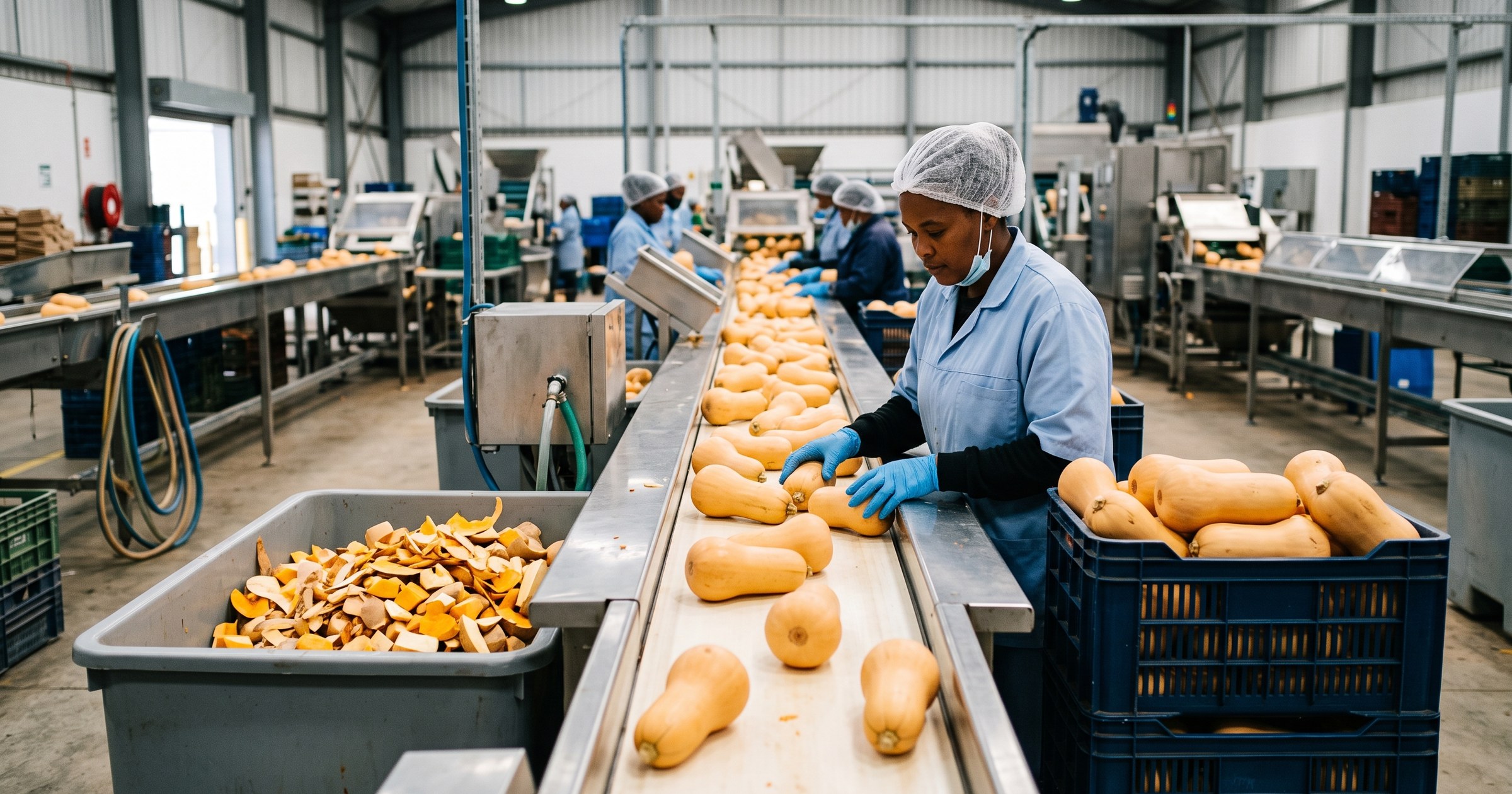
Food loss and waste is any food, or any part of a food crop or animal that was fit for human consumption, that leaves the human food chain at any point from the farm or slaughterhouse through to the point a household would have eaten it. A butternut trimmed past specification on a sorting table is food loss. A pallet held too long in a cold room and downgraded is food loss. A ready meal thrown out by a consumer after its date is food waste. The standards split loss and waste by where in the chain it happens, and a companion guide sets out that difference and why it changes how you classify a stream on an audit.
What does not count is the material that was never edible in the first place. A butternut’s stem end, an orange peel destined for essential oil extraction, bone and feather are inedible parts, not food loss, even though they leave the plant in the same skip. Getting this split right at the point a stream is generated, not later at the skip, is one of the most common places a site’s own number goes wrong.
How much food does South Africa lose or waste, and where does it happen?
South Africa loses or wastes an estimated 10.2 million tonnes of food a year, close to a third of everything the country produces. The instinct is to picture a household bin, but close to half of that total never reaches a home. It is lost on farms, in packhouses, on cold chains and on production lines, inside a fence, with a shift working. That is why a manufacturing site’s own food loss and waste number is not a side issue for a sustainability report. It is a line item that shows up as raw material bought and never sold.
Close to half of South Africa’s food loss and waste happens before a household ever sees the food, on farms, in packhouses and on production lines.
What is the food recovery hierarchy, and why does it matter?
Not every tonne of food loss and waste is equally bad, and the food recovery hierarchy ranks the options from best to worst. Prevention, not generating the loss in the first place, sits at the top. Feeding people through donation and redistribution comes next, then feeding animals. Below that sit industrial uses such as bio-based materials and rendering, then recycling through digestion, composting or land application, then controlled recovery such as combustion, and landfill, sewer or refuse disposal sit at the bottom. A site that measures food loss and waste is expected to be able to place any stream it generates on this hierarchy, in one of several specific destinations, and to show it is moving material up the ladder over time, not just tracking the total.
Where a stream can land on the hierarchy
- Prevention, the loss is designed out and never generated
- Feed people, donation and redistribution to a not for profit
- Feed animals, animal feed and animal food uses
- Industrial uses, bio-based materials and rendering
- Recycling, digestion, composting and land application
- Recovery, controlled combustion with energy capture
- Disposal, landfill, sewer or general refuse
What does FSSC 22000 clause 2.5.16 actually ask a certified site to do?
FSSC 22000 additional requirement 2.5.16 is currently the only GFSI benchmarked scheme requirement written specifically around food loss and waste, in four parts. Part a asks for a policy, a defensible base year and objectives with a prevention plan behind them, not just a statement of intent. Personnel training and the controls that apply when surplus food is donated or routed to animal feed sit under parts b and c, so a site cannot claim the credit for donating surplus without also proving it was controlled and traceable. The requirement closes with monitoring and records under part d, which is the part an auditor actually tests: ask where a number came from, and the file needs to answer.
BRCGS Food Issue 9 clause 4.12 and 4.13 and SQF clause 11.8 deal with waste handling as part of their prerequisite programme and environmental sections, and the practices in this series apply there too, but 2.5.16 is the clause written around measurement and reduction as their own management system, not a housekeeping item.
Build the number an auditor cannot pick apart
Measuring Food Loss and Waste teaches QA and technical managers the scope, quantification method and mass balance discipline behind a defensible clause 2.5.16 baseline.
Enrol in Measuring Food Loss and Waste, R995
See the full food loss and waste pathway
Self paced online with lifetime access. About seven hours in total, including a hands on baseline workshop.
Where a food business should actually start
Start with the people who generate the loss, because a baseline built without the shop floor’s cooperation is a baseline nobody trusts. Food Loss and Waste Essentials gets operators, packers, supervisors and warehouse staff fluent in the vocabulary and able to sort what comes off their own station correctly, using one real production day at a vegetable freezing plant from the weighbridge to the pallet. Once that is in place, Measuring Food Loss and Waste takes a QA or technical manager through the scope, the quantification method and the mass balance discipline that turns raw numbers into a baseline an auditor cannot pick apart, and Reducing Food Loss and Waste for Sustainable Manufacturing turns that baseline into a costed, funded, audit ready reduction programme.
Food Loss and Waste Essentials, R599 · Measuring Food Loss and Waste, R995 · Reducing Food Loss and Waste for Sustainable Manufacturing, R1195
See the full food loss and waste course pathway or browse all ASC courses. Related guides: every food loss and waste article.
Turn the baseline into a funded, audit ready programme
Reducing Food Loss and Waste for Sustainable Manufacturing teaches you to cost the losses, write the policy and objectives, and route surplus to donation or animal feed safely.
Enrol in Reducing Food Loss and Waste, R1195
See the full food loss and waste pathway
Self paced online with lifetime access. About eight hours in total, including a hands on programme workshop.
Frequently asked questions
What is the simple definition of food loss and waste?
Food loss and waste is any food, or the parts of a food crop or animal fit for human consumption, that leaves the human food chain at any point from harvest or slaughter through to the point a household would eat it. It includes a bruised vegetable trimmed on a sorting table, a batch that fails a specification, product held too long in a cold room, and food thrown away by a consumer. It does not include the parts of a plant or animal that were never edible, such as bone, husk or seed.
How much food does South Africa lose or waste each year?
The commonly cited figure is about 10.2 million tonnes of food a year, close to a third of everything the country produces. Close to half of that is lost before it ever reaches a household, on farms, in packhouses and on production lines, which is why a manufacturing site’s own number matters and cannot be waved away as a consumer problem.
Is food loss and waste the same thing as any other food thrown away?
No. The standards draw a line at whether the material stayed in the human food chain. Food that is still fit to eat but is redirected, donated, sold as animal feed, sent to industrial use or composted has left the food chain in different ways with different consequences, and the food recovery hierarchy ranks those options. The full distinction between loss and waste is covered in a companion guide.
Which certification scheme requires a food business to measure food loss and waste?
FSSC 22000 additional requirement 2.5.16 is currently the only GFSI benchmarked scheme requirement that asks a certified site to measure and actively reduce food loss and waste. BRCGS Food Issue 9 and SQF deal with waste handling as part of their prerequisite programme and environmental clauses, but 2.5.16 is written specifically around measurement, objectives and reduction.
What does FSSC 22000 clause 2.5.16 actually require?
In outline, 2.5.16 a asks for a policy, a base year and objectives with a prevention plan behind them. Personnel training and the controls that apply when surplus food is donated or used as animal feed sit under 2.5.16 b and c. The requirement is closed out with monitoring and record keeping, so an auditor can trace any claimed reduction back to evidence rather than a stated intention.
Where should a site start if it has never measured food loss and waste before?
Start with the vocabulary and the hierarchy, covered in this article, then move to measurement. Food Loss and Waste Essentials gives operators and supervisors the vocabulary and the ability to sort what comes off their line correctly, and Measuring Food Loss and Waste gives QA and technical managers the method to turn that into a defensible number.
ASC Food Safety Training · Leading with Science. Ensuring Food Safety. · Fully online, serving all of South Africa and beyond · info@ascfoodsafety.com · WhatsApp +27 61 483 0381 · SAATCA registered training centre (TC No. 065) · FoodBev SETA accredited provider No. 587/00337/1900 · B-BBEE Level 1 · Registered Lead Auditor (Exemplar Global and IRCA) · Consulting and document toolkits at ascfoodsafety.com