
Home / Guides / Food loss vs food waste
FOOD LOSS AND WASTE · DEFINITIONS AND CLASSIFICATION
Key facts
- Food loss happens upstream, farm to processing
- Food waste happens retail and consumer stage
- Classification test where in the chain it left, not how edible
- Trimmed line reject classed as food loss
- Donated surplus a prevention action, still recorded
- Inedible parts excluded from the figure entirely
- Where classification is done at the point the stream is generated
- Course that teaches this Food Loss and Waste Essentials, R599
Turn this into a certificate your auditor can check
Food Loss and Waste Essentials teaches operators, packers and supervisors to sort what comes off a line into the right pile and say why, using one real production day from gate to pallet.
Enrol in Food Loss and Waste Essentials, R599
See the full food loss and waste pathway
Self paced online with lifetime access. About five hours in total. QR verified Certificate of Achievement.
Where exactly does the line between loss and waste fall?
The standards draw the line by stage in the supply chain, not by how edible the food still is. Food loss is the reduction in quantity or quality of food that results from decisions and actions by suppliers in the chain, excluding retailers, food service providers and consumers, occurring from harvest or slaughter up to, but not including, the retail stage. Food waste is that same reduction occurring at the retail and consumer stage, as a result of the behaviour of retailers, food service providers and consumers. The same kilogram of edible food, discarded for the same reason, is loss in one place in the chain and waste in another.
This is why a manufacturing site’s own figure is almost entirely a food loss figure. Nearly everything generated between the intake weighbridge and the dispatch door, trimming, an out of specification batch, a cold chain excursion, a start up or changeover loss, happened upstream of retail and is loss by definition, even on a day when every kilogram of it was still perfectly fit to eat.
Two worked examples from a production line
| Scenario | Stayed in or left the food chain | Loss or waste, and why |
|---|---|---|
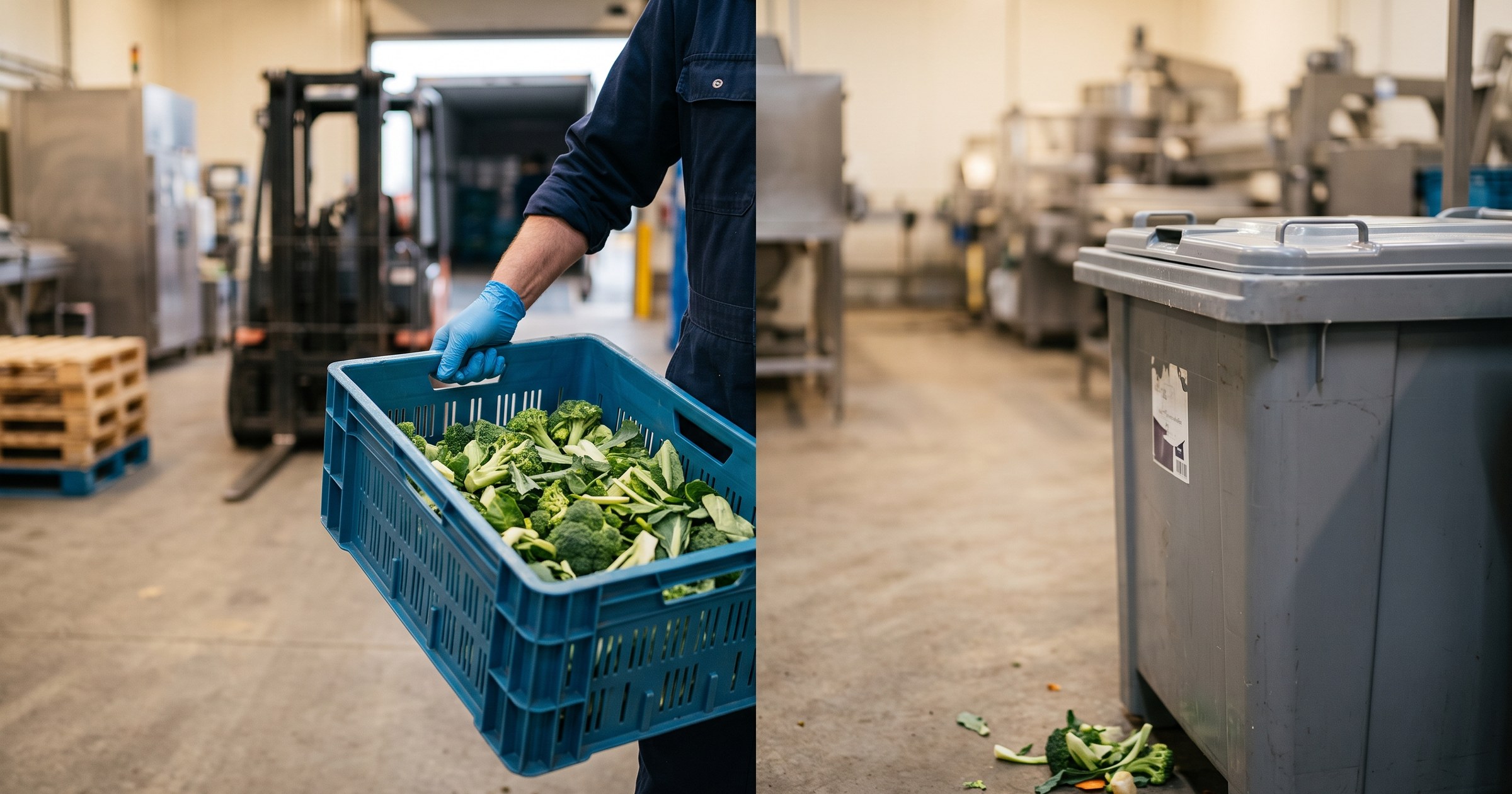
| Butternut trimmed past specification on a sorting table | Left the food chain at the point it was trimmed | Food loss. It happened during processing, upstream of retail, driven by the site’s own specification and sorting decision |
| A finished pack downgraded after a cold chain excursion in distribution | Left the food chain at the point it was downgraded | Food loss. Distribution and storage sit upstream of the retail stage in this definition |
| A ready meal thrown out by a household after its date | Left the food chain in the home | Food waste. It happened at the consumer stage, driven by a household decision |
| Unsold bread removed from a supermarket shelf | Left the food chain at the retailer | Food waste. It happened at the retail stage, driven by a retailer decision |
Why an auditor cares which word you use
FSSC 22000 additional requirement 2.5.16 asks a certified site to set a baseline and objectives for its own food loss and waste, and an auditor testing that evidence will trace a specific stream back to how it was classified. A site that lumps every stream together at the skip, rather than classifying each one at the point it was generated, usually finds two things wrong when it is checked properly: inedible material inflating the reported tonnage, and genuine food loss hidden inside a category called general waste where nobody is looking for it. Both are the kind of finding that turns a routine clause check into a longer conversation.
Build the number an auditor cannot pick apart
Measuring Food Loss and Waste teaches QA and technical managers the scope, quantification method and mass balance discipline behind a defensible clause 2.5.16 baseline.
Enrol in Measuring Food Loss and Waste, R995
See the full food loss and waste pathway
Self paced online with lifetime access. About seven hours in total, including a hands on baseline workshop.
Where donation fits
Donating surplus food that is still fit for human consumption is not an exception to food loss, it is the second best outcome on the food recovery hierarchy, ranked directly below not generating the loss in the first place. It still needs to be measured, recorded and controlled under FSSC 22000 clause 2.5.16 b and c, because the credit for diverting food away from disposal only holds up if the controls and the traceability behind the donation can be shown to an auditor or, in the worst case, traced through a mock recall. A companion guide covers exactly what those controls need to look like.
Food Loss and Waste Essentials, R599 · Measuring Food Loss and Waste, R995 · Reducing Food Loss and Waste for Sustainable Manufacturing, R1195
See the full food loss and waste course pathway or browse all ASC courses. Related guides: every food loss and waste article.
Turn the baseline into a funded, audit ready programme
Reducing Food Loss and Waste for Sustainable Manufacturing teaches you to cost the losses, write the policy and objectives, and route surplus to donation or animal feed safely.
Enrol in Reducing Food Loss and Waste, R1195
See the full food loss and waste pathway
Self paced online with lifetime access. About eight hours in total, including a hands on programme workshop.
Frequently asked questions
What is the difference between food loss and food waste?
Food loss happens upstream of the retail and consumer stage, on farms, in packhouses, during transport, storage or processing, generally as a result of decisions made by businesses in the supply chain. Food waste happens at the retail and consumer stage, and is generally the result of a decision by a retailer, food service outlet or household. The test the standards use is where in the chain the food left it, not how edible it still was.
Is a trimmed vegetable on a production line food loss or food waste?
It is food loss. Trimming, sorting rejects, an out of specification batch and a cold chain failure on a production line all happen upstream of retail, so they are classed as food loss even where the trimmed material is still perfectly edible.
Why does the loss or waste classification matter for an FSSC 22000 audit?
FSSC 22000 additional requirement 2.5.16 expects a site to know which streams it generates and where they sit, because the policy, the baseline and the reduction objectives all describe the site’s own food loss. An auditor checking 2.5.16 evidence will ask why a stream was classified the way it was, and a classification made at the skip rather than at the point the stream was generated is one of the fastest ways to fail that question.
Does donating surplus food count as food loss or as a solution to it?
Donating surplus that is still fit for human consumption is a food loss prevention action under the food recovery hierarchy, ranked second only to not generating the loss at all. It still needs to be recorded and traced under FSSC 22000 clause 2.5.16 b and c, because donation only counts as controlled diversion if the controls and traceability can be shown.
Are inedible parts such as bone or peel counted as food loss?
No. Food loss and waste only counts material that was fit for human consumption. The inedible parts of a food crop or animal, such as bone, husk, seed or a peel destined for extraction, are excluded from the figure even when they leave the site in the same stream as genuine food loss.
Which course teaches a team to classify streams correctly?
Food Loss and Waste Essentials teaches line staff to sort anything coming off a station into one of three piles: still food, thrown away, or never was food, using one real production day. Measuring Food Loss and Waste then teaches QA and technical managers to classify every stream at the point it is generated as part of building a defensible baseline.
ASC Food Safety Training · Leading with Science. Ensuring Food Safety. · Fully online, serving all of South Africa and beyond · info@ascfoodsafety.com · WhatsApp +27 61 483 0381 · SAATCA registered training centre (TC No. 065) · FoodBev SETA accredited provider No. 587/00337/1900 · B-BBEE Level 1 · Registered Lead Auditor (Exemplar Global and IRCA) · Consulting and document toolkits at ascfoodsafety.com