
Introduction to ISO 45001:2018
About Course
Introduction to ISO 45001:2018
| Course code | Price | Duration | Level |
|---|---|---|---|
| FS60 | R1 195 | About 6 hours, self paced | Foundation |
About this course
The auditor stops at the line 2 sleeve applicator, looks at the guard, then looks at the operator and asks: what would you do if you thought this machine was going to hurt you? The operator points at the safety file in the SHEQ office. That answer fails the site, and it is not the operator’s fault. Nobody ever told her that clause 7.3 of ISO 45001:2018 is about her, that she has a part in finding hazards, or that the standard expects her to know how to remove herself from imminent and serious danger and what protects her when she does.
This course closes that gap in about six hours. It walks the whole standard, clauses 4 to 10, at the depth a person on the floor needs: what each clause is for, what it asks in plain words, what your own part is, and what you would say to an auditor or an inspector who asked. It teaches ISO 45001:2018 as amended by Amendment 1:2024, including the one sentence on climate change that the amendment added to clause 4.1.
The law comes first. ISO 45001 is voluntary. The Occupational Health and Safety Act 85 of 1993 and the Compensation for Occupational Injuries and Diseases Act 130 of 1993 apply whether a site is certified or not, and a Department of Employment and Labour inspector enforces the Act whatever the certificate on the wall says. Module 1 teaches sections 8, 9, 13, 14, 16 and 24 of the OHS Act in plain words before it teaches a single clause. The case study is a chilled ready meals plant in Kempton Park, built from real audit, inspection and incident patterns. No real company is named.
Who it is for
Everyone who works inside an OH&S management system and will be interviewed by an auditor or an inspector: operators, supervisors and team leaders, health and safety representatives, administrators, and new SHEQ coordinators in their first months. It suits a site that is about to start ISO 45001, a site that already holds a certificate and wants its people to answer for it, and any team that has a safety file and is being asked for a safety system. It is not the course for the person who has to build the system; that is ISO 45001:2018 Understanding and Implementation. The managing director and the section 16(2) assignees are better served by ISO 45001 Management Awareness.
What you finish with
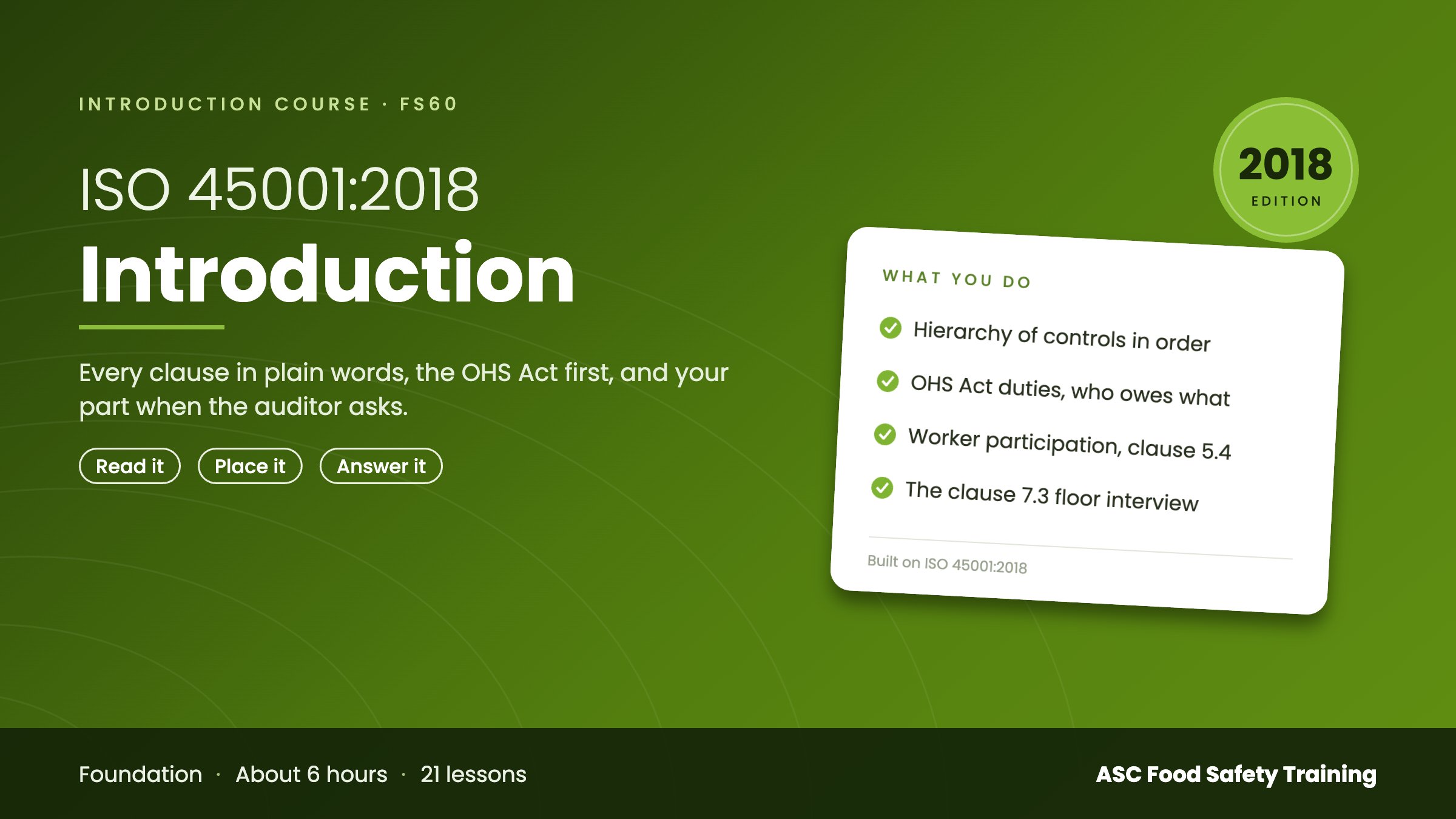
You finish able to use the words that matter the way clause 3 defines them: worker, workplace, hazard, OH&S risk, incident, consultation and participation. You can place any control on the hierarchy of controls in clause 8.1.2, in the standard’s order, and say why a sign on a machine is a weak control. You know what a health and safety representative and a committee do under sections 17 to 20 of the OHS Act and how to raise a concern. You can take part in hazard identification and a risk assessment, report an incident or a near miss properly, and say which legal reports follow a serious injury. You can answer the floor interview on clause 7.3 a) to f) about your own job, and you can tell a certification audit from an inspection. And you hold a certificate of completion with a verification code.
Curriculum
Module 1: Health and safety at work, the law, and why ISO 45001 exists
- Lesson 1.1: Why people get hurt at work, and what a management system changes
- Lesson 1.2: The OHS Act and COIDA in plain words: who owes what to whom
- Lesson 1.3: The words that matter: worker, workplace, hazard, risk, incident, near miss, consultation, participation
- Lesson 1.4: The hierarchy of controls, and why a sign is a weak control
- Lesson 1.5: Worker participation: health and safety representatives, committees and your voice
- Lesson 1.6: The shape of the standard: PDCA and clauses 4 to 10 in one picture
Module 2: What the standard asks, clauses 4 to 7
- Lesson 2.1: Context, interested parties and scope (4.1 to 4.4), and the climate change question
- Lesson 2.2: Leadership and commitment: what the MD must do and be seen to do (5.1)
- Lesson 2.3: The OH&S policy and what it commits to (5.2)
- Lesson 2.4: Roles, responsibilities and authorities, and the legal appointments (5.3)
- Lesson 2.5: Consultation and participation in practice (5.4)
- Lesson 2.6: Hazard identification and risk assessment: what you will be asked to take part in (6.1.1, 6.1.2)
- Lesson 2.7: Legal requirements, objectives and planning (6.1.3, 6.1.4, 6.2)
- Lesson 2.8: Support: resources, competence, awareness, communication and documents (7.1 to 7.5)
Module 3: Operation, emergencies, checking, improving, and your part in the audit
- Lesson 3.1: Operational control and the hierarchy applied (8.1.1, 8.1.2)
- Lesson 3.2: Management of change, procurement, contractors and outsourcing (8.1.3, 8.1.4)
- Lesson 3.3: Emergency preparedness and response (8.2)
- Lesson 3.4: Monitoring, measurement and evaluation of compliance (9.1)
- Lesson 3.5: Internal audit and management review (9.2, 9.3)
- Lesson 3.6: Incidents, nonconformity and corrective action, and continual improvement (10.2, 10.3)
- Lesson 3.7: Certification, the audit, the inspector, and what to say when asked
- Final assessment: 30 questions drawn from 60
How you are assessed
Every module has a knowledge check of 15 questions drawn from a bank of 24, at 30 seconds a question, and a game of 10 rounds drawn from 14, at 45 seconds a round. Between the lessons sit nine scenario checks, three in each module, each drawing 6 questions from 8 at 30 seconds a question and set on the lessons just before it. Each module ends with a case study assessment on the Mzansi site: one scenario with data, 10 questions drawn from 12, 45 seconds each. The final assessment draws 30 questions from a bank of 60, harder than the knowledge checks, a third of them set on a scenario.
The pass mark is 70 percent on everything. Each assessment allows two timed attempts, with a 24 hour break after a failed first attempt. Everything is marked automatically the moment you submit, and the feedback on a failed attempt names what to fix and which lesson to reread.
What you need
A phone, tablet or laptop with an internet connection. You do not need prior knowledge of ISO 45001 or of any management system standard, and you do not need a site of your own: every activity runs on the case study, which comes with its data. If you work on a site, most lessons end with a short task you can do on your next shift instead. A licensed copy of ISO 45001:2018 and its Amendment 1:2024 is useful but not required; ISO sells it, and the SABS publishes it in South Africa as SANS/ISO 45001. The course quotes short passages of the requirements, including the definitions it teaches; it does not reproduce the standard.
Certificate
When you have passed every assessment, ASC issues a certificate of completion that names the course, the code FS60 and the date, and carries a verification code an employer can check. It is a training certificate from ASC Food Safety Consultants. It is not a certification of your organisation and it is not an auditor qualification.
Free guides for this course
- What is ISO 45001? A plain guide for South African employers
- ISO 45001 awareness training: what every worker and supervisor must know
See all eight ISO 45001 and health and safety courses and which one fits your job at ascfoodsafetytraining.com/iso-45001/.
Questions people ask
Is ISO 45001 a legal requirement in South Africa?
No. ISO 45001 is a voluntary standard, and no provision of the OHS Act requires it or any certification. The OHS Act and the COID Act apply to your site whether it is certified or not. The standard is a way of running the work so that you can show you met the law and kept improving.
Do I need to know anything about ISO standards first?
No. The course assumes nothing. Module 1 starts with why people get hurt at work and what the law already asks, and every clause is explained in plain words with an example from a factory floor.
Is this the course for health and safety representatives?
Yes, as a foundation in the standard. Lesson 1.5 covers what representatives and committees do under sections 17 to 20 of the OHS Act, and lesson 2.5 covers consultation and participation under clause 5.4. It does not replace any training your site arranges for representatives under its own agreement.
Does it teach a right to refuse dangerous work?
It teaches what the standard and the law actually say. Clause 7.3 f) requires workers to be made aware of their ability to remove themselves from work situations they consider present an imminent and serious danger, and of the arrangements that protect them from undue consequences for doing so. The OHS Act has no general express right to refuse or leave dangerous work; that right is in the Mine Health and Safety Act and applies only on mines. In the OHS Act, section 26 protects an employee from victimisation for doing what the Act allows or requires. Lesson 1.5 sets out the difference.
Will this course go out of date when ISO 45001:2027 is published?
No. Voting on the draft, ISO/DIS 45001, closed on 9 September 2026, and ISO expects to publish the new edition in the first half of 2027. No transition period has been set yet; certification bodies expect three years, as was set for ISO 9001:2026, and a 2018 certificate stays valid during the transition. Until the new edition is published, ISO 45001:2018 with Amendment 1:2024 is the standard sites are audited against, and it is what this course teaches. Nothing in this course speculates on the final text.
How long do I have access?
Lifetime access, self paced, on any device. Start tonight, finish next week, come back before your audit.
Can we enrol a team?
Yes. Prices are in rand with no VAT added. For a group from one organisation, ask ASC for a group arrangement on WhatsApp or through the contact page.
ISO 45001:2018 is a standard published by ISO. This course is an independent training product and is not approved or endorsed by ISO or by any certification body.
Course Content
Module 1: Health and safety at work, the law, and why ISO 45001 exists
-
Lesson 1.1: Why people get hurt at work, and what a management system changes
-
Lesson 1.2: The OHS Act and COIDA in plain words: who owes what to whom
-
Scenario check 1: the law and why the system exists
-
Lesson 1.3: The words that matter: worker, workplace, hazard, risk, incident, near miss, consultation, participation
-
Lesson 1.4: The hierarchy of controls, and why a sign is a weak control
-
Scenario check 2: words and controls
-
Lesson 1.5: Worker participation: health and safety representatives, committees and your voice
-
Lesson 1.6: The shape of the standard: PDCA and clauses 4 to 10 in one picture
-
Scenario check 3: participation and the shape of the standard
-
Module 1 knowledge check
-
Module 1 case study assessment: the morning after the inspection at Mzansi Fresh Meals
-
Hazard or risk?
Module 2: What the standard asks, clauses 4 to 7
Module 3: Operation, emergencies, checking, improving, and your part in the audit
Student Ratings & Reviews
