
ISO 45001:2018 Understanding and Implementation
About Course
ISO 45001:2018 Understanding and Implementation
| Course code | Price | Duration | Level |
|---|---|---|---|
| FS62 | R3 950 | About 20 hours, self paced | Intermediate to Advanced |
About this course
The board has three problems on one agenda. An inspector’s contravention notice and a prohibition notice from May 2026. A retailer’s supplier questionnaire that now asks for ISO 45001 or an equivalent OH&S management system. And two serious injuries in 2025, both reported under section 24 and the COID Act, with a board that wants the injury record and its cost under control. The managing director sums it up: we have a safety file, not a safety system. You are the person who has to turn one into the other, with three days a week, twelve consultant days and a stage 2 target thirteen months away.
This course builds that system clause by clause. It covers every requirement of ISO 45001:2018 as amended by Amendment 1:2024, from the context and the climate change determination in 4.1 to continual improvement in 10.3, at implementation depth: what each clause requires, sub-item by sub-item; what it looks like on a real site; the documented information the standard names and what it leaves to you; how to build it; and the finding auditors and inspectors raise most. Worker participation under clause 5.4 runs through every module, because it is the heart of this standard, and it is taught on the statutory floor of sections 17 to 20 of the OHS Act without pretending the standard names those mechanisms.
The law sits underneath every clause. Module 1 maps the OHS Act, its regulations and the COID Act to the clauses that pick each one up, including the instruments that changed recently: the Noise Exposure Regulations, 2024 and the Physical Agents Regulations, 2024, the COID Amendment Act 10 of 2022 now in force, with administrative penalties for late accident reports since 1 April 2026, and the COIDA regulations of 6 March 2026 that create a new appointment, the Employee Health and Wellness Representative. ISO 45001 is voluntary; the Act applies regardless. You work on a ready meals plant in Kempton Park, whose data the tools carry, with a citrus packhouse in Letsitele and a restaurant group in Cape Town as workshop variants whose data the lessons give, all training scenarios built from real audit, inspection and incident patterns. No real company is named.
Who it is for
The SHEQ manager or safety officer who must build or rebuild the system. The ISO 9001 or ISO 14001 coordinator who has been handed OH&S as well and wants one integrated system. Consultants who implement ISO 45001 for clients. Internal auditors who need depth in the requirements before they audit them. Health and safety representatives and committee members who will help build the registers. If you only need to understand the standard and your part in it, Introduction to ISO 45001:2018 is enough; if you will audit the system, add ISO 45001:2018 Internal Auditor.
What you finish with
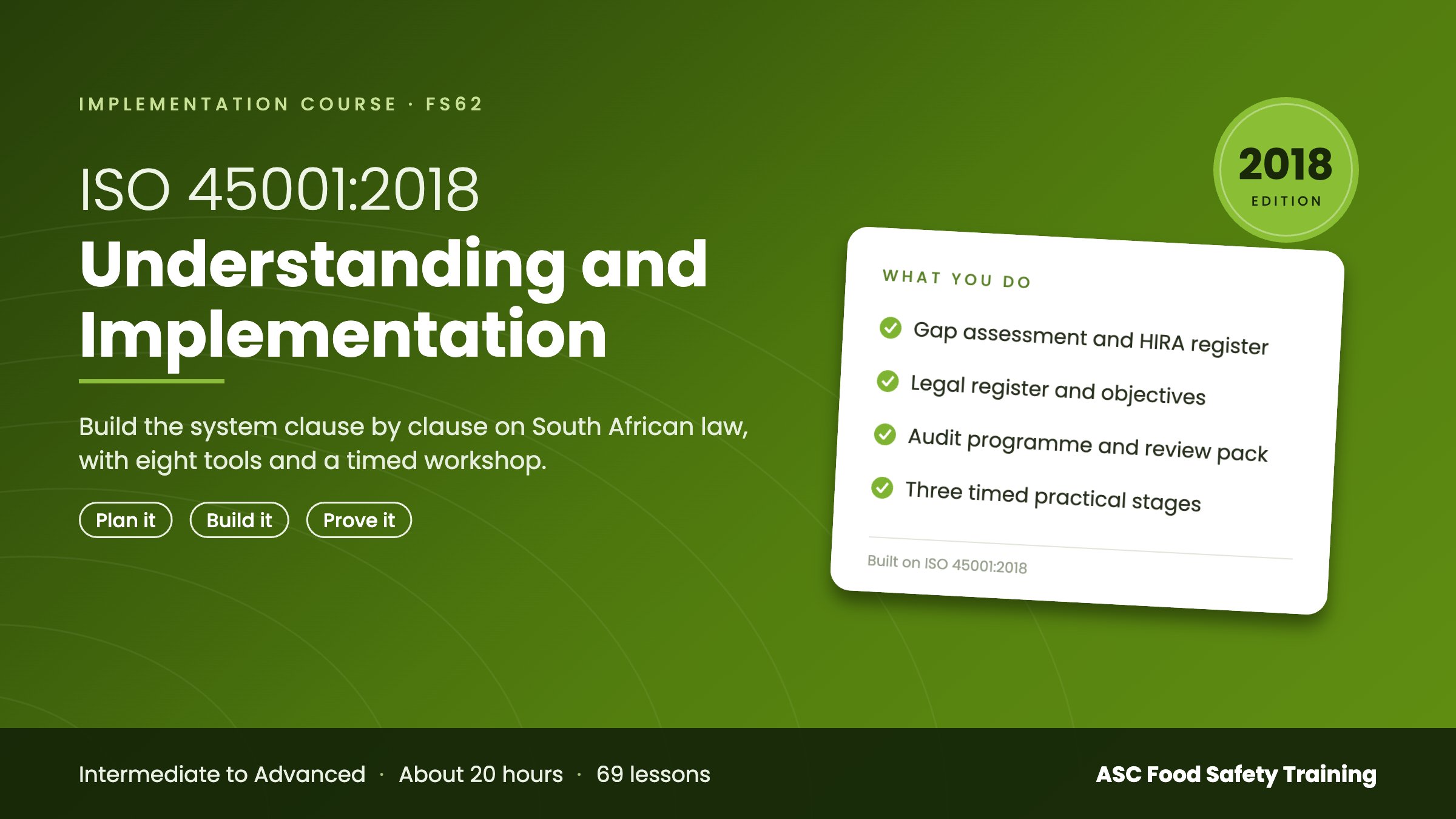
An implementation workbook built in eight tools and exported as one file: an ISO 45001 gap assessment with a status and evidence on every requirement; a context register with the climate change decision; a consultation and participation plan that reaches every shift, the agency staff and the contractors; a HIRA register with every added control labelled by its level on the hierarchy and a control plan; an OH&S legal register built from the South African instruments, with how each applies, an owner, the evidence and a compliance evaluation frequency; five objectives with plans that answer 6.2.2 a) to f); a contractor and outsourcing file; an emergency scenario table; an internal audit programme; a management review pack carrying 9.3 a) to g); and an incident investigation worked through 10.2 a) to g). The eight tools are the ISO 45001 Gap Assessment, the HIRA Register, the OH&S Legal Register and Objectives, the Consultation and Participation Planner, Incident Investigation and Corrective Action, the OH&S Internal Audit Programme Builder, the OH&S Management Review Pack Builder, and the Implementation Workbook self check and export.
Curriculum
Module 1: Foundations, the law, and the implementation project
- Lesson 1.1: What an OH&S management system is meant to achieve: clause 1 and the intended outcomes
- Lesson 1.2: The harmonised structure, and joining ISO 45001 to ISO 9001 and ISO 14001 on one site
- Lesson 1.3: The South African OH&S law map: the OHS Act, its regulations, COIDA, and who enforces what
- Lesson 1.4: The legal appointments map: who must be appointed, and the section or regulation that creates each role
- Lesson 1.5: Reading the standard: shall, consider, take into account, workers at all levels, and documented information
- Lesson 1.6: Terms and definitions that change how you build (clause 3)
- Lesson 1.7: The gap assessment: where Mzansi stands today
- Lesson 1.8: Planning the implementation project: team, budget, and the twelve month plan to a stage 2 in November 2027
- Lesson 1.9: The documented information an OH&S system needs, and what it does not
- Lesson 1.10: Meet the case sites: the ready meals plant, the citrus packhouse and the restaurant group
Module 2: Context, leadership and worker participation, clauses 4 and 5
- Lesson 2.1: External and internal issues, and the climate change decision (4.1)
- Lesson 2.2: Workers and other interested parties, and which needs become legal requirements and other requirements (4.2)
- Lesson 2.3: Scope and boundaries: the whole site, the contractors and the construction project (4.3)
- Lesson 2.4: The system and its processes (4.4), and the activities map
- Lesson 2.5: Leadership and commitment: 5.1 a) to m), the evidence for each, and coaching the MD
- Lesson 2.6: The OH&S policy: 5.2 a) to f), and communicating it
- Lesson 2.7: Roles, responsibilities and authorities (5.3) and the responsibility matrix
- Lesson 2.8: Consultation and participation of workers (5.4): the requirements line by line
- Lesson 2.9: Building the consultation and participation process: the Consultation and Participation Planner
- Lesson 2.10: Removing obstacles and barriers: language, fear of reprisal, time, and the just culture response
- Lesson 2.11: Clinic: the context, leadership and participation evidence pack, line by line
- Lesson 2.12: Integration clinic: one context register and one policy for OH&S, quality and environment
Module 3: Planning: hazards, risks, legal requirements, objectives and change, clause 6
- Lesson 3.1: The planning process and how it connects (6.1.1)
- Lesson 3.2: Hazard identification (6.1.2.1) a) to h)
- Lesson 3.3: Baseline, issue based and task based assessments, and what South African inspectors expect
- Lesson 3.4: Assessing OH&S risks (6.1.2.2): methods, the risk matrix and criteria that hold up
- Lesson 3.5: The hierarchy of controls as the risk assessment’s conclusion (8.1.2 read with 6.1.2)
- Lesson 3.6: Building the HIRA register: the HIRA Register tool, line by line on the cook area
- Lesson 3.7: Other risks to the system, and OH&S opportunities (6.1.2.2 b), 6.1.2.3)
- Lesson 3.8: Legal requirements and other requirements (6.1.3): determining, accessing, keeping up to date
- Lesson 3.9: Building the legal register: the Legal Register tool with the South African instruments
- Lesson 3.10: Planning action (6.1.4): integrating into processes and evaluating effectiveness
- Lesson 3.11: OH&S objectives (6.2.1) and planning to achieve them (6.2.2): the Objectives tab
- Lesson 3.12: Management of change as planning (8.1.3 read with 6.1): the cold store project
- Lesson 3.13: Emergency scenarios as hazards: feeding 8.2 from 6.1.2.1
- Lesson 3.14: Clinic: the planning registers checked line by line
- Lesson 3.15: Clinic: the legal register under an inspector’s eye
Module 4: Support and operation, clauses 7 and 8
- Lesson 4.1: Resources (7.1) and the budget that proves 5.1 d)
- Lesson 4.2: Competence (7.2): the matrix, legal competence requirements and the records
- Lesson 4.3: Awareness (7.3) a) to f): the floor interview and the right to remove oneself
- Lesson 4.4: Communication (7.4.1 to 7.4.3): internal, external, regulators, contractors, languages
- Lesson 4.5: Documented information (7.5): control, external documents, and the safety file becomes a system
- Lesson 4.6: Operational planning and control (8.1.1): criteria, controls, multi employer workplaces
- Lesson 4.7: Eliminating hazards and reducing risks (8.1.2): permits, lockout, guarding, segregation and PPE programmes
- Lesson 4.8: Management of change (8.1.3): the change record and the project
- Lesson 4.9: Procurement (8.1.4.1): buying safety in, for chemicals, machines and PPE
- Lesson 4.10: Contractors (8.1.4.2), the section 37(2) agreement and the construction client duties
- Lesson 4.11: Outsourcing (8.1.4.3): the labour broker, the canteen and the refrigeration contractor
- Lesson 4.12: Emergency preparedness and response (8.2) a) to g): the plan, the drills, the night shift
- Lesson 4.13: Health: occupational hygiene, medical surveillance, ergonomics, noise, chemicals and biological agents
- Lesson 4.14: Clinic: an operational control walk on the Mzansi floor
- Lesson 4.15: Clinic: the contractor and project control file
Module 5: Performance evaluation, improvement and certification, clauses 9 and 10
- Lesson 5.1: Monitoring, measurement, analysis and performance evaluation (9.1.1)
- Lesson 5.2: Leading and lagging indicators: LTIFR, near miss rate, inspections closed, training current
- Lesson 5.3: Evaluation of compliance (9.1.2): the process, the frequency, the record
- Lesson 5.4: Internal audit (9.2): the programme, worker consultation on it, and reporting to workers
- Lesson 5.5: Management review (9.3): inputs a) to g), outputs, and communication to workers
- Lesson 5.6: Incident, nonconformity and corrective action (10.2) a) to g), with participation of workers
- Lesson 5.7: Investigating an incident: methods that find causes, the section 24 report, COIDA
- Lesson 5.8: Continual improvement (10.3) and the culture that supports it
- Lesson 5.9: Preparing for stage 1 and stage 2 (certification body practice)
- Lesson 5.10: After certification: surveillance, the inspector, keeping the system alive
- Lesson 5.11: Clinic: the management review pack, line by line
- Lesson 5.12: Clinic: three incident investigations re-done
Module 6: Workshop, practical stages and final assessment
- Lesson 6.1: Workshop briefing: three sittings, eight tools, three practical stages
- Lesson 6.2: Sitting 1: context, participation, the HIRA register and the legal register
- Lesson 6.3: Sitting 2: objectives, operational controls, contractors and emergencies
- Lesson 6.4: Sitting 3: monitoring, audit, management review and an incident investigation
- Lesson 6.5: Before the final: the golden thread test
- Practical stage 1: context, participation, HIRA and the legal register
- Practical stage 2: objectives, controls, contractors and emergencies
- Practical stage 3: monitoring, audit, management review and incidents
- Final assessment: 35 questions drawn from 75, video proctored
How you are assessed
Each of Modules 1 to 5 has a knowledge check of 15 questions drawn from a bank of 24, at 30 seconds a question, and a game of 10 rounds drawn from 14, at 45 seconds a round. Twenty one scenario checks sit between the lessons, each drawing 6 questions from 8 at 30 seconds a question, and each module ends with a case study assessment on one scenario with data, 10 questions drawn from 12 at 45 seconds each. Most lessons end with a case pack, 64 in all, so you practise on the case before you build.
Module 6 is the workshop: three sittings, the first of about 90 minutes and the other two of about 60, each ending in a timed practical stage of 12 questions drawn from 15, at 60 seconds a question, set on the kind of register lines you have just built and marked automatically. The final assessment draws 35 questions from a bank of 75 across Modules 1 to 5 and is video proctored.
The pass mark is 70 percent on everything. Each assessment allows two timed attempts, with a 24 hour break after a failed first attempt. The feedback on a failed attempt names what to fix and which lesson to reread.
What you need
A laptop or tablet with an internet connection; registers are easier to build on a bigger screen. Use one device and one browser for the workshop, because the tools save on the device you use, and export at the end of each sitting. You do not need a site of your own: each tool loads the facts of the Mzansi ready meals plant; if you prefer the packhouse or the restaurant group, the lessons give their data and you type it into the tools; and you may use your own site instead if you have permission to use its data. Introduction to ISO 45001:2018 is helpful but not required. A licensed copy of ISO 45001:2018 and Amendment 1:2024 is recommended; ISO sells it, and the SABS publishes it in South Africa as SANS/ISO 45001. The final assessment is video proctored, so you also need a webcam. The course quotes short passages of the requirements and does not reproduce the standard.
Certificate
When you have passed every knowledge check, practical stage and the final assessment, ASC issues a certificate of completion that names the course, the code FS62 and the date, and carries a verification code an employer or client can check. It is a training certificate from ASC Food Safety Consultants. It is not a certification of your organisation, and it is not an auditor qualification.
Free guides for this course
- How to implement ISO 45001: a step by step plan for South African sites
- Hazard identification and risk assessment under ISO 45001: HIRA registers that hold up with inspectors and auditors
See all eight ISO 45001 and health and safety courses and which one fits your job at ascfoodsafetytraining.com/iso-45001/.
Questions people ask
Can we integrate ISO 45001 with our ISO 9001 and ISO 14001 systems?
Yes. All three share the harmonised structure, so the context, interested parties, risks and opportunities, support, internal audit, management review and improvement clauses can run as one set of processes. Lesson 1.2 and the integration clinic in Module 2 show how, using the ISO 9001 system already running on the case site.
Do we need an OH&S manual?
No. ISO 45001 requires no manual and no list of mandatory procedures. It names specific documented information to be available, maintained or retained, such as the scope, the policy, the legal requirements, the objectives and plans, and the evidence of competence and of audit and review results. Lesson 1.9 builds the full list from the text of the standard; the rest is the site’s choice.
Does the course cover the South African regulations, or only the standard?
Both. The legal register is built from the OHS Act and the regulations a food site works under, including the General Safety, General Administrative, Hazardous Chemical Agents, Noise Exposure, Physical Agents, Ergonomics, Construction and Pressure Equipment Regulations, and the COID Act. It is training, not legal advice.
How long does it take to implement ISO 45001?
It depends on the size of the site and how much already works. The main case site plans about a year from a gap assessment to a stage 2 audit. Certification bodies usually want to see records of a running system, including internal audits and a management review, before stage 2; that is their practice, not a requirement of the standard.
Do I need a site of my own to do the workshop?
No. The tools carry the data of the Mzansi ready meals plant. The citrus packhouse and the restaurant group are workshop variants: the lessons give their data, and you type it into the tools yourself. The practical stages and the final are set on the case sites, so read the Mzansi data even if you build your own.
Will this course go out of date when ISO 45001:2027 is published?
No. Voting on the draft, ISO/DIS 45001, closed on 9 September 2026, and ISO expects to publish the new edition in the first half of 2027. No transition period has been set yet; certification bodies expect three years, as was set for ISO 9001:2026, and a 2018 certificate stays valid during the transition. Until the new edition is published, ISO 45001:2018 with Amendment 1:2024 is the standard sites are audited against, and it is what this course teaches. Nothing in this course speculates on the final text.
Can we train a team?
Yes. Prices are in rand with no VAT added, and group arrangements are available on request. Ask ASC on WhatsApp or through the contact page.
ISO 45001:2018 is a standard published by ISO. This course is an independent training product and is not approved or endorsed by ISO or by any certification body.
Course Content
Module 1: Foundations, the law, and the implementation project
-
Lesson 1.1: What an OH&S management system is meant to achieve: clause 1 and the intended outcomes
-
Lesson 1.2: The harmonised structure, and joining ISO 45001 to ISO 9001 and ISO 14001 on one site
-
Lesson 1.3: The South African OH&S law map: the OHS Act, its regulations, COIDA, and who enforces what
-
Scenario check 1: the law, the standard and one structure
-
Lesson 1.4: The legal appointments map: who must be appointed, and the section or regulation that creates each role
-
Lesson 1.5: Reading the standard: shall, consider, take into account, workers at all levels, and documented information
-
Lesson 1.6: Terms and definitions that change how you build (clause 3)
-
Scenario check 2: appointments, reading the standard and the terms
-
Lesson 1.7: The gap assessment: where Mzansi stands today
-
Lesson 1.8: Planning the implementation project: team, budget, and the twelve month plan to a stage 2 in November 2027
-
Lesson 1.9: The documented information an OH&S system needs, and what it does not
-
Scenario check 3: the gap, the plan and the documented information
-
Lesson 1.10: Meet the case sites: the ready meals plant, the citrus packhouse and the restaurant group
-
Module 1 knowledge check
-
Module 1 case study assessment: The first month at the Limpopo citrus packhouse
-
Shall, should, consider or take into account?
Module 2: Context, leadership and worker participation, clauses 4 and 5
Module 3: Planning: hazards, risks, legal requirements, objectives and change, clause 6
Module 4: Support and operation, clauses 7 and 8
Module 5: Performance evaluation, improvement and certification, clauses 9 and 10
Module 6: Workshop, practical stages and final assessment
Student Ratings & Reviews
