
ISO 45001 Management Awareness
About Course
ISO 45001 Management Awareness
| Course code | Price | Duration | Level |
|---|---|---|---|
| FS61 | R1 295 | About 4 hours, self paced | Foundation for managers |
About this course
An inspector from the Department of Employment and Labour walks a Kempton Park plant in May 2026, finds an unguarded nip point on the sleeve applicator, no hazardous chemical agents risk assessment since 2021 for the chemical store and CIP, and no record of the medical surveillance decision for the hygiene team’s chemical exposure, and puts a prohibition notice on the dough mixer until the interlock is repaired. The managing director’s first question is who signed what. The answer is that he did. Under section 16(1) of the OHS Act the chief executive officer must, as far as is reasonably practicable, ensure that the employer’s duties are properly discharged, and assigning those duties under section 16(2) does not relieve him of them.
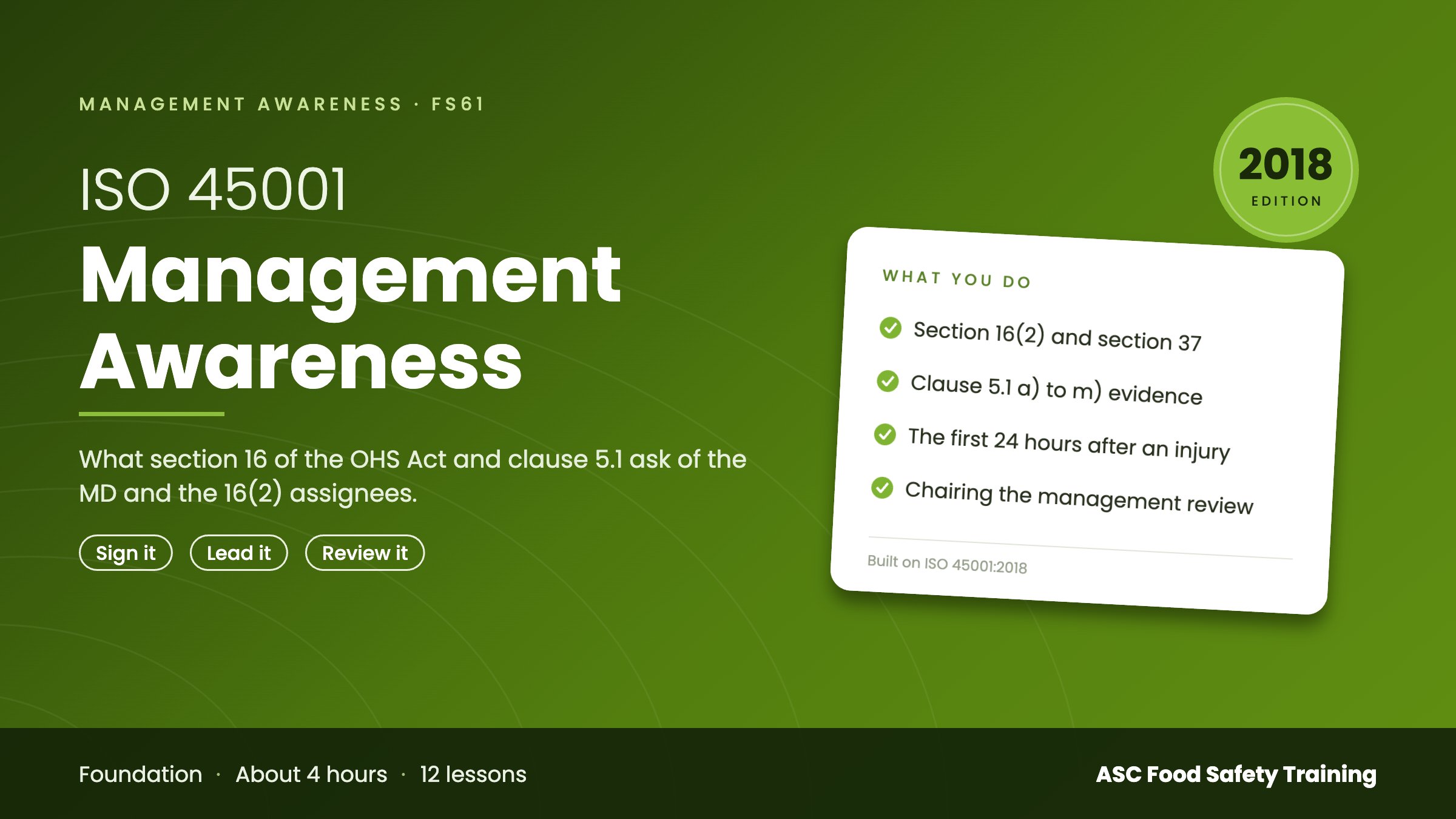
This course is written for the person in that chair. About four hours, in short lessons: the legal duty first, the standard second, the three things the certification auditor will ask you, and the one record that proves each answer. It covers sections 8, 9, 13, 16, 24, 37 and 38 of the OHS Act, the COID Act reporting duty, and what ISO 45001:2018 asks of top management in clauses 5.1 a) to m), 5.2, 5.4, 6.2, 7.1, 9.3 and 10.2.
ISO 45001 is voluntary. The OHS Act applies regardless, and a certificate is not a defence: the test in section 37(1)(c) is whether all reasonable steps were taken. The course shows how the standard helps you prove that you took them. The case is a training scenario built from real audit, inspection and incident patterns. No real company is named.
Who it is for
The managing director, who is the section 16(1) chief executive officer. Directors and executives. Section 16(2) assignees, such as an operations director or an engineering manager with a signed letter. Department managers who will be interviewed on leadership, consultation, incidents or management review. Owners of smaller businesses who carry every role themselves. The course is short on purpose. If you also have to build the system, take ISO 45001:2018 Understanding and Implementation; if your team needs the floor view, enrol them on Introduction to ISO 45001:2018.
What you finish with
You finish knowing what your 16(2) letter does and does not do, how section 37 presumes the employer did what its employees and mandataries did, how section 38 penalises any person who contravenes the Act, why section 16 puts the CEO personally in the frame, and how to apply the reasonably practicable test to a real hazard. You can show the evidence for each of the thirteen leadership items in clause 5.1, approve a policy that carries the commitments in 5.2 a) to f), own objectives that move numbers, and treat the health and safety committee as your meeting rather than the safety officer’s. You can lead the first 24 hours after a serious injury: the section 24 report, the General Administrative Regulations recording and investigation duties, the COID Act report within seven days and the administrative penalty for a late one, the new Employee Health and Wellness Representative, and an investigation that finds causes rather than culprits. You can chair a management review that covers 9.3 a) to g), read a lost time injury frequency rate, and answer fifteen prepared questions in the top management interview. And you hold a certificate of completion with a verification code.
Curriculum
Module 1: Your legal duties and what the standard adds
- Lesson 1.1: The letter you signed: section 16, section 37 and personal liability
- Lesson 1.2: Duties of the employer: sections 8, 9 and 13, reasonably practicable, COIDA and reporting
- Lesson 1.3: Leadership and commitment (5.1): thirteen things top management does, and the evidence for each
- Lesson 1.4: The policy you approve and the objectives you own (5.2, 6.2)
- Lesson 1.5: Consultation and participation: why the committee is your meeting (5.4)
- Lesson 1.6: Resources, competence and the culture you set (7.1, 7.2, 5.1 j) and k))
Module 2: Running the system from the top: review, incidents, audits, certification
- Lesson 2.1: What the auditor will ask you, and the fifteen questions to prepare
- Lesson 2.2: The management review you chair (9.3)
- Lesson 2.3: When someone is hurt: the first 24 hours, section 24, COIDA and 10.2
- Lesson 2.4: Contractors, the labour broker and the construction project: section 37 and 8.1.4
- Lesson 2.5: Reading the numbers: LTIFR, near misses, inspections and audits
- Lesson 2.6: Certification: what it costs and what it is worth
- Final assessment: 25 questions drawn from 40
How you are assessed
Each of the two modules has a knowledge check of 15 questions drawn from a bank of 24, at 30 seconds a question, and a game of 10 rounds drawn from 14, at 45 seconds a round: Whose duty is it? in Module 1 and Reasonably practicable? in Module 2. Six scenario checks sit between the lessons, three in each module, each drawing 6 questions from 8 at 30 seconds a question. Each module ends with a case study assessment set on one scenario with data, 10 questions drawn from 12 at 45 seconds each. The final assessment draws 25 questions from a bank of 40.
The pass mark is 70 percent on everything. Each assessment allows two timed attempts, with a 24 hour break after a failed first attempt. Marking is automatic and immediate, and the feedback on a failed attempt names what to fix and which lesson to reread.
What you need
A phone, tablet or laptop with an internet connection, and about four hours that you can split across a week. No prior knowledge of ISO 45001 is needed. You do not need to bring your own site’s data: the course runs on a case study with the facts supplied, and each lesson ends with a question you can put to your own team on Monday. A licensed copy of ISO 45001:2018 is useful but not required; ISO sells it, and the SABS publishes it in South Africa as SANS/ISO 45001. The course quotes short passages of the requirements and does not reproduce the standard. It is training, not legal advice; take questions about a specific prosecution or claim to your legal adviser.
Certificate
When you have passed every assessment, ASC issues a certificate of completion that names the course, the code FS61 and the date, and carries a verification code an employer, a board or a customer can check. It is a training certificate from ASC Food Safety Consultants. It is not a certification of your organisation.
Free guides for this course
- The OHS Act and ISO 45001: the legal duties a management system has to carry
- Section 16(2) appointments, 37(2) agreements and what the MD personally signs up to
See all eight ISO 45001 and health and safety courses and which one fits your job at ascfoodsafetytraining.com/iso-45001/.
Questions people ask
Does a 16(2) appointment move my liability to the person I appoint?
No. Section 16(2) of the OHS Act lets the chief executive officer assign duties to a person under his control, who then acts subject to his control and directions, and it says in terms that the CEO is not relieved of the duties by doing so. The assignment delegates the duty. The CEO stays accountable.
Does a section 37(2) agreement with a contractor remove our responsibility?
No. Section 37(1) presumes the employer did or omitted what its employee or mandatary did, unless the employer proves the three conditions in the section. A written 37(2) agreement on the arrangements and procedures between you removes that presumption for the mandatary’s acts. It does not remove your own duties under sections 8 and 9.
Is a written health and safety policy a legal requirement?
Not for every employer. Section 7 of the OHS Act lets the chief inspector direct an employer, or a category of employers, to prepare one. Clause 5.2 of ISO 45001 requires an OH&S policy, so a site that wants the standard needs one either way.
Will this course prepare me for the certification auditor’s interview?
Yes. Lesson 2.1 maps fifteen questions to clauses 5.1, 5.2, 5.3, 5.4, 9.3 and 10.2, with the record behind each answer. Stage 1 and stage 2 audits are certification body practice, not requirements of the standard, and the course says how they usually run.
Is it suitable for a small business where the owner does everything?
Yes. The duties in sections 8, 9 and 16 of the Act apply to a small employer as they do to a large one, and an owner who carries every role carries every one of those duties. Section 17 representatives are required where there are more than 20 employees at a workplace, so count your employees at the workplace at the peak, including agency staff (for the OHS Act the labour broker is not their employer), but not contractors’ workers.
Will this course go out of date when ISO 45001:2027 is published?
No. Voting on the draft, ISO/DIS 45001, closed on 9 September 2026, and ISO expects to publish the new edition in the first half of 2027. No transition period has been set yet; certification bodies expect three years, as was set for ISO 9001:2026, and a 2018 certificate stays valid during the transition. Until the new edition is published, ISO 45001:2018 with Amendment 1:2024 is the standard sites are audited against, and it is what this course teaches. Nothing in this course speculates on the final text.
Can we enrol the whole management team?
Yes. Prices are in rand with no VAT added, and group arrangements are available on request. Ask ASC on WhatsApp or through the contact page.
ISO 45001:2018 is a standard published by ISO. This course is an independent training product and is not approved or endorsed by ISO or by any certification body.
Course Content
Module 1: Your legal duties and what the standard adds
-
Lesson 1.1: The letter you signed: section 16, section 37 and personal liability
-
Lesson 1.2: Duties of the employer: sections 8, 9 and 13, reasonably practicable, COIDA and reporting
-
Scenario check 1: The letter, the notices and the employer’s duties
-
Lesson 1.3: Leadership and commitment (5.1): thirteen things top management does, and the evidence for each
-
Lesson 1.4: The policy you approve and the objectives you own (5.2, 6.2)
-
Scenario check 2: Leadership, the policy and the objectives
-
Lesson 1.5: Consultation and participation: why the committee is your meeting (5.4)
-
Lesson 1.6: Resources, competence and the culture you set (7.1, 7.2, 5.1 j) and k))
-
Scenario check 3: Participation, resources and culture
-
Module 1 knowledge check
-
Module E1 case study assessment: The board meeting after the inspection
-
Whose duty is it?
Module 2: Running the system from the top
Student Ratings & Reviews
