

Home / Guides / Environmental monitoring
FOOD MICROBIOLOGY · ENVIRONMENTAL MONITORING · LISTERIA
Key facts
- South African law R638 reg 6(4)(b)(i): 100 viable microorganisms per cm2 on a cleaned food contact surface; no pathogen EMP required
- Who requires an EMP FSSC 22000 V7 2.5.7 (a) to (d), BRCGS Issue 9 4.11.8, Codex CXG 61 Annex I
- Routine target Listeria spp. as the index organism in Zones 1 to 3, about 3 hours into production
- Every event at least 5 food contact and 5 non food contact sites, shifts and days rotated
- Risk rating probability x severity on a 5 x 5 matrix, inherent and residual; the band sets the frequency
- After a positive star burst in six directions before the clean; release on not detected in 25 g and three clean days
- The 2017 to 2018 outbreak 1 060 confirmed cases, 216 deaths, ST6 found across one factory’s environment (NICD)
- Review at least annually and on five triggers, including a long run of negatives
Build the programme, not the sampling list
Practical Pathogen Environmental Monitoring (EMP) and Surface Swabbing is the advanced ASC course that takes you from this guide to a scored, exportable environmental monitoring risk assessment for your own plant: 6 modules, 25 lessons, 15 narrated videos, the EMP Programme Builder and a free EMP package. 9 hours, R1 750, marked in minutes.
See the courseTry the free builderAdvanced level. No factory needed: three case sites carry every activity.Why the sampling list is not a programme
Most plants that have been asked for an environmental monitoring programme at audit have a list of sites, a laboratory contract and a folder of reports that say not detected. That is a record. It is not a programme. A programme starts from a question, where would a resident strain live in this plant, and works backwards to the sites, the frequency, the method, the limits, the response and the review. FSSC 22000 Version 7 writes that structure into clause 2.5.7 (a) to (d): a documented, risk based programme with the methodology and the organisms justified, action limits and corrective actions, data and trend analysis, and a review at least annually and on five triggers. BRCGS Issue 9 clause 4.11.8 asks for the same in fewer words and adds corrective action on an upward trend before any single limit is failed.
South Africa learnt what the difference costs in 2017 and 2018. The NICD confirmed 1 060 listeriosis cases and 216 deaths, the largest listeriosis outbreak ever recorded, and found the outbreak strain, ST6, in 16 environmental samples at one factory, with over 10 percent of the environmental samples positive. A plant with a real programme would have met that strain in a drain months before it met it in a patient.
Regulation R638 sets one limit on a cleaned food contact surface: not more than 100 viable microorganisms per square centimetre. It says nothing about pathogens in the environment. The duty to look for Listeria comes from the schemes, your own hazard analysis and Codex.Regulation R638 of 2018, regulation 6(4)(b)(i); FSSC 22000 Version 7 clause 2.5.7; Codex CXG 61-2007 revised 2026, Annex I
What does a resident strain look like in your results?
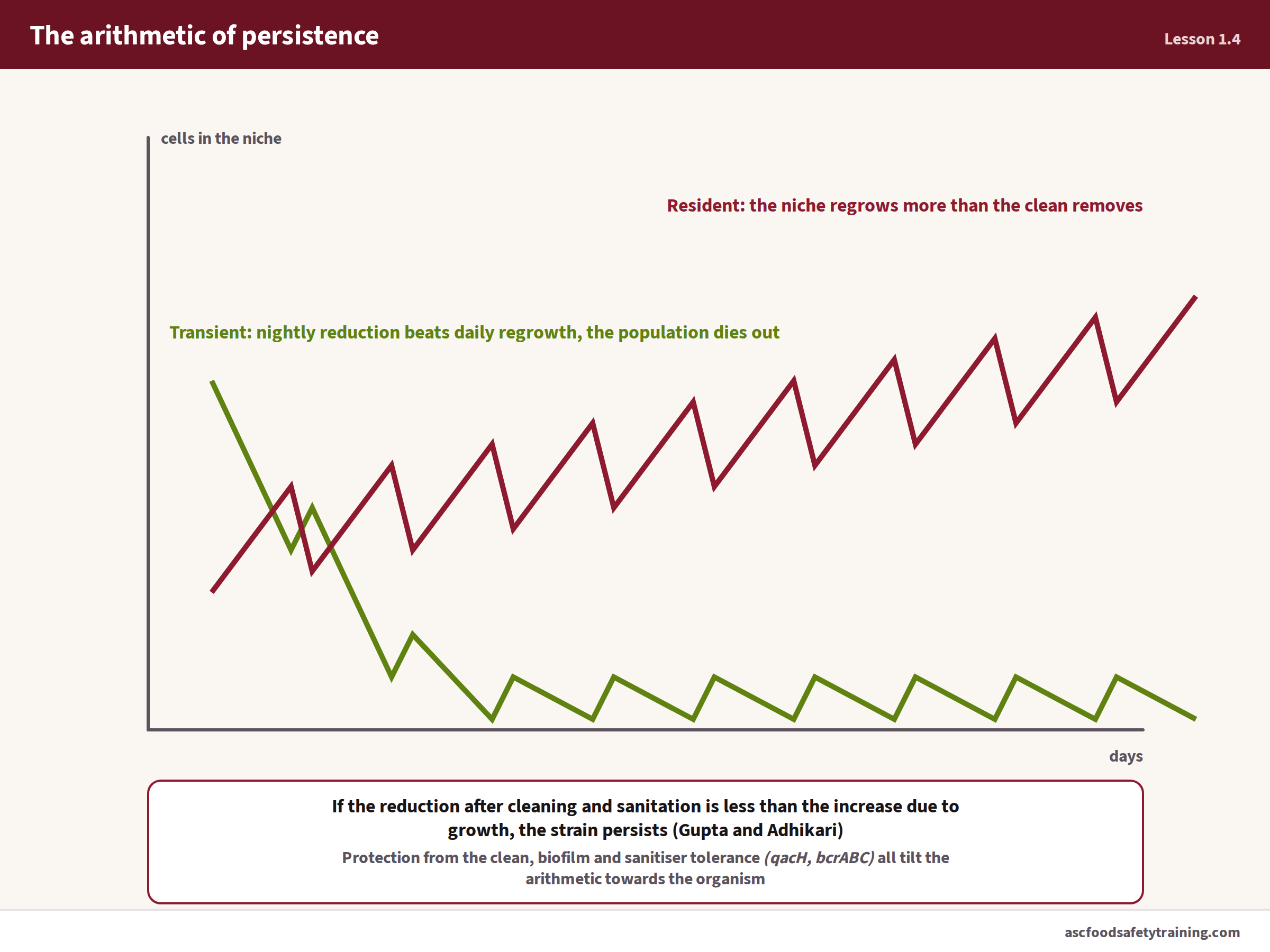
A resident is not a cleaning failure. It is arithmetic. Every night the clean knocks the population in a niche down; every day the niche grows it back. If regrowth beats reduction, the strain stays, and the literature has strains staying for years. The pattern in the results is the tell: the same site positive again months apart, positives clustering around one drain or one belt, and typing that shows the March isolate and the August isolate are the same strain. A visitor is one positive, once, that does not come back after the clean. The course teaches you to read a year of results and say which one you have.
The four zones, and the two question rule
Zone 1 touches exposed ready to eat product after the kill step: the belt, the nozzle, the slicer blade, the glove. Zone 2 is one step away: a hand, a drip, a splash or a tool can carry something from it to product, so the conveyor frame, the sealer touch screen and the evaporator drip tray above the line are Zone 2. Zone 3 is the same room, further off: floors, drains, forklift wheels, the hose on the floor. Zone 4 is outside the processing area. Two questions put any surface in its zone: can exposed product touch it, and if not, can something on it reach product in one step. Codex Annex I describes the same rings in its own words; the numbering is United States practice, set out in the 3M and Cornell handbook.
How often do you swab each site? The 5 x 5 risk rating
This is where most programmes are indefensible. Weekly on everything is unaffordable; monthly on everything misses the niche. The course uses the ASC RA19 method: every site is scored on probability, one to five, and severity, one to five, twice. Inherent, before controls, and residual, after the controls you actually have. Controls reduce probability, not severity, because Listeria monocytogenes in a chilled ready to eat product is as serious after the clean as before it. The residual rating sets the band and the band sets the frequency.
| Residual rating | Band | Routine frequency | What it means |
|---|---|---|---|
| 20 to 25 | Critical | Daily | Immediate action; is product affected, may the activity continue |
| 10 to 16 | High | Weekly | Action now, named owner, target date, report to senior management |
| 5 to 9 | Medium | Monthly | Action on the tracker with an owner and a date |
| 3 to 4 | Low-Med | Quarterly | Control adequate; confirm at the annual review |
| 1 to 2 | Low | Biannual | Control adequate; monitor and confirm annually |
Worked line from the course case site, Mzansi Fresh Meals: the assembly belt is a wet chilled Zone 1 surface with a positive eight months ago. Inherent probability 4, severity 5, rating 20, Critical. With a validated nightly clean, pre operational checks and condensate control the probability drops to 2. Residual 2 x 5 = 10, High, sampled weekly. Every event still carries at least five food contact and five non food contact sites, about three hours into production, with the shifts and days rotated, which is the FDA pattern the course keeps.
The first hour after a positive
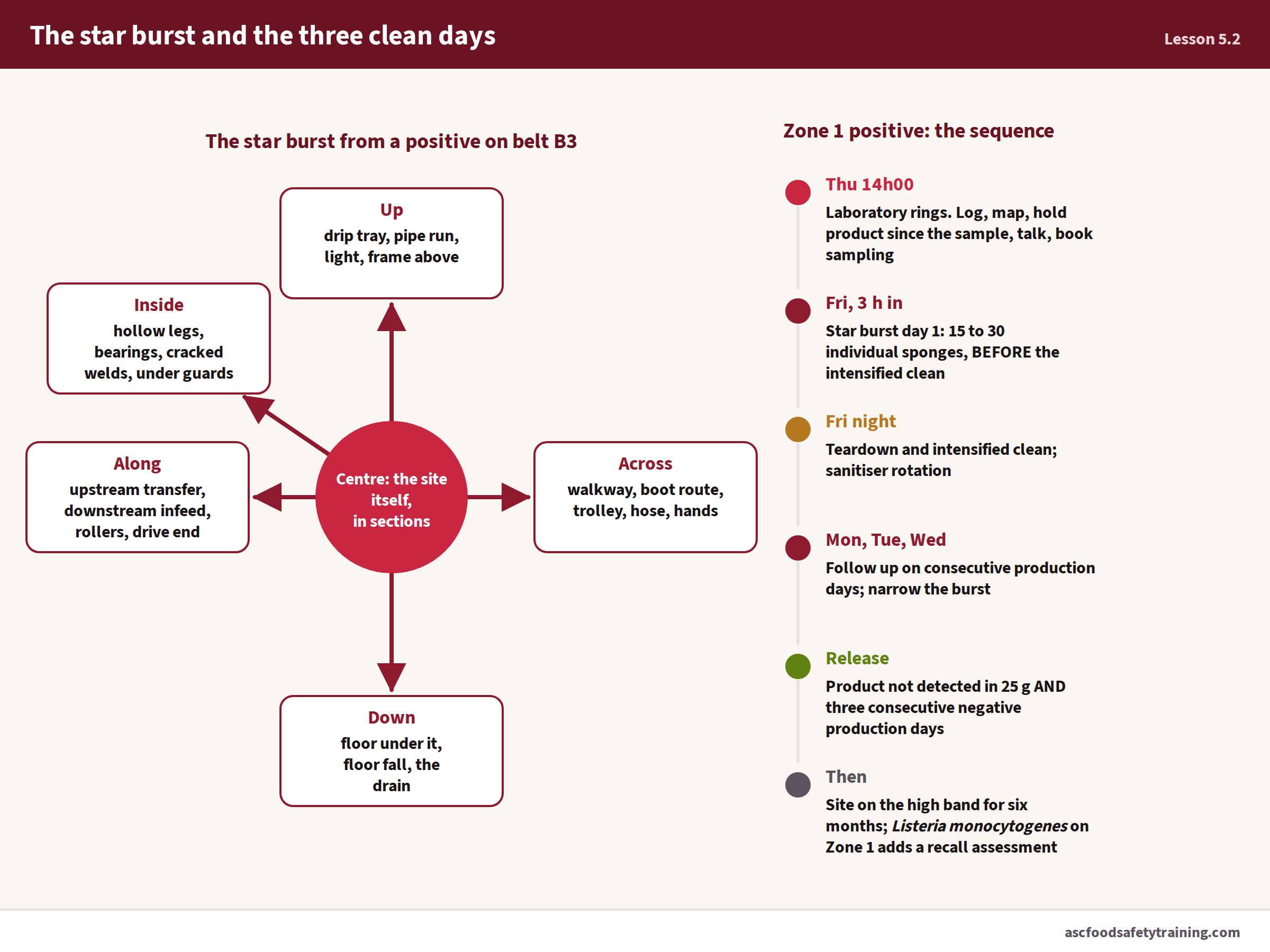
The laboratory rings at two on a Thursday: Listeria spp. detected on the belt, sampled Monday. What happens in the next hour decides whether this is a contained event or the start of a story. Log it with an investigation number. Map it: what is upstream, downstream, above and beside the site, and what product ran since Monday. Decide the product question: a Zone 1 positive holds the product that touched the surface. Tell the people who act, with the map on the table. Then the star burst: from the positive site outwards in six directions, centre, up, down, along, across and inside, fifteen to thirty individual sponges, three hours into the next run, before the intensified clean. Clean first and Friday’s clean star burst tells you only that scrubbing works for a day.
- Log it: investigation number, site, zone, sample date, laboratory number, time of the call.
- Map it: upstream, downstream, above, beside; which product ran on that line since the sample.
- Decide the product question: Zone 1 positive, product on hold now.
- Tell the people who act: production, hygiene, maintenance, with the map on the table.
- Star burst, six directions, 15 to 30 sponges, before the clean.
- Then the intensified clean and the teardown; repeat the burst on following days.
- Release only on not detected in 25 g and three consecutive negative production days.
- Root cause to a design or purchasing cause, never to cleaning failure; CAPA with owners and dates.
Why we built a course that generates the risk assessment
Because a programme you cannot show is a programme you do not have. Practical Pathogen Environmental Monitoring (EMP) and Surface Swabbing ends in a document, not a quiz. Over three sittings in the EMP Programme Builder you describe every line of your register, score it inherent and residual on the 5 x 5 matrix, build the schedule inside a swab budget, match the broth to the sanitiser in every area, set the alert, action and escalation levels with both halves of the release rule, run the positive drill and write the CAPA and the note to management. The builder will not let you export until its review gate is clear, and then it gives you the workbook in the structure of the ASC RA19 Environmental Monitoring Risk Assessment: How to Use, Programme Design mapped to clause 2.5.7, the Risk Register with columns A to T, the Matrices, the Action Tracker and the Review Log, plus the schedule, targets, action levels and positive drill sheets. Build it on the case plant and it is your worked example. Build it on your own plant and it is your programme.
It is an advanced course and it is not only about Listeria. Module 2 takes the wet chilled pathogens, the dry plant survivors Salmonella and Cronobacter, the toxin formers Bacillus cereus, Staphylococcus aureus and Clostridium perfringens, the spoilage yeasts and Alicyclobacillus of juices and ciders, and the moulds and aflatoxins of grain and nuts, each with where it lives in a plant, the foods it takes and the control that beats it. Then zoning, the plant walk, the sponge and the broth, the laboratory, the data and the response. Fifteen narrated videos, twenty two diagrams, fifteen case study packs on three South African case sites, six games, and automatic marking in minutes with three attempts on every assessment.
What the course leaves you with
- Your generated environmental monitoring risk assessment in the ASC RA19 structure, exported from the builder and yours to keep
- The EMP Programme Builder, nine steps on any phone, and the three activity trainers
- The EMP Schedule Matrix workbook, the Swab Log Sheet and the Vectoring Flowchart
- 25 lessons, 15 narrated videos, 22 diagrams, 15 case packs with model answers, the learner manual
- A certificate of achievement with a QR verification code, released automatically when every assessment is passed
Questions people ask
Is an environmental monitoring programme a legal requirement in South Africa?
No. R638 regulation 6 sets a limit of 100 viable microorganisms per square centimetre on a cleaned food contact surface and does not mention Listeria or the environment. FSSC 22000 Version 7 clause 2.5.7, BRCGS Issue 9 clause 4.11.8 and Codex CXG 61 Annex I require a programme on certified sites.
Which organism should the routine programme test for?
Listeria spp. as the index organism in Zones 1 to 3 of a wet chilled plant, because a positive for any Listeria species shows the conditions that support Listeria monocytogenes. Salmonella and indicators are added where the product and the plant call for them; the course teaches how to choose.
How many sites should a sampling event have?
At least five food contact and five non food contact sites, about three hours into production, with the shifts and days rotated across the cycle, which is the FDA 2017 pattern. The 5 x 5 risk rating decides which sites are weekly and which take turns.
What do I do after a Listeria positive on a belt?
Hold the product that touched the surface, log and map the positive, star burst in six directions before the intensified clean, repeat on following days, and release only on not detected in 25 g and three consecutive negative production days. Then take the root cause to a design or purchasing decision, not to cleaning failure.
What is the difference between this course and a Listeria awareness course?
This one ends in a document. You build, score and export an environmental monitoring risk assessment for a case plant or your own, marked automatically against seven printed criteria, and you cover every organism a South African plant meets, not one.
Enrol in the EMP course
Advanced level, 9 hours, self paced, lifetime access, R1 750 in rand through PayFast. You come out with your own environmental monitoring risk assessment in the ASC RA19 structure, the schedule matrix, the swab log, the vectoring flowchart and a certificate of achievement.
Enrol nowPlay Zone it first