
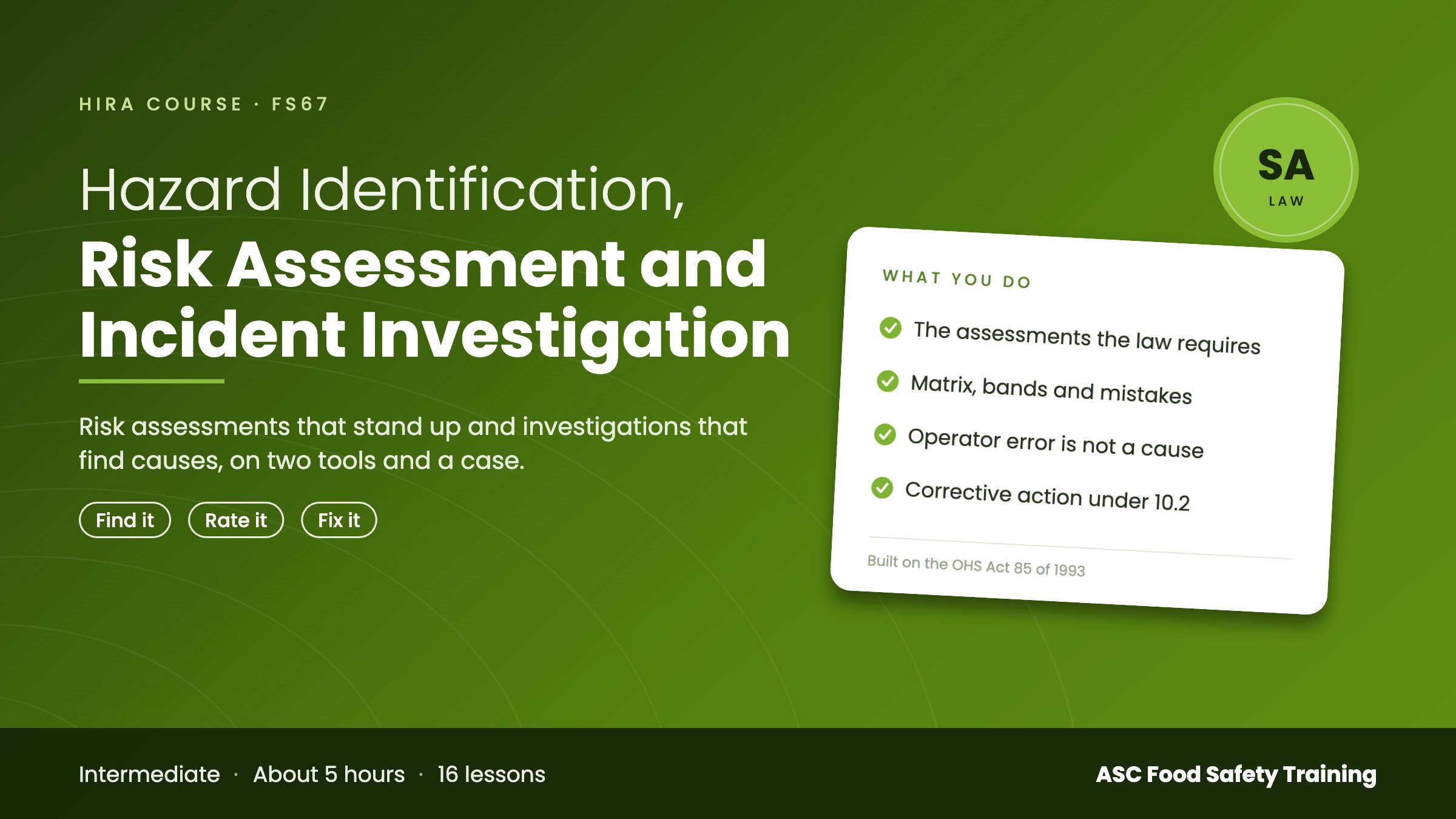
Hazard Identification, Risk Assessment and Incident Investigation
About Course
Hazard Identification, Risk Assessment and Incident Investigation
| Course code | Price | Duration | Level |
|---|---|---|---|
| FS67 | R1 495 | About 5 hours, self paced | Intermediate |
About this course
Mzansi Fresh Meals has a 212 line baseline risk assessment written by a consultant in 2021 and not reviewed since. It has no task based assessments, no issue based assessment for the cold store project, and no hazardous chemical agents assessment since 2021, although regulation 5 of the Regulations for Hazardous Chemical Agents requires one at intervals not exceeding two years. In 2025 a forklift struck an operator in the shared aisle and a caustic splash in the chemical store cost 21 days. Both investigations named “operator did not follow procedure” as the cause. Nothing changed, and the site is on its way to the same two incidents again.
This course teaches the two pieces of work that stop that: a risk assessment that stands up, and an incident investigation that finds causes. Module 1 starts with the legal duty to assess risk in section 8(2)(d) of the Occupational Health and Safety Act 85 of 1993 and the regulations that set their own clocks for chemicals, noise, ergonomics and physical agents, then teaches hazard identification from the sources, the walk, the task analysis and the people; baseline, issue based and task based assessments and what each is for; the matrix, the criteria and the common mistakes; controls by the hierarchy and residual risk; and the writing of a HIRA register on the Mzansi cook area. Module 2 teaches investigation: section 24 and General Administrative Regulations 8 and 9, the Annexure 1 record and the seven days; the first hour; gathering evidence and interviewing without blame; the sequence of events, immediate and underlying causes, the five whys and the cause and effect diagram, and why “operator error” is not a cause; corrective action with verification of effectiveness; and the report on the forklift incident. Module 3 covers the special assessments a food site owes under the chemical, ergonomics and physical agents regulations, management of change for the cold store project, and a workshop on Mzansi data.
Every legal duty is cited by section or regulation. ISO 45001:2018 is used in two places where it helps: clause 6.1.2.1 as the map of hazard sources, and clause 10.2 as the structure for corrective action. The case is a training scenario built from real audit, inspection and incident patterns. No real company is named.
Who it is for
Supervisors and team leaders who are asked to write a task based risk assessment or to lead the first hour after an incident. Health and safety representatives who examine the causes of incidents together with the employer under section 18(1) and may investigate under General Administrative Regulation 9(2). SHEQ officers who own the HIRA register and the incident file. Engineers and project managers who must assess a change or a project before it starts. Consultants who write assessments for clients. Anyone whose 2021 baseline is about to be tested by an inspector or an auditor. It is not an ISO course, but it is the natural depth course under clause 6.1.2 and clause 10.2 for an ISO 45001 implementer or internal auditor.
What you finish with
You finish able to say which risk assessments the law requires of your site and how often, from section 8(2)(d) to the two year intervals in the chemical, ergonomics and biological agents regulations and the 24 month reviews in the physical agents regulations. You can find hazards from the sources, the walk, the task and the people, including past incidents and human factors; choose between a baseline, an issue based and a task based assessment; rate risk with a matrix without the common mistakes; place controls on the hierarchy and record residual risk and a plan. You can make a scene safe, preserve it, as section 24(2) requires after a death, a likely death or the loss of a limb and as site practice after any other injury, gather evidence, interview without blame, build a sequence of events, separate immediate from underlying causes, and write a corrective action that is verified for effectiveness. You leave with a HIRA register for the Mzansi cook area and a closed investigation of the forklift incident, built in the HIRA Register and Incident Investigation and Corrective Action tools and exported, and a certificate of completion with a verification code.
Curriculum
Module 1: Hazard identification and risk assessment that stands up
- Lesson 1.1: The legal duty to assess risk: section 8(2)(d) and the regulations that set their own clock (12 min)
- Lesson 1.2: Hazard identification: the sources, the walk, the task analysis, the people (12 min)
- Lesson 1.3: Baseline, issue based and task based assessments: what each is for (10 min)
- Lesson 1.4: Risk analysis and evaluation: the matrix, the criteria, the bands, the common mistakes (12 min)
- Lesson 1.5: Controls by the hierarchy, residual risk, and the plan (12 min)
- Lesson 1.6: Workshop: writing the HIRA register for the Mzansi cook area in the HIRA Register tool (12 min)
Module 2: Incident investigation that finds causes
- Lesson 2.1: What the law requires: section 24, GAR 8 and 9, Annexure 1, COIDA reporting and the 2026 penalties (12 min)
- Lesson 2.2: The first hour: making safe, preserving the scene, caring for people, who to notify (10 min)
- Lesson 2.3: Gathering evidence: the scene, the people, the records; interviewing without blame (12 min)
- Lesson 2.4: Finding causes: the sequence of events, immediate and underlying causes, the five whys, the cause and effect diagram (14 min)
- Lesson 2.5: Corrective action and follow up: ISO 45001 clause 10.2 as the structure, the hierarchy again, verification of effectiveness (12 min)
- Lesson 2.6: Workshop: writing the report and closing the file in the Incident Investigation tool, on the forklift incident (12 min)
Module 3: Special assessments and the workshop
- Lesson 3.1: Chemical risk assessment under the Regulations for Hazardous Chemical Agents: the walk, the SDS, exposure, controls, the surveillance decision (12 min)
- Lesson 3.2: Ergonomic and physical agents assessments: manual handling, repetitive work, heat, cold and noise (12 min)
- Lesson 3.3: Management of change and project risk assessment: the cold store project (10 min)
- Lesson 3.4: Workshop: one task based assessment and one investigation, on Mzansi data (12 min)
- Workshop work: about 60 minutes in the HIRA Register and Incident Investigation and Corrective Action tools
- Final assessment: 30 questions drawn from 60
Lesson minutes are reading time for the lesson itself; the case pack at the end of a lesson adds a few minutes of your own work on the Mzansi Fresh Meals data.
How you are assessed
Every module has a knowledge check of 15 questions drawn from a bank of 24, at 30 seconds a question, and a game of 10 rounds drawn from 14, at 45 seconds a round: Hazard, risk or control? in Module 1, Cause or symptom? in Module 2 and Which assessment? in Module 3. Between the lessons sit eight scenario checks, three in each of Modules 1 and 2 and two in Module 3, each of 6 questions at 30 seconds a question. Each module ends with a case study assessment on the Mzansi site: the cook area HIRA, the caustic splash, and the new cold store, each 10 questions drawn from 12 at 45 seconds a question. The final assessment draws 30 questions from a bank of 60, a third of them set on a scenario.
The pass mark is 70 percent on everything. Each assessment allows two timed attempts, with a 24 hour break after a failed first attempt. There is no video proctoring on this course. Everything is marked automatically the moment you submit, and the feedback on a failed attempt names what to fix and which lesson to reread.
The tools
Two tools, both loaded with the Mzansi case. The HIRA Register holds the activity, the hazard, who is exposed, the existing controls, the rating with and without them, the control labelled by hierarchy level, the residual risk and the action with an owner and a date; lesson 1.6 builds the cook area in it. The Incident Investigation and Corrective Action tool follows the sequence the course teaches, from the first hour and the Annexure 1 fields to the evidence, the sequence of events, the causes, the corrective action and the verification; lesson 2.6 closes the forklift incident in it. The workshop in lesson 3.4 gives you about 60 minutes across both: one task based assessment and one investigation on Mzansi data. Both tools save on the device you use and export as one file.
What you need
A laptop or tablet with an internet connection, and one device and one browser for the workshop, because the tools save on the device you use. You do not need a site of your own: the case carries the data, including the 2021 baseline, the incident record and the cold store project. Some experience of the floor helps. A copy of the OHS Act and the regulations is useful, and the course shows where the Gazette text is. The course quotes short passages of the Act, the regulations and ISO 45001:2018 by number and does not reproduce them.
Certificate
When you have passed every assessment, ASC issues a certificate of completion that names the course, the code FS67 and the date, and carries a verification code an employer can check. It is a training certificate from ASC Food Safety Consultants. It does not make you a competent person under the Ergonomics Regulations, the Regulations for Hazardous Chemical Agents or any other regulation that defines one; those definitions turn on knowledge, training, experience and, where stated, qualifications for the specific work.
Free guides for this course
- Operator error is not a cause
- Baseline, issue based and task based: which risk assessment do you owe
See all eight ISO 45001 and health and safety courses and which one fits your job at ascfoodsafetytraining.com/iso-45001/.
Questions people ask
Which risk assessments does the law actually require?
Section 8(2)(d) of the OHS Act requires every employer to establish the hazards and the precautionary measures. On top of that, several regulations set their own assessments and clocks: the Regulations for Hazardous Chemical Agents, regulation 5, at intervals not exceeding two years; the Ergonomics Regulations, 2019, regulation 6, by a competent person at intervals not exceeding two years; the Regulations for Hazardous Biological Agents, 2022, regulation 6, reviewed at intervals of no more than 24 months where they apply; the Physical Agents Regulations, 2024, regulation 6, reviewed at least every 24 months; a noise exposure risk assessment under the Noise Exposure Regulations, 2024; and the client’s baseline risk assessment under Construction Regulation 5 for building work. Lesson 1.1 lays them out, and Module 3 does the chemical, ergonomic and physical agents assessments.
Does the law prescribe a root cause method?
No. General Administrative Regulation 9 requires an investigation within seven days and asks, in Annexure 1, for the suspected cause and the recommended steps to prevent a recurrence. It does not name a method. The five whys and the cause and effect diagram in lesson 2.4 are good practice, and ISO 45001 clause 10.2 is the structure the course uses for corrective action. The course says so, and keeps the law and the method apart.
Which incidents must be reported, and how fast?
Section 24 lists them: a death, unconsciousness, loss of a limb or part of one, an injury or illness likely to cause death, a permanent physical defect or at least 14 days off the person’s usual work, a major incident, and the endangerment incidents such as a spill, an uncontrolled release under pressure or machinery running out of control. General Administrative Regulation 8 sets the clock: within seven days on WCL 1 or WCL 2 for the 14 day class, and forthwith by telephone or similar means for a death, unconsciousness, loss of a limb or the more serious injuries and the endangerment incidents. Under the COID Act, section 39 requires the employer to report an accident to the Commissioner within seven days of receiving notice, and since 1 April 2026 law firms report an administrative penalty of 10 percent of the employee’s annual earnings for a late report. Lesson 2.1 covers all of it.
Is this the HIRA course for ISO 45001?
It is the depth course. ISO 45001:2018 Understanding and Implementation builds the HIRA register as one of eight tools inside a whole system; this course spends a module on hazard identification and risk assessment alone, a module on investigation, and a module on the special assessments, with the law cited at each step. An implementer, an internal auditor or a representative who will write assessments benefits from both.
Do I need to be a “competent person”?
Not to take the course. Several regulations require a competent person for a particular assessment, for example the Ergonomics Regulations for an ergonomic risk assessment, and define competence by knowledge, training, experience and any applicable qualifications for that work. The course teaches you to do and to judge the work; whether you are the competent person for a given assessment on your site is a decision your employer records.
Will it go out of date when ISO 45001:2027 is published?
No. The course rests on South African law, which does not change with the standard. The two places it uses ISO 45001:2018, the hazard sources in 6.1.2.1 and the corrective action structure in 10.2, are taught from the current edition with Amendment 1:2024. Voting on the draft of the next edition closed on 9 September 2026, ISO expects publication in the first half of 2027, and no transition period has been set.
Can we enrol a team?
Yes. Prices are in rand with no VAT added. For a group from one organisation, ask ASC for a group arrangement on WhatsApp or through the contact page.
Enrol
Hazard Identification, Risk Assessment and Incident Investigation, FS67, R1 495 with no VAT added. About 5 hours, self paced, lifetime access, certificate on completion.
Enrol: find the hazards and the causes Questions? WhatsApp us
Two ISO 45001 courses carry this work into a system. ISO 45001:2018 Understanding and Implementation, FS62, R3 950, puts the HIRA register and the incident process into clauses 6.1.2 and 10.2 alongside everything else the standard asks. ISO 45001:2018 Internal Auditor, FS63, R3 850 as a limited period special, teaches you to follow the HIRA and incident trails as an auditor.
This course is training, not legal advice. ISO 45001:2018 is a standard published by ISO. This course is an independent training product and is not approved or endorsed by ISO, by any certification body or by the Department of Employment and Labour.
Course Content
Module 1: Hazard identification and risk assessment that stands up
-
Lesson 1.1: The legal duty to assess risk: section 8(2)(d) and the regulations that set their own clock
-
Lesson 1.2: Hazard identification: the sources, the walk, the task analysis, the people
-
Scenario check 1: the legal duty and finding hazards
-
Lesson 1.3: Baseline, issue based and task based assessments: what each is for
-
Lesson 1.4: Risk analysis and evaluation: the matrix, the criteria, the bands, the common mistakes
-
Scenario check 2: assessment types and the matrix
-
Lesson 1.5: Controls by the hierarchy, residual risk, and the plan
-
Lesson 1.6: Workshop: writing the HIRA register for the Mzansi cook area in the HIRA Register tool
-
Scenario check 3: controls, the residual and the register
-
Module 1 knowledge check
-
Module 1 case study assessment: the cook area HIRA
-
Hazard, risk or control?
Module 2: Incident investigation that finds causes
Module 3: Special assessments and the workshop
Student Ratings & Reviews
