
Health and Safety Awareness
About Course
Health and Safety Awareness
| Course code | Price | Duration | Level |
|---|---|---|---|
| FS65 | R495 | About 3 hours, self paced | Foundation, every worker |
About this course
It is 23h00 in the chemical store at Mzansi Fresh Meals. A new agency worker on the hygiene team is told to decant caustic for the CIP run. Nobody has shown her the label, the face shield is on a hook across the room, and the eyewash bottle is empty. She does the job because she wants the shift. That is how a 21 day injury happens, and section 14 of the Occupational Health and Safety Act 85 of 1993 says she has duties too: to take reasonable care, to obey the safety rules, and to report an unsafe situation to the employer or the health and safety representative as soon as practicable. Nobody told her that either.
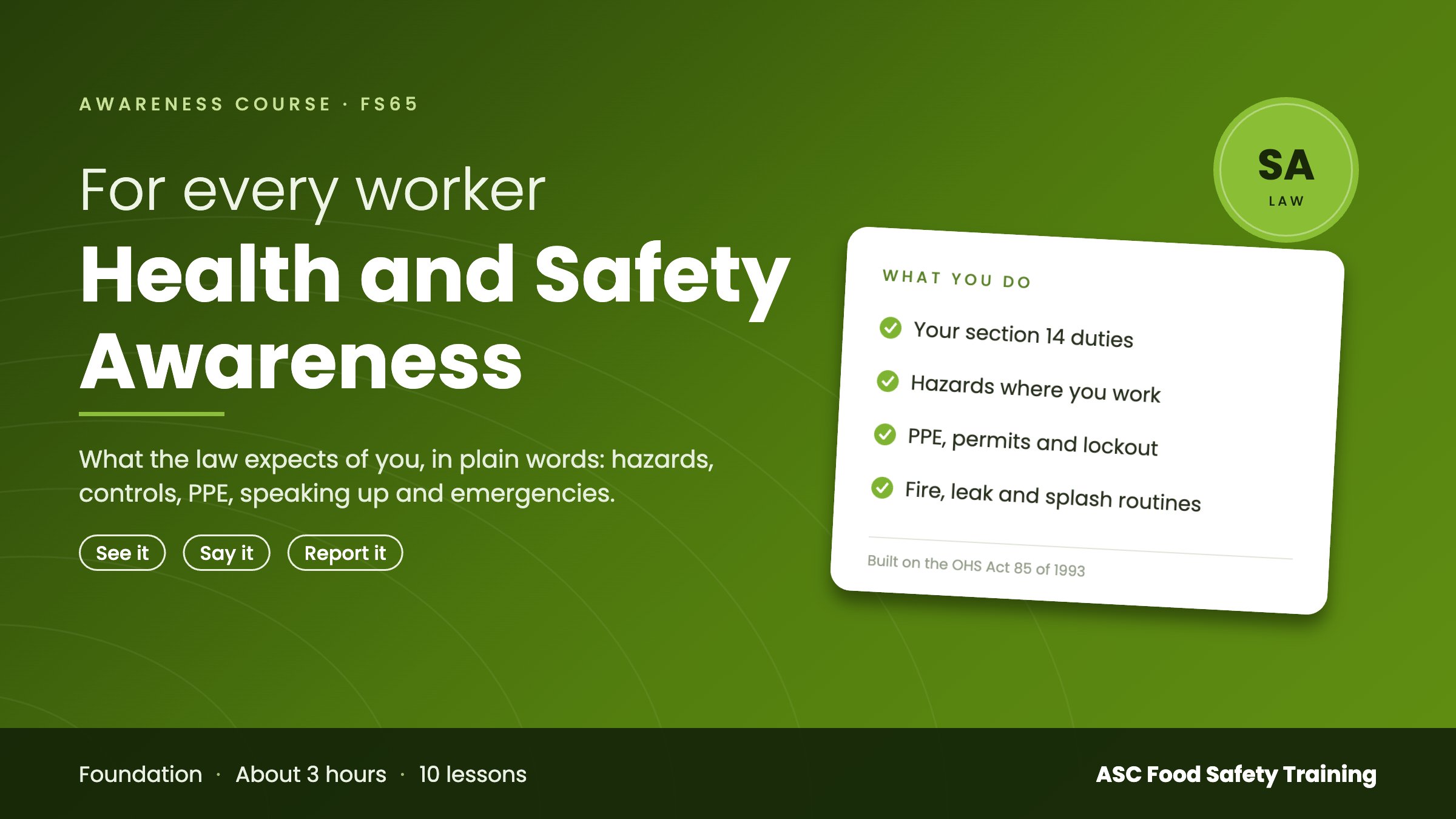
This course tells every worker, in short lessons and plain words, what the law expects of them and of their employer, what can hurt them where they work, how controls work and why PPE is the last line, what a permit, a lockout and a barrier mean, how to raise a concern without fear, what to report and how fast, what to do in a fire, an ammonia leak or a chemical splash, and what they can ask for about their own health. Ten lessons of eight to twelve minutes each, set on the floor of a ready meals plant, with a packhouse and a restaurant kitchen as the other examples. It is written for operators, including people whose first language is not English, in sentences that can be read on a phone in the canteen.
Every legal statement in it is the Act in plain words: section 8 on what the employer owes, section 13 on the duty to inform, section 14 on the worker’s own duties, section 24 on the incidents that must be reported, section 26 on protection from victimisation, and the General Safety Regulations on first aid, PPE and confined spaces. The case is a training scenario built from real audit, inspection and incident patterns. No real company is named.
Who it is for
Every employee, agency worker and contractor’s worker at induction, before the first shift on the floor. Supervisors and team leaders as a refresher, and because they will be asked what their people know. Workers on a site that is starting ISO 45001, so that clause 7.3 awareness is real and not a signature on a register. Sites with a 30 minute talk for agency staff and nothing after it. It is for the person who does the work, not for the person who writes the procedure: the SHEQ officer, the health and safety representative and the manager have their own courses on this hub.
What you finish with
You finish able to say what section 14 asks of you and what section 8 asks of your employer, in your own words. You can name the hazards in your own area and say which control is doing the real work, and why a glove or a pair of earplugs is the last control and not the first. You know what a permit, a lockout tag, a sign and a barrier mean and what you may not do to them. You can find your health and safety representative, raise a concern, and say what section 26 protects you from. You know which incidents the law makes your employer report, that you must report an injury by the end of the shift, and why a near miss you report today stops an injury next month. You know the alarm, the route, the assembly point and the first aider, and you know what you can ask for about hearing tests, medical surveillance, heat, cold and fatigue. And you hold a certificate of completion with a verification code that your employer can keep in your training file.
Curriculum
Module 1: Your safety at work: duties, hazards, controls
- Lesson 1.1: What the law expects of you and of your employer (10 min)
- Lesson 1.2: Hazards where you work (12 min)
- Lesson 1.3: The hierarchy of controls in plain words (10 min)
- Lesson 1.4: PPE: wear it, check it, replace it (8 min)
- Lesson 1.5: Permits, lockout, signs and barriers (10 min)
Module 2: Speaking up, emergencies and when things go wrong
- Lesson 2.1: Your representative, the committee, and speaking up without fear (10 min)
- Lesson 2.2: Near misses and incidents: report it, every time (10 min)
- Lesson 2.3: Emergencies: the alarm, the route, the assembly point, the first aider (10 min)
- Lesson 2.4: Contractors, visitors and agency workers: the same rules for everyone (8 min)
- Lesson 2.5: Your health: surveillance, hearing, fatigue, heat and cold (10 min)
- Final assessment: 20 questions drawn from 40
Lesson minutes are reading time for the lesson itself; the case pack at the end of a lesson adds a few minutes of your own work on the Mzansi Fresh Meals data.
How you are assessed
Each of the two modules has a knowledge check of 15 questions drawn from a bank of 24, at 30 seconds a question, and a game of 10 rounds drawn from 14, at 45 seconds a round: Safe or stop? in Module 1 and Report it or not? in Module 2. Between the lessons sit four scenario checks, two in each module, each of 6 questions at 30 seconds a question. Each module ends with a case study assessment on the Mzansi site, a night shift in Module 1 and the chemical store at 23h00 in Module 2, each 10 questions drawn from 12 at 45 seconds a question. The final assessment draws 20 questions from a bank of 40.
The pass mark is 70 percent on everything. Each assessment allows two timed attempts, with a 24 hour break after a failed first attempt. There is no video proctoring. Everything is marked automatically the moment you submit, and the feedback on a failed attempt names what to fix and which lesson to reread. The questions are written in the same plain words as the lessons.
Tools
This course has no tools. It asks for nothing to be built. Most lessons end with one thing to look at on your next shift: the label on the chemical you use, the guard on the machine you clear, the name on the first aid notice, the route from your station to the assembly point.
What you need
A phone, tablet or laptop with an internet connection. Nothing else. No prior training, no copy of the Act, no site data. If a site enrols a team, each person takes the course on their own login and gets their own certificate.
Certificate
When you have passed every assessment, ASC issues a certificate of completion that names the course, the code FS65 and the date, and carries a verification code an employer can check. It is a training certificate from ASC Food Safety Consultants, and it is evidence for the training file that section 8(2)(e) of the Act asks the employer to keep in mind. It does not make anyone a health and safety representative, a first aider or a competent person under any regulation.
Free guides for this course
See all eight ISO 45001 and health and safety courses and which one fits your job at ascfoodsafetytraining.com/iso-45001/.
Questions people ask
Is this an induction course?
It is the health and safety part of one. It covers what every worker must know about their duties, the hazards, the controls, reporting and emergencies, on any site. It does not replace the site’s own induction on its own layout, its own chemicals and its own emergency plan; it gives the worker the words to understand that induction.
Does it teach a right to refuse dangerous work?
It teaches what the law says. The OHS Act has no general express right to refuse or leave dangerous work; that right is in the Mine Health and Safety Act and applies only on mines. What the OHS Act gives is section 14(d), the duty to report an unsafe situation, section 18, the representative who can take it further, and section 26, which stops an employer from dismissing or punishing a worker for doing what the Act allows or requires. Lesson 2.1 explains it in plain words, and says that on an ISO 45001 site the organisation itself must set up the ability to withdraw from imminent and serious danger under clause 7.3 f).
Does it cover PPE?
Yes, lesson 1.4. General Safety Regulation 2 requires the employer to provide safety equipment free of charge and keep it in good condition, and section 23 of the Act forbids deducting its cost from pay. The lesson covers what you are issued, how to check it, when to ask for a replacement, and what to do when it does not fit.
Is it suitable for workers whose first language is not English?
It is written in short sentences with plain words, and it avoids legal terms where a plain one will do. It is in English. A supervisor or representative can sit with a group and talk each lesson through in the site’s languages, and the questions use the same words as the lessons.
How long does it take?
About three hours, including the checks and the final. The ten lessons are eight to twelve minutes each. It can be done in one sitting or across a week of breaks.
Can we enrol a team?
Yes, and most sites do. Prices are in rand with no VAT added. For a group from one organisation, ask ASC for a group arrangement on WhatsApp or through the contact page.
Enrol
Health and Safety Awareness, FS65, R495 with no VAT added. About 3 hours, self paced, lifetime access, certificate on completion.
Enrol: start the Awareness course Questions? WhatsApp us
If your site runs or is building an ISO 45001 system, the next step for the same worker is Introduction to ISO 45001:2018, FS60, R1 195, which teaches the whole standard in plain words and the floor interview on clause 7.3.
This course is training, not legal advice. ISO 45001:2018 is a standard published by ISO. This course is an independent training product and is not approved or endorsed by ISO, by any certification body or by the Department of Employment and Labour.
Course Content
Module 1: Your safety at work: duties, hazards, controls
-
Lesson 1.1: What the law expects of you and of your employer
-
Lesson 1.2: Hazards where you work
-
Scenario check 1: your duties and the hazards around you
-
Lesson 1.3: The hierarchy of controls in plain words
-
Lesson 1.4: PPE: wear it, check it, replace it
-
Lesson 1.5: Permits, lockout, signs and barriers
-
Scenario check 2: controls, PPE, permits and locks
-
Module 1 knowledge check
-
Module 1 case study assessment: a night shift at Mzansi
-
Safe or stop?
Module 2: Speaking up, emergencies and when things go wrong
Student Ratings & Reviews
