
Health and Safety Representative
About Course
Health and Safety Representative
| Course code | Price | Duration | Level |
|---|---|---|---|
| FS66 | R895 | About 5 hours, self paced | Foundation |
About this course
Mzansi Fresh Meals appointed nine health and safety representatives in 2024. Three have left and were not replaced, the night shift and the 60 agency workers have no representative at all, and the committee last met in February 2026. The six who remain have a letter, a reflective vest and no idea that section 18(1) of the Occupational Health and Safety Act 85 of 1993 lets them inspect the workplace, examine the causes of incidents together with the employer, and make representations to the employer, the committee or, failing that, an inspector. When the inspector came in May 2026, not one of them was asked to accompany her, although section 18(2) entitles them to.
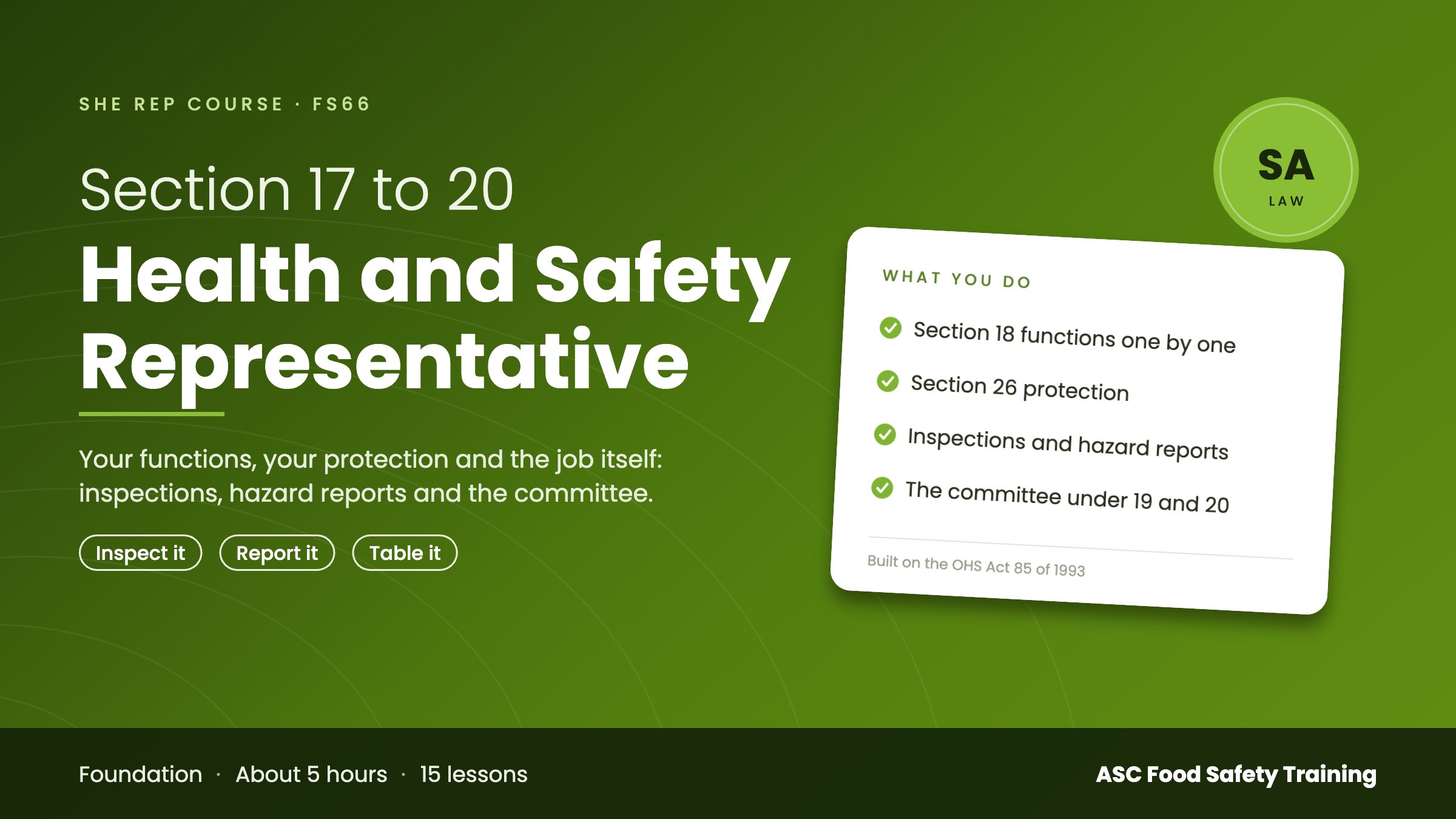
This course is for the representative who wants to do the job the Act describes. It teaches sections 17 and 18, how you were designated and for how long, your functions one by one and what you are entitled to; the General Administrative Regulations on the agreement that comes before designation and on training in working hours; section 26 and section 18(4), the protection behind you; and sections 19 and 20, the committee, its minutes, its recommendations and what the employer must do with them. Then it teaches the work: walking your area with a checklist, reporting a hazard and chasing the answer, contributing to an incident investigation without blame, preparing for and speaking at the committee, and talking to workers, supervisors and contractors in the site’s languages. The last module takes you through the hazards you will meet on a food site, machinery and lockout, forklifts, chemicals and the SDS, ammonia, emergencies and first aid, noise, heat, cold and fatigue, and ends with a workshop on the Mzansi packing hall.
Every legal duty is cited by section or regulation. ISO 45001:2018 appears in one lesson, 1.5, which shows how consultation and participation under clause 5.4 rest on sections 17 to 20 and how a representative makes a system real. The case is a training scenario built from real audit, inspection and incident patterns. No real company is named.
Who it is for
Newly designated health and safety representatives under section 17, in their first weeks. Existing representatives who were given a letter and nothing else. Committee members, including the employer’s nominees under section 19(3). Supervisors and team leaders who support a representative in their area and need to know what the representative may do and ask. SHEQ officers who run the committee and want the representatives trained to the same understanding. It is for any workplace the OHS Act covers, which means everything except mines; the examples come from a ready meals plant, a packhouse and a restaurant group.
What you finish with
You finish able to say how and for how long you were designated, what section 18(1) lets you do and what section 18(2) entitles you to, what the employer must provide under section 18(3), and what section 26 and section 18(4) protect you from. You can walk your area with a checklist, write a finding a supervisor can act on, report a hazard or a near miss and follow it until it is answered, examine an incident with the employer under section 18(1)(c) and contribute to the investigation that General Administrative Regulation 9 requires within seven days, and take an item to the committee and get a decision recorded under section 20. You know what to look for at a machine, a forklift aisle, a chemical store, an ammonia plant room and a noisy packing hall, and what your role is in a drill and in a real emergency. You leave with one inspection, one hazard report and one committee item done on the Mzansi packing hall in the Representative’s Inspection and Report tool, and a certificate of completion with a verification code.
Curriculum
Module 1: Your designation, your functions and your protection
- Lesson 1.1: Sections 17 and 18: how you were designated, for how long, and your functions one by one (14 min)
- Lesson 1.2: The General Administrative Regulations: negotiation before designation, the record, and training in working hours (10 min)
- Lesson 1.3: Your protection: section 26, sections 18(2) to 18(4), and what you may inspect and when (12 min)
- Lesson 1.4: Sections 19 and 20: the committee, its functions, its minutes, its recommendations and the employer’s duties (12 min)
- Lesson 1.5: The ISO 45001 link: consultation and participation, and how a representative makes a system real (10 min)
Module 2: Doing the job: inspections, incidents, meetings
- Lesson 2.1: Walking your area: the inspection checklist, what to look at, what to write, how to follow up (14 min)
- Lesson 2.2: Reporting hazards and near misses, and chasing the answer (10 min)
- Lesson 2.3: Incident investigation as a representative: what you may examine, and how to contribute without blame (12 min)
- Lesson 2.4: The committee meeting: preparing, raising items, getting a decision recorded, following up (12 min)
- Lesson 2.5: Talking to workers, supervisors and contractors: in the site’s languages, with respect, with a record (10 min)
Module 3: The hazards you will meet, and the workshop
- Lesson 3.1: Machinery, guarding and lockout; forklifts and pedestrians (12 min)
- Lesson 3.2: Chemicals, the SDS and the GHS label; ammonia; CIP (12 min)
- Lesson 3.3: Emergencies and first aid: your role in a drill and in a real event (10 min)
- Lesson 3.4: Health hazards: noise, heat and cold, ergonomics, fatigue; what to look for (10 min)
- Lesson 3.5: Workshop: one inspection, one hazard report and one committee item on the Mzansi packing hall (14 min)
- Workshop work: about 45 minutes in the Representative’s Inspection and Report tool
- Final assessment: 30 questions drawn from 60
Lesson minutes are reading time for the lesson itself; the case pack at the end of a lesson adds a few minutes of your own work on the Mzansi Fresh Meals data.
How you are assessed
Every module has a knowledge check of 15 questions drawn from a bank of 24, at 30 seconds a question, and a game of 10 rounds drawn from 14, at 45 seconds a round: Function or not? in Module 1, Raise it where? in Module 2 and Which control first? in Module 3. Between the lessons sit six scenario checks, two in each module, each of 6 questions at 30 seconds a question. Each module ends with a case study assessment on the Mzansi site: the first month as a representative, three findings on the packing floor, and the committee that stopped meeting, each 10 questions drawn from 12 at 45 seconds a question. The final assessment draws 30 questions from a bank of 60, a third of them set on a scenario.
The pass mark is 70 percent on everything. Each assessment allows two timed attempts, with a 24 hour break after a failed first attempt. There is no video proctoring on this course. Everything is marked automatically the moment you submit, and the feedback on a failed attempt names what to fix and which lesson to reread.
The tool
The Representative’s Inspection and Report tool is new for this course. It holds an inspection checklist for an area, with a place to describe what a photograph would show; a hazard report form that records what you found, who you told, when, and what answer came back; and a committee item form that states the item, the recommendation and the decision recorded. It opens with the Mzansi packing hall loaded, and the workshop in lesson 3.5 gives you about 45 minutes of work in it: one inspection, one hazard report, one committee item. It saves on the device you use and exports as one file you can take to your own committee.
What you need
A phone, tablet or laptop with an internet connection, and one device and one browser for the workshop. No prior training and no copy of the Act, although General Administrative Regulation 4 requires your employer to keep one at the workplace if it has five or more employees, and lesson 1.1 shows you where to look in it. You do not need a site of your own; the tool carries the case. Section 17(7) says a representative’s training takes place during ordinary working hours and counts as time worked, so ask for the time.
Certificate
When you have passed every assessment, ASC issues a certificate of completion that names the course, the code FS66 and the date, and carries a verification code an employer can check. It is a training certificate from ASC Food Safety Consultants. It is not a designation: only your employer designates you, in writing, under section 17(1) and under the agreement reached under General Administrative Regulation 6. It does not replace any training that agreement promises you.
Free guides for this course
- Your first month as a health and safety representative
- What the committee may ask the employer, and what the employer must do
See all eight ISO 45001 and health and safety courses and which one fits your job at ascfoodsafetytraining.com/iso-45001/.
Questions people ask
Is this the training the Act requires for representatives?
The Act does not prescribe a course. Section 18(3) requires the employer to provide the facilities, assistance and training that a representative may reasonably require and that have been agreed upon, and General Administrative Regulation 6 puts training in the agreement negotiated before designation. This course covers the functions, entitlements and protections in sections 17 to 20 and the practical work; whether it satisfies your site’s agreement is for the parties to that agreement.
Am I liable if something goes wrong in my area?
Section 18(4) says a representative incurs no civil liability merely because they failed to do something they may or must do under the Act. Your role is to identify, inspect, investigate and represent. The employer’s duties under sections 8 and 9 stay with the employer, and lesson 1.3 explains what that means on the floor.
Can I refuse to do dangerous work, or tell others to stop?
The OHS Act has no general express right to refuse or leave dangerous work; that right is in the Mine Health and Safety Act and applies only on mines. What you have is section 18(1): you may make representations to the employer, the committee or, failing that, an inspector, and an inspector may prohibit dangerous work under section 30. Section 26 protects you for doing what the Act allows. Lesson 1.3 sets this out exactly, and lesson 1.5 explains what an ISO 45001 site must add under clause 7.3 f).
Do agency workers count, and can one be a representative?
The OHS Act excludes a labour broker from the definition of employer, so agency staff who work under the site’s direction are the site’s employees for the Act and count towards the section 17 headcount. Section 17(4) requires a representative to be employed in a full-time capacity at the workplace and acquainted with its conditions and activities. Lesson 1.1 works through what that means for the night shift at Mzansi.
How often must the committee meet?
Section 19(4): as often as necessary and at least once every three months, and also when an inspector directs or when more than 10 percent of the employees concerned ask in writing. Lesson 1.4 covers the committee, and the Module 3 case study is about the committee that stopped meeting.
Can we enrol a team?
Yes. Many sites enrol all their representatives and the committee’s employer nominees together. Prices are in rand with no VAT added. For a group from one organisation, ask ASC for a group arrangement on WhatsApp or through the contact page.
Enrol
Health and Safety Representative, FS66, R895 with no VAT added. About 5 hours, self paced, lifetime access, certificate on completion.
Enrol: do the job the Act describes Questions? WhatsApp us
A representative on an ISO 45001 site has two natural next courses. ISO 45001:2018 Understanding and Implementation, FS62, R3 950, is where representatives help build the HIRA and legal registers under clause 5.4. ISO 45001:2018 Internal Auditor, FS63, R3 850 as a limited period special, is for the representative who will take part in internal audits, which section 18(2) entitles you to do.
This course is training, not legal advice. ISO 45001:2018 is a standard published by ISO. This course is an independent training product and is not approved or endorsed by ISO, by any certification body or by the Department of Employment and Labour.
Course Content
Module 1: Your designation, your functions and your protection
-
Lesson 1.1: Sections 17 and 18: how you were designated, for how long, and your functions one by one
-
Lesson 1.2: The General Administrative Regulations: negotiation before designation, the record, and training in working hours
-
Scenario check 1: designation and the regulations
-
Lesson 1.3: Your protection: section 26, sections 18(2) to 18(4), and what you may inspect and when
-
Lesson 1.4: Sections 19 and 20: the committee, its functions, its minutes, its recommendations and the employer’s duties
-
Lesson 1.5: The ISO 45001 link: consultation and participation, and how a representative makes a system real
-
Scenario check 2: protection, the committee and clause 5.4
-
Module 1 knowledge check
-
Module 1 case study assessment: the first month as a representative
-
Function or not?
Module 2: Doing the job: inspections, incidents, meetings
Module 3: The hazards you will meet, and the workshop
Student Ratings & Reviews
