
South African Occupational Health and Safety Law
About Course
South African Occupational Health and Safety Law
| Course code | Price | Duration | Level |
|---|---|---|---|
| FS64 | R1 495 | About 7 hours, self paced | Intermediate |
About this course
The inspector arrives at 09h40 on a Tuesday without an appointment, which section 29(1) of the Occupational Health and Safety Act 85 of 1993 allows, and asks the SHEQ officer for three things: the section 16(2) assignments, the health and safety committee minutes, and the hazardous chemical agents risk assessment. The officer has a lever arch file with a 2021 risk assessment, two appointment letters and the boiler certificate. By 11h00 the site has a prohibition on the dough mixer and a direction to guard the sleeve applicator within a set period, and nobody in the building can say which regulation the inspector was applying or what the 60 day appeal under section 35 actually does.
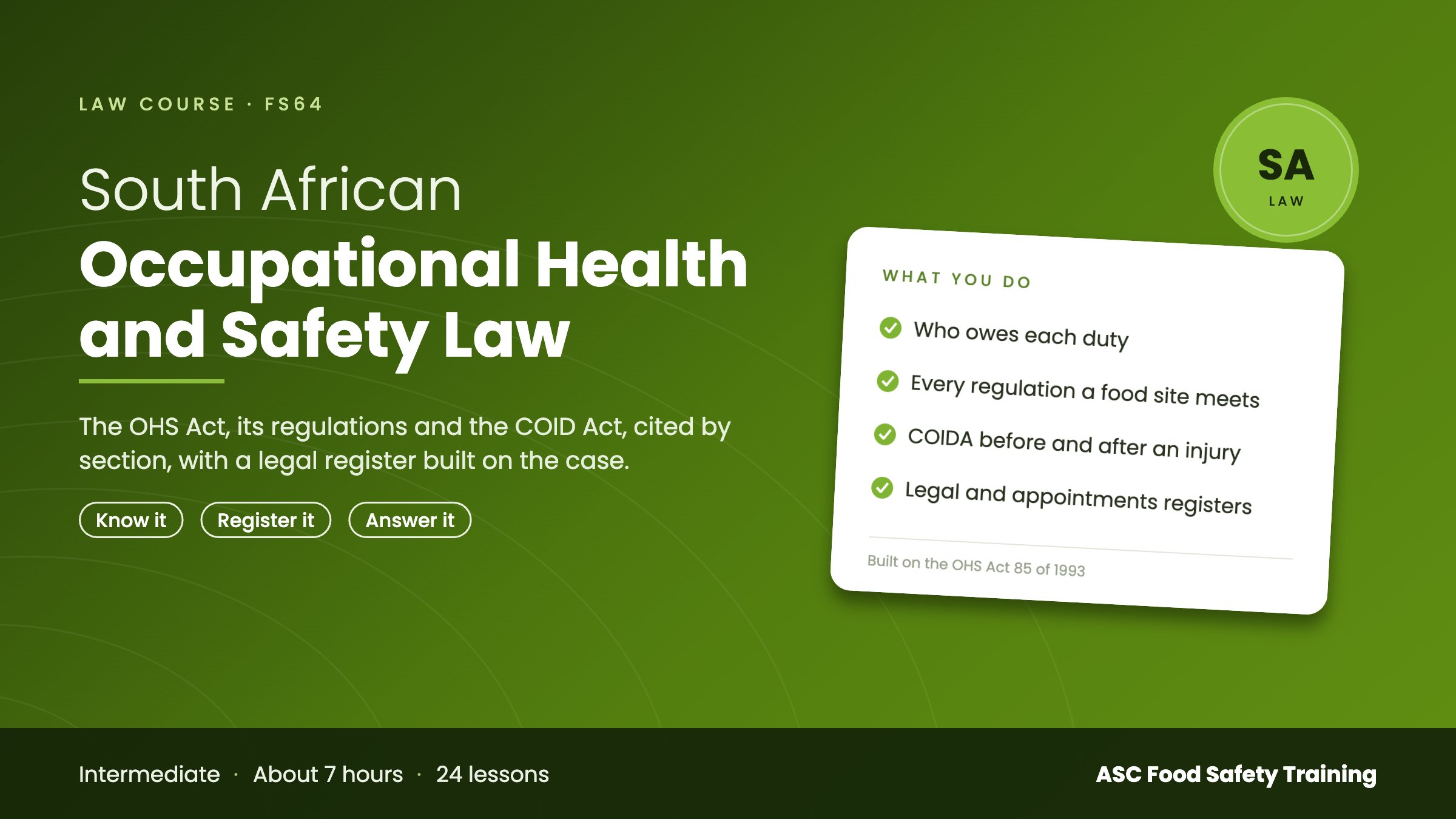
This course teaches the law that inspector was enforcing, section by section and regulation by regulation, for a South African food site. It is not an ISO course. Every duty in it comes from the OHS Act, its regulations and the Compensation for Occupational Injuries and Diseases Act 130 of 1993, cited by section or regulation, and ISO 45001:2018 is mentioned only in one lesson that shows where each legal duty sits in a management system. It covers the Act’s structure and who answers for what; the regulations a food plant, a packhouse or a restaurant group meets, including the Noise Exposure Regulations, 2024 and the Physical Agents Regulations, 2024 that replaced the 2003 and 1987 regulations on 6 September 2026; the COID Act as amended from 2026; and the practical work of building a legal register and an appointments register, evaluating compliance, and living through an inspection and a notice.
The case is Mzansi Fresh Meals, a chilled ready meals plant in Kempton Park with 400 people, 60 agency workers and a May 2026 inspection that ended in two notices. It is a training scenario built from real audit, inspection and incident patterns. No real company is named. The law is stated as at 8 October 2026 from a verified legal reference reviewed by a regulatory specialist, and the course is training, not legal advice.
Who it is for
SHEQ officers and managers who must build and keep the OH&S legal register and answer the inspector. Section 16(2) assignees who signed a letter and want to know what it placed on them. HR managers who handle the COID Act claims, the night work duties under the Basic Conditions of Employment Act and the new Employee Health and Wellness Representative appointment. Consultants who write legal registers for clients. Managers of smaller businesses who carry every role themselves. It suits a site that has a safety file and no legal register, a site that has had a notice and does not want another, and an ISO 45001 implementer who needs the law at regulation depth before clause 6.1.3 can be met. If your need is the standard rather than the law, start with Introduction to ISO 45001:2018 or ISO 45001:2018 Understanding and Implementation instead.
What you finish with
You finish able to say what the OHS Act asks of the employer, the chief executive officer, the 16(2) assignee, the employee and the mandatary, and what section 37 presumes when one of them fails. You can state the thresholds in sections 17 and 19 for representatives and committees, the reporting clocks in section 24 and General Administrative Regulation 8, the recording and investigation duties in regulation 9, and what an inspector may do under sections 29 and 30. You can name the regulation that governs each hazard on a food site, from the General Safety Regulations on first aid, PPE and confined spaces to the Pressure Equipment Regulations on the boiler and the Construction Regulations on a cold store project, and say which appointments, records and intervals each one creates. You can explain the COID Act’s registration, reporting and letter of good standing duties and what the 1 April 2026 administrative penalties change. You leave with a Mzansi legal register and appointments register built in the Legal Register tool, with its new Appointments Register tab, exported as one file, and a certificate of completion with a verification code.
Curriculum
Module 1: The Act: structure, duties and who answers for what
- Lesson 1.1: Why the Act reads the way it does: reasonably practicable, the employer, the user and the worker (16 min)
- Lesson 1.2: Section 16 and section 37: the chief executive officer, the 16(2) assignment and the 37(2) agreement (14 min)
- Lesson 1.3: The duty to inform, the policy on direction, and the sections on prohibitions, sale and deductions (10 min)
- Lesson 1.4: Representatives and committees: sections 17 to 20 and the General Administrative Regulations (14 min)
- Lesson 1.5: Reporting, recording and investigating: sections 24 and 25 and General Administrative Regulations 8 and 9 (14 min)
- Lesson 1.6: Inspectors, notices, victimisation and penalties: sections 26, 28 to 32, 35 and 38 (14 min)
Module 2: The regulations every food site meets
- Lesson 2.1: General Safety Regulations: PPE, first aid, flammables, confined spaces, heights, ladders, hot work, housekeeping, flooding, fire and egress (16 min)
- Lesson 2.2: Facilities Regulations and the Physical Agents Regulations, 2024: sanitation, change rooms, drinking water, heat, cold, lighting and air (12 min)
- Lesson 2.3: Driven Machinery, General Machinery and Lift Regulations: forklifts, lifting equipment, guarding and competent persons (14 min)
- Lesson 2.4: Pressure Equipment and Electrical Installation Regulations: the boiler, the compressor, the ammonia plant and the certificate of compliance (12 min)
- Lesson 2.5: The Regulations for Hazardous Chemical Agents: GHS, safety data sheets, risk assessment, monitoring, medical surveillance and records (16 min)
- Lesson 2.6: Noise Exposure Regulations, 2024, Ergonomics Regulations and Hazardous Biological Agents Regulations (14 min)
- Lesson 2.7: Construction Regulations, 2014 for the client who builds a cold store: appointments, the health and safety file and permits (12 min)
Module 3: COIDA, the Compensation Fund and the other Acts that touch safety
- Lesson 3.1: COIDA: registration, assessments by class, the letter of good standing, section 35 and the Paynter’s Hardware judgment (12 min)
- Lesson 3.2: Reporting an accident and a disease under COIDA: the forms, the seven days, the 2026 penalties, the Employee Health and Wellness Representative and rehabilitation (14 min)
- Lesson 3.3: The BCEA and the LRA where they touch safety: hours, night work, pregnancy and the right to refuse as it actually stands (10 min)
- Lesson 3.4: The Mine Health and Safety Act, the National Building Regulations and SANS 10400, fire by-laws and the Major Hazard Installation Regulations: when they reach a food site (12 min)
- Lesson 3.5: ISO 45001 and the law: where each legal duty sits in a management system, and why certification changes nothing for the inspector (10 min)
Module 4: Building and running the legal register, and living with inspections
- Lesson 4.1: Building the legal register: instruments, applicability, how it applies, appointments, records and evaluation of compliance (14 min)
- Lesson 4.2: The appointments register: every appointment the law creates, who signs, for how long, and the competence behind it (12 min)
- Lesson 4.3: Evaluating compliance: the method, the evidence, the frequency, and what an inspector will test (12 min)
- Lesson 4.4: Preparing for an inspection and responding to a notice: rights, the 60 day realities, the appeal (12 min)
- Lesson 4.5: Keeping the register current: the Gazette, the Department’s notices, and the 2024 to 2026 changes as the worked example (10 min)
- Lesson 4.6: Workshop: the Mzansi legal register and appointments register, step by step (12 min)
- Workshop work: about 60 minutes in the Legal Register tool and its Appointments Register tab
- Final assessment: 30 questions drawn from 60
Lesson minutes are reading time for the lesson itself; the case pack at the end of a lesson adds a few minutes of your own work on the Mzansi Fresh Meals data.
How you are assessed
Every module has a knowledge check of 15 questions drawn from a bank of 24, at 30 seconds a question, and a game of 10 rounds drawn from 14, at 45 seconds a round: Who owes the duty? in Module 1, Which regulation? in Module 2, Act, regulation or standard? in Module 3, and Compliant, not compliant or not applicable? in Module 4. Between the lessons sit eleven scenario checks, each of 6 questions at 30 seconds a question, set on the lessons just before it. Each module ends with a case study assessment on the Mzansi site: the May 2026 inspection, the regulations map, the COIDA file and the register before the inspector returns, each 10 questions drawn from 12 at 45 seconds a question. The final assessment draws 30 questions from a bank of 60, harder than the knowledge checks, a third of them set on a scenario.
The pass mark is 70 percent on everything. Each assessment allows two timed attempts, with a 24 hour break after a failed first attempt. There is no video proctoring on this course. Everything is marked automatically the moment you submit, and the feedback on a failed attempt names what to fix and which lesson to reread.
The tool
The Legal Register tool opens with the Mzansi case loaded: the instruments, how each applies on the site, the records it creates and the evaluation of compliance. This course adds the Appointments Register tab, which lists every appointment the law creates for the site, from the section 16(2) assignees and the health and safety representatives to the General Machinery Regulations competent person, the first aiders and the Employee Health and Wellness Representative that the COIDA regulations of 6 March 2026 require, with who signs, for how long and the competence behind each one. Module 4 builds both registers step by step on the case data, and the workshop lesson gives you about 60 minutes of work in the tool before the case study assessment. The tool saves on the device you use and exports as one file.
What you need
A laptop or tablet with an internet connection, and one device and one browser for the workshop. You do not need prior legal training, and you do not need a site of your own: the case carries the data. A copy of the OHS Act and its regulations is useful; General Administrative Regulation 4 requires an employer with five or more employees to keep one at the workplace anyway, and the course shows where to find the Gazette text. The course quotes short passages of the Act and the regulations by section and regulation number and does not reproduce them.
Certificate
When you have passed every assessment, ASC issues a certificate of completion that names the course, the code FS64 and the date, and carries a verification code an employer can check. It is a training certificate from ASC Food Safety Consultants. It is not a legal qualification and it is not a certification of your organisation.
Free guides for this course
- What the inspector asks for first: the records a Department of Employment and Labour inspection opens with
- The 16(2) assignment is not a delegation of blame
See all eight ISO 45001 and health and safety courses and which one fits your job at ascfoodsafetytraining.com/iso-45001/.
Questions people ask
Is this an ISO 45001 course?
No. It is a course on South African occupational health and safety law. ISO 45001:2018 appears in one lesson, 3.5, which shows where each legal duty sits in a management system and why certification changes nothing for an inspector. Everything else is the OHS Act, its regulations, the COID Act and the other Acts that touch safety, cited by section and regulation.
Is it legal advice?
No. It is training. The law is stated as at 8 October 2026 from a verified legal reference, and where a source is a law firm’s report rather than the Gazette text, the lesson says so. A decision on your own site, especially after a notice or an injury, needs your own legal adviser.
Does it cover the 2024 noise and physical agents regulations?
Yes. The Noise Exposure Regulations, 2024 and the Physical Agents Regulations, 2024 were published in Government Gazette 52226 on 6 March 2025 and replaced the 2003 noise regulations and the 1987 Environmental Regulations for Workplaces 18 months later, on 6 September 2026. Lessons 2.2 and 2.6 teach them as the current law, and lesson 4.5 uses the 2024 to 2026 changes as the worked example of keeping a register current.
Does it cover the COID Act changes of 2026?
Yes. Module 3 covers the COID Amendment Act 10 of 2022 as it came into force in phases from 23 January 2026, the regulations published on 6 March 2026 including the Employee Health and Wellness Representative appointment and the return to work duties, and the administrative penalties that law firms report from 1 April 2026, including the penalty for an accident not reported within seven days.
Has the OHS Act been amended, and is a bill coming?
A notice of intention to introduce an OHS Amendment Bill was published in May 2021; no bill has been found before Parliament since. The course teaches the Act as it stands, with the section 38 penalties as they stand, and does not anticipate changes.
Does it cover mines?
No. Section 1(3)(a) of the OHS Act excludes mines, which fall under the Mine Health and Safety Act 29 of 1996. Lesson 3.4 explains where the boundary runs, but the course does not teach the Mine Health and Safety Act.
How is this different from ISO 45001 Management Awareness?
Management Awareness is four hours for the managing director and the 16(2) assignees on what the law and the standard ask of them personally. This course is seven hours at regulation depth for the person who has to build the legal register, know every appointment and record, and answer the inspector. Many sites put the MD on one and the SHEQ officer on the other.
Can we enrol a team?
Yes. Prices are in rand with no VAT added. For a group from one organisation, ask ASC for a group arrangement on WhatsApp or through the contact page.
Enrol
South African Occupational Health and Safety Law, FS64, R1 495 with no VAT added. About 7 hours, self paced, lifetime access, certificate on completion.
Enrol: know the law you answer to Questions? WhatsApp us
Once you know the law, two ISO 45001 courses build on it. ISO 45001 Management Awareness, FS61, R1 295, gives the managing director and the 16(2) assignees their part in four hours. ISO 45001:2018 Understanding and Implementation, FS62, R3 950, turns the legal register you built here into the clause 6.1.3 and 9.1.2 processes of a management system.
This course is training, not legal advice. ISO 45001:2018 is a standard published by ISO. This course is an independent training product and is not approved or endorsed by ISO, by any certification body or by the Department of Employment and Labour.
Course Content
Module 1: The Act: structure, duties and who answers for what
-
Lesson 1.1: Why the Act reads the way it does: reasonably practicable, the employer, the user and the worker
-
Lesson 1.2: Section 16 and section 37: the chief executive officer, the 16(2) assignment and the 37(2) agreement
-
Scenario check 1: definitions, duties, assignments and mandataries
-
Lesson 1.3: The duty to inform, the policy on direction, and the sections on prohibitions, sale and deductions
-
Lesson 1.4: Representatives and committees: sections 17 to 20 and the General Administrative Regulations
-
Scenario check 2: informing people, buying safely, representatives and committees
-
Lesson 1.5: Reporting, recording and investigating: sections 24 and 25 and General Administrative Regulations 8 and 9
-
Lesson 1.6: Inspectors, notices, victimisation and penalties: sections 26, 28 to 32, 35 and 38
-
Scenario check 3: reporting, investigation, inspectors and penalties
-
Module 1 knowledge check
-
Module 1 case study assessment: The May 2026 inspection at Mzansi
-
Who owes the duty?
Module 2: The regulations every food site meets
Module 3: COIDA, the Compensation Fund and the other Acts that touch safety
Module 4: Building and running the legal register, and living with inspections
Student Ratings & Reviews
