
Legionella training in South Africa
Two online courses built on the OHS Act and the HBA Regulations, 2022. One for the people who run the taps, showers, geysers and cooling towers every day. One for the person appointed to manage the risk.
- HPCSA CPD accredited
- Self-paced, works on a phone
- No classroom day, no travel
- 3 600+ course enrolments
- 366+ Google reviews across our Johannesburg, Gqeberha and Cape Town offices
- Below 20 °C: dormant, not dead
- 20 to 45 °C: grows, fastest near body temperature
- 50 °C: survives for hours
- 60 °C and above: killed, faster the hotter
Where can you get Legionella training in South Africa?
ASC Food Safety Consultants runs two online, self-paced Legionella courses written for South African law. Legionella Awareness Training (Basic, 4 hours, R799) is for staff who work on or near water systems. Legionella Responsible Person Training (Intermediate, 10 hours, R2 950) is for the person who manages the risk assessment and water management plan. Both are HPCSA CPD accredited and built on the OHS Act.
- Courses Basic (Level 1) and Intermediate (Level 3)
- Prices R799 and R2 950, no VAT charged on courses
- Time 4 hours and 10 hours, self-paced, on a phone
- Built on the OHS Act 85 of 1993, the HBA Regulations, 2022 and NICD guidance, with SANS 893 Parts 1 and 2 explained
- Accreditation HPCSA CPD accredited
- Assessment 70 percent pass mark, three attempts on every test, instant marking
- Tools the Legionella Water Walk and the Risk Assessment and Water Management Plan Builder
- Certificate a dated ASC certificate on passing
Which Legionella courses does ASC run?
Both courses use the same three case sites. Basic is for the people who do the checks, Intermediate for the person who answers for them.
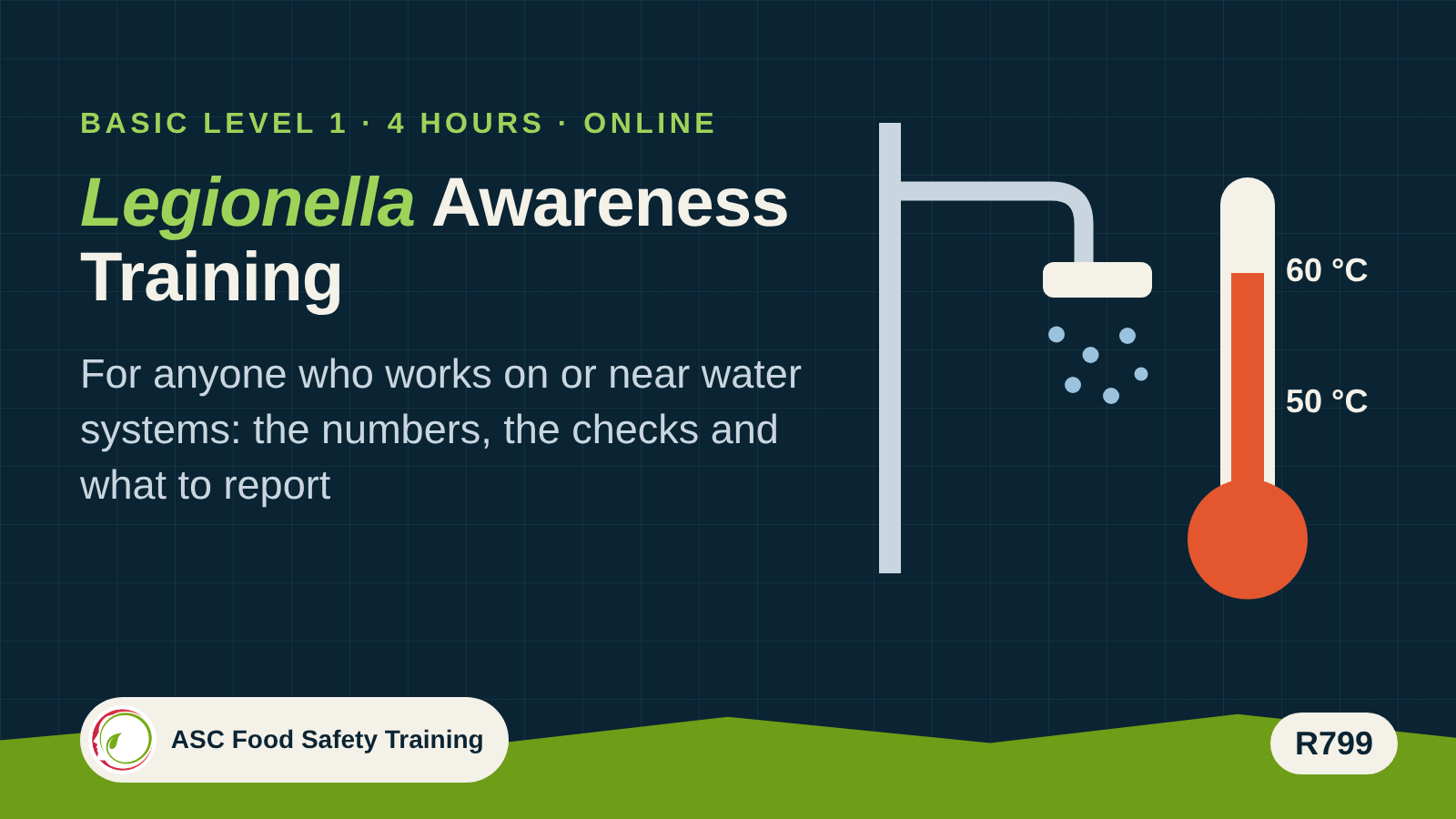
Legionella Awareness Training (Basic)
For the people who run the water every day: maintenance, housekeeping, spa, pool and gym staff, kitchen and cleaning teams, plant operators, care workers, caretakers and their supervisors.
- 4 hoursself-paced
- 4 modules14 lessons
- 4 games4 knowledge checks
- 30 questionsfinal assessment
- Water Walk24-point site checklist
- Certificatedated, verifiable online
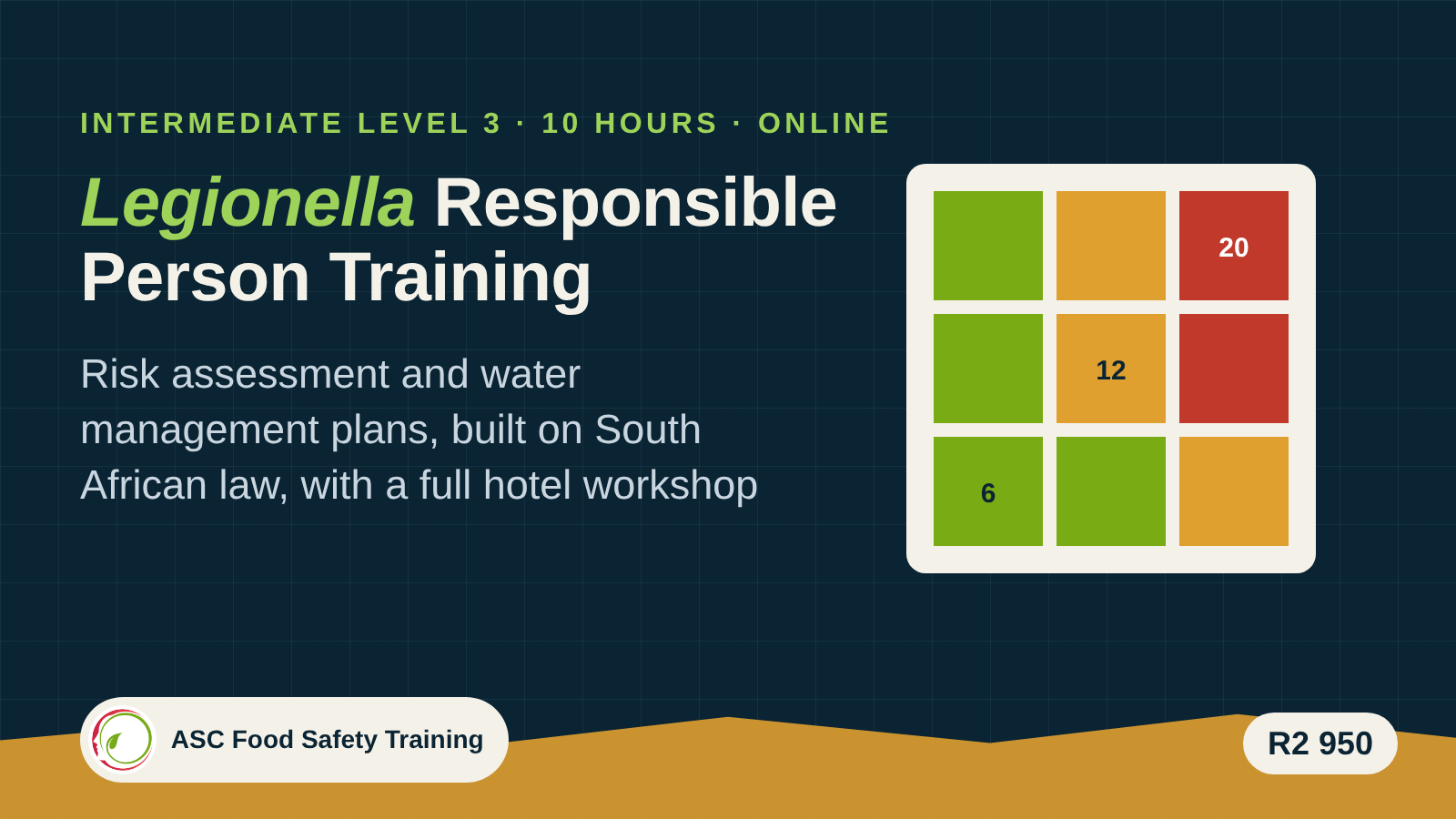
Legionella Responsible Person Training (Intermediate)
For the person appointed to manage Legionella on a site: chief engineers, facilities and property managers, SHEQ and QA managers, frail care and clinic managers, hotel general managers and owners, environmental health practitioners and consultants.
- 10 hoursself-paced
- 5 modules25 lessons, 5 games, 5 checks
- Workshop3 sittings, full hotel case
- 40 questionsfinal assessment
- Builderexports your plan (xlsx)
- Certificatedated, verifiable online
Which Legionella course does each role need?
Find the role, read across. Every person needs their own seat, because every person needs their own dated certificate in the training file.
| Your role | Your course |
|---|---|
| Maintenance artisans and general hands | Basic |
| Housekeeping and room attendants | Basic |
| Spa, pool and gym staff | Basic |
| Kitchen and cleaning staff | Basic |
| Plant operators on food and beverage sites | Basic |
| Care workers in frail care and clinics | Basic |
| Caretakers, estate and building staff | Basic |
| Supervisors of these teams | Basic plus Intermediate if appointed deputy |
| The appointed responsible person and deputy | Basic first, then Intermediate |
| Chief engineers and engineering managers | Intermediate |
| Facilities and property managers | Intermediate |
| SHEQ and QA managers | Intermediate |
| Frail care and clinic managers | Intermediate |
| Hotel general managers and owners | Intermediate |
| Environmental health practitioners and consultants | Intermediate |
New to Legionella and about to be appointed? Take Basic first. Intermediate recaps the basics, so it is not required, but Basic shows you the checks your team will be doing.
Which South African laws does the training cover?
The law is the OHS Act and the Regulations for Hazardous Biological Agents, 2022, with the notifiable medical condition regulations for reporting cases. SANS 893 is the benchmark, not the law.
Section 8 covers employees and section 9 covers everyone else on site: guests, patients, residents, visitors. Section 16 keeps the chief executive responsible after duties are assigned, and section 37 presumes the employer liable for its employees and contractors unless it proves it did not permit the act, the act was outside their authority, and it took all reasonable steps.
Government Notice R. 1887 lists Legionella spp. as a Risk Group 2 hazardous biological agent. The regulations never mention water or cooling towers, but they apply wherever exposure may occur, and that wording brings building and process water systems into scope.
Train employees who may be exposed before exposure, in theory and practice, and refresh the training every year or at intervals the health and safety committee or representative recommends.
A documented risk assessment by a competent person, including pregnant, immunocompromised and vulnerable employees, with an action plan. Review at least every 24 months, and at once after a change or an incident.
Monitoring at intervals the risk assessment sets, never more than 24 months apart. Risk assessments and monitoring reports kept for at least 40 years, records of control checks and repairs for at least 5 years.
A voluntary national standard, not law. It is the recognised South African benchmark a competent person uses to show the controls are reasonably practicable.
Legionellosis is a Category 2 notifiable medical condition. The doctor or laboratory that diagnoses it notifies within 7 days, not the hotel or the employer. Environmental health practitioners investigate.
Mines fall under the Mine Health and Safety Act 29 of 1996, not the OHS Act. Food premises also answer to R638, which requires potable water, hot and cold water at wash-up facilities and hot water at hand-washing facilities where possible, but does not mention Legionella. Read the full guide: Legionella regulations in South Africa.
Which sectors is the training built for?
Three case sites run through both courses: a 140-room beachfront hotel, a dairy with an ammonia plant and a 90-bed frail care centre. They are training scenarios built from real audit patterns.
Hotels, lodges and guesthouses
Guest showers, calorifiers, closed floors, spas and rooftop cooling towers. Of 27 outbreaks the CDC investigated in the USA from 2000 to 2014, 12 were in hotels and resorts.
Staff: Basic. General manager or chief engineer: Intermediate.
Facilities and property
Rooftop cooling towers, storage tanks and long pipe runs. A 2025 study found Legionella pneumophila in 14 of 15 Hillbrow residential high-rises sampled, all of them on storage tanks (Buthane et al., 2025).
Technicians: Basic. Facilities manager: Intermediate.
Food and beverage plants
Evaporative condensers on ammonia plant, process cooling towers, washdown and high-pressure cleaning mist, and recovered water. A dairy case runs through both courses.
Maintenance: Basic. QA, SHEQ and engineering: Intermediate.
Healthcare and frail care
The people most at risk. The CDC puts the death rate at about 1 in 4 when the disease is caught during a healthcare stay. Assisted showers, geysers turned down after a scald, nebulisers.
Care workers: Basic. Frail care and clinic managers: Intermediate.
Mines and heavy industry
Cooling towers, change house showers and dust suppression sprays. Mines fall under the Mine Health and Safety Act 29 of 1996, not the OHS Act, but the control method is the same.
Teams: Basic. Engineers and SHEQ: Intermediate.
Environmental health practitioners
You investigate legionellosis cases and monitor premises against the national norms and standards (GN 7779, August 2026). They list Legionella spp. in pool and hot bath monitoring at accommodation, set monthly Legionella monitoring for hot tubs with a limit below 1 per 100 mL, and require health establishments to keep hot water above 50 °C and cold water below 20 °C.
Intermediate, HPCSA CPD accredited.
Gyms, spas and wellness
Hot tubs, showers and pool plant. A whirlpool spa on display at a flower show in Bovenkarspel, Netherlands, in 1999 was linked to 188 cases and 21 deaths.
Staff: Basic. Owner or manager: Intermediate.
Schools and hostels
Hostel showers on geysers and timers, storage tanks, and buildings that stand empty over the holidays. NICD authors note that long closures raise the risk in water systems.
Caretakers and hostel staff: Basic. Estates manager or bursar: Intermediate.
What will you walk away with?
Legionella Awareness Training (Basic)
- The four conditions model, and how to break each condition
- The temperature numbers that matter: 60 °C stored, 50 °C at the tap in one minute, cold below 20 °C in two
- How to take a temperature reading properly, and what to write down
- A flushing and showerhead routine for little-used outlets, showerheads and hoses
- What to report, and to whom
- The Water Walk checklist with an exportable findings list (xlsx)
Legionella Responsible Person Training (Intermediate)
- An asset register and schematic method
- The ASC risk rating scale, with Low, Medium and High bands and action times
- A complete risk assessment and action plan for a 140-room hotel, built by you
- A monitoring schedule and corrective action matrix, as sheets in your exported workbook
- A results reader for laboratory reports (builder step 6)
- A contractor oversight checklist (Lesson 4.5)
- The builder, which exports your own site’s plan as an xlsx workbook
Can you try the Legionella tools for free?
Yes. Both tools are free to use and are also built into the courses.
The Legionella Water Walk
A 24-point walk in six groups: hot water, cold water, outlets, cooling towers and evaporative condensers, other risk systems, and records. Answer each point, and it ranks your findings High, Medium or Low and exports the list as a spreadsheet.
Open the free Water WalkThe Risk Assessment and Water Management Plan Builder
Seven steps: site and team, asset register, risk rating, controls and monitoring, corrective actions, a results reader for laboratory reports, and export to an xlsx workbook.
Open the free builderTry the free Water Walk, then learn to act on what it finds in the course. The tools are free. The courses teach the method, the judgement behind every rating and limit, the worked hotel case, the assessments and the certificate.
Legionella guides for South African sites
Thirteen free guides from the team that wrote the courses. More in all ASC guides.
- Legionnaires’ disease in South Africa: symptoms, causes, who is at risk and how it is prevented
- Legionella regulations in South Africa: what the OHS Act, the HBA Regulations 2022 and SANS 893 require
- Who is responsible for Legionella? The duty holder, the responsible person and your water treatment contractor
- What a Legionella risk assessment in South Africa must contain, who can do it, and a worked hotel example
- A Legionella water management plan template for South African buildings, step by step
- Legionella and hot water temperature: geysers, heat pumps and solar systems in South African buildings
- Legionella in water storage tanks: JoJo tanks, water outages and boreholes
- Legionella flushing procedure: little-used outlets, showerhead cleaning and a log to copy
- When and how to do Legionella testing in South Africa, and how to read your results
- Controlling Legionella in cooling towers and evaporative condensers on South African sites
- Legionella prevention in hotels, lodges and guesthouses: a practical water safety checklist
- Protecting patients and residents from Legionella in hospitals, clinics and frail care
- Legionella in the food industry: cooling water, washdown, reused water and what auditors ask for
Ready to train your site? Basic is R799 a person. Intermediate is R2 950.
Enrol in Basic (R799)Start Intermediate (R2 950)Legionella training questions
Is there an online Legionella course in South Africa?
Yes. ASC Food Safety Consultants runs two online, self-paced Legionella courses: Legionella Awareness Training (Basic) at R799 and Legionella Responsible Person Training (Intermediate) at R2 950. They are among the few online Legionella courses written for South African law, built on the OHS Act and the HBA Regulations, 2022, and both are HPCSA CPD accredited.
Which Legionella course do I need?
If you run the taps, showers, geysers, pools or plant, or supervise the people who do, take Legionella Awareness Training (Basic). If you are, or will be, the person appointed to manage Legionella on a site, take Legionella Responsible Person Training (Intermediate). Intermediate recaps the basics, so Basic first is helpful but not required.
Does South African law require Legionella training?
For employees who may be exposed, yes. The Regulations for Hazardous Biological Agents, 2022, made under the OHS Act, list Legionella spp. as a Risk Group 2 agent and apply wherever exposure may occur, which is how most competent persons bring water systems into scope. Regulation 4 requires training before exposure and a refresher every year, or at intervals the health and safety committee or representative recommends. The law does not name a particular course.
Are ASC’s Legionella courses accredited?
Both courses are HPCSA CPD accredited. They are written for South African law, and you receive an ASC certificate when you pass.
How much does Legionella training cost?
Legionella Awareness Training (Basic) costs R799 and Legionella Responsible Person Training (Intermediate) costs R2 950. That is what you pay, because ASC charges no VAT on courses. A currency converter on the site shows each price in US dollars, euros, pounds and other currencies.
How long do the Legionella courses take?
Basic takes about 4 hours and Intermediate about 10 hours. Both are self-paced and work on a phone, so there is no classroom day and no travel.
Who is the Legionella responsible person in South Africa?
South African law does not use the phrase. ASC uses it, as the UK’s ACOP L8 does, for the named, competent person the employer appoints in writing under section 16(2) of the OHS Act to manage day-to-day control. The chief executive stays responsible, because assigning the duty does not relieve the employer. Read who is responsible for Legionella.
We pay a water treatment company. Do we still need Legionella training?
Yes. The duty stays with the employer under sections 8, 9 and 16 of the OHS Act, and section 37 presumes the employer liable for its employees and contractors unless it proves it did not permit the act, the act was outside their authority, and it took all reasonable steps. Your staff still run the water every day, and the Intermediate course teaches you to read and challenge a contractor’s reports.
How often does Legionella training need to be refreshed?
Regulation 4(4) of the HBA Regulations, 2022 calls for refresher training every year, or at intervals your health and safety committee or representative recommends. ASC certificates are dated, so your training file shows when each person is due.
Is SANS 893 the law?
No. SANS 893-1 (risk management) and SANS 893-2 (the control of Legionella in water systems) are a voluntary national standard that no regulation makes compulsory. They are the recognised South African benchmark a competent person uses to show controls are reasonably practicable. Both courses explain what each part covers in ASC’s own words.
Start your team this week
HPCSA CPD accredited, self-paced, on a phone. No classroom day, no travel, and a dated certificate for every person who passes.
Buying for a team? Ask for a team quote on WhatsApp. Written by Mthokozisi Nkosi, founder of ASC Food Safety Consultants, FSSC 22000 and BRCGS lead auditor, who advises national hotel, restaurant and food brands. Related courses: Guesthouse Support Staff Essentials, Chemical Safety for Housekeeping and Laundry, Food Safety for Engineering and Maintenance Teams and Hygienic Design Essentials. See all ASC courses.