
FSSC 22000 Version 7 for Food and Feed Packaging Manufacturing
Course Prerequisite(s)
- Please note that this course has the following prerequisites which must be completed before it can be accessed
-
 The ISO 22000 Standard
-
 ISO22002-100:2025 The PRP Standard Requirements
About Course
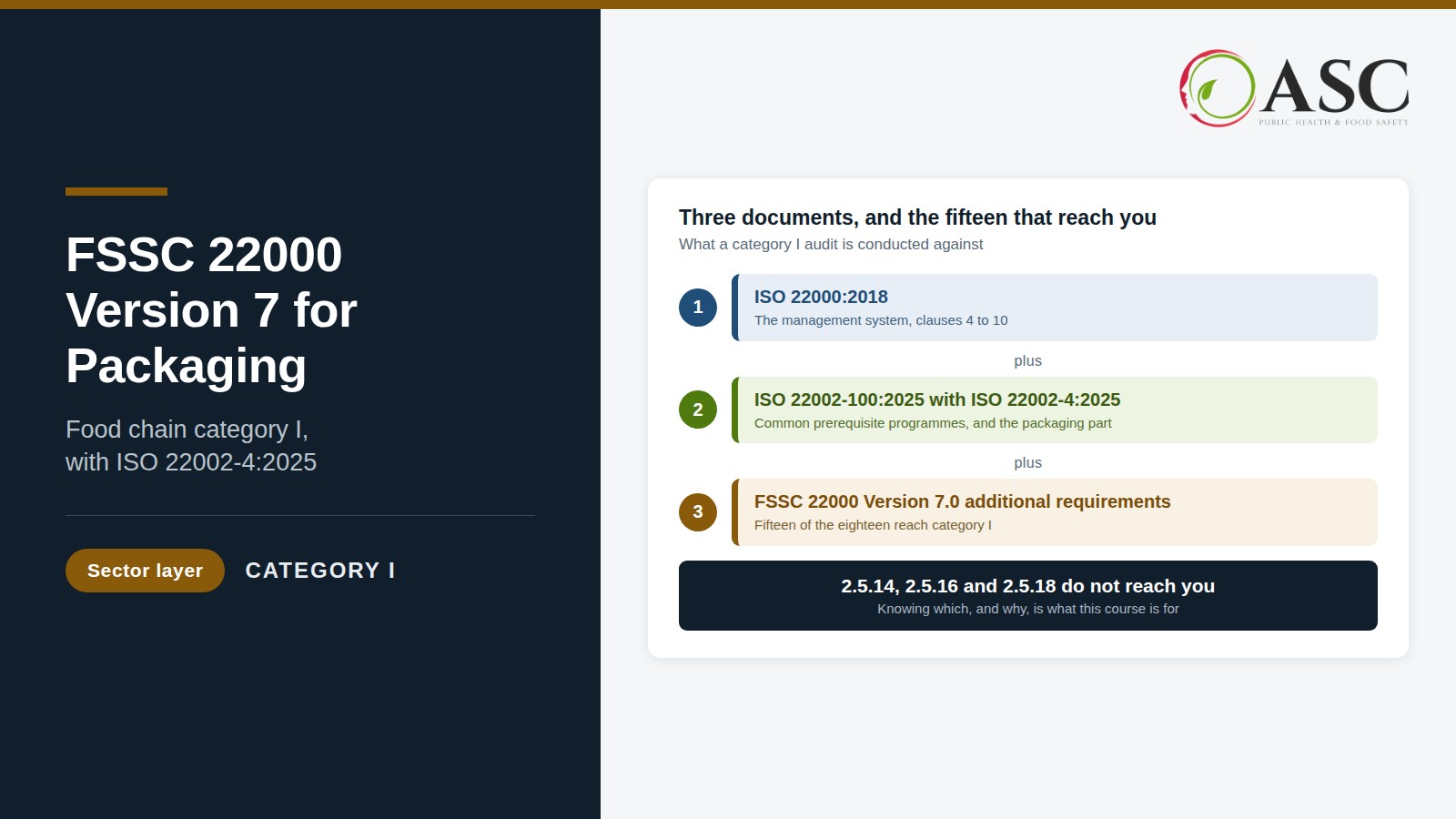
You must finish Step 1 and Step 2 before this course will open. A category I FSSC 22000 audit is conducted against four documents. Steps 1 and 2 teach two of them. This course teaches the other two, ISO 22002-4:2025 and the FSSC 22000 additional requirements. Taken in order, the four fit together and nothing is repeated.
Enrolment on this course opens on its own the moment Steps 1 and 2 show as complete in your dashboard. There is nothing to send us and nothing to claim — the system checks it for you.
This course is the packaging layer of FSSC 22000 Version 7. It takes food chain category I, production of packaging material in contact with food, feed and animal food, and teaches the two things a packaging site cannot get from a general FSSC course: what ISO 22002-4:2025 adds on top of ISO 22002-100:2025, and which of the eighteen additional requirements actually reach category I.
Three of them do not reach you at all, and a site that has built a food loss and waste programme has built something the scheme never asked of it. Six of them narrow inside the clause, so only some sub requirements apply: 2.5.1, 2.5.3, 2.5.4, 2.5.10, 2.5.11 and 2.5.13. One of them, environmental monitoring, does reach category I and catches sites that assumed it was only for food manufacturers. The course works through every one at its real scope, quoting the clause, naming the documented information it demands and the toolkit document that holds it.
Twenty four lessons in four modules, eight games and knowledge checks, and a graded final assessment in two parts. Three attempts at each assessed part and a pass mark of 70 percent. Every question carries a written explanation naming the clause that settles it.
Course Content
MODULE 1: CATEGORY I, AND WHAT AN AUDIT IS CONDUCTED AGAINST
-
Lesson 1: What this course covers, and what it assumes you already know
-
Lesson 2: Category I in the scheme’s own words, Part 1 section 3.7
-
Lesson 3: The four documents a category I audit is conducted against
-
Lesson 4: What a category I certificate does not give you
-
Lesson 5: How the scheme grades what it finds
-
In or out of category I?
-
Module 1 knowledge check
MODULE 2: ISO 22002-4:2025, THE PACKAGING LAYER
MODULE 3: THE ADDITIONAL REQUIREMENTS AT CATEGORY I SCOPE
MODULE 4: PROVING IT
Student Ratings & Reviews
