
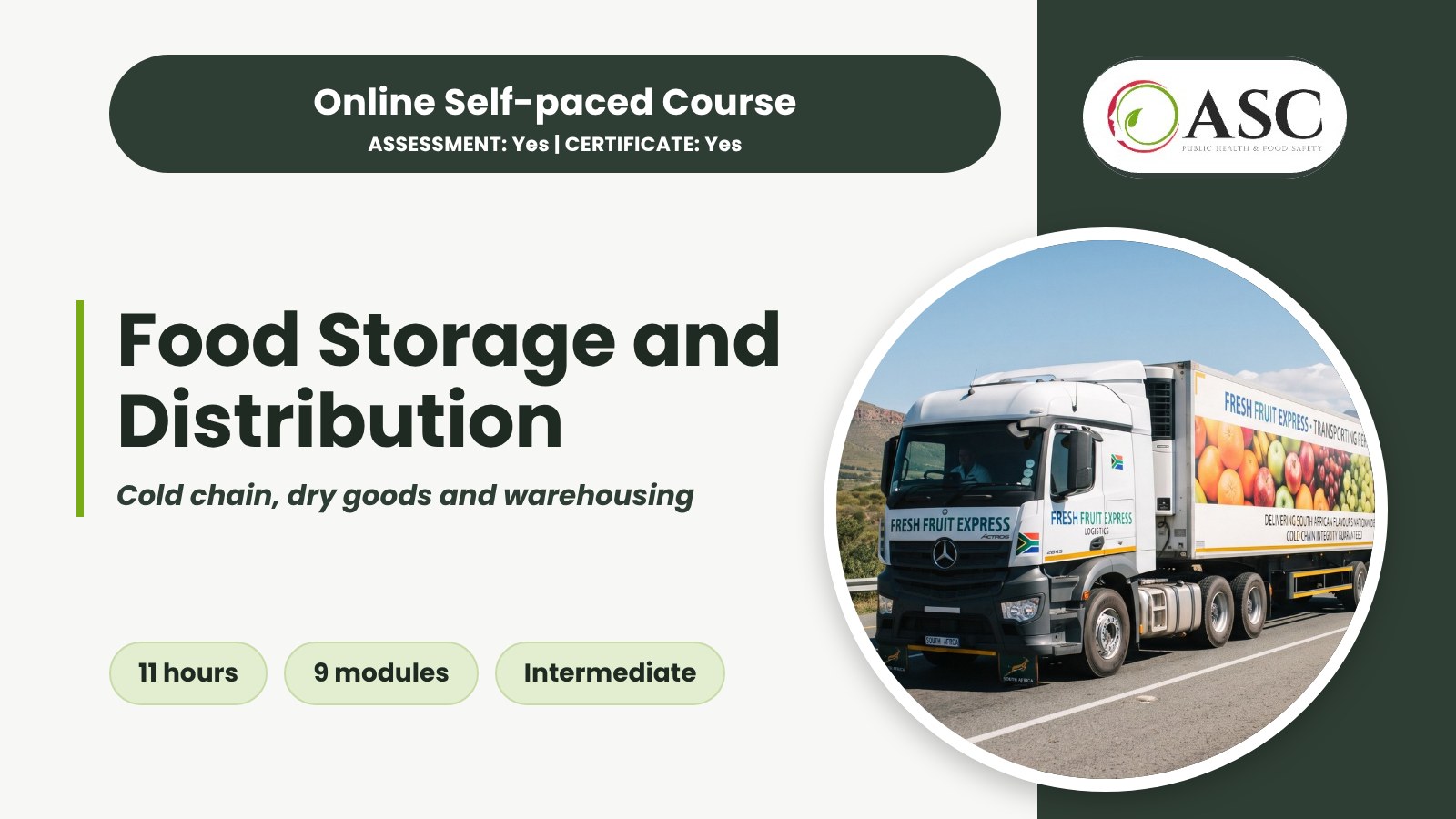
Warehouse, cold chain and transport · South Africa
Food storage and distribution training, from the receiving dock to the last drop.
For the people who keep food safe between the factory gate and the shop shelf: DC and warehouse managers, cold store and fleet supervisors, QA officers, traders who use other people’s stores and trucks, and owners of distribution businesses with two trucks or twenty. Start with the law. Add BRCGS, FSSC 22000 or IFS when your site is certified or a customer asks for it.
Free to read: R638 temperatures for storage and transport · when the cold chain breaks · Durban versus Johannesburg
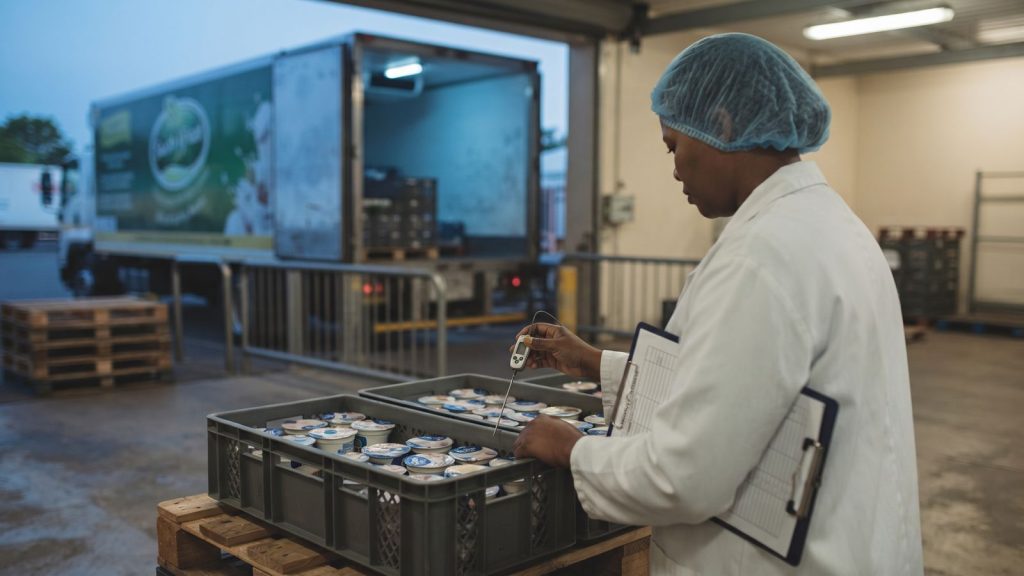
Why storage gets its own course
Your truck is food premises.
What the inspector asks, and what the course makes you able to show
R638 says to handle food includes to keep, store and transport it, and a vehicle counts as food premises. So the DC, the cold rooms and every truck and bakkie answer to the same regulations as the factory. An inspector checks the law. A certification body checks the scheme, and the law as well.
I still walk into DCs that mix the two up, usually by treating a customer’s spec as if it were the legal limit, or the other way round. The course starts there, then goes through the cold chain, dry goods, frozen, chilled and hot food, coast against Highveld, the store, the vehicle and the people working in both.
- The law first. R638, the OHS Act and the road traffic regulations, which apply whether or not a site is certified.
- A case study to work on. Mzansi Fresh Meals, a fictional ready meal maker with its own Pinetown DC, trucks and hot-box vans.
- Coast and inland. Sweating cartons in Durban, pack swell and frost on the Highveld, and the N3 in between.
- People as well as product. Forklifts, racking, cold stress in the freezer, ammonia, PrDP and driver fatigue.
Start here
One course for the floor, one for the people who run it.
Food Storage and Distribution: Cold Chain, Dry Goods and Warehousing New
For DC and warehouse managers, cold store, dock and fleet supervisors, QA officers, and owners of small distribution businesses. Start here if you run stores or trucks and nobody has asked you for a certificate yet.
Intermediate
- 1Storage and distribution: the risks and the law3 lessons
- 2Cold chain management4 lessons
- 3Distributing dry goods3 lessons
- 4Frozen, chilled and hot food3 lessons
- 5Inland versus coastal3 lessons
- 6Storage facilities and stacking3 lessons
- 7Distribution vehicles3 lessons
- 8Health and safety3 lessons
- 9Workshop, risk assessment and final assessment3 sittings
You finish with a risk assessment of a chain from receiving to returns: each hazard scored on a 5 by 5 scale, an owned and dated action against each one, and your top three argued to a manager.
Food Storage and Distribution Basics: Docks, Cold Stores and Deliveries New
For the floor team: receiving clerks, pickers, forklift and reach truck operators, cold store workers, drivers, driver assistants and dispatch clerks. Plain English, short lessons, any phone.
Entry
- 1Your part in the cold chain3 lessons
- 2Temperature for frozen, chilled and hot food3 lessons
- 3Receiving, storing and picking3 lessons
- 4Loading, vehicles and deliveries3 lessons
- 5Safety and the practical check3 lessons
R638 temperatures for frozen, chilled and hot food, probing between packs, receiving, storing, loading for airflow, and working safely around forklifts, in the cold store and on the road. It ends with a 20 point Dock and Delivery Check.
Both courses are self paced with lifetime access, run on any phone or laptop, are priced in rand with a currency converter on the course page, and allow three attempts on every assessment.
Who takes what
The dock, the office, and the boardroom.

The floor team
Receiving clerks, pickers, forklift operators, cold store workers, drivers and dispatch clerks. They need the limits, the probe and what to do when a reading is wrong.

Supervisors and managers
Cold store, dock, warehouse and fleet supervisors, DC managers, QA officers and owners of small fleets. They need the law, the routine and the judgement calls.

Certified sites
Owners, directors, DC and QA managers on BRCGS Storage and Distribution or FSSC 22000, or a site whose retailer has just asked for one. They need the scheme on top of the law.
BRCGS, FSSC 22000 and IFSfrom R1 195
When a customer asks for a certificate
Scheme courses for storage, transport and trading.
A certified DC usually needs both kinds of course: the practical one for its supervisors and the scheme course for its managers. None of these replaces the law. An auditor will look for R638 compliance as well.
BRCGS Storage and Distribution Issue 4
For warehouses, cold stores, transport and logistics operations, including cross-docking and e-commerce.
FSSC 22000 Version 7
Category G uses ISO 22002-5:2025 for transport and storage. Category F uses ISO 22002-7:2025 for retail and wholesale.
Trading companies, importers and agents
A lot of food in South Africa is bought and sold by companies that never touch it. These courses cover how you approve and watch the cold stores and hauliers you pay.
Quality control on the receiving dock
The daily checks a QC does in a supermarket, a DC and a cash and carry, for the person with the probe and the clipboard.
On IFS Logistics? IFS publishes its own standard for storage and transport sites, IFS Logistics Version 3. ASC does not run an IFS Logistics course yet, so a logistics site on IFS should take Food Storage and Distribution for the daily work.
Law versus certification
The law binds every site. A scheme binds you once you sign up.
R638, the OHS Act and the road traffic regulations apply to a two-truck operation in Pinetown exactly as they apply to a national DC in Midrand. Nobody chooses them. Breaking R638 is an offence under regulation 15, and the local authority can issue a prohibition order under regulation 4.
BRCGS Storage and Distribution and FSSC 22000 are GFSI benchmarked schemes. A site signs up, mostly because a retailer or brand owner will not list it otherwise. A failed audit puts the certificate at risk, and the listing that depends on it.

3(1)(a) · 10(16) · 13 · Annexure Es8 · GSR 8 · DMRReg 246 · Reg 330A-12 °C law · -18 °C targetThe full temperature guideGFSI benchmarkedCategory GInside Food Storage and Distribution
Nine modules, one company’s stores, trucks and routes.
Mzansi Fresh Meals, the course’s fictional case study, makes ready meals and runs its own DC in Pinetown, multi-temperature trucks, hot-box vans and a bakkie. It also hires a reefer to get stock up the N3 to Midrand. You work through its stores, trucks and routes as the course goes.

- Module 1
- Storage and distribution: the risks and the lawWhy storing and moving food counts as handling it under R638, when a vehicle needs its own CoA, and how law, standards and customer specifications differ.
- Module 2
- Cold chain managementWhere the chain breaks, the Annexure E temperatures and the 2 °C surface rule, probing by the Annexure G method, and hold, assess, decide and record when a load goes out of limits.
- Module 3
- Distributing dry goodsDamp, mould, pests and damaged cans, the R638 regulation 7 can rules at receiving, FEFO, keeping chemicals and allergens apart, and vehicles under regulation 13.
- Module 4
- Frozen, chilled and hot foodThe -12 and -18 °C gap, refreezing rules, loading so raw food cannot drip onto ready-to-eat food, meat vehicles under regulation 12, and hot food that arrives at 60 °C or hotter.
- Module 5
- Inland versus coastalDew point and sweating cartons in Durban, salt air, altitude pack swell on the Highveld, frost and dust, and controls for a route like the N3 to Midrand.
- Module 6
- Storage facilities and stackingChecking a store against R638 regulations 3, 5, 6 and 8, laying out zones from receiving to returns and waste, and every condition of General Safety Regulation 8 for stacks.
- Module 7
- Distribution vehiclesMatching the vehicle to the load, CoA and thermometers, the pre-trip check and pre-cool, loading a reefer for airflow, and securing the load under the road traffic regulations.
- Module 8
- Health and safetyOHS Act duties, forklifts and pedestrians, racking, cold stress under the Physical Agents Regulations, ammonia and chemicals, PrDP, fatigue and breakdowns.
- Module 9
- Workshop and final assessmentThree sittings to walk a chain from receiving to returns, score each hazard on a 5 by 5 scale, write owned and dated actions, and argue the top three to a manager.Then the risk assessment assignment and the final assessment.
Which course do I need?
Find your job in the left column.
Suggestions only. Each person needs their own seat and their own certificate in the training file. For five or more people, ask ASC for a group arrangement.
| If this is you | Start with |
|---|---|
| Receiving clerk, picker, forklift or reach truck operator, cold store worker, driver or dispatch clerk | Food Storage and Distribution Basics, R899 |
| Cold store, dock, warehouse or fleet supervisor | Food Storage and Distribution, R1 795 |
| Owner of a small distribution business with its own trucks or bakkies | Food Storage and Distribution, R1 795 |
| QC on the receiving dock of a supermarket, DC or cash and carry | QC Fundamentals, plus Food Storage and Distribution |
| Manager or QA officer at a site looking at BRCGS Storage and Distribution | Introduction to BRCGS S&D, R1 195 |
| Owner, director or DC manager of a BRCGS certified site, or one going for it | Introduction to BRCGS S&D, then BRCGS S&D for Management |
| QA or food safety team at a transport, storage or cross-dock site on FSSC 22000 | FSSC 22000 V7 Transport and Storage, R5 500 |
| Importer, agent or trading company that uses other people’s cold stores and hauliers | Introduction to IFS Broker or BRCGS Agents and Brokers |
| Logistics site certified to IFS Logistics | Food Storage and Distribution for the daily work (ASC has no IFS Logistics course yet) |
| Wholesaler or retailer with its own DC on FSSC 22000 | FSSC 22000 V7 Retail and Wholesale, plus Food Storage and Distribution for the DC team |
| Supervisors at any certified site | Food Storage and Distribution for the daily work, while managers take the scheme course |
Three people, three routes
How a site usually splits the training.
She runs the 05:00 receiving shift and the dispatch of chilled and frozen loads. Nobody has asked her site for a certificate. She needs the law and the daily routine.
- Food Storage and Distribution, 11 hours, R1 795
- If she also signs off receiving checks: Food Quality Controller Fundamentals, 15 hours, R1 750
First step R1 795. Both courses: 26 hours, R3 545.
A retailer has told his DC it needs BRCGS Storage and Distribution certification before the next contract renewal. He has to understand the standard, then own it.
- Introduction to BRCGS Storage and Distribution Issue 4, 6 hours, R1 195
- BRCGS Storage and Distribution Issue 4 for Management, 4 hours, R1 195
- His supervisors: Food Storage and Distribution, R1 795 each
Sipho’s two courses: 10 hours, R2 390.
A cold store and cross-dock operation in Durban holding stock for several brand owners, certified to FSSC 22000 Version 7 under Category G.
- QA manager and food safety team: FSSC 22000 Version 7 for Transport and Storage, 12 hours, R5 500
- Shift, dock and fleet supervisors: Food Storage and Distribution, 11 hours, R1 795
One QA manager plus one supervisor: R7 295.
Free reading
Five guides written alongside the course.
Each one is built from a module of Food Storage and Distribution, and is free whether or not you ever enrol.
- R638 food temperatures for storage and transport: frozen, chilled and hot
Annexure E, the -12 and -18 °C gap, the 2 °C surface rule, the four exemptions and Annexure G probing.
- Coastal versus inland: why your cold chain behaves differently in Durban and Johannesburg
Dew point, soft cartons, salt, pack swell at altitude and Highveld frost on the N3 run.
- Dry goods storage and stacking in a food warehouse: damp, mould, pests and GSR 8
Off the floor, aflatoxin you cannot see, weevils and beetles, FEFO, chemicals and stack geometry.
- Choosing and loading food delivery vehicles in South Africa
Vehicle types, CoA for hired and own trucks, meat vehicles, reefer loading and NRTR 246 and 330A.
- When the cold chain breaks: handling temperature excursions and power failures
Hold, assess, decide and record, refreezing limits, client stock, alarms, generators and records.
BRCGS, audits and R638
What certification involves for a South African warehouse or DC.
BRCGS Storage and Distribution audit gradesHow a BRCGS Storage and Distribution audit is graded.
Management responsibilities under BRCGS S&DWhat the standard expects of the people who run the site.
Warehouse food safety auditGetting a food warehouse ready for its audit.
Food safety inspection checklistWalk your own site before someone else does.
R638 trainingCourses built on the hygiene regulations every food premises answers to.
BRCGS certification and training in South AfricaAll ASC’s BRCGS courses and guides in one place.
Warehouse, DC or transport manager coursesThe course pathway for logistics managers.
Questions people ask
Before you enrol.
Still unsure which course fits your site? A person answers WhatsApp during office hours.
Is there an online food storage and distribution course in South Africa?
Yes. ASC runs Food Storage and Distribution: Cold Chain, Dry Goods and Warehousing, an intermediate online course built on R638. It takes about 11 hours, costs R1 795 and works on any phone at your own pace. There are 9 modules, a three-sitting workshop and a risk assessment assignment, and you get a certificate when you pass the final assessment.
Does R638 apply to a warehouse, cold store or delivery truck?
Yes. R638 defines handling food to include keeping, storing and transporting it, and food premises include a vehicle. So your DC, your cold rooms and your trucks are all food premises. The Annexure E temperatures apply during storage, transport and display, and regulation 13 sets the rules for freight compartments.
Does an outsourced refrigerated truck need its own certificate of acceptability?
Yes. Regulation 3(1)(a) of R638 covers an outsourced vehicle that carries perishable food for a person in charge of food premises, so the haulier needs a valid CoA. Your own vehicle carrying prepacked food from your own premises is treated differently under regulation 14(6)(a): it can run on a certified copy of the premises CoA kept in the vehicle.
Is BRCGS or FSSC 22000 certification a legal requirement?
No. BRCGS Storage and Distribution and FSSC 22000 are GFSI benchmarked schemes. A site chooses one, usually because a retailer or brand owner makes it a condition of supply. R638, the OHS Act and the road traffic regulations apply to every site whether it is certified or not, and an auditor will look for that legal compliance too.
What is the legal temperature for frozen food in storage and transport?
Under R638 Annexure E, ice cream, sorbet and frozen fish must be -18 °C or colder, and any other food marketed as frozen -12 °C or colder. Codex and most customer specifications expect -18 °C, so that is the usual operating target. Frozen food also may not be sold if its surface is more than 2 °C warmer than the required core temperature.
Should my site train for BRCGS Storage and Distribution or FSSC 22000?
Train for the scheme you hold or the one your customer asks for. A site going for BRCGS Storage and Distribution Issue 4 usually starts its manager on the introduction course, then the management course. A transport or storage site on FSSC 22000 Version 7 takes the FSSC 22000 for Transport and Storage course. In both cases the supervisors take Food Storage and Distribution.
How long must storage and distribution records be kept?
R638 regulation 10(16) says records of processing, production and distribution must be kept for at least 6 months after the shelf life of the product. BRCGS Storage and Distribution Issue 4 expects never less than one year. A certified site keeps whichever period is longer, and longer again if a customer contract asks for it.
Who is the Food Storage and Distribution course for?
DC and warehouse managers, cold store, dock and fleet supervisors, QA officers, and owners of small distribution businesses. It suits supervisors and managers in any business that receives, stores, loads or delivers food, from a two-bakkie operation to a multi-temperature DC. The floor team takes the Basics course. The case study, Mzansi Fresh Meals, runs its own Pinetown DC, trucks and hot-box vans and outsources a reefer to Midrand.
Is there an IFS course for warehouses and logistics?
IFS has a standard for storage and transport sites, IFS Logistics Version 3, but ASC does not run an IFS Logistics course yet. A logistics site on IFS can train its supervisors on Food Storage and Distribution for the daily work. Trading companies that use other people’s cold stores and trucks can take the IFS Broker Version 3.2 series.
About ASC
Written by practitioners who walk DCs, cold stores and trucks.
ASC Food Safety Consultants write and review every course in this catalogue. This page is by Mthokozisi Nkosi, ASC Food Safety Consultants.
If your site also makes food, see the R638 courses and the BRCGS courses. Every ASC course is listed on the all courses page.
Train the dock before the next audit.
Food Storage and Distribution R1 795, 11 hours on a phone. Basics R899, 5 hours. The BRCGS, FSSC 22000 and IFS courses start at R1 195. For a team of five or more, ask for a group quote.