
Transition to ISO 9001:2026
About Course
Transition to ISO 9001:2026
| Course code | Price | Duration | Level |
|---|---|---|---|
| FS54 | R1950 | About 8 hours, self paced | Intermediate |
About this course
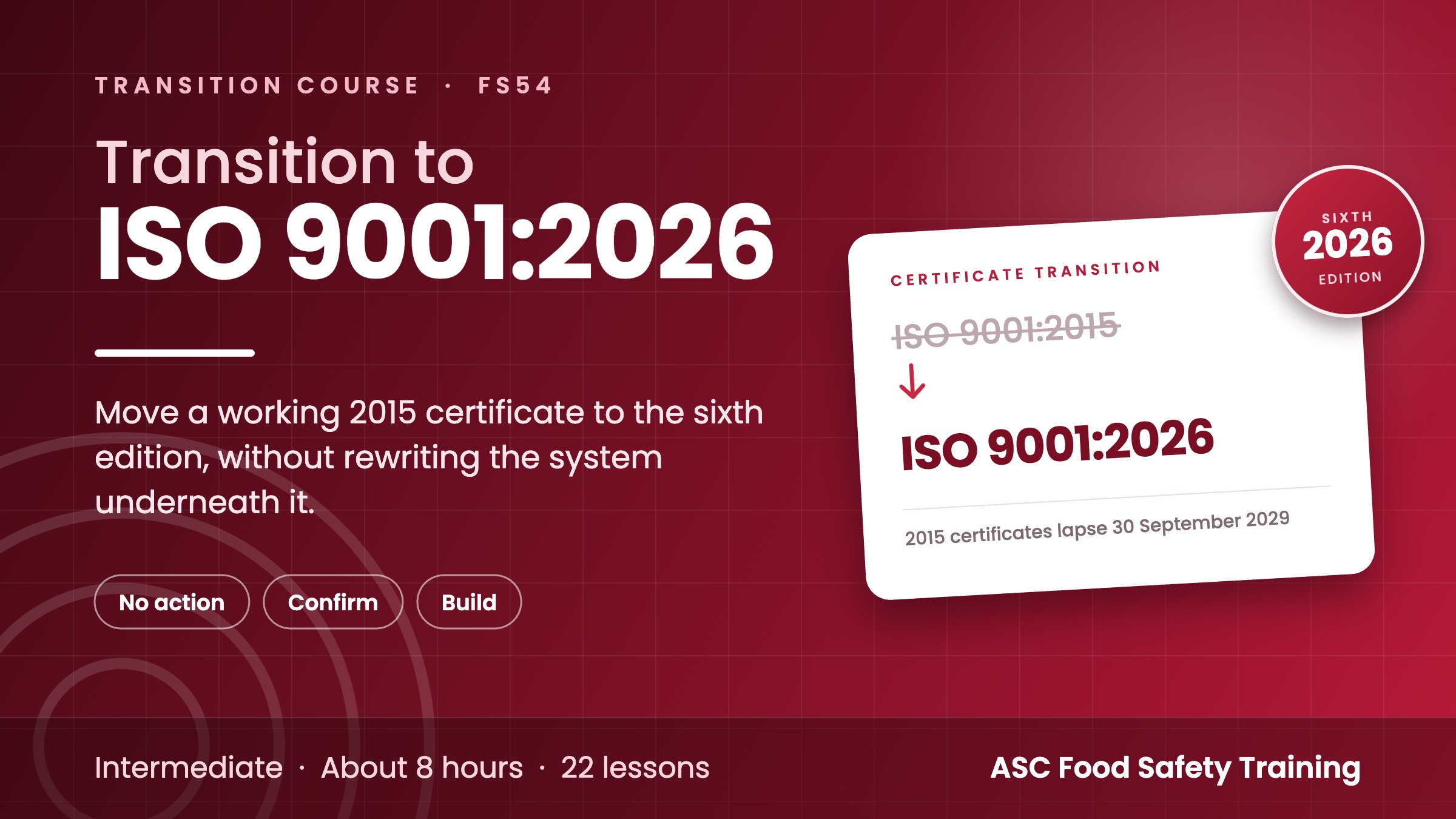
Your certificate says ISO 9001:2015. The standard it was issued against no longer exists. ISO 9001:2026 was published on 16 September 2026, it cancels and replaces the 2015 edition, and it incorporates Amendment 1:2024, the climate change amendment. The IAF transition period is three years from publication, so ISO 9001:2015 certificates are expected to remain valid until 30 September 2029, after which they lapse. Your own certification body has a date inside that window, and it is earlier than you think.
This course is for the person who has to move a working certificate onto the new edition without breaking the system underneath it. It assumes you already run a quality management system. It does not teach you what a process card is, how to write a context analysis or how to build a risk register from nothing. Those are the other two ASC courses.
Eight hours, twenty two lessons, four modules and one interactive tool. You will finish with a delta check of your own system, an evidence position on every line, a transition action plan with owners and dates, and a readiness score you can show your steering meeting.
The honest message of this course
Most of a good 2015 system carries over untouched. The transition is a short list of real builds and a longer list of confirmations, and a consultant who tells you to rewrite your manual is selling you work you do not need.
Every change between the editions is sorted into one of three buckets, and the same three words run through every lesson, the game and the tool.
| Bucket | What it means | Lines on the delta map |
|---|---|---|
| No action | The 2026 text says the same thing in different words, or the change is editorial. Confirm and move on. | 17 |
| Confirm | The requirement existed and you probably already meet it, but the 2026 wording sharpens it. Go and look at your evidence before the auditor does. | 11 |
| Build | There is something to create, split, rewrite or record that does not exist today. | 11 |
What this course is, and what it is not
It is a transition course for a certified site. It covers what was published and what the dates oblige you to do, the six foreword changes and four things people wrongly call new, a complete delta map of clauses 4 to 10, the real builds (the opportunity register under 6.1.3, the rebuilt change record under 6.3, climate change under 4.1, quality culture under 5.1.1 i) and 7.3 e), and the split of risks from opportunities), what to reissue and what to leave alone, who actually needs retraining, and how to prove the transition through one internal audit, one management review and the certification body visit.
It is not an implementation course and it is not an awareness course. It does not build a system from nothing and it does not teach the clauses from first principles. It is not a lead auditor qualification, and it does not certify your organisation. Only an accredited certification body can do that.
Who it is for
- QA and quality managers at a site that holds an ISO 9001:2015 certificate and has to move it.
- QMS coordinators and management representatives who own the transition project.
- Internal auditors who have to audit against a standard that changed under them.
- Consultants advising certified clients on the sixth edition.
- Process owners who will be asked, at the next audit, what changed in their area.
If your site is not certified and a customer has just asked for ISO 9001, you want ISO 9001:2026 Understanding and Implementation, R4800, about 24 hours. If you need everyone on site to understand the standard rather than run the project, that is Introduction to ISO 9001:2026, R1495, about 6 hours.
What you will be able to do
- Say what the transition dates oblige your site to do, and work backwards from your own certification body’s audit date to a dated plan.
- Sort every change between the editions into no action, confirm or build, and defend the sort.
- Split a combined risks and opportunities register into 6.1.2 and 6.1.3 without losing the history.
- Rebuild a change record so it answers every consideration 6.3 lists.
- Record the climate change determination under 4.1 and defend it, whichever way it went.
- Show quality culture and ethical behaviour from records you already keep, without inventing a programme.
- Triage a document set so that you reissue what must change and leave the rest alone.
- Run one transition internal audit and one management review that close the project on the record.
- Brief your certification body, and answer a nonconformity raised against a new requirement.
The interactive tool
The ISO 9001:2026 Transition Planner runs inside the course and on its own page. It has four tabs and it works on a phone.
| Tab | What it does |
|---|---|
| 1. Delta check | All 39 lines of the delta map, each with a suggested bucket you can override for your own system, and a note. |
| 2. Gap and evidence | Every line you marked confirm or build flows through automatically. What evidence exists today, what is missing, and a status of in place, partial or missing. |
| 3. Action plan | One action line per build and per partial or missing confirm, with owner, effort in hours, dependency and target date. Impossible dates are caught as you type. |
| 4. Readiness and export | A readiness percentage, a review gate that names exactly what is still missing, and an export of the whole plan to a spreadsheet. |
Your work is saved on your own device and nothing leaves it until you press Export. Load the case study numbers to see a worked transition before you start your own.
What is inside
Four modules, 22 lessons, 330 minutes of lesson time, plus four knowledge checks, a sorting game and the final assessment. About eight hours in total. Every lesson carries a worked example on the case site, at least one template you can copy, and a task that puts something on your plan.
Module 1: The sixth edition, and what it obliges you to do (90 minutes)
| Lesson | Minutes |
|---|---|
| 1.1 What was published, what it replaces, and what the dates actually oblige you to do | 15 |
| 1.2 Reading the foreword change list like an auditor | 15 |
| 1.3 The delta map: every change sorted into no action, confirm and build | 15 |
| 1.4 Running the delta check on your own system, with the Transition Planner | 15 |
| 1.5 Scoping the transition project: people, hours, sequence and what it costs you in time | 15 |
| 1.6 The two big builds: why 6.1.3 and 6.3 take the most work | 15 |
| Knowledge check | included |
Module 2: The builds, clause by clause (90 minutes)
| Lesson | Minutes |
|---|---|
| 2.1 Clause 3 terms and Annex A: what informative means for your documents | 15 |
| 2.2 Climate change under 4.1 and the 4.2 note: the decision, the record and the review | 15 |
| 2.3 Splitting risks and opportunities: 6.1.2 and 6.1.3 without losing your history | 15 |
| 2.4 Management of change under 6.3: rebuilding the change record | 15 |
| 2.5 Quality culture and ethical behaviour: 5.1.1 i), the 5.1.1 note, 7.1.4 and 7.3 e) | 15 |
| 2.6 The smaller deltas, worked in one session | 15 |
| Knowledge check | included |
Module 3: Updating the system people actually use (75 minutes)
| Lesson | Minutes |
|---|---|
| 3.1 Documented information: what to reissue, what to leave alone, and the version trap | 15 |
| 3.2 Updating the policy, the objectives and the process cards without a rewrite | 15 |
| 3.3 Retraining and awareness: who needs to know what, and the evidence under 7.2 and 7.3 | 15 |
| 3.4 Communicating the transition to top management, process owners, the floor and customers | 15 |
| 3.5 Building the transition action plan and owning the dates | 15 |
| Knowledge check | included |
Module 4: Proving the transition (75 minutes)
| Lesson | Minutes |
|---|---|
| 4.1 The transition internal audit: planning one audit against the new text | 15 |
| 4.2 Auditing the new requirements: what evidence satisfies each, and what does not | 15 |
| 4.3 The management review that closes the transition (9.3) | 15 |
| 4.4 The certification body visit: what to ask for, the briefing pack, what the auditor will sample | 15 |
| 4.5 The readiness review, the remaining risks, and what you hand over | 15 |
| Knowledge check | included |
The case site
Every lesson works on Mzansi Fresh Meals, a chilled ready meals site in Kempton Park, Gauteng. It is a training scenario built from real audit patterns and no real company, retailer or certification body is named. For this course the site already holds an ISO 9001:2015 certificate, so you see a real transition rather than a build. The data is fixed, so your answer can be compared with the model answer line by line. Twenty two case packs run through the course, each with tasks, the facts you need and a model answer.
Assessment and certificate
- A knowledge check after every module: 15 questions drawn at random from a bank of 24, covering every lesson in that module.
- A sorting game, No action, confirm or build?, that drills the delta sort on 14 situations.
- A final assessment: 30 questions drawn from a bank of 60, covering every module.
- 70 percent to pass, three attempts on everything, and every question carries a written explanation.
- An ASC Certificate of Achievement with QR verification, carrying the document code FS54, released once every assessment is passed and a short course review is submitted.
The final assessment on this course is not video proctored.
Questions people ask
How long do I actually have?
ISO 9001:2026 was published on 16 September 2026. The IAF transition period is three years from publication, so ISO 9001:2015 certificates are expected to remain valid until 30 September 2029, after which they lapse. That is the outer wall, not your date. Certification bodies stop conducting initial certifications to the 2015 edition some time before that and publish their own timetables inside the IAF window, so confirm the exact cut-off dates with your own certification body. Module 1 Lesson 1 gives you the three questions to ask them.
Do I need the Implementation course as well?
No, if your system is working and you only have to move it to the new edition. The Implementation course builds a system clause by clause for a site that does not have one. This course starts from the system you already run.
Will this course rewrite my quality manual?
No, and neither will the standard. Neither the 2026 edition nor the 2015 edition requires a quality manual, six documented procedures or a management representative. Annex A says the clause structure is not a documentation model, and Annex A is informative: it clarifies, it adds no requirements. If you keep a manual because it suits you, the course shows you the smallest honest edit.
Does this apply outside food?
Yes. ISO 9001 applies to any organisation of any size in any sector. The case site is a food manufacturer because that is where these practitioners work, but the clauses, the deltas and the auditor’s questions are sector neutral.
Can we put the whole quality team through it?
Prices are in rand with a currency converter on the page. For teams of five or more, contact ASC for a group arrangement. Module 3 Lesson 3 covers who at your site actually needs retraining on the new edition, which is usually fewer people than you expect.
About ASC
ASC Food Safety Consultants write and review every course in this catalogue. The practitioners who wrote this one implement and audit management systems on South African sites, and every clause reference was checked against the published text of the standard before the course went live. Each course is reviewed by a panel of ASC practitioners.
ISO 9001:2026 is a standard published by ISO. This course is an independent training product and is not approved or endorsed by ISO or by any certification body.
Course Content
Module 1: The sixth edition, and what it obliges you to do
-
Lesson 1.1: What was published, what it replaces, and what the dates actually oblige you to do
-
Lesson 1.2: Reading the foreword change list like an auditor
-
Lesson 1.3: The delta map: every change sorted into no action, confirm and build
-
Lesson 1.4: Running the delta check on your own system, with the Transition Planner
-
Lesson 1.5: Scoping the transition project: people, hours, sequence and what it costs you in time
-
Lesson 1.6: The two big builds: why 6.1.3 and 6.3 take the most work
-
Module 1 knowledge check
-
No action, confirm or build?
Module 2: The builds, clause by clause
Module 3: Updating the system people actually use
Module 4: Proving the transition
Student Ratings & Reviews
