
Home / Guides / Legionella in cooling towers
Legionella · Cooling towers · Evaporative condensers
Key facts
- Dip slides weekly, target 10 000 cfu/mL or less
- Legionella at least quarterly, target 100 cfu/L or less
- More than 1 000 cfu/L immediate action, resample within 48 hours
- Drift modern eliminators keep it below 0.01 percent of flow
- Idle more than a few days dose and circulate at least weekly
- Shutdown a month or more clean and disinfect before restart
- US outbreaks 2000 to 2014 cooling towers were the source in 22 percent
- The duty stays with the employer, not the contractor
Know what your water treatment contractor should be doing
Legionella Responsible Person Training covers cooling towers and evaporative condensers in depth, the monitoring schedule, the action bands, and how to read and challenge a contractor’s service report. Ten hours, online, R2 950.
Why are cooling towers behind the biggest Legionella outbreaks?
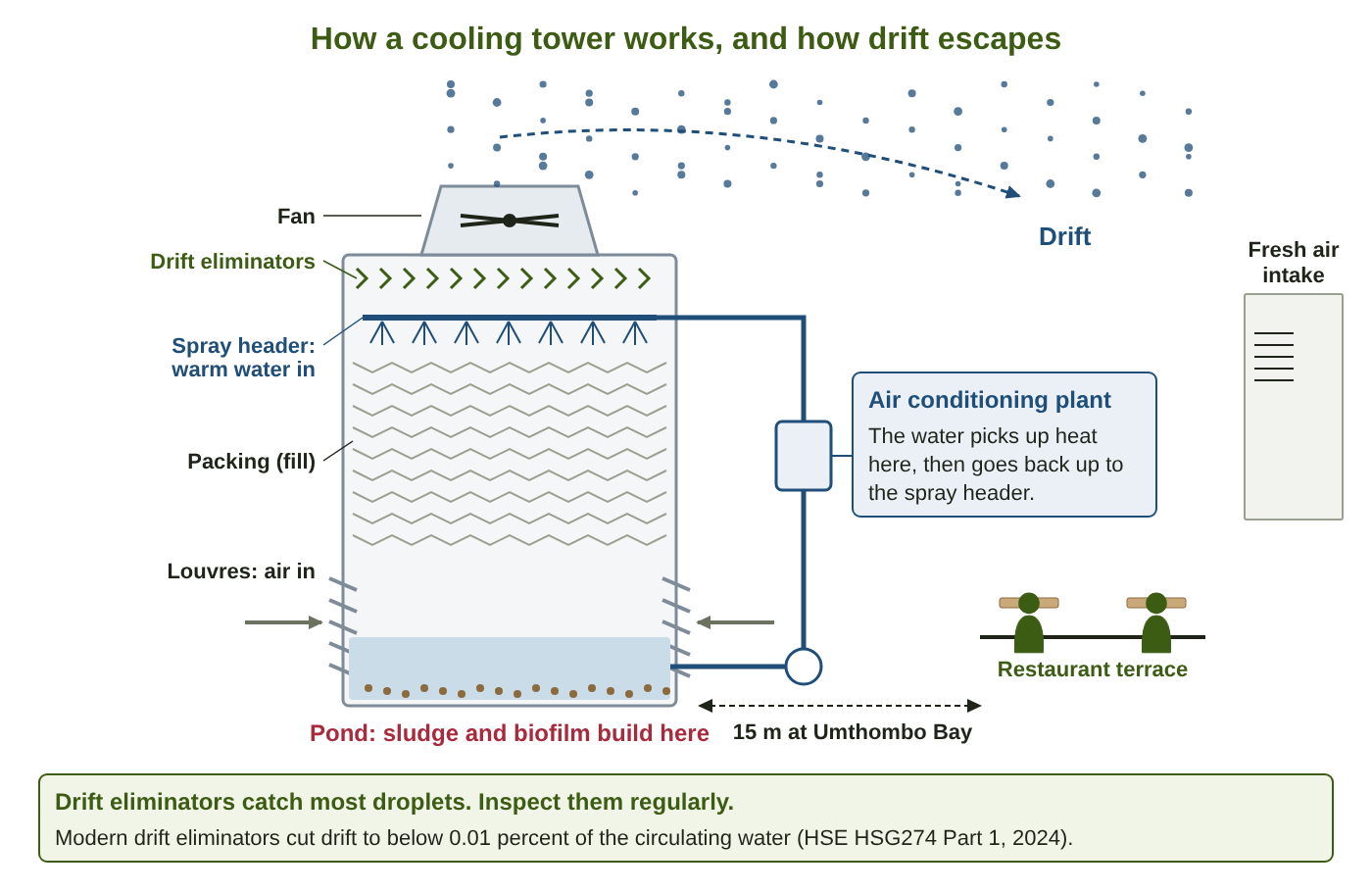
A cooling tower cools water by evaporation. Warm water from the plant is sprayed over packing while a fan pulls air through. The water sits warm, it collects dust and organic matter from the air, and the pond at the bottom builds sludge and biofilm. Then the fan throws droplets out of the top, and the wind carries them across a car park, a terrace, a street or into a building’s fresh air intake.
That is why HSE says a tower should ideally not be sited near air conditioning or ventilation inlets, or near windows that open. Where it already is, the risk assessment says so, the drift eliminators get more attention, and the people downwind are counted when the consequence is rated.
| Outbreak | Cases | Deaths | Source |
|---|---|---|---|
| Murcia, Spain, 2001 | 449 confirmed (over 800 suspected) | 6 | Hospital cooling towers |
| Edinburgh, UK, 2012 | 56 confirmed | 4 | Most likely industrial wet cooling towers |
| Quebec City, Canada, 2012 | 181 | 13 | A downtown cooling tower |
| Vila Franca de Xira, Portugal, 2014 | 403 | 14 | Industrial wet cooling systems |
| South Bronx, New York, 2015 | 138 | 16 | A hotel rooftop cooling tower |
Across the 27 outbreaks the CDC investigated in the USA from 2000 to 2014, cooling towers were the source in six (22 percent). After Quebec City, the public health director recommended a cooling tower registry with mandatory maintenance and monitoring. After the South Bronx, New York City passed a law requiring cooling tower registration, maintenance, inspection and Legionella testing. We found no equivalent register in South Africa, so control sits with the site.
Where are cooling towers and evaporative condensers found on South African sites?
- Hotels, offices and shopping centres: rooftop towers serving the air conditioning, often a few metres from terraces, windows and air intakes.
- Hospitals: large air conditioning loads, with the most susceptible people in the country next door.
- Food and beverage plants: evaporative condensers on ammonia refrigeration, and process cooling towers on pasteurisers, retorts and compressors. Many sit upwind of a canteen or a change room. See Legionella in the food industry.
- Industry and mining: process cooling at scale.
An evaporative condenser works on the same principle as a cooling tower, except the water is sprayed over a coil carrying the refrigerant, usually ammonia on dairies and meat plants. For Legionella control, treat it exactly like a cooling tower.
What is drift, and what do drift eliminators do?
Drift is the water carried out of the tower as droplets, not the evaporated vapour. Drift eliminators are rows of shaped blades under the fan that catch most droplets before they leave. The UK’s 2024 technical guidance says modern drift eliminators should cut drift to below 0.01 percent of the water circulating through the tower, and that they need regular inspection.
On site I find eliminators that have never been looked at since installation: blades cracked, sections lifted out during a repair and never refitted, gaps at the edges. A tower with poor eliminators is broadcasting whatever is in its pond.
Free tool: walk your cooling tower and the rest of the site
The free Legionella Water Walk includes the cooling tower and evaporative condenser checks: dip slides, sampling, eliminators, siting and the contractor’s written scheme. It ranks what it finds and exports the list.
Try the free Water Walk, then learn to act on what it finds in Legionella Awareness Training (R799).
What monitoring does a cooling tower need?
| Check | How often | Limit or target |
|---|---|---|
| Operational checks and water appearance | Daily | Running normally, water clear, no slime or algae |
| Physical condition, dip slides | Weekly | Aerobic count 10 000 cfu/mL or less (incubated at 30 °C for at least 48 hours) |
| Control functions and distribution condition | Every one to three months | Dosing, bleed and controls working |
| Legionella sample to an accredited laboratory | At least quarterly | Not detected or 100 cfu/L or less |
| Contractor’s service report read against the scheme | Every visit | Every scheduled check done and in limit |
Water treatment itself (biocide, scale and corrosion control, bleed) is specialist work and the products and doses belong in the contractor’s written scheme. Your job as the site is to make sure the scheme exists, that it is followed, and that the numbers in it are being met.
Your contractor’s report says “Dip slide OK”. Is it?
The Responsible Person course works through a hotel tower with no Legionella sample in 18 months and eliminators nobody has inspected. You set the monitoring, read the results against current bands and write the contractor’s scope. Ten hours, online, R2 950.
What Legionella level in a cooling tower needs action?
Dip slides (aerobic count). 10 000 cfu/mL or less: under control. More than 10 000 up to 100 000: review the programme, confirm the treatment is working, adjust the biocide and resample after 24 hours. More than 100 000: corrective action, a shot dose or raised dosing per the written scheme, resample after 24 hours, and if counts stay high, find the cause instead of dosing again and again.
Legionella. 100 cfu/L or less: keep the controls in place. More than 100 up to 1 000: review the control programme, check aerobic counts and treatment, resample to confirm and again to check the corrective action worked. More than 1 000, or repeated lower positives: immediate action. Resample promptly, shot dose or raise the dosing as a precaution, review the whole programme, take corrective action and resample within 48 hours. Revisit the risk assessment if high counts persist.
Be careful with the older South African numbers. The WRC’s 2003 code treats cooling water below 10 000 Legionella per litre as acceptable. A contractor quoting that code can call 1 200 cfu/L acceptable while current guidance puts it in the immediate action band. Write the current bands into your water management plan and the contractor’s scope. How sampling is done, and how every band reads, is in Legionella testing in South Africa.
What should happen when a cooling tower is shut down or restarted?
- Before first commissioning: clean and disinfect.
- Standing idle more than a few days: dose with biocide and circulate at least once a week.
- Shut down for a month or more: clean and disinfect before it restarts. In healthcare, after more than five days.
- Altered, fouled or contaminated: clean and disinfect after any physical change to the tower or cooling system, such as new pumps, pipework or heat exchangers, and whenever it is known or suspected to be fouled, for example by process contamination, nearby construction work or rising make-up water turbidity.
- Routine cleaning: HSE gives typical intervals and calls them not prescriptive: at least every three months for a tower in a dirty environment, at least twice a year for air conditioning comfort cooling, and at least every 12 months for a clean industrial application. Your written scheme sets the interval for your tower.
- Annual maintenance shutdowns: the December shutdown at a food plant is exactly when a tower or condenser sits warm and stagnant. Put the restart steps in the shutdown plan, not in someone’s memory.
Cleaning a cooling tower is aerosol-generating work. It is done by trained people with suitable respiratory protection, photographed before and after, and recorded.
How do you manage your water treatment contractor?
Most sites rightly use a specialist. What they get wrong is assuming the contract moves the duty. Section 37 of the OHS Act presumes the employer liable for the acts and omissions of its employees and mandataries, such as contractors, unless it proves all three of these: it did not connive at or permit the act, the act was outside the person’s authority, and it took all reasonable steps to prevent it. A written instruction is not enough proof on its own. A written agreement with a mandatary under section 37(2) removes that presumption for the mandatary’s acts, but not the employer’s own duties under sections 8 and 9, or the HBA Regulations’ requirement for a risk assessment, monitoring and records. Who answers for what is set out in who is responsible for Legionella.
Five things to check on every service report:
- Was every scheduled check done, on the date it was due?
- Are the dip slide results recorded with dates, and what happened when one exceeded 10 000 cfu/mL?
- When was the last Legionella sample, and was the result read against current bands?
- Were the drift eliminators inspected, and is there a photograph?
- Is the dosing equipment working and is product in stock?
Awareness Training for your team (R799) →Start the Responsible Person course (R2 950) →
Related guides: the Legionella water management plan template, Legionella testing in South Africa, Legionella in the food industry and Legionnaires’ disease in South Africa.
Frequently asked questions
How often should a cooling tower be tested for Legionella?
At least quarterly, by an accredited laboratory, with dip slides for general microbial activity every week and operational checks every day.
What Legionella level in a cooling tower needs action?
Above 100 cfu/L, review the programme and resample. Above 1 000 cfu/L, take immediate action: resample promptly, shot dose or raise dosing, review the whole programme and resample within 48 hours.
What is an acceptable dip slide count?
10 000 cfu/mL or less. Between 10 000 and 100 000, review the treatment and resample after 24 hours. Above 100 000, take corrective action and find the cause if counts stay high.
Does an evaporative condenser carry the same Legionella risk as a cooling tower?
Yes. It sprays recirculating water over a refrigerant coil and throws drift in the same way, so it is monitored and controlled like a cooling tower.
What happens if the cooling tower is shut down?
If it stands idle more than a few days, dose and circulate at least weekly. After a shutdown of a month or more, clean and disinfect before restarting. In healthcare, after more than five days.
Can we hand Legionella control to our water treatment contractor?
You can hand over the work, not the duty. The employer keeps its duties under the OHS Act and the HBA Regulations, so someone on site must read the contractor’s reports against the written scheme and act on them.
What do drift eliminators do?
They catch droplets before they leave the tower. Modern eliminators should keep drift below 0.01 percent of the circulating water flow, and they must be inspected regularly.
Take control of the tower on your roof
Cooling towers, evaporative condensers, hot and cold water and the other risk systems, the risk assessment, the water management plan, sampling, results and incident response, all built on South African law.
Start the Responsible Person course (R2 950) →Awareness Training for your team (R799)Self-paced, works on a phone. HPCSA CPD accredited. Certificate on passing.