
Home / Guides / Legionella testing
Legionella · Sampling · Reading laboratory results
Key facts
- Daily control temperature and flow, not sampling
- Open systems cooling towers and condensers at least quarterly, hotel hot tubs and spa pools monthly (GN 7779)
- Cooling towers dip slides weekly
- Laboratory SANAS-accredited, ISO 11731, detection limit 100 cfu/L or lower (10 cfu/L or lower for spa water)
- Sample 1 litre sterile bottle plus a biofilm swab, temperature recorded
- Hot and cold water more than 1 000 cfu/L: act immediately
- Healthcare any detection triggers action
- qPCR fast, but does not show whether the bacteria are alive
Learn to plan the sampling and read the report yourself
Module 5 of Legionella Responsible Person Training covers when, where and how to sample, choosing a laboratory, culture versus qPCR, every action band, and a worked reading of a training hotel’s laboratory results, built from real audit patterns. Ten hours, online, R2 950.
Do you need to test for Legionella?
Not always, and that surprises people. The UK’s technical guidance (HSE HSG274 Part 2) says routine microbiological testing of hot and cold water is not usually needed where temperatures or disinfectant levels are consistently achieved. A hot water system that stores at 60 °C, delivers at least 50 °C within one minute and returns at least 50 °C is controlled by its temperatures, and the monthly temperature log is your evidence.
Sampling hot and cold water is indicated:
- where biocides are used or storage and distribution temperatures are reduced,
- where control levels are not being consistently achieved,
- in high-risk areas or where the population is more susceptible, for example hospitals, frail care and clinics,
- where a system is suspected in a case or an outbreak.
Open systems are different. Cooling towers and evaporative condensers should be tested for Legionella at least quarterly, with dip slides for general microbial activity weekly on cooling systems, because they run warm by design and throw aerosol into the air. HSE’s spa guidance asks for quarterly tests on spa pools too, but hotel hot tubs and spa pools go further in South Africa: the National Environmental Health Norms and Standards for Premises and Acceptable Monitoring Standards for Environmental Health Practitioners (GN 7779, 7 August 2026) set Legionella monitoring monthly for hot tubs and three-monthly for public pools, with a limit below 1 per 100 mL where Legionella is tested. That limit is below 10 cfu/L. On cooling towers, see Legionella in cooling towers and evaporative condensers.
Under the HBA Regulations, 2022, a monitoring programme set by a competent person at intervals in the risk assessment is a legal duty (regulation 7). For water systems, that monitoring is temperatures, disinfectant checks and sampling where it is indicated. Where sampling fits in the routine is shown in our water management plan template.
How are Legionella samples taken, and where?
The NICD’s guidance for environmental investigations uses 1 litre water samples in sterile bottles plus biofilm swabs, with the water temperature recorded at the point of sampling. That is a good default for routine work too.
- Plan the points before you go. The furthest outlet on each loop, the calorifier drain, a shower in a high-risk area, outlets in areas closed or rarely used, the cooling tower pond. Mark them on a schematic.
- Decide what each sample must tell you. A sample taken the moment a tap is opened tells you about the outlet and the last length of pipe. A sample taken after the water has run tells you about the water in the system behind it. Label which one you took.
- Record the temperature as you sample, and the time.
- Neutralise any biocide in the sample where possible, so the chemical does not keep killing bacteria on the way to the laboratory and give you a falsely low count. The laboratory supplies the right bottles.
- Keep a chain of custody. Who took it, when, how it was kept, when it reached the laboratory.
Free tool: the results reader
Step 6 of the free Legionella Risk Assessment and Water Management Plan Builder reads a result against the HSE action bands for hot and cold water, cooling towers, spa pools and healthcare, and shows how the older South African code would have read the same number.
The builder gives you the form. Legionella Responsible Person Training (R2 950) teaches the judgement behind every rating and limit.
How do you choose a Legionella testing laboratory in South Africa?
- SANAS accreditation for the method. Ask for the schedule of accreditation and check that Legionella enumeration is on it, not just general water microbiology.
- ISO 11731:2017 is the international culture method for counting Legionella in water and related samples such as biofilm and sediment.
- A detection limit of 100 cfu/L or lower. UK guidance asks for no higher than 100 Legionella per litre. A result of “not detected” means nothing if the limit was 1 000. For spa and hot tub water, ask for 10 cfu/L or lower, because GN 7779 sets the limit below 1 per 100 mL.
- Proficiency testing. The laboratory should take part in a proficiency scheme for the method.
- Identification. Ask for serogroup or species where Legionella is found. It matters for interpretation and for any investigation.
Should you ask for culture or qPCR testing?
| Culture (ISO 11731) | qPCR (ISO/TS 12869) | |
|---|---|---|
| What it measures | Live bacteria that grow on the plate, reported as cfu/L | Legionella DNA, reported as genome units per litre |
| Speed | Days | Fast |
| Strength | The basis of every action band in this guide | A quick screen to rule a system out. HSE's cooling tower guidance is written around culture and does not cover it |
| Limitation | Not every species grows on culture, so some are missed | Does not show whether the bacteria are alive. Some treatment chemicals reduce sensitivity |
For decisions, use culture results against culture-based action levels. If you use qPCR as a screen, agree in advance with your laboratory what a positive screen triggers.
Read the report yourself, not only the contractor’s summary
Module 5 of the Responsible Person course takes you through every band, the older WRC code and the healthcare rule, then has you read the hotel case’s five results and decide the action for each. Ten hours, online, R2 950.
How do you read a Legionella laboratory result?
This is where most South African files go wrong, because there are two sets of numbers in circulation and they are a long way apart.
| System | Result | What to do (HSE HSG274 Parts 1 and 2, HSE HSG282, GN 7779) |
|---|---|---|
| Hot and cold water | Not detected or 100 cfu/L or less | Normal monitoring |
| Hot and cold water | More than 100 up to 1 000 cfu/L, a minority of samples positive | Resample. If similar results return, review controls and the risk assessment |
| Hot and cold water | More than 100 up to 1 000 cfu/L, most samples positive | Possible low-level colonisation: review controls and the risk assessment now and consider disinfection |
| Hot and cold water | More than 1 000 cfu/L | Resample, review controls and the risk assessment now including disinfection, retest a few days after disinfection and then frequently |
| Cooling tower, Legionella | More than 100 up to 1 000 cfu/L | Review the programme, check aerobic counts and treatment, resample to confirm and again after corrective action |
| Cooling tower, Legionella | More than 1 000 cfu/L | Immediate action: resample promptly, shot dose or raise dosing, review the whole programme, resample within 48 hours |
| Cooling tower, dip slide | More than 10 000 cfu/mL | Review treatment, adjust biocide, resample after 24 hours. Above 100 000, corrective dosing |
| Spa pool or hot tub | 10 cfu/L or more (GN 7779 limit: below 1 per 100 mL) | Review the controls and resample, whatever the HSG282 band |
| Spa pool or hot tub | More than 1 000 cfu/L | Close it at once and keep the public out of the area, shut it down, shock dose with 50 mg/L free chlorine circulating for 1 hour or equivalent, drain, clean and disinfect, review the controls and the risk assessment, refill, and retest the next day and 2 to 4 weeks later (HSE HSG282) |
| Healthcare (and frail care, ASC position) | Any detection | Corrective action and immediate control of exposure of vulnerable people (enHealth). See Legionella in hospitals, clinics and frail care |
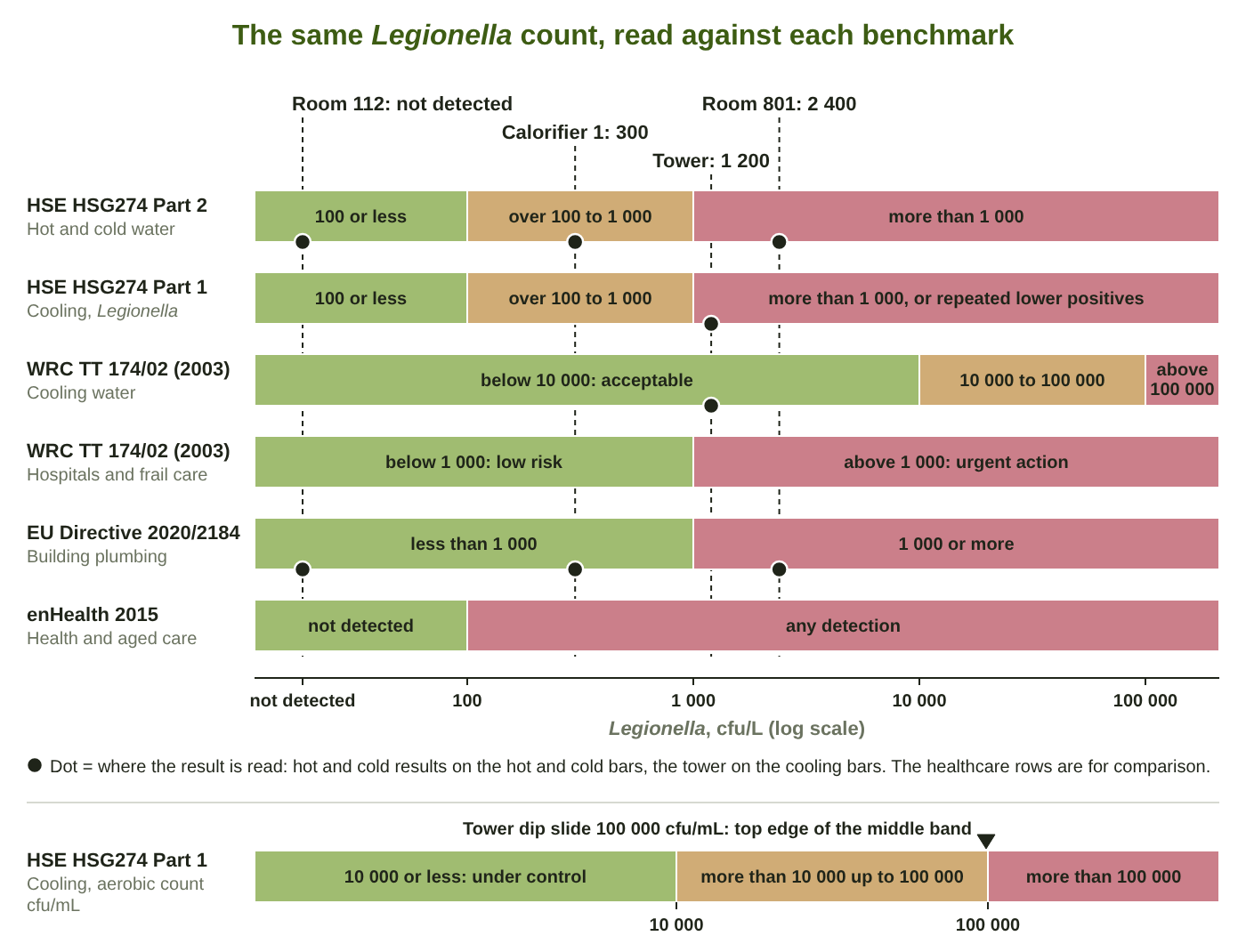
Now compare the older South African code. The Water Research Commission’s 2003 guideline (TT 174/02) treats cooling water below 10 000 Legionella per litre as acceptable and low risk, investigates 10 000 to 100 000, and calls for urgent action only above 100 000. Under that code, a cooling tower at 1 200 cfu/L is “acceptable”. Under current HSE guidance, the same result is in the immediate action band. I set action triggers on the current guidance, and so should you, because the WRC levels are more than twenty years old and much looser. For reference, the EU Drinking Water Directive sets a Legionella parametric value of less than 1 000 cfu/L in building plumbing.
What does a result look like? A worked example
In the hotel case in our Intermediate course, four samples come back. The furthest guest shower on a floor closed for three months, sampled the moment it was opened: 2 400 cfu/L. The calorifier drain: 300 cfu/L. The nearest guest shower: not detected. The rooftop cooling tower: a dip slide of 100 000 cfu/mL and Legionella at 1 200 cfu/L.
Read them properly and the plan writes itself. The closed floor is above 1 000: resample, review and disinfect, and keep it closed to guests until results are satisfactory. Two of the three hot and cold samples are positive, so most are positive: the 300 at the calorifier points to low-level colonisation, and the calorifiers, which were set to 55 °C, go back to 60 °C. The tower’s Legionella is above 1 000: immediate action and a resample within 48 hours, whatever the contractor’s report says about the old code.
What should you do after a positive Legionella result?
- Protect people first. Restrict use of affected outlets and systems while you act.
- Find the cause. A positive result is a symptom: low temperatures, stagnation, a dirty tank, failed dosing. Disinfecting without fixing the cause buys you weeks.
- Disinfect where the band requires it, thermally or chemically, with scald and chemical controls in place.
- Retest a few days after disinfection, then frequently until control is shown.
- Review the risk assessment. A positive result can show the assessment is no longer valid, which triggers a review under regulation 6(6) of the HBA Regulations. ACOP L8 para 47 lists failed checks as a trigger in its own right. See Legionella risk assessment in South Africa.
If someone is ill and your system is suspected, the order changes: people are protected first, but nothing is drained or disinfected until the investigating EHP agrees, so samples can be taken. That process is set out in Legionnaires’ disease in South Africa.
Train the team who take the readings (R799) →Start the Responsible Person course (R2 950) →
Frequently asked questions
How often should you test for Legionella?
Cooling towers and evaporative condensers at least quarterly, and hotel hot tubs and spa pools monthly under GN 7779, with dip slides weekly on cooling systems. Hot and cold water when temperatures or disinfectant levels are not consistently achieved, in high-risk areas such as healthcare, where biocides are used, and whenever a system is suspected in a case.
What is an acceptable Legionella level in water?
In hot and cold water under HSE guidance, not detected or 100 cfu/L or less needs only normal monitoring. Above 100 cfu/L triggers resampling and review, and above 1 000 cfu/L triggers immediate action including disinfection. In healthcare, and in frail care, which ASC treats as healthcare, any detection triggers action. In spa and hot tub water GN 7779 sets the limit below 1 per 100 mL (below 10 cfu/L).
What method should the laboratory use?
Culture to ISO 11731, by a SANAS-accredited laboratory with the method on its schedule of accreditation and a detection limit of 100 cfu/L or lower. qPCR (ISO/TS 12869) is a fast screen but does not show whether the bacteria are alive.
How is a Legionella water sample taken?
The NICD’s guidance uses 1 litre water samples in sterile bottles and biofilm swabs, with the water temperature recorded. Label whether the sample was taken as the outlet was opened or after the water ran, neutralise biocide where possible, and keep a chain of custody.
Is a negative Legionella test proof the system is safe?
No. It is a snapshot of one point on one day. Control is shown by consistent temperatures, flushing records and monitoring over time, with sampling as the check that the controls work.
Is 1 200 cfu/L in a cooling tower acceptable?
Not under current HSE guidance, where more than 1 000 cfu/L in a cooling system calls for immediate action and a resample within 48 hours. The older WRC 2003 code would have called it acceptable, which is why sites should set triggers on current guidance.
Who should read the laboratory report?
The appointed responsible person, not only the contractor who took the sample. The employer keeps the legal duty, so someone on site must read each result against the action bands and record the decision.
Read the next laboratory report with confidence
Sampling, results, disinfection, incident response and a three-sitting workshop on a full hotel case. You finish with a risk assessment and water management plan you can adapt for your own site.
Start the Responsible Person course (R2 950) →Compare both Legionella coursesSelf-paced, works on a phone. HPCSA CPD accredited. Certificate on passing.
Sources and further reading
- HSE: testing and monitoring water systems
- HSE HSG274 Part 2: hot and cold water systems
- HSE HSG274 Part 1: evaporative cooling systems
- ISO 11731:2017 and ISO/TS 12869:2019
- HSE HSG282: spa pools
- National Environmental Health Norms and Standards (GN 7779, 2026)
- WRC TT 174/02 (2003): guidelines for Legionella levels in water
- NICD recommendations for Legionnaires’ disease