
Legionella Awareness Training (Basic): Online Course for Anyone Working with Water Systems
About Course
Most Legionella problems start with an ordinary decision on an ordinary shift: a geyser turned down to save power, a closed floor nobody flushes, a showerhead nobody descales. This four-hour online course teaches the people who make those decisions what to check, what the numbers mean and who to tell. R799, written for South African buildings and South African law.
Legionella Awareness Training (Basic) is a four-hour, self-paced online course from ASC Food Safety Consultants for anyone who works on or near water systems in South Africa. It covers how Legionella grows and spreads, where it hides, what the OHS Act and the HBA Regulations, 2022 require, and the daily temperature, flushing and reporting checks. It costs R799, is HPCSA CPD accredited and ends in a certificate.
- Price: R799, the price you pay (ASC charges no VAT on courses)
- Time: about 4 hours, self-paced, on a phone, tablet or laptop
- Level: Basic Level 1, course code FS70-0101
- Inside: 4 modules, 14 lessons, 4 games, 4 knowledge checks and a 30 question final assessment
- Tool: the Legionella Water Walk, with a findings list you export as a spreadsheet (xlsx)
- Pass mark: 70 percent, three attempts on every test, instant marking
- Accreditation: HPCSA CPD accredited, dated ASC certificate on passing, verifiable online
Enrol in Legionella Awareness Training (R799)
Secure checkout. You are enrolled as soon as payment is confirmed.
Who is this Legionella awareness course for?
Anyone whose work touches water that can turn into spray or mist:
- Maintenance artisans and general hands
- Housekeeping and room attendants
- Spa, pool and gym staff
- Kitchen and cleaning staff
- Plant operators on food and beverage sites
- Care workers in frail care centres and clinics
- Caretakers, estate and building staff
- The supervisors of all of these teams
Many of the people who do these jobs read English as a second language, so the lessons use short sentences and explain every technical word the first time it appears.
If you are the person appointed to manage Legionella on a site, start here and go on to Legionella Responsible Person Training (Intermediate). See both courses side by side on the Legionella training in South Africa page.
What will you walk away with?
- The four conditions model. Legionella becomes a risk when the bacteria are present, the water sits between 20 and 45 °C, it has food and shelter (stagnation, biofilm, scale, sludge) and there is a way out to people as spray. Break any one and the risk falls.
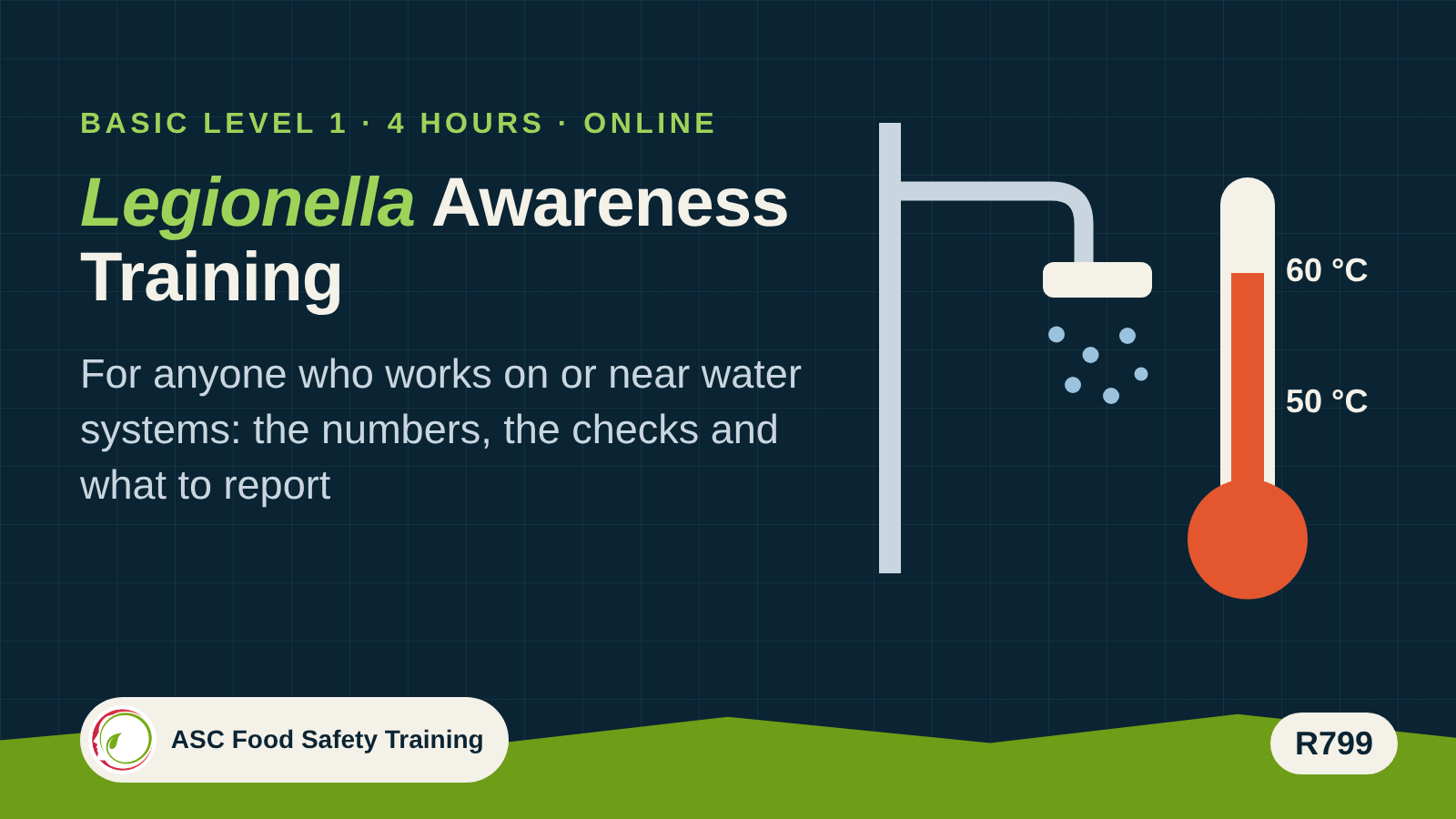
- The temperature numbers that matter. Hot water stored at 60 °C or above and reaching at least 50 °C at the tap within one minute (55 °C in healthcare). Cold water below 20 °C within two minutes.
- How to take a temperature reading properly. Which outlets to test, how long to run them, what to write down, and what to do when a reading fails. Why turning a calorifier or geyser down to save power is a finding, and why thermostatic mixing valves, not lower storage temperatures, are the answer to scalding.
- A flushing and showerhead routine. Weekly flushing of little-used outlets, quarterly cleaning, descaling and disinfecting of showerheads and hoses, tank checks, and what must happen before a closed floor or a system is used again. All done without spraying yourself.
- What to report, and to whom. Failed temperatures, slime and debris in tanks, drift from a cooling tower, outlets nobody uses, and a guest or colleague with pneumonia symptoms.
- The Legionella Water Walk. A 24-point checklist in six groups (hot water, cold water, outlets, cooling towers and evaporative condensers, other risk systems, records). Answer each point, and it ranks what you found High, Medium or Low and exports the findings list as a spreadsheet (xlsx).
The Water Walk is free to try on its own at the Legionella Water Walk page. Try it, then learn in the course what each finding means and what to do about it.
What does the Legionella awareness course cover?
- Module 1: What Legionella is and why it matters. Legionnaires’ disease and Pontiac fever, how Legionella reaches the lungs, who is most at risk, and the four conditions.
- Module 2: Where Legionella hides in your workplace. Geysers, calorifiers, roof and JoJo tanks, cooling towers, spa pools, misters and eyewash stations, then a hotel, a food plant and a care centre.
- Module 3: The law and your part in it. The OHS Act, the HBA Regulations, 2022, SANS 893, who does what, and how the rest of the world does it.
- Module 4: The everyday controls you carry out. Temperature checks, flushing, showerheads, tanks, restarting after a shutdown, records, protecting yourself and your first water walk.
Three case sites run through the lessons: a 140-room beachfront hotel with a spa and a rooftop cooling tower, a dairy with an ammonia plant, and a 90-bed frail care centre. They are training scenarios built from real audit patterns, and every on-site task has a case version for anyone without a site to hand.
How is the Legionella awareness course assessed?
Each module has a short game in the middle (True or myth, Risk or no risk, Whose job is it, Pass or fail the reading) and a knowledge check at the end. The final assessment is 30 questions. The pass mark is 70 percent, you get three attempts on every test, and the games are unlimited. Marking and feedback are instant, so nobody waits for a trainer. The final assessment is video proctored, so use a phone, tablet or computer with a working camera and allow camera access when asked. Your certificate is issued when you pass, dated and verifiable online.
Enrol in Legionella Awareness Training (R799)
Four hours, on your phone, between jobs.
How much does Legionella awareness training cost?
R799 per person, and that is what you pay: ASC charges no VAT on courses. A currency converter on the site shows the price in US dollars, euros, pounds and other currencies beside the rand.
Set it against a classroom day: the fee, the travel, perhaps a night away, and the shift someone else covers while your artisan sits in a training room. This course takes four hours on a phone, with no travel at all.
Then set it against a case. Of the legionellosis cases notified in South Africa from January 2018 to September 2020, 98.8 percent were admitted to hospital, and 15 of the 74 with a known outcome died (NICD). Where an employer negligently causes an injury (conduct that would have been culpable homicide had the person died), section 38(2) of the OHS Act allows a fine of up to R100 000 or two years’ imprisonment, or both. Next to either, R799 a head is a small line in the budget.
Buying for a team? Ask for a team quote on WhatsApp.
Straight answers before you buy
Is it accredited?
Yes. The course is HPCSA CPD accredited, it is written for South African law, and you receive an ASC certificate when you pass.
Isn’t this just UK content?
No. It is built on the OHS Act, the HBA Regulations, 2022 and NICD guidance, and on South African buildings: geysers on timers, heat pumps set low, JoJo tanks filled after outages, the ammonia plant on a dairy, assisted showers in frail care. The UK HSE guidance (ACOP L8 and HSG274), ASHRAE 188, the CDC and WHO appear as benchmarks, because hotel groups and export customers audit against them.
Can an online course make someone competent?
Not on its own, and we will not pretend otherwise. The HBA Regulations, 2022 ask for training in theory and practice. The course gives your people the knowledge, the method and the checklist, and its on-site tasks have them practise on your own taps, showers and tanks. Competence comes from doing those checks on site. A supervised Water Walk of your building, filed with the certificate, gives you the practical record. Regulation 4 also asks for training on your own site’s controls, safe work and emergency procedures, so add a short site induction and keep its record with the certificate.
We already pay a water treatment company. Why train our own staff?
Because the duty stays with the employer. Sections 8 and 9 of the OHS Act make the employer responsible for employees and for guests, residents and visitors, and section 16 places that on the chief executive. The contractor visits. Your staff run the taps, showers and geysers every day, and they are the first to see a reading fail.
We can’t spare people for a training day.
You don’t have to. Four hours, self-paced, on a phone, in lessons of 8 to 12 minutes. No travel, no venue, no shift to cover.
How long is the certificate valid? Do we need refreshers?
The HBA Regulations, 2022 require training before anyone may be exposed (regulation 4(3)) and refresher training every year, or at intervals your health and safety committee or representative recommends (regulation 4(4)). Your certificate is dated, so your training file shows when each refresher is due.
Will it fit my sector?
The hotel, the dairy and the frail care centre run through every module, so hospitality, food and beverage, and healthcare teams all see their own plant rooms, showers and spray systems.
What if I fail?
Every test allows three attempts at 70 percent, with instant feedback, and the games are unlimited, so you can practise until the answers stick. If you use all three attempts, a reassessment costs R250. Course fees are not refundable.
Do I have to buy SANS 893?
No. SANS 893 Parts 1 and 2 are a voluntary national standard, and the course explains what each part covers in ASC’s own words. The person your site appoints to manage Legionella should still hold a licensed copy.
Who wrote the course?
Mthokozisi Nkosi, founder of ASC Food Safety Consultants. He is completing a PhD in Public Health, holds an MSc in International Public Health, is an FSSC 22000 and BRCGS lead auditor and a registered lead auditor with Exemplar Global and IRCA, and advises national hotel, restaurant and food brands. ASC’s clients include KFC and Spur.
ASC has offices in Gqeberha, Johannesburg and Cape Town, 3 600+ course enrolments and 366+ Google reviews across those three offices, and was named Nelson Mandela Bay Business Chamber Entrepreneur of the Year 2022.
Read before you start
Two free guides from the same team: Legionella and hot water temperature in South African buildings and Legionella prevention in hotels, lodges and guesthouses.
Enrol in Legionella Awareness Training (R799)
HPCSA CPD accredited. Certificate on passing.
Frequently asked questions
How long does Legionella awareness training take?
About four hours: 148 minutes of lessons in short sections of 8 to 12 minutes, plus the games, knowledge checks, a two-minute briefing and the final assessment. It is self-paced, so you can finish in one sitting or spread it over a few days.
Is Legionella awareness training a legal requirement in South Africa?
For anyone who may be exposed, yes. The HBA Regulations, 2022 list Legionella spp. as a Risk Group 2 hazardous biological agent and apply wherever exposure may occur, which is how most competent persons bring water systems into scope. Regulation 4 then requires training before exposure, with a refresher every year or at intervals the health and safety committee or representative recommends (regulation 4(4)). The law does not name a course. This one covers the health risks, the controls, safe ways of working and what to report, and gives you a dated certificate for the training file.
Which temperatures does the course teach?
The numbers your checks are judged against: hot water stored at 60 °C or above, at least 50 °C at the tap within one minute (55 °C in healthcare), and cold water below 20 °C within two minutes. Why those numbers, and how fast heat kills Legionella, is in our guide to Legionella and hot water temperature.
Can I do the course on my phone?
Yes. Every lesson, game and test works on a phone, and you can use the Water Walk on your phone as you walk your own site. A tablet or laptop works just as well.
What do I get when I pass?
A dated ASC certificate for your training file, which anyone can verify online, and the Water Walk findings list for your own site, exported as a spreadsheet you can hand to your supervisor or responsible person.
What is the difference between the Basic and Intermediate Legionella courses?
Basic (4 hours, R799) is for the people who run the water every day and do the checks. Intermediate (10 hours, R2 950) is for the person appointed to manage Legionella on a site: the risk assessment, the water management plan, sampling, laboratory results and the water treatment contractor.
Do I need any training or equipment before I start?
No. The course starts from what Legionella is and explains every technical word the first time it appears. A probe thermometer at work helps with the on-site tasks, and every task also has a case study version, so you can finish the course without one.
What happens after I pay?
Once payment is confirmed you are enrolled, and the course appears under Enrolled Courses in your dashboard. Work through it at your own pace. When you pass, your dated certificate is issued, and anyone can check it on the site’s certificate verification page.
How long do I keep access?
For as long as ASC offers the course. There is no expiry date, so you can come back to the lessons and the tools whenever you need them.
Can I buy the course for my whole team?
Yes. Each person needs their own seat so that each gets their own certificate. Send us a WhatsApp for a team quote and tell us how many seats you need.
Where to go next
The person who manages Legionella on your site takes Legionella Responsible Person Training (Intermediate), R2 950, and can try the free Risk Assessment and Water Management Plan Builder first. Compare both courses on the Legionella training hub. Hospitality teams often pair this course with Guesthouse Support Staff Essentials and Chemical Safety for Housekeeping and Laundry. See all ASC courses.
Course Content
Module 1: What Legionella is and why it matters
-
Lesson 1.1: A water bacterium that kills people
-
Lesson 1.2: How it gets into the lungs, and who is most at risk
-
Game 1: True or myth?
-
Lesson 1.3: What Legionella needs to grow: the four conditions
-
Knowledge check 1
Module 2: Where Legionella hides in your workplace
Module 3: The law and your part in it
Module 4: The everyday controls you carry out
Final assessment and certificate
Student Ratings & Reviews
