
Home / Guides / Legionella flushing and showerhead cleaning
Legionella · Flushing · Showerheads · Log sheet
Key facts
- Little-used outlets flush weekly, for several minutes
- Showerheads and hoses clean, descale, disinfect quarterly
- Emergency showers and eyebaths flush to drain at least six-monthly
- How much three to five times the stagnant volume
- Eyewash heads and nozzles clean quarterly
- Descaler plus bleach releases chlorine gas: never mix
- Compressed air prohibited, HBA Regulations reg 13
- New systems flush and disinfect before first use
Teach your team to flush safely and write it down
Legionella Awareness Training gives housekeeping and maintenance staff the flushing and showerhead routine, the temperature numbers, how to take a reading properly, and what to report and to whom. Four hours on a phone, R799 a person.
What is a little-used outlet?
A tap, shower or other outlet that is not used at least once a week. Guest rooms nobody books, a closed wing or floor, the conference centre shower room, visitor showers, empty rooms in frail care, a spare basin in a plant room, and the eyewash station nobody touches.
Water standing in the pipe behind that outlet drifts into the growth range, loses its disinfectant and feeds biofilm, the slime layer inside pipes. HSE’s HSG274 Part 2 names dead legs, capped pipes and little-used outlets as risk areas. Then someone opens the tap or stands under the shower and breathes the first spray.
The best flush is the one you never need. If an outlet has no use, remove it and cut the pipework back as close as possible to the common supply, as HSG274 Part 2 advises. Then nobody has to remember it every week.
How often and for how long should you flush?
HSG274 Part 2 says little-used outlets should be flushed weekly, for several minutes, or as the risk assessment indicates. The guidance says several minutes rather than a fixed number, so ASC teaches a working rule: run the hot until it reaches its normal temperature and the cold until it runs cold, for several minutes each.
If you take temperatures while you flush, use the same limits as sentinel outlets: hot at least 50 °C within one minute (55 °C in healthcare) and cold below 20 °C within two minutes. An outlet that never gets there needs reporting, not more flushing. Our hot water temperature guide explains why.
What is the step-by-step flushing procedure?
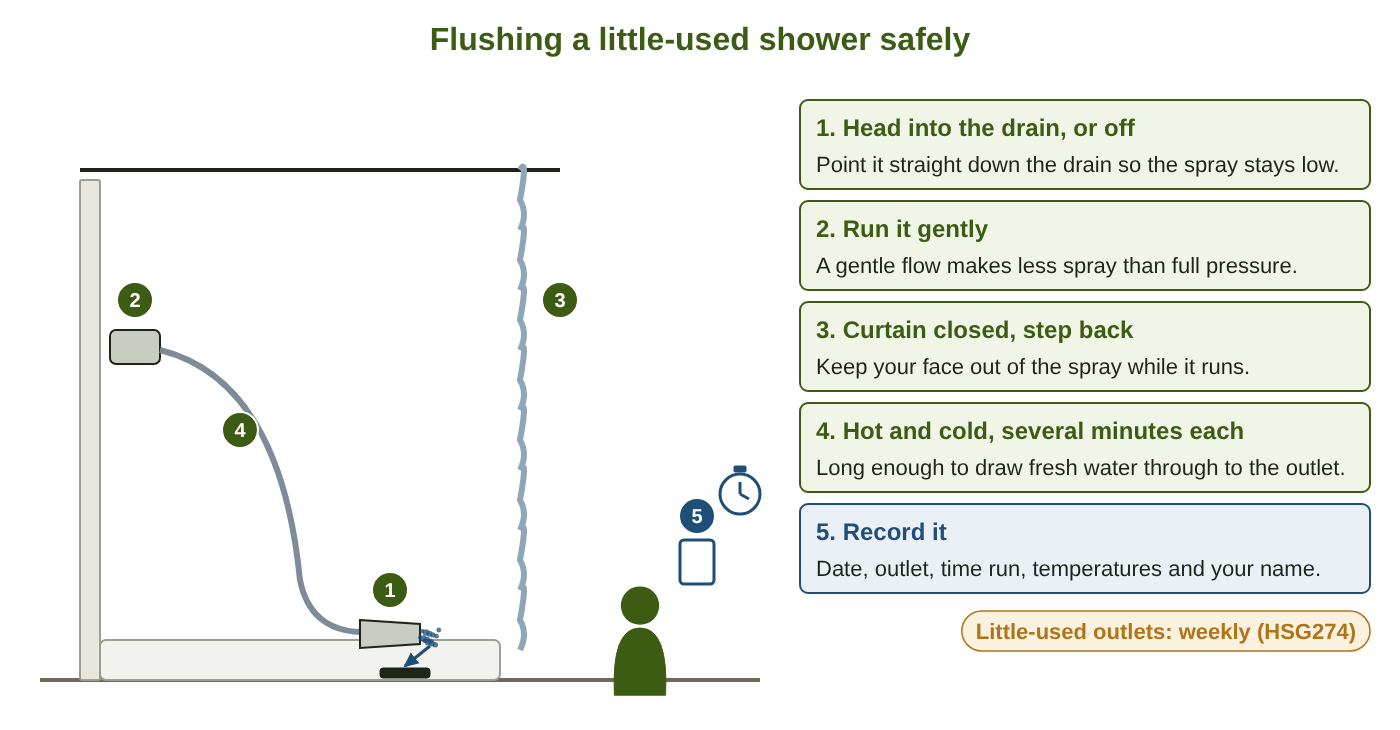
- Get the list. Housekeeping knows which rooms are empty. The responsible person keeps the list of little-used outlets.
- Prepare. A timer, a probe thermometer if readings are needed, the log sheet, and the PPE your site procedure names.
- Keep the spray down. Take the showerhead off or point it into the drain. Open the tap gently. Close the curtain and step back, out of the spray. Never put your face over a showerhead that has stood unused.
- Run hot and cold, several minutes each: hot until it reaches its normal temperature, cold until it runs cold. Do every outlet in the room: basin, shower and bath.
- Take readings if your procedure asks, probe in the middle of the stream.
- Close the taps gently and refit the head.
- Record it: date, room, outlet, time run, temperatures, your name.
- Report what you see: brown water, a smell, slime, hot that never gets hot, cold that never runs cold, or an outlet nobody needs.
One exception. If a case of illness is linked to your site, do not flush, drain, dose or clean that system on your own. The responsible person agrees the next steps with the investigating environmental health practitioner, so samples are taken before the evidence is washed away.
How do you clean a showerhead for Legionella?
Scale and biofilm build up inside showerheads and hoses, which are warm, wet and spray straight into your breathing zone. HSG274 Part 2 says clean, descale and disinfect them quarterly, or sooner if they foul.
- Take off the head and hose, wearing the gloves and eye protection your procedure names.
- Take the head apart as far as it allows. Note what you find: scale, black slime, debris.
- Soak it in the descaler your procedure names, at the strength on the label, and brush the holes clean.
- Rinse well. Then disinfect with the product and contact time your procedure names, and rinse again.
- Refit and run the shower to flush the hose.
- Record the room, date, condition and your name. Replace any head or hose that is damaged or will not come clean.
Never mix descaler and bleach. Most descalers are acids, and the New Jersey Department of Health warns that an acid mixed with chlorine bleach produces chlorine gas. Use them one at a time and rinse well between the two.
Never use compressed air to blow out a showerhead, pipe or filter. Regulation 13 of the HBA Regulations, 2022 prohibits compressed air to remove hazardous biological agents from surfaces or people.
In frail care, hang hand-held showers up to drain instead of leaving them in the tray. Our guide to Legionella in hospitals and frail care covers the rest of the healthcare routine.
Free tool: see what your routine is missing
The free Legionella Water Walk checks whether little-used outlets are flushed weekly and recorded, whether showerheads are on a quarterly schedule, and whether eyewash stations are flushed to drain at least every six months. It ranks the gaps and exports them.
Try the free Water Walk, then learn to act on what it finds in Legionella Awareness Training (R799).
How do you flush emergency showers and eyewash stations?
HSG274 Part 3 says flush and purge emergency showers and eyebaths to drain at least every six months, drawing off three to five times the stagnant volume, and clean the heads and nozzles quarterly. The stagnant volume is the water standing in the unit and the pipe run that feeds it. Maintenance can work it out from the pipe length and size, and running the flush into a bucket of known size shows you how much has gone. Run the flush to drain through a hose or into a bucket. Stand to one side, never lean over the bowl or stand under the showerhead, and let the stagnant water clear before you look closely.
In our course cases, the dairy’s eyewash and shower stations in the chemical store and ammonia plant room have never been flushed since installation, and neither has the hotel’s pool plant room eyewash. The first person who needs one after a chemical splash gets a face full of stagnant water at the worst possible moment.
Every flush your team does is only as good as the log
Legionella Awareness Training teaches housekeeping and maintenance staff the flushing and showerhead routine step by step, with the eyewash and tank checks, the temperature limits and what to report. Four hours on a phone, R799 a person.
How often does each outlet need attention?
| Task | How often | Source |
|---|---|---|
| Flush little-used outlets, hot and cold | Weekly, several minutes, or as the risk assessment says | HSG274 Part 2 |
| Clean, descale and disinfect showerheads and hoses | Quarterly, or sooner if fouled | HSG274 Part 2 |
| Hot and cold sentinel temperatures | Monthly | HSG274 Part 2 |
| Clean TMV strainers and filters | Annually, or as the risk assessment says | HSG274 Part 2 |
| Flush emergency showers and eyebaths to drain | At least every six months, three to five times the stagnant volume | HSG274 Part 3 |
| Clean eyewash and emergency showerheads and nozzles | Quarterly | HSG274 Part 3 |
| New system, or occupation delayed | Flush and disinfect before use, flush weekly until occupied | HSG274 Part 2 |
What about new buildings, renovations and closed floors?
HSG274 Part 2 says any new water system needs, as a minimum, flushing and disinfection before it is brought into use. Once filled, it should not be drained down. If occupation is delayed, flush weekly to reduce stagnation. It is the step I most often find missing at handover.
Closed floors are the same problem. At Umthombo Bay Hotel, the hotel case in our courses, 12 eighth-floor rooms have been closed for renovation for three months, unflushed. Room 801’s hot tap reaches 43 °C after one minute and 48 °C after three. Its cold tap reads 24 °C after two minutes. The model answer: flush every outlet weekly until the floor reopens, and before guests return, flush, sample and disinfect where results require.
In the Intermediate course, the laboratory result for room 801’s shower comes back at 2 400 cfu/L, above the 1 000 cfu/L level where HSE guidance calls for an immediate review of controls, including possible disinfection. Weekly flushing for those three months was the cheapest control on the list. See our hotel checklist and testing guide.
What should a Legionella flushing log look like?
If it is not written down, it did not happen, and that is how an inspector or auditor will see it. Copy this layout. The first two rows show the room 801 readings recorded.
| Date | Room or area | Outlet and task | Time run | Temperature reached | What you saw, what you reported | Name |
|---|---|---|---|---|---|---|
| Week 1, Mon | Room 801 | Shower, hot, weekly flush | 3 min | 43 °C at 1 min, 48 °C at 3 min | Did not reach 50 °C. Reported to the chief engineer | Nomvula |
| Week 1, Mon | Room 801 | Cold tap, weekly flush | 2 min | 24 °C | Not below 20 °C. Reported to the chief engineer | Nomvula |
Use the same sheet for quarterly showerhead cleans (record the condition you found) and six-monthly eyewash flushes (record the volume drawn off). The responsible person signs the sheet each week. UK ACOP L8 asks for records of checks to be kept for at least 5 years, and the HBA Regulations keep records of control measure examinations and tests for at least 5 years. Keep flushing logs at least 5 years. Where a log carries temperature readings, ASC keeps it with the monitoring records for 40 years.
Who should do the flushing, and who checks it?
Housekeeping usually flushes rooms, and maintenance does plant rooms, eyewash stations and closed areas. Under the HBA Regulations, 2022, every employee who may be exposed must be trained before possible exposure, with a refresher every year or at intervals the health and safety committee or representative recommends, and must report any possible exposure immediately. The responsible person builds the list from the asset register, checks the log every week and decides what happens when a reading fails. Our guides on who is responsible for Legionella and the water management plan template cover that role. Related: water storage tanks and food and beverage plants.
What your team walks away with from Awareness Training
- The four conditions that make Legionella a risk, and how flushing breaks one of them
- The temperature numbers that matter, and how to take a reading properly
- The flushing, showerhead, tank and eyewash routine taught step by step
- What to report, to whom, and what never to do on your own
- The Water Walk checklist with an exportable findings list
- A dated certificate on passing. HPCSA CPD accredited
Four hours to a routine your whole team can follow
No classroom day, no travel, works on a phone. Three attempts at every test, instant feedback and a dated certificate for the training file (regulation 9(1)(f)). Add a short site induction on your own procedures and a supervised practical, and file it with the certificate.
Frequently asked questions
How often should little-used outlets be flushed for Legionella?
Weekly, according to HSE HSG274 Part 2, or as your risk assessment indicates. A little-used outlet is any tap or shower not used at least once a week. Run hot and cold for several minutes each, keep the spray low, and record every flush with the date, outlet, time run and your name.
How long should you flush a tap or shower for Legionella?
HSE guidance says several minutes. ASC’s working rule is to run the hot until it reaches its normal temperature and the cold until it runs cold. If hot water does not reach 50 °C within one minute, or cold does not fall below 20 °C within two minutes, report it.
How often should showerheads be cleaned for Legionella?
Every quarter, or sooner if they foul, following HSE HSG274 Part 2. Take the head and hose off, descale, rinse, disinfect, rinse again, refit and run the shower. Record the room and condition, and replace any head or hose that will not come clean.
Can I mix descaler and bleach to clean showerheads?
No. Most descalers are acids, and an acid mixed with chlorine bleach releases chlorine gas, which is dangerous in a small bathroom. Use the descaler first, rinse well, then disinfect with the product your procedure names, and rinse again.
What should a Legionella flushing log record?
The date, room or area, outlet and task, how long it ran, the temperature reached if taken, anything unusual and who it was reported to, and the name of the person who did it. The responsible person signs the log weekly and acts on failed readings.
How often should eyewash stations be flushed?
At least every six months, flushed and purged to drain, drawing off three to five times the stagnant volume, with heads and nozzles cleaned quarterly, according to HSE HSG274 Part 3. An eyewash nobody flushes delivers stagnant water to the eyes of someone already injured.
Should a new or renovated building be flushed before people move in?
Yes. HSE HSG274 Part 2 says a new water system needs, as a minimum, flushing and disinfection before it is brought into use, should not be drained once filled, and should be flushed weekly if occupation is delayed. Closed floors need the same weekly flushing until they reopen.
Turn flushing from a forgotten job into a recorded routine
Four hours for the people who flush, clean and report. Ten hours for the person who builds the list, reads the log and acts on a failed reading.
Enrol in Awareness Training (R799) →Responsible Person course (R2 950)Self-paced, works on a phone. HPCSA CPD accredited. Certificate on passing.