
Food Safety for Engineering and Maintenance Teams
About Course
The line was handed back at 05h40. The M6 nut was found at 09h15, by a customer.
Nobody on the engineering team set out to contaminate food. The fitter changed the filler valve in the time he was given, with the tools he had, and signed the job card. What nobody gave him was a count of what went in and what came out, a rule about who releases the line, or a reason to believe that a nut is a food safety hazard and not a housekeeping matter. This course gives the engineering team those three things.
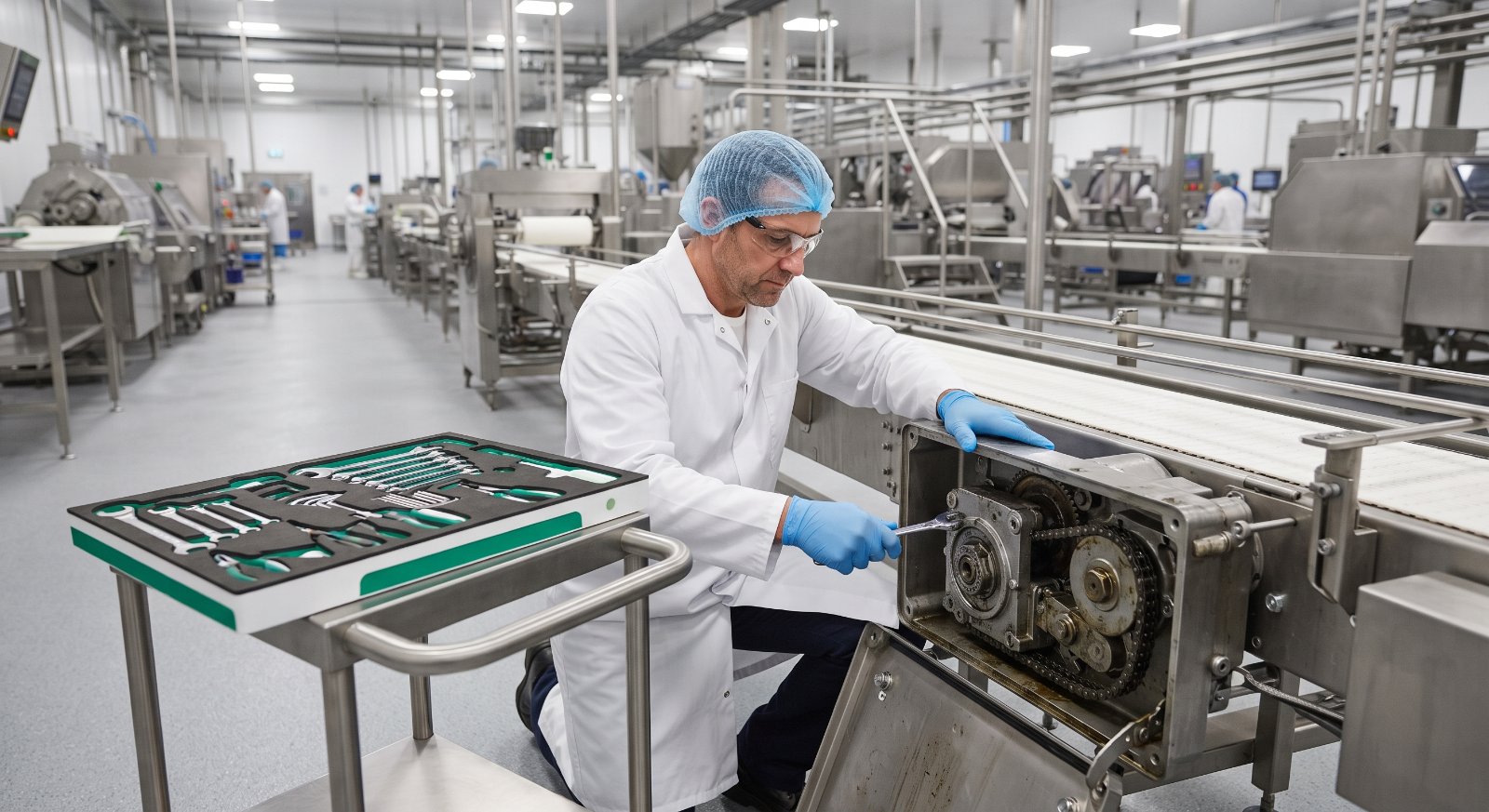
Engineering and Maintenance touch more food contact surfaces than anyone on site except production. They open the machine, put their hands, tools, grease and spare parts inside it, and close it again. Every food safety scheme knows this, which is why the prerequisite programme for maintenance asks for trained maintenance personnel, food grade lubricants, safe temporary fixes and a release procedure with clean up and pre-use inspection.
Built on the ASC Hygienic Design series
Food Safety for Engineering and Maintenance Teams takes the core of Hygienic Design Essentials, where microorganisms live on a machine and the ten rules with their numbers, and builds the maintenance controls around it: foreign body control, lubricants and chemicals, planned and breakdown work, temporary repairs, release after maintenance, CCP and OPRP equipment, calibration, contractors, permits, change control and utilities.
Food Safety for Engineering and Maintenance Teams. Document code FS54. Foundation level, 5 hours, self paced, online, on any phone. Six modules, 21 taught lessons, 12 quizzes and scenario games, and a final assessment. R1,399. Aligned to FSSC 22000 Version 7, ISO 22000:2018 and the ISO 22002-1 prerequisite programmes.
What you will be able to do
- Name the physical, chemical, microbiological and allergen hazards your own jobs can introduce, and the control for each.
- Spot the common hygienic design faults on installed equipment and quote the rule each one breaks.
- Count tools, fasteners and parts in and out, and control swarf, brittle materials and consumables.
- Choose, store and apply H1 lubricants and approved maintenance materials.
- Do planned and breakdown work in a production area, and make a temporary repair that is recorded, owned and time limited.
- Hand equipment back through a clean, inspect and release step with a second signature.
- Recognise CCP, OPRP and other food safety critical equipment, and know what may not be bypassed, adjusted or replaced without approval.
- Explain calibration and verification, and what to do when a device is found out of tolerance.
- Apply contractor control, work permits and engineering change control before the work starts.
- Link each duty to the FSSC 22000, ISO 22000 and ISO/TS 22002-1 clause an auditor will test.
Who it is for
Fitters, electricians, millwrights, instrument technicians, maintenance planners, engineering supervisors and managers, project engineers and the contractors who work on site regularly. No food safety background is needed. Quality and production staff who release equipment after maintenance will also find it useful.
How it is taught
Six modules, short lessons, a knowledge check at the end of each module and a final assessment. Every lesson ends with something to do on your next shift, and every activity can be done on the built in case study, Mzansi Fresh Meals, if you do not have a site of your own. Template forms for tool and parts reconciliation, release after maintenance, the temporary repair register and the engineering change risk assessment are described in the lessons so you can build them into your own system.
This course can also be delivered onsite in one day, with a guided walk on your own line. Contact ASC for a quotation.
Course Content
Module 1: Your role in food safety
-
Lesson 1: Learning Outcomes
-
Lesson 2: Why the engineering team is a food safety team
-
Lesson 3: The hazards maintenance work creates
-
Lesson 4: Where maintenance sits in the food safety system
-
Module 1 knowledge check
-
Name the hazard
Module 2: Hygienic design of equipment and infrastructure
Module 3: Preventing contamination during maintenance
Module 4: Planned work, breakdowns, temporary repairs and release
Module 5: Critical equipment, calibration and verification
Module 6: Contractors, permits, change control and utilities
Course assessment and Feedback
Student Ratings & Reviews
