
Food Storage and Distribution: Cold Chain, Dry Goods and Warehousing (Intermediate)
About Course
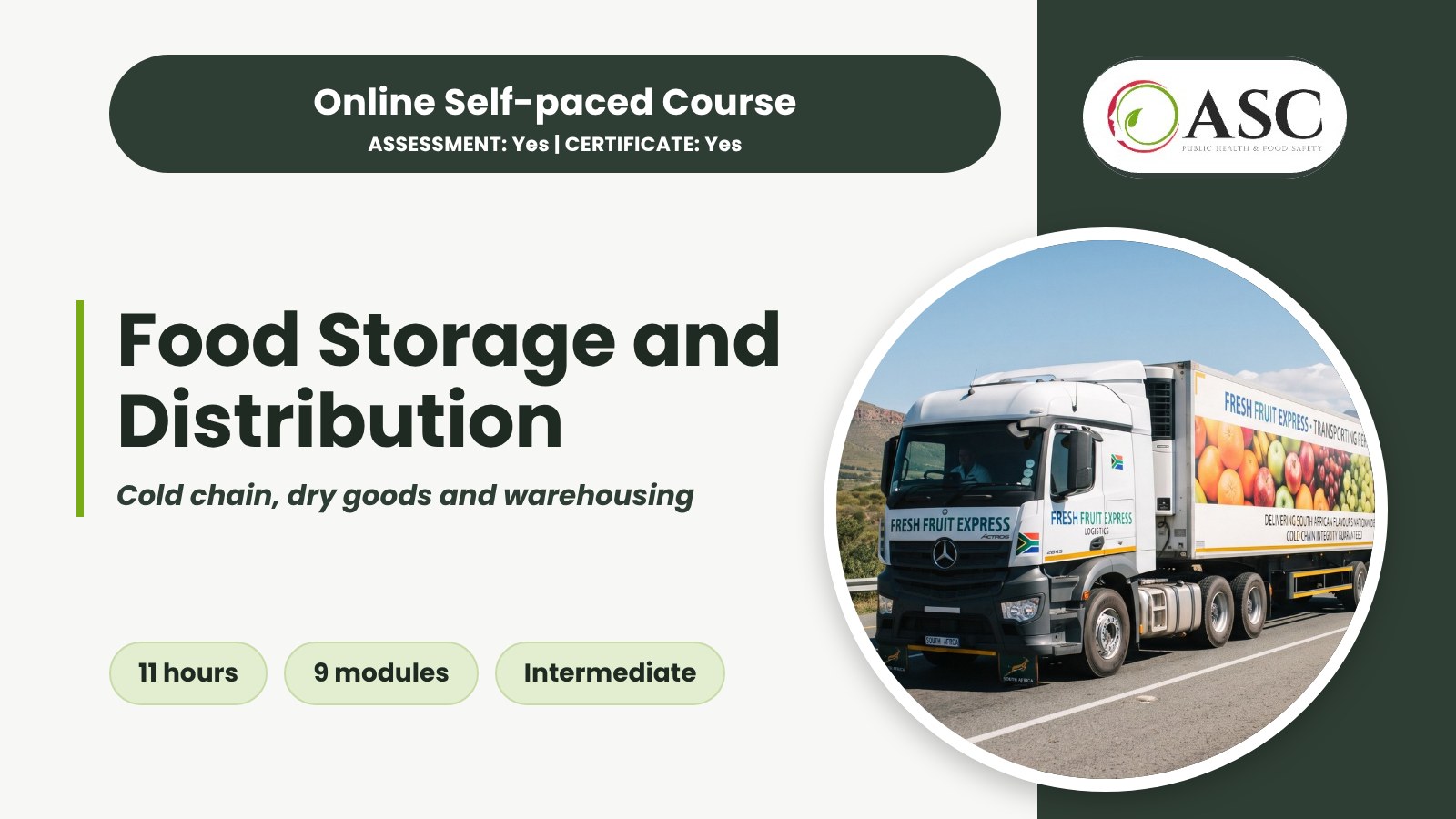
Food that leaves your dock safe can arrive unsafe. This intermediate course is for warehouse, dispatch, transport, cold store and QA people who keep food safe and legal between the factory and the customer in South Africa.
You work through a full distribution centre case, Mzansi Fresh Meals in Pinetown, from the cold room to the customer: cold chain management, dry goods, frozen, chilled and hot food distribution, inland versus coastal climate risks, storage facilities and stacking, vehicles, and health and safety.
What you will be able to do
- Apply R638 storage and transport rules, including Annexure E temperatures, the 2 °C surface rule and Annexure G probing
- Run a cold chain that holds from dispatch to delivery, and handle an excursion or power failure properly
- Store and move dry goods without moisture, mould, pests or taint
- Choose the right vehicle and load it for airflow and security
- Plan for the coast and the Highveld: humidity, condensation, altitude, frost and heat
- Meet GSR 8 stacking, forklift, cold stress and road traffic duties
- Build a storage and distribution risk assessment for your own site or a case study
27 lessons, 8 knowledge checks, 8 games, 14 diagrams, a practical workshop and assignment, and a final assessment. About 11 hours, on any phone. 70% to pass every assessment, three attempts each.
Training your floor team?
Food Storage and Distribution Basics covers the same cold chain for receiving clerks, pickers, forklift operators, cold store workers and drivers in 5 hours, for R899 a person.
Related courses
This course covers the law and the daily practice of running stores, cold rooms and delivery fleets. If your site is certified, or wants to be, add the scheme course for your managers:
- Introduction to BRCGS Storage and Distribution Issue 4 (6 hours, R1 195)
- BRCGS Storage and Distribution Issue 4 for Management (4 hours, R1 195)
- FSSC 22000 Version 7 for Transport and Storage (12 hours, R5 500)
- Food Quality Controller Fundamentals: Retail, DC and Wholesale (15 hours, R1 750)
Not sure which you need? See food storage and distribution training for a side-by-side guide.
Course Content
Module 1: Storage and distribution: the risks and the law
-
1.1 Where storage and distribution sit in the food chain
-
1.2 Hazards and risks in storage and distribution
-
1.3 The legal map: laws, specifications and standards
-
M1 Knowledge check: Storage and distribution: the risks and the law
-
M1 Game: Law, standard or myth?
Module 2: Cold chain management
Module 3: Distributing dry goods
Module 4: Distributing temperature-sensitive food: frozen, chilled and hot
Module 5: Inland versus coastal: climate, humidity and temperature
Module 6: Storage facilities, storage requirements and stacking
Module 7: Distribution vehicles
Module 8: Health and safety in storage and distribution
Module 9: Practical workshop and final assessment
Student Ratings & Reviews
